
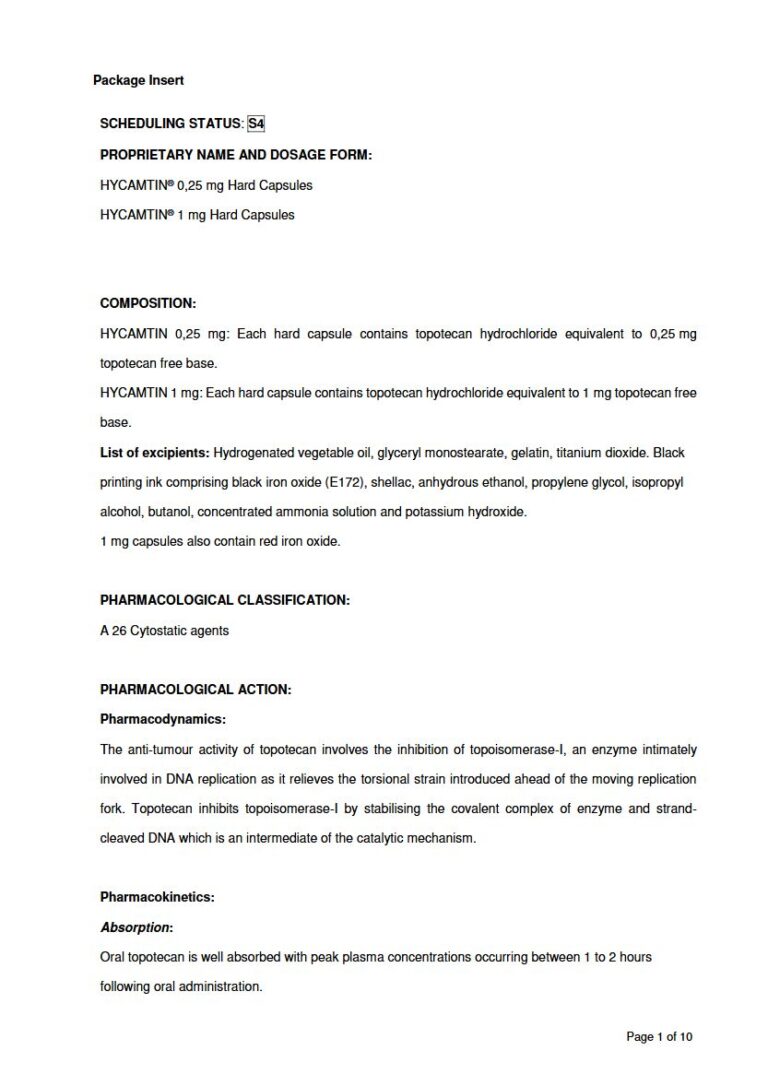
Hycamtin 0.25mg. 1mg Capsule
PDF Leaflet Revision Date: 9 May 2012
Clinical Summary
Quick overview from the medicine insert
Indication
Palliative treatment of small cell lung carcinoma.
Dosage (summary)
2.3 mg/mu00b2 daily for 5 days every 21 days.
Onset of Action / Duration
Onset: 1-2 hours, Duration: 3-6 hours
Special Populations
- Renal impairment
- Hepatic impairment
- Elderly
Pregnancy & Breastfeeding
Contraindicated in pregnancy and breastfeeding.
Key Drug Interactions
- Enhanced myelosuppression with cytotoxic agents
- Increased exposure with ABCB1/ABCG2 inhibitors
Contraindications
- Severe hypersensitivity to topotecan
- Pregnancy
- Severe bone marrow depression
Common side effects
- Diarrhoea
- Nausea
- Vomiting
- Fatigue
- Neutropenia
Counselling Points
- Avoid pregnancy during treatment
- Report signs of infection or severe diarrhoea
- Do not chew or crush capsules
Serious warnings
- Severe myelosuppression
- Risk of neutropenic colitis
- Monitor blood counts regularly
Important Disclaimer
The Hycamtin 0.25mg. 1mg Capsule professional information leaflet below is the property of Sandoz and is provided on Medinsert exactly as issued, with no.. alterations or editorial changes. We make every effort to keep content current by updating documents as soon as new versions become available. Medinsert serves as a trusted access point for healthcare professionals, but does not replace official sources or clinical judgement. For more details, please read our full disclaimer. read more>>
 Healthcare Professionals Only
This content is for registered healthcare professionals
Sign in or create a free account to read the full package insert.
Free for HPCSA-registered professionals. Powered by Medinsert.
Clinical Particulars
Section 4 of the official insert — extracted exactly as issued, no alterations
4.1 Therapeutic indications
HYCAMTIN hard capsules are indicated for the palliative treatment of small cell lung carcinoma, as a second-line chemotherapeutic agent in patients who have relapsed after an initial response to treatment with first-line chemotherapeutic agents.
4.2 Posology and method of administration
Prior to administration of the first course of HYCAMTIN, patients must have a baseline neutrophil count of more than or equal to 1,5 x 10⁹/u2113, a platelet count of more than or equal to 100 x 109/u2113 and a haemoglobin level of more than or equal to 9 g/dl (after transfusion if necessary). The hard capsule(s) must be swallowed whole, and must not be chewed, crushed or divided. HYCAMTIN hard capsules may be taken with or without food.
Initial dose: The recommended dose of HYCAMTIN hard capsules is 2,3 mg/m2 daily for five consecutive days every 21 days. Subsequent doses:
For patients who experience Grade 3 or 4 diarrhoea, the HYCAMTIN capsules dose should be reduced by 0,4 mg/m2/day for subsequent courses (see WARNINGS). Patients with Grade 2 diarrhoea may need to follow the same dose modification guidelines. HYCAMTIN should not be re-administered unless the neutrophil count is more than or equal to 1 x 10⁹/u2113, the platelet count is more than or equal to 100 x 109/u2113, and the haemoglobin level is more than or equal to 9 g/dl (after transfusion if necessary). Patients who experience severe neutropenia (neutrophil count less than or equal to 0,5 x 10⁹/u2113) for seven days or more, or severe neutropenia associated with fever or infection, or who have had treatment delayed due to neutropenia, should be treated as follows: either reduce the dose by 0,4 mg/m2/day to 1,9 mg/m2/day (or subsequently down to 1,5 mg/m2/day if necessary) Doses should be similarly reduced if the platelet count falls below 25 x 109/u2113. In clinical trials, HYCAMTIN hard capsules were discontinued if the dose had to be reduced below 1,5 mg/m2. or be given G-CSF prophylactically in subsequent courses to maintain dose intensity starting from day six of the course (the day after completion of the HYCAMTIN administration). If neutropenia is not adequately managed with G-CSF administration, doses should be reduced.
4.3 Contraindications
HYCAMTIN is contra-indicated in patients who:
- have a history of severe hypersensitivity reactions to topotecan and/or its excipients
- are pregnant or breastfeeding (see PREGNANCY AND LACTATION)
- already have severe bone marrow depression prior to starting first course, as evidenced by baseline neutrophils less than 1,5 x 10⁹/u2113 and/or a platelet count of less than or equal to 100 x 109/u2113.
4.4 Special warnings and precautions for use
HYCAMTIN should be initiated under the direction of a medical practitioner experienced in the use of cytotoxic agents. Haematological toxicity is dose-related and full blood count including platelets should be monitored regularly (see DOSAGE AND DIRECTIONS FOR USE). HYCAMTIN can cause severe myelosuppression. Myelosuppression leading to sepsis and fatalities due to sepsis have been reported in patients treated with HYCAMTIN (see SIDE EFFECTS AND SPECIAL PRECAUTIONS). HYCAMTIN-induced neutropenia can cause neutropenic colitis. Fatalities due to neutropenic colitis have been reported in clinical trials with HYCAMTIN. In patients presenting with fever, neutropenia, and a compatible pattern of abdominal pain, the possibility of neutropenic colitis should be considered. Dose adjustment may be necessary if HYCAMTIN is administered in combination with other cytotoxic agents (see INTERACTIONS). Diarrhoea, including severe diarrhoea requiring hospitalisation, has been reported during treatment with oral HYCAMTIN. The incidence of diarrhoea has been reported to be greater in patients receiving oral HYCAMTIN compared to those receiving HYCAMTIN i.v. Additionally, in patients with relapsing small cell lung cancer, greater than 65 years of age, there is substantially higher risk of severe diarrhoea and subsequent hospitalisation than in patients less than 65 years of age. Communication with patients prior to medicine administration regarding diarrhoea and proactive management of all signs of diarrhoea is important. Medical practitioners are advised to follow guidelines that describe the aggressive management of this event. This includes use of anti-diarrhoeal agents, administration of fluids and electrolytes and interruption or discontinuation of therapy with oral HYCAMTIN. Diarrhoea related to oral HYCAMTIN can occur at the same time as medicine-related neutropenia and its sequelae.
4.5 Interactions with other medicines
Myelosuppression is enhanced when HYCAMTIN is used in combination with other cytotoxic agents (e.g. paclitaxel or etoposide) thereby necessitating dose reduction. However, in combining with platinum agents (e.g. cisplatin or carboplatin), there is a distinct sequence-dependent interaction depending on whether the platinum agent is given on day 1 or 5 of the HYCAMTIN dosing. Topotecan does not inhibit human cytochrome P450 enzymes (see Pharmacokinetics). Topotecan is a substrate for both ABCG2 (BCRP) and ABCB1 (P-glycoprotein). Inhibitors of ABCB1 and ABCG2 (e.g. elacridar) administered with oral HYCAMTIN increased topotecan exposure. Cyclosporin A (an inhibitor of ABCB1, ABCC1 [MRP-1], and CYP3A4) with oral HYCAMTIN increased topotecan AUC. Patients should be carefully monitored for adverse events when oral HYCAMTIN is administered with a medicine known to inhibit ABCG2 or ABCB1 (see Pharmacokinetics). The pharmacokinetics of topotecan were generally unchanged when co-administered with ranitidine.
4.6 Fertility, pregnancy and lactation
Pregnancy: HYCAMTIN has been shown to be both embryotoxic and foetotoxic in preclinical studies. HYCAMTIN may cause foetal harm when administered to pregnant women and therefore is contra-indicated during pregnancy. Women should be advised to avoid becoming pregnant during therapy with HYCAMTIN and to inform the treating medical practitioner immediately should this occur (see CONTRA-INDICATIONS).
Lactation: HYCAMTIN is contra-indicated during breastfeeding.
4.7 Effects on ability to drive and use machines
Caution should be observed when driving or operating machinery if fatigue and asthenia persist.
4.8 Undesirable effects
Adverse events are listed below by system organ class and frequency. Frequencies are defined as: very common (greater than or equal to 1/10), common (greater than or equal to 1/100 and less than 1/10), uncommon (greater than or equal to 1/1 000 and less than 1/100), rare (greater than or equal to 1/10 000 and less than 1/1 000) and very rare (less than 1/10 000) including isolated reports, not known (cannot be estimated from the available data). Very common, common and uncommon events were generally determined from clinical trial data.
Infections and Infestations
- Very common: infections
- Common: sepsis (see WARNINGS)
Blood and lymphatic system disorders
- Very common: anaemia, febrile neutropenia, leucopenia (see Gastrointestinal disorders), neutropenia, thrombocytopenia
- Common: pancytopenia
- Unknown: severe bleeding (associated with thrombocytopenia)
Immune system disorders
- Common: hypersensitivity, including rash
Metabolism and nutrition disorders
- Very common: anorexia (which may be severe)
Gastrointestinal disorders
- Very common: diarrhoea (see WARNINGS), nausea and vomiting (all of which may be severe), abdominal pain*, constipation and stomatitis.
*with oral HYCAMTIN the overall incidence of medicine-related diarrhoea was 22 %, including 4 % with Grade 3 and 0,4 % with Grade 4. Medicine-related diarrhoea was more frequent in patients greater than or equal to 65 years of age (28 %) compared to those less than 65 years of age (19 %). After i.v. HYCAMTIN, medicine related diarrhoea in patients greater than 65 years of age was 10 %. * Neutropenic colitis, including fatal neutropenic colitis, has been reported to occur as a complication of HYCAMTIN-induced neutropenia (see WARNINGS).
Hepatobiliary disorders
- Common: hyperbilirubinaemia
Skin and subcutaneous disorders
- Very common: alopecia
General disorders and administrative site conditions
- Very common: asthenia, fatigue, pyrexia
- Common: malaise
4.9 Overdose
Symptoms and Signs: The primary complications of overdosage are anticipated to be bone marrow suppression and stomatitis.
Treatment: There is no known antidote for HYCAMTIN overdosage.
