
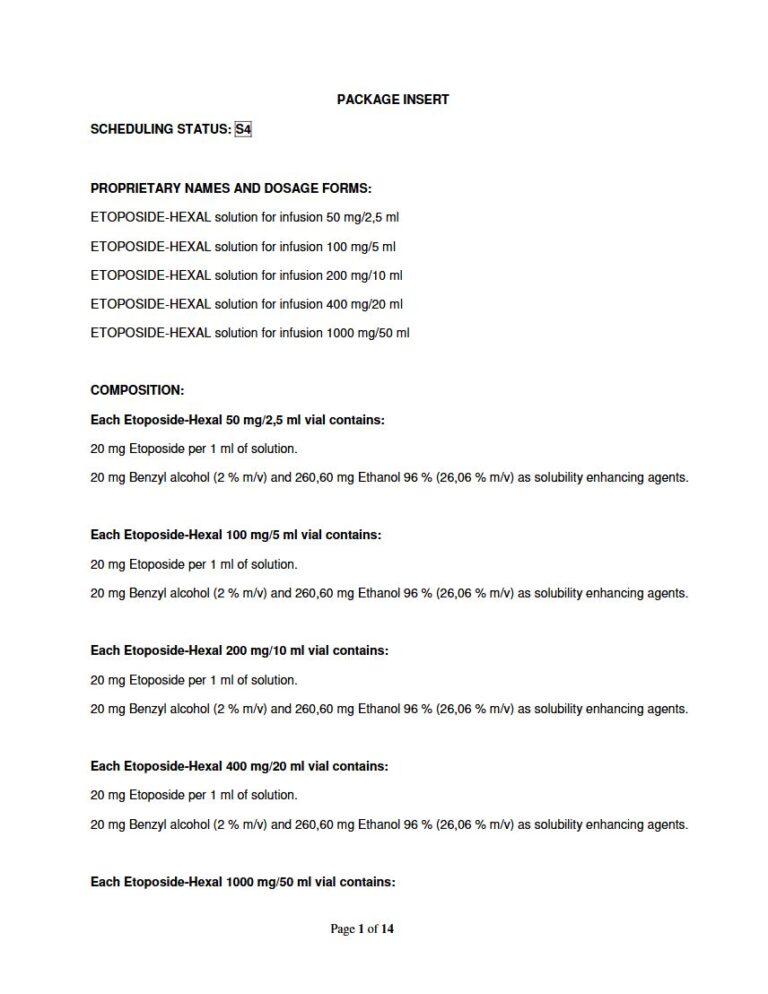
Etoposide-Hexal 50 mg/2.5 ml/100 mg/5 ml/200 mg/10 ml/400 mg/20
PDF Leaflet Revision Date: 29 June 2019
Clinical Summary
Quick overview from the medicine insert
Indication
Management of testicular and small cell lung tumors.
Dosage (summary)
IV: 50-100 mg/mu00b2/day for 5 days or 100 mg/mu00b2 on days 1, 3, 5 every 3-4 weeks.
Special Populations
- Renal impairment
- Hepatic impairment
Pregnancy & Breastfeeding
Can cause fetal harm; effective contraception required during treatment.
Key Drug Interactions
- Ciclosporin
- Cisplatin
- Phenytoin
- Warfarin
Contraindications
- Hypersensitivity to etoposide
- Severe hepatic dysfunction
- Bone marrow depression
- Renal impairment
Common side effects
- Myelosuppression
- Leukopenia
- Thrombocytopenia
- Anaphylactic reactions
- Nausea
Counselling Points
- Monitor for signs of infection
- Avoid live vaccines
- Report any bleeding or bruising
Serious warnings
- Severe myelosuppression
- Risk of anaphylaxis
- Tumor lysis syndrome
Important Disclaimer
The Etoposide-Hexal 50 mg/2.5 ml/100 mg/5 ml/200 mg/10 ml/400 mg/20 professional information leaflet below is the property of Sandoz and is provided on Medinsert exactly as issued, with no.. alterations or editorial changes. We make every effort to keep content current by updating documents as soon as new versions become available. Medinsert serves as a trusted access point for healthcare professionals, but does not replace official sources or clinical judgement. For more details, please read our full disclaimer. read more>>
 Healthcare Professionals Only
This content is for registered healthcare professionals
Sign in or create a free account to read the full package insert.
Free for HPCSA-registered professionals. Powered by Medinsert.
Clinical Particulars
Section 4 of the official insert — extracted exactly as issued, no alterations
4.1 Therapeutic indications
ETOPOSIDE-HEXAL is indicated for the management of:
- Testicular tumours - First line
The intravenous form of ETOPOSIDE-HEXAL is recommended in combination with other approved chemotherapeutic medicines. - Refractory testicular tumours
In combination with other approved medicines, for those with refractory testicular tumours who have already received appropriate surgical, chemotherapeutic and radiotherapeutic treatment. - Small cell anaplastic lung tumours
In combination with other approved chemotherapeutic medicines for small cell anaplastic lung tumours. - Malignant (non-Hodgkin's) lymphomas, especially of the histiocytic (large cell diffuse) variety
In combination with other approved chemotherapeutic medicines.
4.2 Posology and method of administration
Safety and efficacy in paediatric patients have not been established. Dosage should be adjusted according to the individual requirements of each patient, based on clinical response and the appearance or severity of toxicity. The dosage may also need to be adjusted if the patient has received radiation or other chemotherapy.
Intravenous dosage:
The usual intravenous dose of ETOPOSIDE-HEXAL is 50 to 100 mg/m2/day, for days 1 to 5 or 100 mg/m2/day on days 1, 3 and 5. These regimens are given every 3 to 4 weeks in combination with other approved relevant medicines.
Dosage in renal impairment:
Dose adjustments for measured creatinine clearance are recommended as follows:
- Measured creatinine clearance
Dose of etoposide - > 50 ml/min
100 % of dose - 15 to 50 ml/min
75 % of dose - *data not available for creatinine clearance < 15 ml/min and further dose reduction should be considered.
Administration precautions:
Hypotension following rapid intravenous administration of ETOPOSIDE-HEXAL has been reported. It is recommended that the medicine be given by slow intravenous infusion over 30 to 60 minutes. Hypotension usually responds to cessation of infusion and/or other supportive therapy as appropriate. When restarting the infusion, a slower rate of administration should be used.
Caution should be exercised with handling and preparation of ETOPOSIDE-HEXAL. Skin reactions with accidental exposure may occur. Use of gloves and masks is recommended. If ETOPOSIDE-HEXAL does come into contact with skin or mucosae, the area should be washed immediately with soap and water.
During intravenous infusion, great care must be taken to ensure the catheter stays in the vein as any leakage into surrounding tissue is highly irritant. ETOPOSIDE-HEXAL should not be administered intra-arterially, intra-pleurally or intra-peritoneally. ETOPOSIDE-HEXAL SHOULD NOT BE GIVEN BY RAPID INTRAVENOUS PUSH.
Preparation for intravenous infusion:
Hard plastic devices made from acrylic or ABS (a polymer of acrylonitrile, butadiene and styrene) can crack or leak when used for undiluted ETOPOSIDE-HEXAL injection. This effect has not been reported with the diluted form. ETOPOSIDE-HEXAL can be diluted with 5 % dextrose water or 0,9 % sodium chloride solution to give a final concentration of 0,2 to 0,4 mg/ml. More concentrated solutions may show crystal formation within 5 minutes and should not be given intravenously. If a 0,4 mg/ml solution of ETOPOSIDE-HEXAL is administered through tubing connected to a peristaltic pump, it may precipitate out of solution. The final mixture of ETOPOSIDE-HEXAL for parenteral use should be visually inspected for particulate matter and discolouration prior to administration.
4.3 Contraindications
- ETOPOSIDE-HEXAL is contraindicated in patients who have demonstrated previous hypersensitivity to etoposide or any component in ETOPOSIDE-HEXAL.
- Concomitant use of yellow fever vaccine or other live vaccines is contraindicated in immunosuppressed patients (see u201cINTERACTIONSu201d).
- Severe hepatic dysfunction.
- Severely impaired medullary haematopoiesis (particularly after extensive radio- and/or chemotherapy or secondary to neoplastic infiltration).This may be evidenced by mild to marked leukopenia and/or thrombocytopenia.
- Renal function impairment.
- Chickenpox, existing or recent (including recent exposure).
- Herpes zoster.
- Bone marrow depression.
- Pregnancy and Lactation.
4.4 Special warnings and precautions for use
ETOPOSIDE-HEXAL should be administered under the supervision of a qualified medical practitioner experienced in the use of cancer chemotherapeutic medicines.
Injection site reactions may occur during the administration of ETOPOSIDE-HEXAL. Given the possibility of extravasation, it is recommended to closely monitor the infusion site for possible infiltration during medicine administration. A specific treatment for extravasation reactions is unknown at this time.
Medical practitioners should be aware of the possible occurrence of an anaphylactic reaction with ETOPOSIDE-HEXAL manifested by chills, fever, tachycardia, bronchospasm, dyspnea and hypotension, which can be fatal. Treatment is symptomatic. The infusion of ETOPOSIDE-HEXAL should be terminated immediately, followed by the administration of pressor agents, corticosteroids, antihistamines or volume expanders at the discretion of the medical practitioner.
Severe myelosuppression with resulting infection or bleeding may occur. Fatal myelosuppression has been reported following ETOPOSIDE-HEXAL administration. Patients being treated with ETOPOSIDE-HEXAL must be observed for myelosuppression carefully and frequently both during and after therapy.
Tumour lysis syndrome (sometimes fatal) has been reported following the use of etoposide in association with other chemotherapeutic medicines. Granulocyte and platelet nadirs tend to occur about 10 to 14 days after administration of ETOPOSIDE-HEXAL depending on the way of administration and treatment scheme. Nadirs tend to occur earlier with intravenous administration compared to oral administration.
Leukopenia and severe leukopenia (less than 1,000 cells/mm3) were observed in 60 to 91 % and 7 to 17 %, respectively, for etoposide/etoposide phosphate. Thrombocytopenia and severe thrombocytopenia (less than 50,000 platelets/mm3) were seen in 28 to 41 % and 4 to 20 %, respectively, for etoposide/etoposide phosphate. Reports of fever and infection were also very common in patients with neutropenia treated with etoposide.
If anaphylactic reactions manifested by chills, fever, tachycardia, bronchospasm, dyspnea and hypotension occur, administration of ETOPOSIDE-HEXAL should be terminated immediately, followed by the administration of pressor agents, corticosteroids, antihistamines, or volume expanders at the discretion of the medical professional.
Dose limiting bone marrow suppression is the most significant toxicity associated with ETOPOSIDE-HEXAL therapy. The following studies should be obtained at the start of therapy and prior to each subsequent dose of ETOPOSIDE-HEXAL - platelet count, haemoglobin, white blood cell count, and differential. If radiotherapy or chemotherapy has been given prior to starting ETOPOSIDE-HEXAL treatment, an adequate interval should be allowed to enable the bone marrow to recover.
ETOPOSIDE-HEXAL should not be administered to patients with neutrophil counts less than 1,500 cell/mm3 or platelet counts less than 100,000 cells/mm3, unless caused by malignant disease.
Doses subsequent to the initial dose should be adjusted if neutrophil count less than 500cells/mm3 occurs for more than 5 days or is associated with fever or infection, if platelet count less than 25,000 cells/mm3 occurs, if any other grade 3 or 4 toxicity develops or if renal clearance is less than 50 ml/min. Dosage should be modified to take into account the myelosuppressive effects of other drugs in the combination or the effects of prior radiation therapy or chemotherapy which may have compromised bone marrow reserve.
If thrombocytopenia occurs as a consequence of administration of ETOPOSIDE-HEXAL, patients should be observed carefully for signs of bleeding (skin, intravenous puncture sites, mucosae, unusual bruising, melaena stools, haematuria). Intramuscular injections, alcohol, aspirin and contact sports should be avoided. Platelet transfusions may be required. Patients who develop leukopenia should be carefully observed for signs of infection. Antibiotic support may be necessary.
Immunisations should be avoided unless approved by the attending doctor.
The occurrence of acute leukaemia, which can occur with or without myelodysplastic syndrome, has been described in patients that were treated with etoposide containing chemotherapeutic regimens. Neither the cumulative risk, nor the predisposing factors related to the development of secondary leukaemia are known. The roles of both administration schedules and cumulative doses of etoposide have been suggested, but have not been clearly defined. An 11q23 chromosome abnormality has been observed in some cases of secondary leukaemia in patients who have received epipodophyllotoxins. Another characteristic that has been associated with secondary leukaemia in patients who have received epipodophyllotoxins appears to be a short latency period, with average median time to development of leukaemia being approximately 32 months.
ETOPOSIDE-HEXAL injection should be given only by slow intravenous infusion (usually over a 30 to 60 minute period) since hypotension has been reported as a possible side effect of rapid intravenous injection. In all instances where the use of ETOPOSIDE-HEXAL is considered for chemotherapy, the medical practitioner must evaluate the need and usefulness of the medicine against the risk of adverse reactions. If severe reactions occur, the medicine should be reduced in dosage or discontinued and appropriate corrective measures should be taken according to the clinical judgment of the medical practitioner.
Reinstitution of ETOPOSIDE-HEXAL therapy should be carried out with caution, and with adequate consideration of the further need for the treatment and close attention to possible recurrence of toxicity. Patients with low serum albumin may be at increased risk for etoposide-associated toxicities. Patients with impaired hepatic and renal function should regularly have their renal and hepatic function monitored due to the risk of accumulation. Bacterial infections should be brought under control before treatment with ETOPOSIDE-HEXAL.
Paediatric use:
Safety and effectiveness of ETOPOSIDE-HEXAL in paediatric patients have not been systematically studied.
4.5 Interactions with other medicines
High dose ciclosporin, resulting in concentrations above 2000 ng/ml, administered with oral ETOPOSIDE-HEXAL has led to an 80 % increase in ETOPOSIDE-HEXAL exposure (AUC) with a 38 % decrease in total body clearance of ETOPOSIDE-HEXAL compared to ETOPOSIDE-HEXAL alone.
Concomitant cisplatin therapy is associated with reduced total body clearance of ETOPOSIDE-HEXAL.
Concomitant phenytoin therapy is associated with increased ETOPOSIDE-HEXAL clearance and reduced efficacy.
Concomitant warfarin therapy may result in elevated international normalised ratio (INR). Close monitoring of INR is recommended.
There is an increased risk of fatal systemic vaccinal disease with the use of yellow fever vaccine. Live vaccines are contraindicated in immunosuppressed patients (see u201cCONTRAINDICATIONSu201d).
Prior or concurrent use of other medicines with similar myelosuppressant action as ETOPOSIDE-HEXAL may be expected to have additive or synergetic effects (see u201cWARNINGS AND SPECIAL PRECAUTIONSu201d).
In vitro plasma protein binding is 97 %. Sodium salicylate, and aspirin may displace ETOPOSIDE-HEXAL from plasma protein binding.
Cross resistance between anthracyclines and ETOPOSIDE-HEXAL has been reported in preclinical experiments.
4.6 Fertility, pregnancy and lactation
Safety and efficacy in pregnancy and lactation have not been established (see u201cCONTRAINDICATIONSu201d). ETOPOSIDE-HEXAL can cause foetal harm when administered during pregnancy. If ETOPOSIDE-HEXAL is used during pregnancy, or if a woman falls pregnant on treatment, she should be advised of possible danger to the foetus. Women of childbearing age should be advised not to fall pregnant while taking ETOPOSIDE-HEXAL.
Given the mutagenic potential of ETOPOSIDE-HEXAL, an effective contraception is required for both male and female patients during treatment and up to 6 months after ending treatment. Genetic consultation is recommended if the patient wishes to have children after ending the treatment. As ETOPOSIDE-HEXAL may decrease male fertility, preservation of sperm may be considered for the purpose of later fatherhood (see u201cCONTRAINDICATIONSu201d).
4.7 Effects on ability to drive and use machines
No studies on the effects on the ability to drive and use machines have been performed with ETOPOSIDE-HEXAL. If the patient experiences side effects such as fatigue and somnolence they should avoid driving or operating machines.
4.8 Undesirable effects
Blood and lymphatic system disorders:
Frequent: Myelosuppression (with fatal outcome), leukopenia, thrombocytopenia, neutropenia, anaemia, acute leukemia, Tumour lysis syndrome (sometimes fatal)
Immune system disorders:
Frequent: Anaphylactic-type reactions (can be fatal)
Nervous system disorders:
Frequent: Dizziness
Less frequent: Neuropathy peripheral, seizure (occasionally associated with allergic reactions), optic neuritis, cortical blindness transient, neurotoxicities (e.g. somnolence, fatigue)
Cardiac disorders:
Frequent: Myocardial infarction, dysrhythmia
Vascular disorders:
Frequent: Transient systolic hypotension following rapid intravenous administration, hypertension
Respiratory, thoracic and mediastinal disorders:
Less frequent: Pulmonary fibrosis, interstitial
Gastrointestinal disorders:
Frequent: Abdominal pain, constipation, nausea and vomiting, anorexia, mucositis (including stomatitis and oesophagitis)
Less frequent: Dysphagia, dysgeusia
Hepatobiliary disorders:
Frequent: Hepatotoxicity
Skin and subcutaneous tissue disorders:
Frequent: Alopecia, pigmentation, rash urticaria, pruritus
Less frequent: Stevens-Johnson syndrome, toxic epidermal necrolysis, radiation recall dermatitis
General disorders and administration site conditions:
Frequent: Asthenia, malaise, extravasation (including local soft tissue toxicity, swelling, pain, cellulitis, and necrosis including skin necrosis), phlebitis
4.9 Overdose
Total doses of 2,4 g/m2 to 3,5 g/m2 administered intravenously over three days have resulted in severe mucositis and myelotoxicity. Metabolic acidosis and cases of serious hepatic toxicity have been reported in patients receiving higher than recommended intravenous doses of ETOPOSIDE-HEXAL.
A specific antidote is not available. Treatment should therefore be symptomatic and supportive, and patients should be closely monitored.
