
Ilaxten Oral 2,5 mg Oral Solution
PDF Leaflet Revision Date: 04 June 2024
Clinical Summary
Quick overview from the medicine insert
Indication
Symptomatic treatment of allergic rhino-conjunctivitis and urticaria in children aged 6 to 11 years.
Dosage (summary)
10 mg (4 mL) once daily for children 6-11 years.
Special Populations
- Renal impairment
- Hepatic impairment
Pregnancy & Breastfeeding
Preferable to avoid during pregnancy; excretion in breast milk not studied in humans.
Key Drug Interactions
- P-glycoprotein inhibitors
- Grapefruit juice
- Ketoconazole
- Erythromycin
Contraindications
- Hypersensitivity to bilastine or excipients
Common side effects
- Headache
- Allergic conjunctivitis
- Abdominal pain
- Somnolence
Counselling Points
- Take 1 hour before or 2 hours after food/fruit juice.
- Monitor for allergic reactions.
Serious warnings
- Avoid in children under 2 years
- Coadministration with P-glycoprotein inhibitors in renal impairment may increase plasma levels.
Important Disclaimer
The Ilaxten Oral 2,5 mg Oral Solution professional information leaflet below is the property of Lebasi Pharmaceuticals and is provided on Medinsert exactly as issued, with no.. alterations or editorial changes. We make every effort to keep content current by updating documents as soon as new versions become available. Medinsert serves as a trusted access point for healthcare professionals, but does not replace official sources or clinical judgement. For more details, please read our full disclaimer. read more>>
 Healthcare Professionals Only
This content is for registered healthcare professionals
Sign in or create a free account to read the full package insert.
Free for HPCSA-registered professionals. Powered by Medinsert.
Clinical Particulars
Section 4 of the official insert — extracted exactly as issued, no alterations
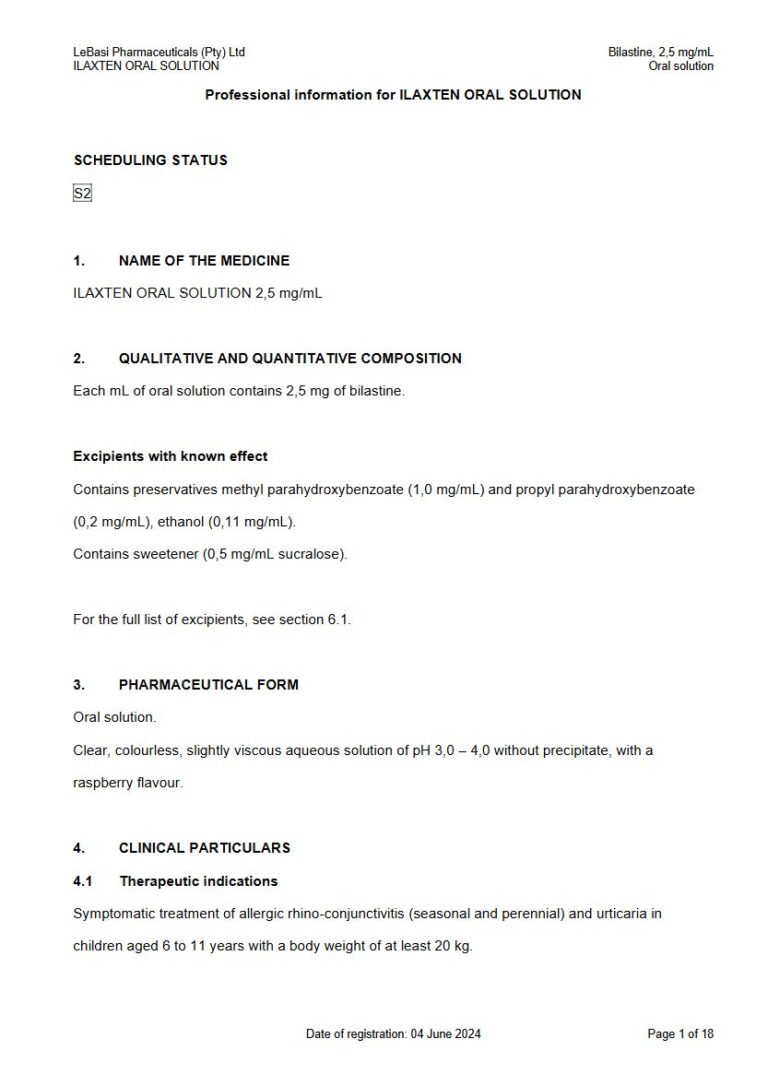
4.1 Therapeutic indications
Symptomatic treatment of allergic rhino-conjunctivitis (seasonal and perennial) and urticaria in children aged 6 to 11 years with a body weight of at least 20 kg.
4.2 Posology and method of administration
Posology
Paediatric population
Children 6 to 11 years of age with a body weight of at least 20 kg 10 mg bilastine (4 mL oral solution) once daily for the relief of symptoms of allergic rhino-conjunctivitis (seasonal allergic rhinitis and perennial allergic rhinitis) and urticaria. The oral solution should be taken one hour before or two hours after the intake of food or fruit juice (see section 4.5).
Children under 6 years of age and under 20 kg Currently available data are described in section 4.4, 4.8, 5.1 and 5.2 but no recommendation on a posology can be made. Therefore, ILAXTEN ORAL SOLUTION should not be used in this age group.
Duration of treatment
For allergic rhino-conjunctivitis the treatment should be limited to the period of exposure to allergens. For seasonal allergic rhinitis treatment could be discontinued after the symptoms have resolved and reinitiated upon their reappearance. In perennial allergic rhinitis continued treatment may be proposed to the patients during the allergen exposure periods. For urticaria the duration of treatment depends on the type, duration and course of the symptoms.
Special populations
Renal impairment The safety and efficacy of bilastine in renally impaired children have not been established. Studies conducted in adults in special risk groups (renally impaired patients) indicate that it is not necessary to adjust the dose of bilastine in adults (see section 5.2).
Hepatic impairment The safety and efficacy of bilastine in hepatically impaired children have not been established. There is no clinical experience in adult or paediatric patients with hepatic impairment. However, since bilastine is not metabolised and is eliminated as unchanged in urine and feces, hepatic impairment is not expected to increase systemic exposure above the safety margin in adult patients. Therefore, no dosage adjustment is required in adult patients with hepatic impairment (see section 5.2).
Paediatric population The safety and efficacy of ILAXTEN OS in children under the age of 6 years have not yet been established (see section 4.4).
Method of administration
Oral use. The bottle of oral solution is provided with a child-proof cap and must be opened as follows: press the plastic screwcap downwards and simultaneously turn anti-clockwise. The oral solution is accompanied by a measuring cup for dosage with a mark of 4 mL (10 mg bilastine per dosing).
4.3 Contraindications
Hypersensitivity to the active substance or to any of the excipients listed in section 6.1.
4.4 Special warnings and precautions for use
Paediatric population
Efficacy and safety of bilastine in children under 2 years of age have not been established and there is little clinical experience in children aged 2 to 5 years, therefore bilastine should not be used in these age groups.
In patients with moderate or severe renal impairment, coadministration of bilastine with P-glycoprotein inhibitors, such as e.g. ketoconazole, erythromycin, ciclosporin, ritonavir or diltiazem, may increase plasma levels of bilastine and therefore increase the risk of adverse effects of bilastine. Therefore, coadministration of bilastine and P-glycoprotein inhibitors should be avoided in patients with moderate or severe renal impairment.
ILAXTEN ORAL SOLUTION contains methyl parahydroxybenzoate (E218) and propyl parahydroxybenzoate (E216) which may cause allergic reactions (possibly delayed).
ILAXTEN ORAL SOLUTION contains up to 0,44 mg of alcohol (ethanol) in each dose (4 mL) which is equivalent to 11 mg/100 mL (0,011 % w/v ). The amount in 4 mL of ILAXTEN ORAL SOLUTION is equivalent to less than 0,02 mL beer or 0,005 mL wine. The small amount of alcohol in ILAXTEN ORAL SOLUTION will not have any noticeable effects.
ILAXTEN ORAL SOLUTION contains less than 1 mmol sodium (23 mg) per 4 mL, that is to say essentially sodium free.
4.5 Interaction with other medicinal products and other forms of interaction
Interaction studies have only been performed in adults and are summarised below.
Food
Food significantly reduces the oral bioavailability of bilastine 20 mg tablets by 30 % and bilastine 2,5 mg/mL oral solution by 20 %.
Grapefruit juice
Concomitant intake of bilastine 20 mg and grapefruit juice decreased bilastine bioavailability by 30 %. This effect may also apply to other fruit juices. The degree of bioavailability decrease may vary between producers and fruits. The mechanism for this interaction is an inhibition of OATP1A2, an uptake transporter for which bilastine is a substrate (see section 5.2).
Medicines that are substrates or inhibitors of OATP1A2, such as ritonavir or rifampicin, may likewise have the potential to decrease plasma concentrations of bilastine.
Ketoconazole or erythromycin
Concomitant intake of bilastine 20 mg o.d and ketoconazole 400 mg o.d or erythromycin 500 mg t.i.d increased bilastine AUC 2-fold and C max 2 to 3-fold. These changes can be explained by interaction with intestinal efflux transporters, since bilastine is a substrate for P-gp and not metabolised (see section 5.2). These changes do not appear to affect the safety profile of bilastine and ketoconazole or erythromycin, respectively. Other medicines that are substrates or inhibitors of P-gp, such as ciclosporin, may likewise have the potential to increase plasma concentrations of bilastine.
Diltiazem
Concomitant intake of bilastine 20 mg and diltiazem 60 mg increased C max of bilastine by 50 %. This effect can be explained by interaction with intestinal efflux transporters (see section 5.2) and does not appear to affect the safety profile of bilastine.
Alcohol
The psychomotor performance after concomitant intake of alcohol and bilastine 20 mg was similar to that observed after intake of alcohol and placebo.
Lorazepam
Concomitant intake of bilastine 20 mg o.d. and lorazepam 3 mg o.d. did not potentiate the depressant CNS effects of lorazepam.
Paediatric population
No interaction studies have been performed in children with bilastine oral solution. As there is no clinical experience regarding the interaction of bilastine with other medicines, food or fruit juices in children, the results obtained in adult interactions studies should be at present taken into consideration when prescribing bilastine to children. There are no clinical data in children to state whether changes to the AUC or C max due to interactions affect the safety profile of bilastine.
4.6 Fertility, pregnancy and lactation
Pregnancy
There are no or a limited amount of data from the use of bilastine in pregnant women. Animal studies did not indicate direct or indirect harmful effects with respect to reproductive toxicity, parturition or postnatal development (see section 5.3). As a precautionary measure, it is preferable to avoid the use of ILAXTEN ORAL SOLUTION during pregnancy.
Breastfeeding
The excretion of bilastine in milk has not been studied in humans. Available pharmacokinetic data in animals have shown excretion of bilastine in milk (see section 5.3).
Fertility
There are no or a limited amount of clinical data. A study in rats did not indicate any negative effect on fertility (see section 5.3).
4.7 Effects on ability to drive and use machines
A study performed in adults to assess the effects of bilastine on the ability to drive demonstrated that treatment with 20 mg bilastine did not affect driving performance. However, as the individual response to the medicines may vary, patients should be advised not to drive or use machines until they have established their own response to bilastine.
4.8 Undesirable effects
Summary of safety profile in paediatric population
During the clinical development the frequency, type and severity of adverse reactions in adolescents (12 years to 17 years) were the same as observed in adults. The information collected in this population (adolescents) during post-marketing surveillance has confirmed clinical trial findings.
The percentage of children (2 u2013 11 years) which reported adverse events (AEs) after treatment with bilastine 10 mg for allergic rhinoconjunctivitis or chronic idiopathic urticaria in a 12-week controlled clinical trial was comparable with patients receiving placebo (68,5 % versus 67,5 %).
The related AEs most commonly reported by 291 children (2 u2013 11 years) receiving bilastine 10 mg (orodispersible tablet formulation) during clinical trials ( # 260 children exposed in the clinical safety study, 31 children exposed in the pharmacokinetic study) were headache, allergic conjunctivitis, rhinitis and abdominal pain. These related adverse events occurred with a comparable frequency in 249 patients receiving placebo.
Tabulated summary of adverse reactions in paediatric population
Adverse events at least possibly related to bilastine and reported in more than 0,1 % of children (2 u2013 11 years) receiving bilastine during the clinical development are tabulated below. Frequencies are assigned as follows: Very common (u2265 1/10) Common (u2265 1/100 to < 1/10) Uncommon (u2265 1/1 000 to < 1/100) Rare (u2265 1/10 000 to < 1/1 000) Very rare (< 1/10 000) Not known (cannot be estimated from the available data) Rare, very rare and reactions with unknown frequency have not been included in the table.
System Organ Class Frequency Adverse Reaction
Infections and infestations Common Rhinitis
Nervous system disorders Common Headache
Uncommon Dizziness
Loss of consciousness
Eye disorders Common Allergic conjunctivitis
Uncommon Eye irritation
Gastrointestinal disorders Common Abdominal pain / Upper abdominal pain
Uncommon Diarrhoea
Nausea
Lip swelling
Skin and subcutaneous tissue disorders Uncommon Eczema
Urticaria
General disorders and administration site conditions Uncommon Fatigue
Summary of safety profile in adult and adolescent patients
The incidence of adverse events in adult and adolescent patients suffering from allergic rhinoconjunctivitis or chronic idiopathic urticaria treated with 20 mg bilastine in clinical trials was comparable with the incidence in patients receiving placebo (12,7 % versus 12,8 %).
The phase II and III clinical trials performed during the clinical development included 2 525 adult and adolescent patients treated with different doses of bilastine, of which 1697 received bilastine 20 mg. In these trials 1 362 patients received placebo. The ADRs most commonly reported by patients receiving 20 mg bilastine for the indication of allergic rhinoconjunctivitis or chronic idiopathic urticaria were headache, somnolence, dizziness, and fatigue. These adverse events occurred with a comparable frequency in patients receiving placebo.
Tabulated summary of adverse reactions in adult and adolescent patients
ADRs at least possibly related to bilastine and reported in more than 0,1 % of the patients receiving 20 mg bilastine during the clinical development (n=1 697) are tabulated below. Frequencies are assigned as follows: Very common (u2265 1/10) Common (u2265 1/100 to < 1/10) Uncommon (u2265 1/1 000 to < 1/100) Rare (u2265 1/10 000 to < 1/1 000) Very rare (< 1/10 000) Not known (cannot be estimated from the available data) Rare, very rare and reactions with unknown frequency have not been included in the table.
System Organ Class Frequency Adverse reaction
Infections and infestations Uncommon Oral herpes
Metabolism and nutrition disorders Uncommon Increased appetite
Psychiatric disorders Uncommon Anxiety
Insomnia
Nervous system disorders Common Somnolence
Headache
Uncommon Dizziness
Ear and labyrinth disorders Uncommon Tinnitus
Vertigo
Cardiac disorders Uncommon Right bundle branch block
Sinus dysrhythmia
Electrocardiogram QT prolonged
Other ECG abnormalities
Respiratory, thoracic and mediastinal disorders Uncommon Dyspnoea
Nasal discomfort
Nasal dryness
Gastrointestinal disorders Uncommon Upper abdominal pain
Abdominal pain
Nausea
Stomach discomfort
Diarrhoea
Dry mouth
Dyspepsia
Gastritis
Skin and subcutaneous tissue disorders Uncommon Pruritus
General disorders and administration site conditions Uncommon Fatigue
Thirst
Improved pre-existing condition
Pyrexia
Asthenia
Investigations Uncommon Increased gamma-glutamyltransferase
Increased alanine aminotransferase
Increased aspartate aminotransferase
Increased blood creatinine
Increased blood triglicerides
Increased weight
Frequency not known (cannot be estimated from the available data): Palpitations, tachycardia and hypersensitivity reactions (such as anaphylaxis, angioedema, dyspnoea, rash, localised oedema/local swelling, and erythema), and vomiting have been observed during the post-marketing period. The information collected during the post-marketing surveillance has confirmed the safety profile observed during the clinical development.
Reporting of suspected adverse reactions Reporting suspected adverse reactions after authorisation of ILAXTEN ORAL SOLUTION is important. It allows continued monitoring of the benefit/risk balance of ILAXTEN ORAL SOLUTION. Healthcare professionals are asked to report any suspected adverse reactions via the u201c6.04 Adverse Drug Reaction Reporting Formu201d, found online under SAHPRAu2019s publications: https://www.sahpra.org.za/Publications/Index/8.
4.9 Overdose
There are no data for overdose in children. Information regarding acute overdose of bilastine is retrieved from the experience of clinical trials conducted during the development in adults and the post-marketing surveillance. In clinical trials, after administration of bilastine at doses 10 to 11 times the therapeutic dose (220 mg as single dose or 200 mg/day for 7 days) to 26 adult healthy volunteers, frequency of treatment emergent adverse events was two times higher than with placebo. The adverse reactions most frequently reported were dizziness, headache and nausea. No serious adverse events and no significant prolongation in the QTc interval were reported. The information collected in the post-marketing surveillance is consistent with that reported in clinical trials.
Critical evaluation of bilastineu2019s multiple dose (100 mg x 4 days) effect on ventricular repolarisation by a QT/QTc cross-over study involving 30 healthy adult volunteers did not show significant QTc prolongation. In the event of overdose symptomatic and supportive treatment is recommended. There is no known specific antidote for bilastine.
