
Ilaxten 20 Mg Tablets
PDF Leaflet Revision Date: 19 April 2022
Clinical Summary
Quick overview from the medicine insert
Indication
Symptomatic treatment of allergic rhinitis and chronic urticaria.
Dosage (summary)
One tablet (20 mg) once daily, taken with water.
Special Populations
- Elderly
- Renal impairment
- Hepatic impairment
Pregnancy & Breastfeeding
Not recommended during pregnancy or breastfeeding.
Key Drug Interactions
- Food reduces bioavailability by 30%
- Grapefruit juice decreases bioavailability
- Ketoconazole increases AUC 2-fold
Contraindications
- Hypersensitivity to bilastine or excipients
Common side effects
- Headache
- Somnolence
- Dizziness
- Fatigue
Counselling Points
- Take one hour before or two hours after food
- May cause drowsiness, avoid driving if affected
Serious warnings
- Avoid in moderate/severe renal impairment with P-glycoprotein inhibitors
Important Disclaimer
The Ilaxten 20 Mg Tablets professional information leaflet below is the property of Lebasi Pharmaceuticals and is provided on Medinsert exactly as issued, with no.. alterations or editorial changes. We make every effort to keep content current by updating documents as soon as new versions become available. Medinsert serves as a trusted access point for healthcare professionals, but does not replace official sources or clinical judgement. For more details, please read our full disclaimer. read more>>
 Healthcare Professionals Only
This content is for registered healthcare professionals
Sign in or create a free account to read the full package insert.
Free for HPCSA-registered professionals. Powered by Medinsert.
Clinical Particulars
Section 4 of the official insert — extracted exactly as issued, no alterations
4.1 Therapeutic indications
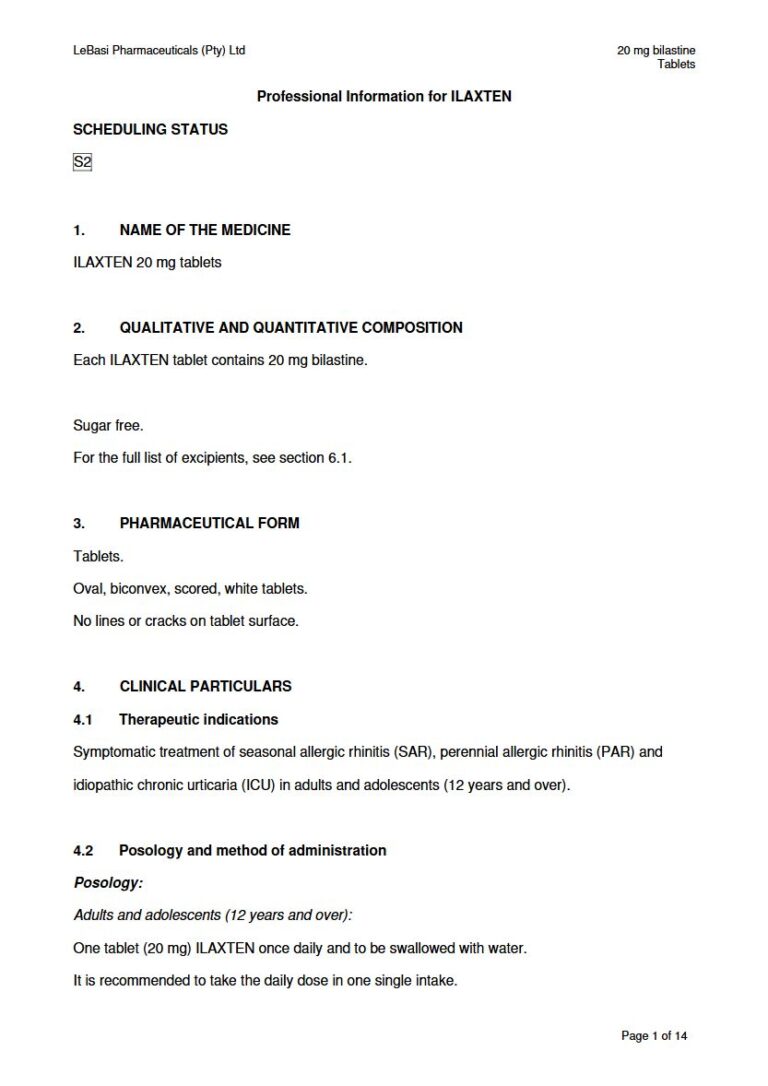
Symptomatic treatment of seasonal allergic rhinitis (SAR), perennial allergic rhinitis (PAR) and idiopathic chronic urticaria (ICU) in adults and adolescents (12 years and over).
4.2 Posology and method of administration
Posology:
Adults and adolescents (12 years and over): One tablet (20 mg) ILAXTEN once daily and to be swallowed with water. It is recommended to take the daily dose in one single intake.
ILAXTEN should be taken one hour before or two hours after intake of food or fruit juice (see section 4.5).
Special populations:
Elderly patients: No dosage adjustments are required in elderly patients (see sections 5.1 and 5.2).
Renal impairment: No dosage adjustment is required in patients with renal impairment because, despite the increase in AUC, the concentrations of bilastine were within the therapeutic range (see section 5.2).
Hepatic impairment: There is no clinical experience in patients with hepatic impairment. Since ILAXTEN is not metabolised, hepatic impairment is not expected to increase systemic exposure above the safety margin. Therefore, no dosage adjustment is required in patients with hepatic impairment (see section 5.2).
Paediatric population: The safety and efficacy in children below 12 years have not yet been established.
Duration of treatment: Treatment should be discontinued after the symptoms have resolved. For seasonal allergic rhinitis treatment should not exceed 14 days, while for idiopathic chronic urticaria the duration of treatment should not exceed 28 days.
4.3 Contraindications
Hypersensitivity to bilastine or to any of the excipients listed in section 6.1.
4.4 Special warnings and precautions for use
Renal impairment: In patients with moderate or severe renal impairment coadministration of ILAXTEN with P-glycoprotein inhibitors, such as e.g. ketoconazole, erythromycin, ciclosporin, ritonavir or diltiazem, may increase plasmatic levels of ILAXTEN and therefore increase the risk of adverse reactions of ILAXTEN (see section 4.5). Therefore, coadministration of ILAXTEN and P-glycoprotein inhibitors should be avoided in patients with moderate or severe renal impairment.
4.5 Interaction with other medicines and other forms of interaction
Interaction with food: Food significantly reduces the oral bioavailability of ILAXTEN by 30 %.
Interaction with grapefruit juice: Concomitant intake of ILAXTEN and grapefruit juice decreased ILAXTEN bioavailability by 30 %. The mechanism for this interaction is an inhibition of organic anion-transporting polypeptide 1A2 (OATP1A2), an uptake transporter for which ILAXTEN is a substrate (see section 5.2). Medicines that are substrates or inhibitors of OATP1A2, such as ritonavir or rifampicin, may likewise have the potential to decrease plasma concentrations of ILAXTEN.
Interaction with ketoconazole or erythromycin: Concomitant intake of ILAXTEN and ketoconazole or erythromycin increased ILAXTEN AUC 2-fold and C max 2 u2013 3-fold. These changes can be explained by interaction with intestinal efflux transporters, since ILAXTEN is a substrate for P-gp and not metabolised by the hepatic enzymes (see section 5.2). These changes do not appear to affect the safety profile of ILAXTEN and ketoconazole or erythromycin, respectively. Other medicines that are substrates or inhibitors of P-gp, such as ciclosporin, may likewise have the potential to increase plasma concentrations of ILAXTEN.
Interaction with diltiazem: Concomitant intake of ILAXTEN and diltiazem 60 mg increased C max of ILAXTEN by 50 %. This effect can be explained by interaction with intestinal efflux transporters (see section 5.2) and does not appear to affect the safety profile of ILAXTEN.
4.6 Fertility, pregnancy and lactation
Pregnancy: ILAXTEN should not be used during pregnancy. The safety of ILAXTEN in pregnancy has not been established. There are no or limited amount of data from the use of ILAXTEN in pregnant women. Animal studies do not indicate direct or indirect harmful effects with respect to reproductive toxicity, parturition or postnatal development (see section 5.3).
Breastfeeding: ILAXTEN should not be used during lactation or breastfeeding. The safety of ILAXTEN in lactation has not been established. The excretion of ILAXTEN in milk has not been studied in humans. Available pharmacokinetic data in animals have shown excretion of ILAXTEN in milk (see section 5.3).
Fertility: There are no or limited amount of clinical data. A study in rats did not indicate any negative effect on fertility (see section 5.3).
4.7 Effects on ability to drive and use machines
ILAXTEN can cause drowsiness and dizziness. Patients experiencing drowsiness or dizziness should avoid driving and use of machines.
4.8 Undesirable effects
Summary of the safety profile: The incidence of adverse events in clinical studies was comparable with the incidence in patients receiving placebo. The adverse drug reactions (ADRs) most commonly reported by patients receiving 20 mg ILAXTEN were headache, somnolence, dizziness and fatigue.
Tabulated summary of adverse reactions: Adverse drug reactions (ADRs) reported in patients receiving ILAXTEN at recommended doses during the clinical development are tabulated below. Frequencies are assigned as follows: Very common (u2265 1/10) Common (u2265 1/100 to < 1/10) Uncommon (u2265 1/1 000 to < 1/100) Rare (u2265 1/10 000 to < 1/1 000) Very rare (< 1/10 000) Not known (cannot be estimated from the available data) Rare, very rare and reactions with unknown frequency have not been included in the table.
4.9 Overdose
In clinical trials, after administration of ILAXTEN at doses 10 to 11 times the therapeutic dose (220 mg as single dose or 200 mg/day for 7 days) to healthy volunteers, the frequency of treatment emergent adverse events was two times higher than with placebo. The adverse reactions most frequently reported were dizziness, headache and nausea. In the event of overdose, symptomatic and supportive treatment is recommended. There is no known specific antidote to ILAXTEN.
