
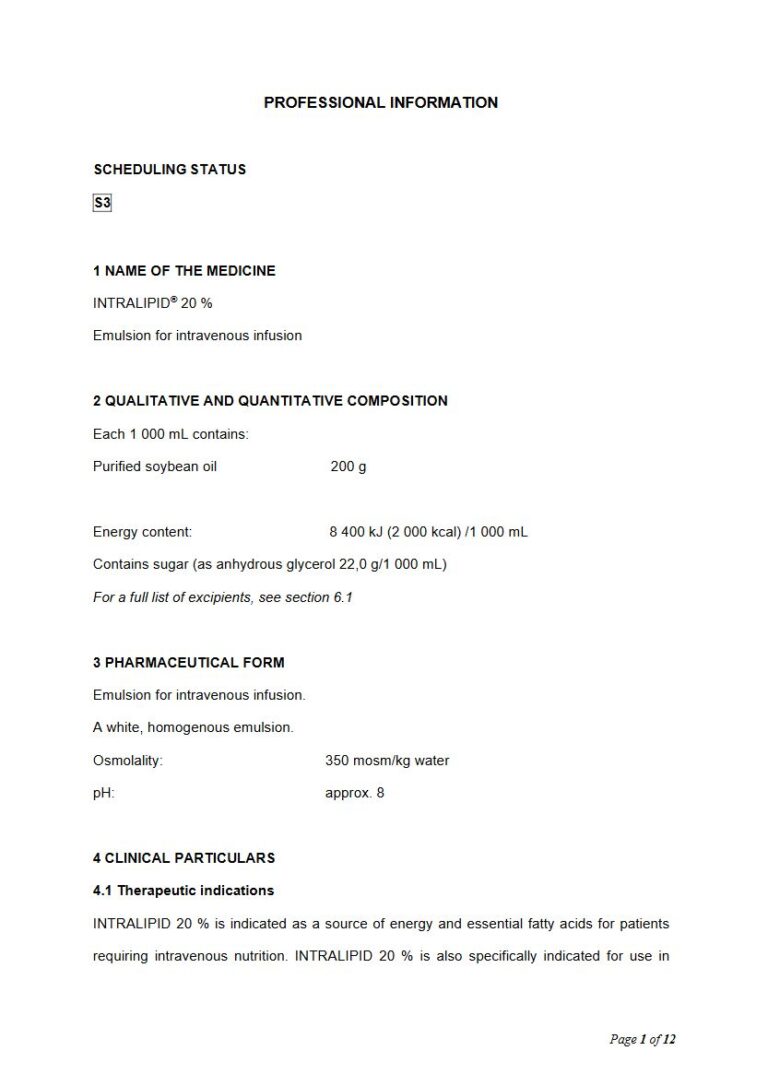
Intralipid 20 % 1 000 mL Emulsion for infusion
PDF Leaflet Revision Date: 28 January 2026
Clinical Summary
Quick overview from the medicine insert
Indication
Source of energy and essential fatty acids for intravenous nutrition.
Dosage (summary)
Adults: max 3 g/kg/day; Neonates: 2.5 - 20 mL/kg/day.
Special Populations
- Renal impairment
- Hepatic impairment
Pregnancy & Breastfeeding
Safe in pregnancy; safety in breastfeeding not established.
Key Drug Interactions
- Insulin
- Heparin
- Coumarin derivatives
Contraindications
- Hypersensitivity to soy/egg proteins
- Acute shock
- Lipid metabolism disorders
Common side effects
- Abdominal pain
- Nausea
- Vomiting
- Rash
- Hypersensitivity reactions
Counselling Points
- Monitor for allergic reactions
- Do not exceed recommended dosage
- Discard unused emulsion after opening
Serious warnings
- Fat overload syndrome
- Monitor triglyceride levels
- Protect from light in neonates
Important Disclaimer
The Intralipid 20 % 1 000 mL Emulsion for infusion professional information leaflet below is the property of Fresenius Kabi South Africa and is provided on Medinsert exactly as issued, with no.. alterations or editorial changes. We make every effort to keep content current by updating documents as soon as new versions become available. Medinsert serves as a trusted access point for healthcare professionals, but does not replace official sources or clinical judgement. For more details, please read our full disclaimer. read more>>
 Healthcare Professionals Only
This content is for registered healthcare professionals
Sign in or create a free account to read the full package insert.
Free for HPCSA-registered professionals. Powered by Medinsert.
Clinical Particulars
Section 4 of the official insert — extracted exactly as issued, no alterations
4.1 Therapeutic indications
INTRALIPID 20 % is indicated as a source of energy and essential fatty acids for patients requiring intravenous nutrition. INTRALIPID 20 % is also specifically indicated for use in infants and children. INTRALIPID 20 % is also indicated for patients with essential fatty acid deficiency who cannot maintain or restore a normal essential fatty acid pattern by oral intake, for example:
- Pre- and post-operative nutritional disturbances in which a large supply of energy is necessary or desirable, e.g. in order to improve the nitrogen balance.
- Nutritional disorders or disturbances of nitrogen balance due to inadequate or failing intestinal absorption, caused by tumours in the gastrointestinal tract, or acute and chronic intestinal disease (peritonitis, ulcerative colitis and terminal ileitis).
- Burns: In extensive burns, every additional supply of energy is of value as a means of reducing the frequently excessive nitrogen losses. A larger supply of energy also improves the utilisation of orally ingested protein.
- Intravenously administered fat is also indicated in patients in whom oral nutrition is inadequate.
- Cases where true feeding is inappropriate or impossible, e.g. during unconsciousness following cranial trauma or poisoning.
- Impaired renal function, in which case an adequate supply of energy is essential to reduce protein breakdown.
- Cachexia.
4.2 Posology and method of administration
Posology:
Adults: The quantity of intravenously administered fat should not normally exceed 3 g/kg body weight per day. INTRALIPID 20 % can supply up to 70 % of the energy requirements of the patient (also in patients with highly increased energy requirements). The infusion rate of INTRALIPID 20 % should be about 20 drops/minute initially, being continually increased until it can be stabilised at the desired rate after 30 minutes.
The infusion rate of INTRALIPID 20 % should not exceed 500 mL in 5 hours.
Neonates and infants: INTRALIPID 20 % should be used in new-borns and infants. The infantu2019s ability to eliminate fat should govern the dosage of INTRALIPID 20 %. The recommended dosage range in neonates and infants is 2,5 - 20 mL INTRALIPID 20 % per kg body weight per day. The rate of infusion should not exceed 0,17 g of triglycerides/kg/hour (4 g/kg in 24 hours). In premature and low birth weight neonates, INTRALIPID 20 % should preferably be infused continuously over 24 hours. The initial dosage of 0,5 - 1 g/kg/day may be increased by 0,5 u2013 1 g/kg/day up to 2 g/kg/day. Only with close monitoring of the serum triglyceride concentration, liver tests and oxygen saturation, may the dosage be increased to 4 g/kg/day. No attempt should be made to exceed these rates in order to compensate for missed doses.
IMPORTANT: Fat elimination:
Adults: The ability to eliminate fat should be tested in adult patients given INTRALIPID 20 % for more than one week. This is done by collecting a blood sample before the infusion is started after a fat clearance period of 4 - 6 hours. Blood cells are then separated from plasma by centrifugation (1 200 u2013 1 500 rpm). If the plasma is opalescent, the planned infusion should be postponed. The sensitivity of this method is, however, such that hypertriglyceridaemia can pass undetected. Therefore, it is recommended that serum triglyceride concentrations are measured in patients who are likely to have an impaired fat tolerance. In conditions mentioned under section 4.4, fat elimination should be closely monitored.
Neonates and infants: In neonates and infants, the ability to eliminate fat should be tested regularly. Measurement of serum triglyceride levels is the only reliable method.
Method of Administration:
INTRALIPID 20 % may be infused into the same central or peripheral vein as carbohydrate/amino acid solutions by means of a Y-connector near the infusion site. INTRALIPID 20 % may also be given in a phthalate-free plastic bag as one part of an all-in-one admixture also containing carbohydrates, amino acids, electrolytes, vitamins and trace elements. The admixture must be approved for physical stability, and additives may only be added to INTRALIPID 20 % where compatibility is documented. Vitalipid Novum Adult or Vitalipid Novum Infant and/or Soluvit Novum are recommended additives. Admixtures, which have been aseptically prepared, shall be used within 7 days after preparation. The admixtures should be stored in a refrigerator (2 u2013 8 u00b0C) and when infused, a maximum infusion period of 24 hours should be kept. N.B. THE CONTENTS OF AN OPENED BOTTLE ARE FOR A SINGLE INFUSION ONLY. ANY REMAINING EMULSION FROM AN OPENED BOTTLE MUST BE DISCARDED.
4.3 Contraindications
Hypersensitivity to egg -, soy- or peanut protein or to the active substance or any of the excipients listed in section 6.1 (also see section 4.4). INTRALIPID 20 % is contraindicated in patients with acute shock and in those with disturbances in lipid metabolism.
4.4 Special warnings and precautions for use
The ability of the patient to eliminate administered fat (INTRALIPID 20 %) should govern the dosage and infusion rate of INTRALIPID 20 % - see section 4.2 u201c Fat elimination u201d. INTRALIPID 20 % should not be administered to patients with severe liver disease, hyperlipidaemia or other conditions where the ability to absorb or metabolise fat may be impaired e.g. renal insufficiency, (uncontrolled) diabetes mellitus, pancreatitis, impaired liver function, hypothyroidism (with hypertriglyceridemia) and sepsis. However, if administration of INTRALIPID 20 % is considered in such patients, close monitoring of the serum triglyceride concentration, on a daily basis, is obligatory. Light exposure of solutions for intravenous parenteral nutrition, especially after admixture with trace elements and/or vitamins, may have adverse effects on clinical outcome in neonates, due to generation of peroxides and other degradation products. When used in neonates and children below 2 years, INTRALIPID 20 % should be protected from ambient light until administration is completed (see section 6.3 and 6.6). INTRALIPID 20 % should be given with caution to neonates and premature babies with hyperbilirubinaemia and in cases with suspected pulmonary hypertension. In neonates, particularly premature babies on long-term parenteral nutrition, platelet count, liver tests and serum triglyceride concentrations should be monitored. INTRALIPID 20 % contains soybean oil and egg phospholipids, which may rarely cause allergic reactions. Cross allergic reactions have been observed between soybean and peanut (see section 4.3).
4.5 Interactions with other medicines and other forms of interaction
Some medicines, like insulin, may interfere with the bodyu2019s lipase system. This kind of interaction seems, however, to be of only limited clinical importance. Heparin in clinical doses causes a transient increase in lipolysis in plasma, resulting in a transient decrease in triglyceride clearance due to depletion of lipoprotein lipase. Soybean oil has a natural content of vitamin K1. This is considered important only for patients treated with coumarin derivatives, which interfere with vitamin K1. INTRALIPID 20 % may interfere with certain laboratory measurements (e.g. bilirubin, lactate dehydrogenase, oxygen saturation, haemoglobin, etc.) if blood is sampled before fat has been adequately cleared from the blood stream. Fat is normally cleared after a period of 4 - 6 hours in most patients.
4.6 Fertility, pregnancy and lactation
Pregnancy: Successful and safe administration of INTRALIPID 20 % during pregnancy has been reported. Animal reproduction studies have not been carried out with INTRALIPID 20 %.
Breastfeeding: The safety in lactating women has not been established.
Fertility: No data available.
4.7 Effects on ability to drive and use machines
No effects on the ability to drive and operate machines are to be expected.
4.8 Undesirable effects
Blood and lymphatic system disorders: Very rare (<1/10 000) Haemolysis, reticulocytosis. Thrombocytopenia has been reported in association with prolonged treatment with INTRALIPID 20 % in infants.
Cardiac disorders: Very rare (<1/10 000) Circulatory effects (hyper/hypotension).
Respiratory, thoracic and mediastinal disorders: The following side effect has been reported and the frequency is unknown: Respiratory symptoms (e.g. tachypnoea).
Gastrointestinal disorders: Uncommon (>1/1 000, <1/100) Abdominal pain, nausea, vomiting, abnormal pain.
Hepato-biliary disorders: Very rare (<1/10 000) Transient increases in liver enzymes after prolonged intravenous nutrition with or without INTRALIPID 20 % have been noted. Impaired capacity to eliminate INTRALIPID 20 % may lead to fat overload syndrome as a result of overdosage but also at recommended rates of infusion in association with prolonged administration or with a sudden change in the clinical condition, such as renal function impairment or infection (see section 4.9). Pigmentation of tissues after prolonged therapy has also been reported.
Skin and subcutaneous tissue disorders: Very rare (<1/10 000) Rash, urticaria.
Musculoskeletal and connective tissue disorders: Very rare (<1/10 000) Abdominal pain.
Reproductive system and breast disorders: Very rare (<1/10 000) Priapism.
General disorders and administration site conditions: Uncommon (>1/1 000, <1/100) Infusion of INTRALIPID 20 % may cause a rise in body temperature, shivering, chills, headache and tiredness.
Immune system disorders: Very rare (<1/10 000) Hypersensitivity reactions (anaphylactic reaction, skin rash, urticaria).
Reporting of suspected adverse reactions: Reporting suspected adverse reactions after authorisation of the medicine is important. It allows continued monitoring of the benefit/risk balance of the medicine. Healthcare providers are asked to report any suspected adverse drug reactions to SAHPRA via the Med Safety APP (Medsafety X SAHPRA) and eReporting platform (who-umc.org) found on the SAHPRA website. Healthcare providers are asked to report any suspected adverse drug reactions to the Holder of the Certificate of Registration at the following email address: [email protected] and to the relevant medicines regulatory authority in the country where the product is marketed.
4.9 Overdose
Impaired capacity to eliminate INTRALIPID 20 % may lead to fat overload syndrome as a result of overdose (but also at recommended rates of infusion, in association with a sudden change in the clinical condition, such as renal function impairment or infection). Fat overload syndrome is characterised by hyperlipidaemia, fever, fat infiltration and disorders of various organs (e.g. bone marrow depression, anaemia, thrombocytopenia, spontaneous bleeding and hepatosplenomegaly) and coma. Symptoms are usually reversible, if the infusion of INTRALIPID 20 % is discontinued. Immediate reactions to the intravenous administration of soybean oil emulsion may be treated by the intravenous administration of corticosteroids and antihistamines. Treatment with adrenaline 0,5 mL to 1,0 mL (0,5 mg to 1,0 mg) of a 1:1 000 solution by subcutaneous or intramuscular injection may be necessary.
