
Kivexa 600mg. 300mg Tablet
PDF Leaflet Revision Date: 05 August 2019
Clinical Summary
Quick overview from the medicine insert
Indication
Treatment of HIV infection in adults and adolescents from 12 years of age, weighing at least 40 kg.
Dosage (summary)
One tablet once daily for adults and adolescents weighing at least 40 kg.
Special Populations
- Renal impairment
- Hepatic impairment
Pregnancy & Breastfeeding
Not recommended during pregnancy or breastfeeding due to potential risks.
Key Drug Interactions
- Ethanol may increase abacavir levels.
- Trimethoprim increases lamivudine exposure.
Contraindications
- Hypersensitivity to abacavir or lamivudine.
- Moderate and severe hepatic impairment.
- Children below 12 years or weighing less than 40 kg.
Common side effects
- Nausea
- Vomiting
- Diarrhoea
- Rash
- Fever
- Fatigue
Counselling Points
- Inform patients about hypersensitivity risks.
- Advise against restarting KIVEXA after hypersensitivity.
- Encourage patients to report any symptoms immediately.
Serious warnings
- Risk of life-threatening hypersensitivity reactions.
- Lactic acidosis and severe hepatomegaly.
- Pancreatitis risk.
Important Disclaimer
The Kivexa 600mg. 300mg Tablet professional information leaflet below is the property of Gsk and is provided on Medinsert exactly as issued, with no.. alterations or editorial changes. We make every effort to keep content current by updating documents as soon as new versions become available. Medinsert serves as a trusted access point for healthcare professionals, but does not replace official sources or clinical judgement. For more details, please read our full disclaimer. read more>>
 Healthcare Professionals Only
This content is for registered healthcare professionals
Sign in or create a free account to read the full package insert.
Free for HPCSA-registered professionals. Powered by Medinsert.
Clinical Particulars
Section 4 of the official insert — extracted exactly as issued, no alterations
4.1 Therapeutic indications
KIVEXA is a combination of two nucleoside analogues (abacavir and lamivudine). It is indicated in antiretroviral combination therapy for the treatment of Human Immunodeficiency Virus (HIV) infection in adults and adolescents from 12 years of age, weighing at least 40 kg.
4.2 Posology and method of administration
Patients should be stabilised on individual medicines before being switched over to KIVEXA. Therapy should be initiated by a medical practitioner experienced in the management of HIV infection. KIVEXA should not be administered to adults or adolescent patients who weigh less than 40 kg because it is a fixed-dose tablet that cannot be dose reduced. KIVEXA can be taken with or without food. KIVEXA is a fixed-dose tablet and should not be prescribed for patients requiring dosage adjustments, such as those with creatinine clearance less than 50 ml/min or with mild hepatic impairment. Separate preparations of abacavir or lamivudine should be administered in cases where discontinuation or dose adjustment is indicated. In these cases, the physician should refer to the individual product information for these medicines.
Adults and adolescents weighing at least 40 kg: The recommended dose of KIVEXA in adults and adolescents weighing 40 kg or more is one tablet once daily.
Children weighing less than 40 kg: KIVEXA is not recommended for treatment of children weighing less than 40 kg, as the necessary dose adjustment cannot be made. Medical practitioners should refer to the individual product information for lamivudine and abacavir.
Elderly: The pharmacokinetics of abacavir and lamivudine have not been studied in patients over 65 years of age. When treating elderly patients, consideration needs to be given to the greater frequency of decreased hepatic, renal and cardiac function, concomitant medicinal products or disease.
Renal impairment: Whilst no dosage adjustment of abacavir is necessary in patients with renal impairment, a dose reduction of lamivudine is required due to decreased clearance. Therefore, KIVEXA is not recommended for use in patients with a creatinine clearance less than 50 ml/min (see section 5.2 Pharmacokinetic properties).
Hepatic impairment: A dose reduction of abacavir may be required for patients with mild hepatic impairment (Child-Pugh grade A). As dose reduction is not possible with KIVEXA, the separate preparation of abacavir should be used when this is judged necessary. KIVEXA is contraindicated in patients with moderate and severe hepatic impairment (see section 5.2 Pharmacokinetic properties).
4.3 Contraindications
KIVEXA is contraindicated in patients with known hypersensitivity to abacavir or lamivudine, or to any of the excipients. KIVEXA is contraindicated in patients with moderate and severe hepatic impairment. KIVEXA is contraindicated in children below 12 years of age (weighing less than 40 kg) as the necessary dose adjustment cannot be made.
4.4 Special warnings and precautions for use
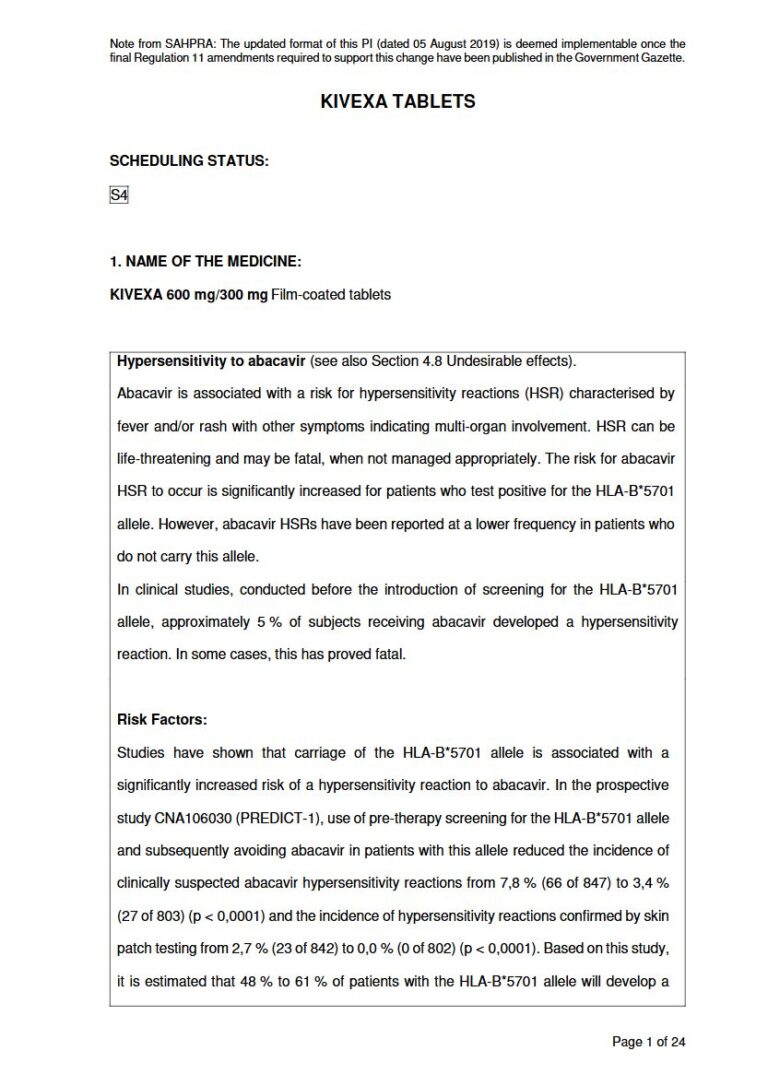
The special warnings and precautions relevant to both abacavir and lamivudine are included in this section. There are no additional precautions and warnings relevant to KIVEXA. Hypersensitivity to abacavir (see Section 4.8 Undesirable effects): In clinical studies, conducted before the introduction of screening for the HLA-B*5701 allele, approximately 5 % of subjects receiving abacavir developed a hypersensitivity reaction, which in rare cases has proved fatal. Hypersensitivity is characterised by the appearance of symptoms indicating multi-organ/body-system involvement. Patients who develop a hypersensitivity reaction must discontinue KIVEXA and MUST not be rechallenged with KIVEXA, or any other product containing abacavir (see section 1 NAME OF MEDICINE - Boxed warning).
Lactic acidosis/severe hepatomegaly with steatosis: Long-term use of KIVEXA can result in potentially fatal lactic acidosis as a consequence of mitochondrial dysfunction. Symptomatic hyperlactataemia and lactic acidosis are uncommon. Clinical features are non-specific and include nausea, vomiting, abdominal pain, dyspnoea and tachypnoea, fatigue and weight loss. Suspicious biochemical features include raised transaminases, raised lactate dehydrogenase (LDH) and/or creatine kinase. In patients with suspicious symptoms of biochemistry, measure the venous lactate level (normal < 2 mmol/l) and the serum bicarbonate and respond as follows:
- Lactate 2-5 mmol/l with minimum symptoms: switch to agents that are less likely to cause lactic acidosis
- Lactate 5-10 mmol/l with symptoms and/or reduced standard bicarbonate: Stop NRTIs and change treatment option. Once lactate has settled, use medicines that are less likely to cause lactic acidosis. Exclude other causes (e.g. sepsis, uraemia, diabetic ketoacidosis, thyrotoxicosis and hyperthyroidism).
- Lactate >10 mmol/l: STOP all therapy (80 % mortality).
Diagnosis of lactic acidosis is confirmed by demonstrating metabolic acidosis with an increased anion gap and raised lactate level. Therapy should be stopped in any patient with a raised lactate level. Blood for lactate assay should be heparinised and stored on ice. After recovery, NRTIs should be avoided. Seek expert advice on medicine selection. The above lactate values may not be applicable to paediatric patients. Lactic acidosis and severe hepatomegaly with steatosis, including fatal cases, have been reported with the use of KIVEXA alone or in combination. Caution should be exercised when administering KIVEXA particularly to those with known risk factors for liver disease. Treatment with KIVEXA should be suspended in any patient who develops clinical or laboratory findings suggestive of lactic acidosis with or without hepatotoxicity (which may include hepatomegaly and steatosis even in the absence of marked transaminase elevations).
Mitochondrial dysfunction: Nucleoside and nucleotide analogues have been demonstrated in vitro and in vivo to cause a variable degree of mitochondrial damage. There have been reports of mitochondrial dysfunction in HIV negative infants exposed in utero and/or post-natally to nucleoside analogues. Apart from lactic acidosis/hyperlactataemia (see above), other manifestations of mitochondrial dysfunction include haematological disorders (anaemia, neutropenia) and peripheral neuropathy. Some late-onset neurological disorders have been reported (hypertonia, convulsion, abnormal behaviour). It is not known whether the neurological disorders are transient or permanent. Any foetus exposed in utero to nucleoside and nucleotide analogues, even HIV negative infants/children, should have clinical and laboratory follow-up and should be fully investigated for possible mitochondrial dysfunction in case of relevant sign and symptoms.
Pancreatitis: Pancreatitis has been observed in some patients receiving KIVEXA. Pancreatitis must be considered whenever a patient develops abdominal pain, nausea, vomiting or elevated biochemical markers. Discontinue use of KIVEXA until diagnoses of pancreatitis is excluded.
...
4.5 Interactions with other medicines and other forms of interaction
As KIVEXA contains abacavir and lamivudine, any interactions that have been identified with these agents individually may occur with KIVEXA. Clinical studies have shown that there are no clinically significant interactions between abacavir and lamivudine. Abacavir and lamivudine are not significantly metabolised by cytochrome P 450 enzymes (such as CYP 3A4, CYP 2C9 or CYP 2D6) nor do they inhibit or induce this enzyme system. Therefore, there is little potential for interactions with antiretroviral protease inhibitors, non-nucleosides and other medicinal products metabolised by major P 450 enzymes. The likelihood of metabolic interactions with lamivudine is low due to limited metabolism and plasma protein binding and almost complete renal clearance. Lamivudine is predominantly eliminated by active organic cationic secretion. The possibility of interactions with other medicinal products administered concurrently should be considered, particularly when the main route of elimination is renal.
Interactions relevant to abacavir: Ethanol - The metabolism of abacavir is altered by concomitant ethanol resulting in an increase in AUC of abacavir of about 41 %. Given the safety profile of abacavir, these findings are not considered clinically significant. Abacavir has no effect on the metabolism of ethanol. Methadone - In a pharmacokinetic study, co-administration of 600 mg abacavir twice daily with methadone showed a 35 % reduction in abacavir C max and a one hour delay in T max, but AUC was unchanged. The changes in abacavir pharmacokinetics are not considered clinically relevant. In this study, abacavir increased the mean methadone systemic clearance by 22 %. This change is not considered clinically relevant for the majority of patients, however occasionally methadone dose re-titration may be required.
Interactions relevant to lamivudine: Trimethoprim - Administration of trimethoprim/sulphamethoxazole 160 mg/800 mg (co-trimoxazole) causes a 40 % increase in lamivudine exposure because of the trimethoprim component. However, unless the patient has renal impairment, no dosage adjustment of lamivudine is necessary (see 4.2 Posology and method of administration). Lamivudine has no effect on the pharmacokinetics of trimethoprim or sulphamethoxazole. The effect of co-administration of lamivudine with higher doses of co-trimoxazole used for the treatment of Pneumocystis carinii pneumonia and toxoplasmosis has not been studied. Zalcitabine - Lamivudine may inhibit the intracellular phosphorylation of zalcitabine when the two medicinal products are used concurrently. KIVEXA is therefore, not recommended to be used in combination with zalcitabine. Emtricitabine u2013 Lamivudine may inhibit the intracellular phosphorylation of emtricitabine when the two medicinal products are used concurrently. Additionally, the mechanism of viral resistance for both lamivudine and emtricitabline is mediated via mutation of the same viral reverse transcriptase gene (M184V) and therefore the therapeutic efficacy of these medicines in combination therapy may be limited. Lamivudine is not recommended for use in combination with emtricitabine or emtricitabine-containing fixed-dose combinations.
4.6 Fertility, pregnancy and lactation
Pregnancy: The safety of KIVEXA in human pregnancy has not been established. KIVEXA should not be used during pregnancy and lactation since teratogenicity and/or foetal toxicity cannot be excluded.
Lactation: Lamivudine is excreted in human milk at similar concentrations to those found in serum. It is expected that abacavir will also be secreted into human milk. Therefore, mothers on treatment with KIVEXA should not breastfeed their babies. HIV infected women should not breastfeed their infants in order to avoid transmission of HIV. In settings where formula feeding is not feasible, the local official lactation and treatment guidelines should be followed when considering breastfeeding during antiretroviral therapy.
4.7 Effects on ability to drive and use machines
There have been no studies to investigate the effect of KIVEXA on driving performance or the ability to operate machinery. Further, a detrimental effect on such activities cannot be predicted from the pharmacology of these medicinal products. The clinical status of the patient and the adverse event profile of KIVEXA should be borne in mind when considering the patient's ability to drive or operate machinery.
4.8 Undesirable effects
KIVEXA contains abacavir and lamivudine, therefore the adverse events associated with these may be expected. The side effects for abacavir or lamivudine are listed in the tables below by body system and absolute frequency. Frequencies are defined as very common ( u2265 1/10), common ( u2265 1/100, < 1/10), uncommon ( u2265 1/1 000, < 1/100), rare ( u2265 1/10 000, < 1/1 000), very rare (< 1/10 000). Many of the adverse events listed occur commonly (nausea, vomiting, diarrhoea, fever, lethargy, rash) in patients with abacavir hypersensitivity. Therefore, patients with any of these symptoms should be carefully evaluated for the presence of this hypersensitivity reaction. If KIVEXA has been discontinued in patients due to experiencing any one of these symptoms and a decision is made to restart abacavir, this must be done only under direct medical supervision (see Special considerations following an interruption of KIVEXA therapy in section 1 NAME OF MEDICINE - Boxed warning).
Clinical Trial Data:
Body system Abacavir Lamivudine Blood and lymphatic systems disorders Uncommon: neutropenia, anaemia, thrombocytopenia Immune system disorders Common: medicine hypersensitivity Metabolism and nutrition disorders Common: anorexia Nervous system disorders Common: headache Common: headache Gastrointestinal disorders Common: nausea, vomiting, diarrhoea, abdominal pain, mouth ulceration Common: nausea, vomiting, upper abdominal pain, diarrhoea Hepatobiliary disorders Uncommon: transient rises in liver enzymes (AST, ALT) Skin and subcutaneous tissue disorders Common: rash General disorders and administration site conditions Common: fever, lethargy, fatigue Common: fatigue, malaise, fever
Post-marketing Data: In addition to the adverse events included from clinical trial data, the following adverse events listed in the table below have been identified during post-approval use of abacavir and lamivudine. These events have been chosen for inclusion due to a potential causal connection to abacavir and/or lamivudine.
Body system Abacavir Lamivudine Blood and lymphatic systems disorders pure red cell aplasia Metabolism and nutrition disorders hyperlactataemia 1 lactic acidosis hyperlactataemia 1 lactic acidosis
4.9 Overdose
Symptoms and Signs: No specific symptoms or signs have been identified following acute overdose with abacavir or lamivudine, apart from those listed as side effects.
Treatment: If overdose occurs the patient should be monitored for evidence of toxicity and standard supportive treatment applied as necessary. Since lamivudine is dialysable, continuous haemodialysis could be used in the treatment of overdose, although this has not been studied. It is not known whether abacavir can be removed by peritoneal dialysis or haemodialysis.
