
Kwinco 12,5 mg Tablets
PDF Leaflet Revision Date: 12 March 2021
Clinical Summary
Quick overview from the medicine insert
Indication
Treatment of mild to moderate hypertension.
Dosage (summary)
10/12.5 mg to 20/25 mg daily.
Onset of Action / Duration
Onset: 2 hours, Duration: 6-12 hours
Special Populations
- Elderly
- Renal impairment
- Hepatic impairment
Pregnancy & Breastfeeding
Contraindicated in pregnancy and breastfeeding.
Key Drug Interactions
- Lithium
- Potassium-sparing diuretics
- Tetracycline
Contraindications
- Hypersensitivity to components
- Severe renal impairment
- Angioedema history
- Pregnancy
- Lactation
Common side effects
- Headache
- Dizziness
- Cough
- Fatigue
Counselling Points
- Monitor for hypotension
- Avoid potassium supplements
- Report signs of angioedema
Serious warnings
- Angioedema risk
- Hypotension in salt-depleted patients
- Neutropenia risk
Important Disclaimer
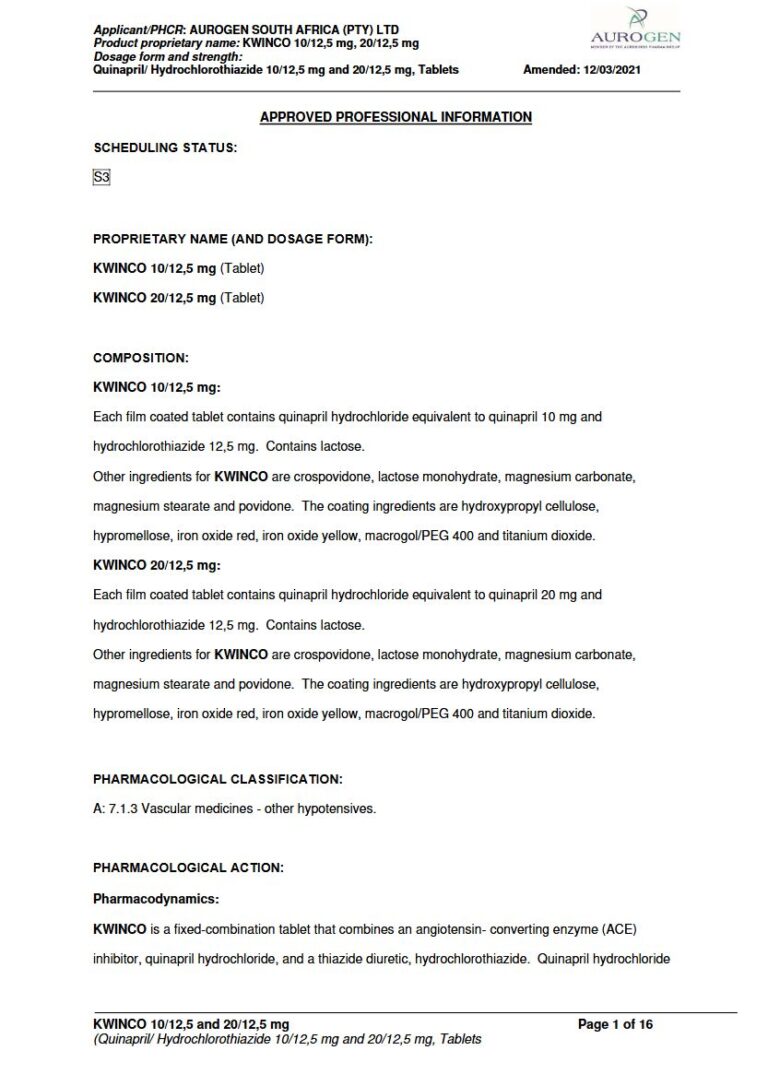
The Kwinco 12,5 mg Tablets professional information leaflet below is the property of Aurogen South Africa and is provided on Medinsert exactly as issued, with no.. alterations or editorial changes. We make every effort to keep content current by updating documents as soon as new versions become available. Medinsert serves as a trusted access point for healthcare professionals, but does not replace official sources or clinical judgement. For more details, please read our full disclaimer. read more>>
 Healthcare Professionals Only
This content is for registered healthcare professionals
Sign in or create a free account to read the full package insert.
Free for HPCSA-registered professionals. Powered by Medinsert.
Clinical Particulars
Section 4 of the official insert — extracted exactly as issued, no alterations
4.1 Therapeutic indications
KWINCO is indicated for the treatment of mild to moderate hypertension in patients who have been stabilised on the individual components given in the same proportions.
4.2 Posology and method of administration
Effective blood pressure control is usually achieved with a daily dose of 10/12,5 mg to a maximum of 20/25 mg.
Dosage Adjustment in Renal Impairment: KWINCO should not be used as initial therapy in patients with severe renal impairment (creatinine clearance < 30 ml/min). KWINCO is not recommended for patients with hepatic impairment.
4.3 Contraindications
- Hypersensitivity to any of the components of KWINCO.
- Because of the hydrochlorothiazide component, KWINCO is contra-indicated in patients with hypersensitivity to other sulphonamide u2013 derived medicines.
- A history of angioedema related to previous therapy with ACE inhibitors or angiotensin receptor blockers (ARBs): such patients must never again be given these medicines.
- Hereditary or idiopathic angioedema.
- Hypertrophic obstructive cardiomyopathy (HOCM).
- Anuria or severe renal function impairment (creatinine clearance < 30 ml/min) u2013 hydrochlorothiazide may produce cumulative effects or precipitate azotaemia.
- Bilateral renal artery stenosis.
- Renal artery stenosis in patients with a single kidney.
- Aortic stenosis.
- Concomitant therapy with potassium sparing diuretics such as spironolactone, triamterene, amiloride.
- Porphyria.
- KWINCO is a fixed dose combination tablet containing a thiazide diuretic and ACE inhibitor, and therefore should not be given to patients with Addisonu2019s disease.
- Lithium therapy: Concomitant administration with KWINCO may lead to toxic blood concentrations of lithium.
- KWINCO is contra-indicated throughout pregnancy and during lactation (see u201cWARNINGS AND SPECIAL PRECAUTIONSu201d and u201cPREGNANCY AND LACTATIONu201d).
4.4 Special warnings and precautions for use
WARNINGS: Should a woman become pregnant while receiving KWINCO, the treatment should be stopped promptly and switched to a different class of medicine. (See u201cCONTRA - INDICATIONSu201d and u201cPREGNANCY AND LACTATIONu201d). Should a woman contemplate pregnancy, the doctor should consider alternative medication.
- Patients with electrolyte imbalances u2013 the condition may be exacerbated. The correction of electrolyte imbalance prior to administration of KWINCO is recommended.
- Patients with allergy or bronchial asthma u2013 hypersensitivity reactions to hydrochlorothiazide may be more likely in these patients.
Special Precautions:
Quinapril: Angioedema: Angioedema which may be fatal has been reported in patients treated with KWINCO. If laryngeal stridor or angioedema of the face, tongue, or glottis occurs, treatment with KWINCO should be discontinued immediately, the patient treated in accordance with accepted medical care, and carefully observed until the swelling disappears. In instances where swelling is confined to the face and lips, the condition generally resolves without treatment; antihistamines may be useful in relieving symptoms. Angioedema associated with laryngeal involvement may be fatal. Where there is involvement of the tongue, glottis, or larynx likely to cause airway obstruction, emergency therapy including but not limited to subcutaneous epinephrine (adrenaline) injection 1:1 000 (0,3 to 0,5 ml), should be promptly instituted (see u201cSIDE-EFFECTSu201d). Patients with a history of angioedema unrelated to ACE-inhibitor therapy may be at increased risk of angioedema while receiving KWINCO.
Anaphylactoid reactions during desensitisation: Patients receiving ACE-inhibitors during desensitising treatment with hymenoptera venom have sustained life-threatening anaphylactoid reactions. In the same patients, these reactions may be avoided when ACE-inhibitors are temporarily withheld, but they may reappear upon inadvertent re-challenge.
Hypotension: Symptomatic hypotension is a possible consequence of therapy in salt/volume depleted patients, such as those previously treated with diuretics or patients on dialysis (see u201cINTERACTIONSu201d, and u201cSIDE-EFFECTSu201d). In patients at risk of excessive hypotension, including those with congestive heart failure, therapy should be started under close medical supervision. These patients should be followed closely for the first 2 weeks of treatment and whenever the dosage of antihypertensive medication is increased (see u201cDOSAGE AND DIRECTIONS FOR USEu201d). The patient should be placed in the supine position and, if necessary, normal saline may be administered intravenously, if symptomatic hypotension occurs. A transient hypotensive response is not a contra-indication to further doses; however, lower doses of quinapril or reduced concomitant diuretic therapy should be considered.
Neutropenia/Agranulocytosis: In patients with uncomplicated hypertension, ACE-inhibitors have been associated with agranulocytosis and bone marrow depression. Periodic monitoring of white blood cell counts in patients with collagen vascular disease and/or renal disease should be considered.
Impaired renal function: As a consequence of inhibiting the renin-angiotensin-aldosterone system, changes in renal function may be anticipated in susceptible individuals. In patients with severe heart failure whose renal function may depend on the activity of the renin-angiotensin-aldosterone system, treatment with KWINCO may be associated with oliguria and/or progressive azotaemia and rarely acute renal failure and/or death. In clinical studies in hypertensive patients with unilateral or bilateral renal artery stenosis, increases in blood urea and serum creatinine have been observed. Some patients with hypertension or heart failure with no apparent pre-existing renal vascular disease have developed increases in blood urea and serum creatinine, when quinapril has been given concomitantly with a diuretic. This is more likely to occur in patients with pre-existing renal impairment. Dosage reduction and/or discontinuation of any diuretic and/or quinapril may be required. Renal function should be closely monitored in patients with renal impairment.
ACE-inhibitors have been associated with hypoglycaemia in diabetic patients on insulin or oral hypoglycaemic agents; closer monitoring of diabetic patients may be required.
Hyperkalaemia and potassium-sparing diuretics: Patients on quinapril alone may have increased serum potassium levels. When administered concomitantly, quinapril may reduce the hypokalaemia induced by thiazide diuretics. Quinapril has not been studied as concomitant therapy with potassium-sparing diuretics. Because of the risk of further potentiating increases in serum potassium, combination therapy with potassium-sparing diuretics is contra-indicated (see u201cCONTRA- INDICATIONSu201d). With KWINCO, which contains both an ACE-inhibitor and a diuretic, the addition of a potassium-sparing diuretic is contra-indicated.
Surgery/anaesthesia: In patients undergoing anaesthesia with agents that produce hypotension, quinapril may block angiotensin II formation secondary to compensatory renin release. If hypotension occurs and is considered to be due to this mechanism, it can be corrected by volume expansion.
Hydrochlorothiazide: Hydrochlorothiazide such as in KWINCO should not be used in patients with severe renal disease since uraemia may result. Cumulative medicine effects may develop in patients with impaired renal function (see u201cCONTRA-INDICATIONSu201d). Hydrochlorothiazide such as in KWINCO should be used with caution in patients with impaired hepatic function or progressive liver disease, since minor alterations of fluid and electrolyte balance may precipitate hepatic coma. In patients with or without a history of allergy or bronchial asthma, sensitivity reactions may occur. Exacerbation or activation of systemic lupus erythematosus has been reported. Serum electrolyte evaluation should be performed at appropriate intervals to detect possible electrolyte imbalance. All patients receiving hydrochlorothiazide therapy (such as in KWINCO) should be observed for clinical signs of fluid or electrolyte imbalance, including hyponatraemia, hypochloraemic alkalosis, and hypokalaemia. Serum and urine electrolyte determinations are particularly important when the patient is vomiting excessively or receiving parenteral fluids. Warning signs or symptoms of fluid and electrolyte imbalance, irrespective of cause, include dryness of mouth, thirst, weakness, lethargy, drowsiness, restlessness, muscle pains or cramps, muscle fatigue, hypotension, oliguria, tachycardia, and gastrointestinal disturbances such as nausea and vomiting.
Hypokalaemia may develop, especially with brisk diuresis, when severe cirrhosis is present, or after prolonged therapy. Interference with adequate oral electrolyte intake will also contribute to hypokalaemia. Hypokalaemia may cause cardiac dysrhythmia and may also sensitise or exaggerate the response of the heart to the toxic effects of digoxin, for example, increased ventricular irritability. Because quinapril reduces the production of aldosterone, concomitant therapy with quinapril attenuates the diuretic-induced potassium loss (see u201cINTERACTIONSu201d, Agents Increasing Serum Potassium).
Although any chloride deficit is generally mild and usually does not require specific treatment, chloride replacement may sometimes be required in the treatment of metabolic alkalosis. In hot weather, dilutional hyponatraemia may occur in oedematous patients. Appropriate therapy is water restriction, rather than administration of salt, except in rare instances when the hyponatraemia is life threatening. In actual salt depletion, appropriate replacement is the therapy of choice.
Hyperuricaemia may occur or gout may be precipitated in certain patients receiving hydrochlorothiazide therapy. In diabetic patients dosage adjustments of insulin or oral hypoglycaemic agents may be required. Hyperglycaemia may occur with hydrochlorothiazide, such as in KWINCO. Thus, latent diabetes mellitus may become manifest during therapy. The antihypertensive effects of KWINCO may be enhanced in the post-sympathectomy patient. If progressive renal impairment becomes evident, it may be necessary to withhold or discontinue diuretic therapy. Hydrochlorothiazide has been shown to increase urinary magnesium excretion, which may cause hypomagnesaemia. Hydrochlorothiazide may decrease urinary calcium excretion. Hydrochlorothiazide may cause intermittent and slight serum calcium elevation in the absence of known calcium metabolism disorders. Marked hypercalcaemia may be evidence of hidden hyperparathyroidism. Hydrochlorothiazide and thus KWINCO should be discontinued before performing tests for parathyroid function. Increases in cholesterol and triglyceride levels may be associated with hydrochlorothiazide therapy. Hydrochlorothiazide decreases the serum PBI levels without signs of thyroid disturbance.
Paediatric use: Safety and efficacy in children have not been established.
Elderly use: Elderly patients exhibited increased AUC and peak levels for quinaprilat compared to values observed in younger patients; this appeared to be related to decreased renal function rather than age itself. No overall differences in effectiveness or safety were observed between older and younger patients, however, greater sensitivity of some older individuals cannot be ruled out.
KWINCO contains lactose and should not be administered to patients with rare hereditary problems, or a history of galactose intolerance, lapp lactase deficiency or glucose-galactose malabsorption.
Ability to drive and use machinery: The ability to engage in activities such as operating machinery or operating a motor vehicle may be impaired due to dizziness and fatigue.
4.5 Interactions with other medicines
Quinapril: Tetracycline: Simultaneous administration of tetracycline with quinapril reduced the absorption of tetracycline by approximately 28 % to 37 % in subjects. Decreased absorption is due to the presence of magnesium carbonate as an excipient in KWINCO. This interaction should be considered when contemplating concurrent KWINCO and tetracycline therapy.
Lithium: Increased serum lithium levels and symptoms of lithium toxicity have been reported in patients receiving concomitant lithium and ACE inhibitory therapy. With KWINCO, which includes a diuretic, the risk of lithium toxicity may be increased (see u201cCONTRA- INDICATIONSu201d).
Other agents: When quinapril was administered concomitantly with propranolol, hydrochlorothiazide, digoxin or cimetidine, no clinically important pharmacokinetic interactions occurred. When quinapril and warfarin were given together, no change in prothrombin complex activity occurred.
Concomitant diuretic therapy: Patients on diuretics, especially those on recently instituted diuretic therapy, may experience an excessive reduction of blood pressure after initiation of therapy with quinapril. In patients in whom a diuretic is continued, medical supervision should be provided up to two hours after the initial dosage of KWINCO (see u201cWARNINGS AND SPECIAL PRECAUTIONSu201d and u201cDOSAGE AND DIRECTIONS FOR USEu201d).
Agents increasing serum potassium: Since KWINCO contains quinapril, the addition of a potassium-sparing diuretic is not recommended.
Hydrochlorothiazide: When administered concurrently, the following medicines may interact with hydrochlorothiazide: Alcohol, barbiturates, or narcotics: Potentiation of orthostatic hypotension may occur. Anti-diabetic medicines (oral hypoglycaemic agents and insulin): Dosage adjustments of the anti-diabetic medicine may be required. Other antihypertensive medicines: Additive effect or potentiation. Corticosteroids, ACTH: Intensified electrolyte depletion, particularly hypokalaemia. Pressor amines, (e.g. noradrenaline): Possible decreased response to pressor amines, but not sufficient to preclude their use. Skeletal muscle relaxants, nondepolarising (e.g. tubocurarine): Possible increased responsiveness to the muscle relaxant. Lithium: should not be given with diuretics. Diuretic agents reduce the renal clearance of lithium and add a high risk of lithium toxicity (see u201cCONTRA-INDICATIONSu201d). Non-steroidal Anti-inflammatory Medicines: In some patients, the administration of a non-steroidal anti-inflammatory agent can reduce the diuretic, natriuretic, and antihypertensive effects of loop, potassium-sparing, and thiazide diuretics. Therefore, when KWINCO and non-steroidal anti-inflammatory agents are used concomitantly, the patient should be observed closely to determine if the desired effect of KWINCO is obtained. Beta2-agonists: Enhancement of potassium u2013 depleting effect of hydrochlorothiazide.
4.6 Fertility, pregnancy and lactation
Pregnancy: Both components of KWINCO cross the placenta. KWINCO is contra-indicated throughout pregnancy. KWINCO passes through the placenta and can be presumed to cause disturbance in fetal blood pressure regulatory mechanisms. Oligohydramnios as well as hypotension, oliguria and anuria in new-borns, have been reported after administration of KWINCO in the second and third trimester. Cases of defective skull ossification have been observed. Prematurity and low birth mass can occur. In addition, the use of KWINCO during the first trimester of pregnancy has been associated with an increased risk of birth defects, in particular of the cardiovascular and central nervous system (See u201cCONTRA-INDICATIONSu201d and u201cWARNINGS AND SPECIAL PRECAUTIONSu201d). ACE u2013 inhibitors and ARBu2019s, including KWINCO can cause fetal morbidity and death when given to pregnant women. When pregnancy is established KWINCO should be discontinued as soon as possible and monitoring of the fetal development should be performed on a regular basis. In women planning to become pregnant, ACE u2013 inhibitors (including KWINCO) should not be used. Women of child-bearing age should be made aware of the potential risks of ACE u2013 inhibitors (including KWINCO).
Breastfeeding Mothers: Because quinapril and its metabolites as well as hydrochlorothiazide are secreted in human breast milk, KWINCO should not be used by breastfeeding women.
4.7 Effects on ability to drive and use machines
The ability to engage in activities such as operating machinery or operating a motor vehicle may be impaired due to dizziness and fatigue.
4.8 Undesirable effects
Adverse experiences that have occurred have been limited to those that have been previously reported with quinapril or hydrochlorothiazide. The most frequent clinical adverse experiences were headache, dizziness, cough, and fatigue. See u201cWARNINGS AND SPECIAL PRECAUTIONSu201d regarding angioedema and excessive hypotension or syncope. Adverse experiences by bodily systems reported during treatment with KWINCO include the following:
Infections and Infestations: Less frequent: Viral infection.
Blood and the lymphatic system disorders: Frequency not known: Haemolytic anaemia.
Immune system disorders: Angioedema has been reported in patients receiving quinapril (see u201cWARNINGS AND SPECIAL PRECAUTIONSu201d).
Psychiatric disorders: Frequent: Somnolence, insomnia.
Nervous system disorders: Frequent: Headache, dizziness. Less frequent: Vertigo, paraesthesia, nervousness, syncope.
Cardiac disorders: Frequent: Chest pain. Less frequent: Tachycardia, palpitations.
Vascular disorders: Frequent: Vasodilation Frequency not known: Postural hypotension.
Respiratory, thoracic and mediastinal disorders: Frequent: Coughing, rhinitis, upper respiratory infection, bronchitis, pharyngitis. Less frequent: Dyspnoea, sinusitis.
Gastro-intestinal disorders: Frequent: Nausea and/or vomiting, abdominal pain, dyspepsia, diarrhoea. Less frequent: Flatulence, dry mouth or throat, constipation. Frequency not known: Pancreatitis.
Skin and subcutaneous tissue disorders: Less frequent: Alopecia, pruritus, rash. Frequency not known: Erythema multiforme, exfoliative dermatitis, pemphigus.
Renal and urinary disorders: Less frequent: Impotence, urinary tract infection. Frequency not known: Urinary abnormality, dysuria, urinary frequency.
Musculoskeletal, connective tissue and bone disorders: Frequent: Myalgia, back pain. Less Frequent: Arthralgia. Frequency not known: Muscle cramps.
General disorders and administrative site conditions: Frequent: Fatigue, asthenia. Less frequent: Peripheral oedema, fever. Frequency not known: Malaise.
Investigations: Serum electrolytes: (see u201cWARNINGS AND SPECIAL PRECAUTIONSu201d). Frequent: Creatinine, blood urea: increases ( > 1,25 times the upper limit of normal) in serum creatinine and blood urea. Serum uric acid, glucose, magnesium, cholesterol, triglyceride, protein-bound iodine (PBI), parathyroid function tests and calcium: (see u201cWARNINGS AND SPECIAL PRECAUTIONSu201d).
4.9 Overdose
Quinapril/Hydrochlorothiazide: No data is available with respect to overdosage in humans. Treatment is symptomatic and supportive consistent with established medical care. Therapy with KWINCO should be discontinued and the patient observed closely.
Quinapril: No data is available with respect to overdosage in humans. The most likely clinical manifestation would be symptoms attributable to severe hypotension, which would usually be treated by infusion of intravenous normal saline solution. Haemodialysis and peritoneal dialysis have little effect on the elimination of quinapril and quinaprilat.
Hydrochlorothiazide: The most common signs and symptoms observed are those caused by electrolyte depletion (hypokalaemia, hypochloraemia, hyponatraemia) and dehydration resulting from excessive diuresis. If digoxin has also been administered, hypokalaemia may accentuate cardiac dysrhythmias.
