
Lidocaine Hcl 10 %/2 mg Solution
PDF Leaflet Revision Date: 31 January 2024
Clinical Summary
Quick overview from the medicine insert
Indication
Treatment of ventricular dysrhythmias during surgery and myocardial infarction.
Dosage (summary)
Up to 300 mg IM for myocardial infarction; 50-100 mg IV for dysrhythmias.
Special Populations
- Elderly
- Hepatic impairment
- Renal impairment
Pregnancy & Breastfeeding
Use in pregnancy not established; excreted in breast milk.
Key Drug Interactions
- Propranolol
- Cimetidine
- Class I and III antidysrhythmics
Contraindications
- Hypersensitivity to lidocaine
- Porphyria
- Heart block
- Hypovolaemia
Common side effects
- Dizziness
- Drowsiness
- Blurred vision
Counselling Points
- Avoid driving until effects are known
- Report any severe reactions immediately
Serious warnings
- ECG monitoring required
- Risk of cumulative toxicity
- Severe CNS and cardiovascular effects
Important Disclaimer
The Lidocaine Hcl 10 %/2 mg Solution professional information leaflet below is the property of Fresenius Kabi South Africa and is provided on Medinsert exactly as issued, with no.. alterations or editorial changes. We make every effort to keep content current by updating documents as soon as new versions become available. Medinsert serves as a trusted access point for healthcare professionals, but does not replace official sources or clinical judgement. For more details, please read our full disclaimer. read more>>
 Healthcare Professionals Only
This content is for registered healthcare professionals
Sign in or create a free account to read the full package insert.
Free for HPCSA-registered professionals. Powered by Medinsert.
Clinical Particulars
Section 4 of the official insert — extracted exactly as issued, no alterations
4.1 Therapeutic indications
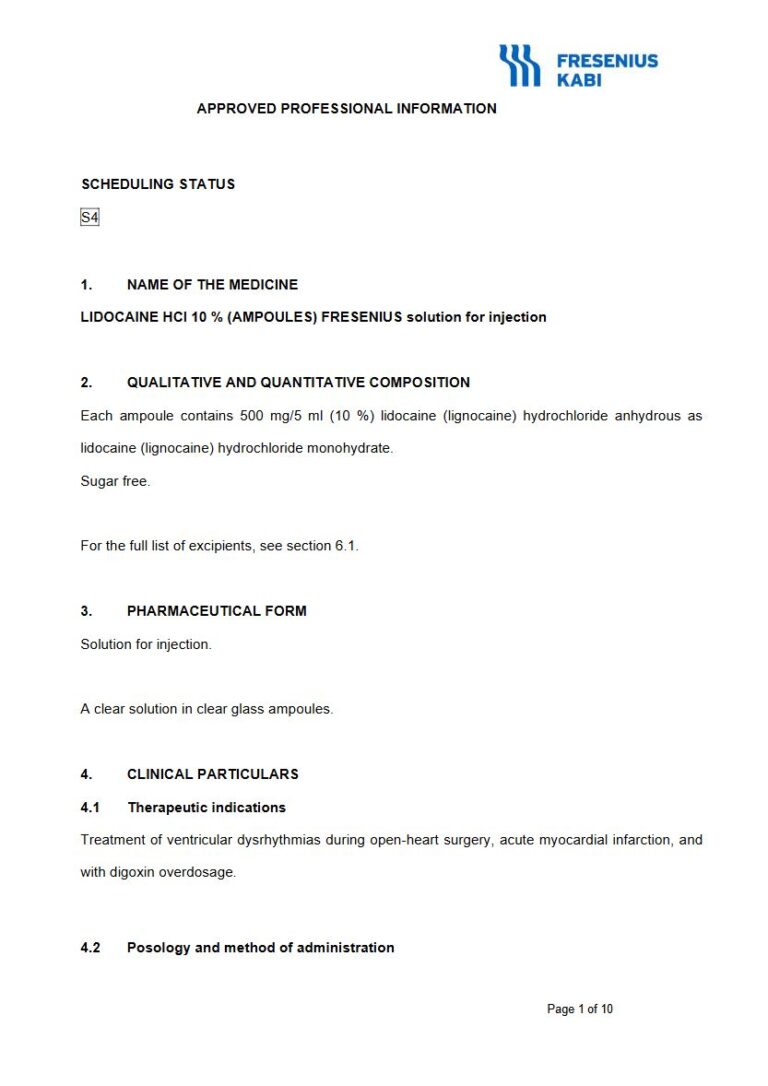
Treatment of ventricular dysrhythmias during open-heart surgery, acute myocardial infarction, and with digoxin overdosage.
4.2 Posology and method of administration
Posology: For the emergency treatment of acute myocardial infarction, doses of up to 300 mg may be given by intramuscular injection into the deltoid muscle, followed by a 0,1 % to 0,2 % intravenous infusion in dextrose 5 % in water for injections at a rate of 1 to 4 mg per minute, in accordance with the needs of the patient. In the treatment of cardiac dysrhythmias 50 to 100 mg may be administered by a slow intravenous injection over 2 minutes (0,5 ml to 1,0 ml of the 10 % solution). Doses should be reduced in elderly and debilitated patients and in children. Method of administration: For intramuscular or intravenous use.
4.3 Contraindications
LIDOCAINE HCl FRESENIUS is contraindicated in:
- Patients that are hypersensitive to lidocaine (lignocaine), amide type local anaesthetics or any of the excipients of LIDOCAINE HCl FRESENIUS, listed in section 6.1.
- Patients with porphyria.
- Patients with hypovolaemia, heart block or other conduction disturbances, bradycardia, cardiac decompensation or hypotension (not due to treatable tachy dysrhythmias).
4.4 Special warnings and precautions for use
Intravenous injection should be given slowly over 2 minutes and infusion at a rate of 1 to 4 mg per minute. Constant electrocardiogram (ECG) monitoring is necessary during IV administration. Resuscitative equipment and medicines should be immediately available for the management of severe adverse cardiovascular, respiratory or central nervous system effects. If severe reactions occur, LIDOCAINE HCl FRESENIUS should be discontinued. Caution should be exercised in the presence of hepatic insufficiency, other cardiac conditions (such as congestive heart failure), epilepsy, myasthenia gravis, severe renal disease, marked hypoxia, during shock and impaired respiratory function. Administration of LIDOCAINE HCl FRESENIUS to eliminate ventricular ectopic beats without prior acceleration in heart rate may provoke more frequent and serious ventricular dysrhythmias. Continuous or repeated administration of LIDOCAINE HCl FRESENIUS may give rise to cumulative toxicity and tachyphylaxis. Caution should be employed in the repeated use of LIDOCAINE HCl FRESENIUS in patients with severe liver or renal disease, because accumulation may lead to toxic phenomena, since lidocaine (lignocaine) is metabolised mainly in the liver and the metabolites are excreted via the kidneys. The plasma half-life of LIDOCAINE HCl FRESENIUS may be prolonged in conditions which reduce hepatic blood flow, such as cardiac and circulatory failure.
4.5 Interaction with other medicines and other forms of interaction
Propranolol and cimetidine may reduce the renal and hepatic clearance of lidocaine (lignocaine), thus increasing toxicity. The cardiac depressant effects of LIDOCAINE HCl FRESENIUS are additive to those of other antidysrhythmic medicines, particularly class I (e.g., kinidine, disopyramide) or class III (e.g., amiodarone, bretylium, sotalol or dofetilide). Caution should be exercised particularly in patients with cardiac decompensation.
Potent inhibitors of cytochrome P450 3A4 enzymes (such as fluvoxamine and erythromycin) may cause an increase in lidocaine (lignocaine) concentrations when administered concurrently. Because lidocaine (lignocaine) possesses a narrow therapeutic window, doses of LIDOCAINE HCl FRESENIUS may need to be adjusted accordingly. Conversely, reduced serum lidocaine (lignocaine) concentrations may result from medicines that may stimulate the hepatic metabolism of lidocaine (lignocaine), e.g., phenytoin. Hypokalaemia produced by acetazolamide, loop diuretics and thiazides antagonises the effect of LIDOCAINE HCl FRESENIUS. Propranolol, metoprolol and nadolol may increase lidocaine (lignocaine) levels by 20 % to 30 %. With concurrent beta-blocker therapy, monitor lidocaine (lignocaine) levels more closely (at least every 24 hours) and adjust LIDOCAINE HCl FRESENIUS infusion rates appropriately. Lidocaine (lignocaine) is markedly bound to a I-acid glycoprotein (AAG). AAG concentrations may be reduced by oestrogens leading to a higher free fraction of lidocaine (lignocaine) in women than in men and the free fraction is further increased during pregnancy and in women taking oral contraceptives or hormone replacement therapy (HRT). LIDOCAINE HCl FRESENIUS prolongs the action of neuromuscular blocking medicines such as suxamethonium and cisatracurium.
4.6 Fertility, pregnancy and lactation
Pregnancy: The safe use of LIDOCAINE HCl FRESENIUS during pregnancy has not been established. Lidocaine (lignocaine) passes the placenta and blood-brain barrier. Fetal intoxication has occurred following the use of LIDOCAINE HCl FRESENIUS in labour.
Lactation: LIDOCAINE HCl FRESENIUS is excreted into breast milk and should be used with caution in nursing women.
4.7 Effects on ability to drive and use machines
LIDOCAINE HCl FRESENIUS as blurred or double vision, light-headedness, drowsiness or dizziness. Patients should be advised not to drive or operate machines until it is established that their ability to perform such activities is not affected.
4.8 Undesirable effects
Adverse effects associated with LIDOCAINE HCl FRESENIUS are usually due to inadvertent intravenous administration or overdosage. Mild and transient side effects (dizziness, drowsiness) may occur following a rapid intravenous loading dose and during the infusion therapy. More severe side effects are indicative of overdosage or too rapid a rate of administration. When properly administered, severe reactions of the central nervous system or cardiovascular type occur less frequently. The following systemic effects have been reported in association with LIDOCAINE HCl FRESENIUS:
Blood and lymphatic disorders: Methaemoglobinaemia.
Immune system disorders: Less frequent: Allergic reactions (including anaphylaxis).
Psychiatric disorders: Confusion, psychosis.
Nervous system disorders: Light-headedness, drowsiness, lassitude, amnesia, dizziness, apprehension, nervousness, euphoria, sensations of heat, cold or numbness, twitching tremors, paraesthesia, convulsions, unconsciousness, headache, transient neurological symptoms (i.e., pain and/or dysaesthesia in the buttocks or legs), numbness of the tongue and perioral region (as an early sign of systemic toxicity).
Eye disorders: Blurred or double vision, nystagmus.
Ear disorders: Tinnitus.
Cardiac disorders: Dysrhythmia, cardiovascular collapse and bradycardia, which may lead to cardiac arrest. AV block and myocardial depression.
Vascular disorders: Hypotension.
Respiratory, thoracic and mediastinal disorders: Respiratory depression and arrest.
Gastrointestinal disorders: Nausea, vomiting.
Reporting of suspected adverse reactions: Reporting suspected adverse reactions after authorisation of the medicine is important. It allows continued monitoring of the benefit/risk balance of the medicine. Health care providers are requested to report any suspected adverse drug reactions to SAHPRA via the Med Safety APP (Medsafety X SAHPRA) and eReporting platform (who-umc.org) found on SAHPRA website.
4.9 Overdose
The main systemic toxic effect is excitation of the central nervous system, manifested by yawning, restlessness, excitement, nervousness, dizziness, blurred vision, nausea, vomiting, muscle twitching and convulsions. Excitation of the central nervous system may be transient, and followed by depression, with drowsiness, respiratory failure and coma. There is simultaneous depression of the cardiovascular system, with pallor, sweating and hypotension. Dysrhythmias, bradycardia and cardiac arrest may be precipitated. When severe side effects occur, the administration of LIDOCAINE HCl FRESENIUS should be stopped immediately, and the appropriate resuscitative procedures should be instituted. Treatment is symptomatic and supportive.
- Hypotension may be counteracted by a vasopressor medicine or a myocardial stimulant and proper positioning of the patient.
- Bradycardia may be treated with atropine or atropine-like medicines.
- Asystole requires immediate cardiopulmonary resuscitation including, if necessary, medicines such as epinephrine (adrenaline) or isoprenaline, and cardiac pacing if required.
- Convulsions may be treated with small doses of a short-acting barbiturate, and pulmonary ventilation should be ensured (free airway and oxygen). Artificial ventilation, if required, can be facilitated by the IV injection of a short-acting muscle relaxant.
