
Linezolid 600 Mg/300 Ml Solution
PDF Leaflet Revision Date: 10 November 2020
Clinical Summary
Quick overview from the medicine insert
Indication
Treatment of infections caused by susceptible Gram-positive bacteria.
Dosage (summary)
600 mg IV every 12 hours for adults; 10 mg/kg IV every 8 hours for children.
Special Populations
- Elderly
- Renal impairment
- Hepatic impairment
Pregnancy & Breastfeeding
Contraindicated in pregnancy; likely excreted in breast milk.
Key Drug Interactions
- Monoamine oxidase inhibitors
- Serotonergic medications
- Sympathomimetics
Contraindications
- Hypersensitivity to linezolid
- Uncontrolled hypertension
- Carcinoid syndrome
Common side effects
- Headache
- Diarrhoea
- Nausea
- Vomiting
- Metallic taste
Counselling Points
- Monitor for visual impairment
- Avoid serotonergic drugs
- Report severe diarrhoea
Serious warnings
- Myelosuppression
- Peripheral neuropathy
- Optic neuropathy
- Lactic acidosis
Important Disclaimer
The Linezolid 600 Mg/300 Ml Solution professional information leaflet below is the property of Pharmacare and is provided on Medinsert exactly as issued, with no.. alterations or editorial changes. We make every effort to keep content current by updating documents as soon as new versions become available. Medinsert serves as a trusted access point for healthcare professionals, but does not replace official sources or clinical judgement. For more details, please read our full disclaimer. read more>>
 Healthcare Professionals Only
This content is for registered healthcare professionals
Sign in or create a free account to read the full package insert.
Free for HPCSA-registered professionals. Powered by Medinsert.
Clinical Particulars
Section 4 of the official insert — extracted exactly as issued, no alterations
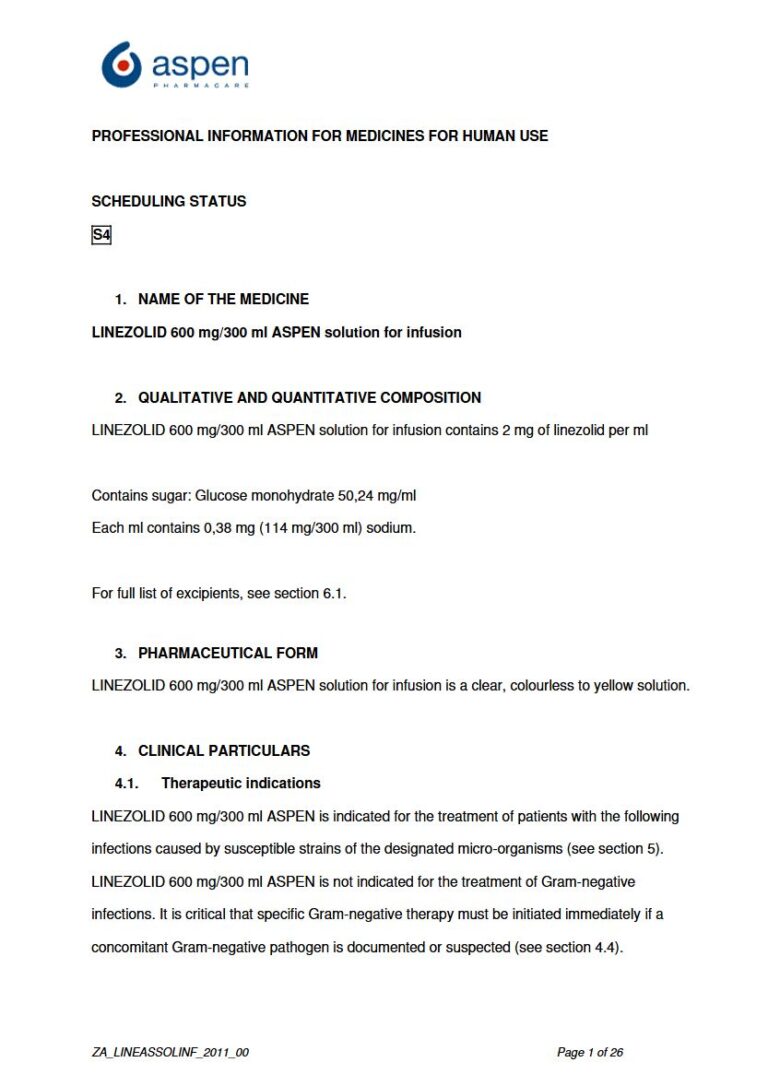
4.1. Therapeutic indications
LINEZOLID 600 mg/300 ml ASPEN is indicated for the treatment of patients with the following infections caused by susceptible strains of the designated micro-organisms (see section 5). LINEZOLID 600 mg/300 ml ASPEN is not indicated for the treatment of Gram-negative infections. It is critical that specific Gram-negative therapy must be initiated immediately if a concomitant Gram-negative pathogen is documented or suspected (see section 4.4).
- Vancomycin-resistant Enterococcus faecium infections, including cases with concurrent bacteraemia.
- Nosocomial pneumonia caused by Staphylococcus aureus (methicillin-susceptible and -resistant strains), or Streptococcus pneumoniae (including multi-drug resistant S. pneumoniae (MDRSP) strains).
- Complicated skin and skin structure infections caused by Staphylococcus aureus (methicillin-susceptible and -resistant strains), Streptococcus pyogenes, or Streptococcus agalactiae. LINEZOLID 600 mg/300 ml ASPEN has not been studied in the treatment of decubitus ulcers.
- Uncomplicated skin and skin structure infections caused by Staphylococcus aureus (methicillin susceptible and -resistant strains), Streptococcus pyogenes.
- Community-acquired pneumonia caused by Streptococcus pneumoniae (including multi-drug resistant S. pneumoniae (MDRSP) strains), including cases with concurrent bacteraemia, or Staphylococcus aureus (methicillin-susceptible and -resistant strains).
Due to concern about inappropriate use of antibiotics leading to an increase in resistant organisms, prescribers should carefully consider alternatives before initiating treatment with LINEZOLID 600 mg/300 ml ASPEN in the outpatient setting. Appropriate specimens for bacteriological examination should be obtained in order to isolate and identify the causative organisms and to determine their susceptibility to linezolid.
Therapy may be instituted empirically while awaiting results of these tests. Once these results become available, antimicrobial therapy should be adjusted accordingly.
4.2. Posology and method of administration
Posology
LINEZOLID 600 mg/300 ml ASPEN solution for infusion may be used as initial therapy. Patients who commence treatment on the parenteral formulation may be switched to either oral presentation when clinically indicated. In such circumstances, no dose adjustment is required as the oral formulation has bioavailability of approximately 100 %.
The recommended LINEZOLID 600 mg/300 ml ASPEN dosage should be administered IV as described in the tables below.
Table A: Adult and Adolescent (12 years and older) patients:
Infections (including those associated with concurrent bacteraemia)
Dosage and route of administration
Duration of treatment
- Community-acquired pneumonia, including concurrent bacteraemia 600 mg IV every 12 hours 10 to 14 consecutive days
- Nosocomial pneumonia, including concurrent bacteraemia Skin and soft tissue infections, including concurrent bacteraemia 600 mg IV every 12 hours depending on clinical severity
- Enterococcal infections, including vancomycin-resistant infections, and those with concurrent bacteraemia 600 mg IV every 12 hours 14 to 28 consecutive days
Table B: Paediatric Patients (birth* through to 11 years):
Infections (including those associated with concurrent bacteraemia)
Dosage and route of administration
Duration of treatment
- Community-acquired pneumonia, including concurrent bacteraemia 10 mg/kg IV every 8 hours 10 to 14 consecutive days
- Nosocomial pneumonia, including concurrent bacteraemia Skin and soft tissue infections, including concurrent bacteraemia 10 mg/kg IV every 8 hours 14 to 28 consecutive days
* Pre-term neonates less than 7 days of age (gestational age less than 34 weeks) have lower systemic LINEZOLID 600 mg/300 ml ASPEN clearance values and larger AUC values than many full-term neonates and older infants. By day 7 of age, LINEZOLID 600 mg/300 ml ASPEN clearance and AUC values are similar to those of full-term neonates and older infants.
Special populations
Elderly population No dose adjustment is necessary.
Renal impairment No dose adjustment is required. Patients with severe renal insufficiency (i.e., CL CR < 30 mL/min) No dose adjustment is required. Due to the unknown clinical significance of higher exposure (up to 10-fold) to the two primary metabolites of LINEZOLID 600 mg/300 ml ASPEN in patients with severe renal insufficiency, LINEZOLID 600 mg/300 ml ASPEN should be used with special caution in these patients and only when the anticipated benefit is considered to outweigh the theoretical risk. As approximately 30 % of LINEZOLID 600 mg/300 ml ASPEN dose is removed during 3 hours of haemodialysis, LINEZOLID 600 mg/300 ml ASPEN should be given after dialysis in patients receiving such treatment. The primary metabolites of LINEZOLID 600 mg/300 ml ASPEN are removed to some extent by haemodialysis, but the concentrations of these metabolites are still very considerably higher following dialysis than those observed in patients with normal renal function or mild to moderate renal insufficiency.
Therefore, LINEZOLID 600 mg/300 ml ASPEN should be used with special caution in patients with severe renal insufficiency who are undergoing dialysis and only when the anticipated benefit is considered to outweigh the theoretical risk. To date, there is no experience of LINEZOLID 600 mg/300 ml ASPEN administration to patients undergoing continuous ambulatory peritoneal dialysis (CAPD) or alternative treatments for renal failure (other than haemodialysis).
Hepatic impairment No dose adjustment is required. However, there are limited clinical data and it is recommended that LINEZOLID 600 mg/300 ml ASPEN should be used in such patients only when the anticipated benefit is considered to outweigh the theoretical risk.
Paediatric population Currently available data are described in section 4.2 Table B: Paediatric patients (birth* through to 11 years).
Method of administration For intravenous administration. The solution for infusion should be administered over a period of 30 to 120 minutes. For instructions on administration and other handling, see section 6.6.
4.3. Contraindications
LINEZOLID 600 mg/300 ml ASPEN is contraindicated in:
- Patients with hypersensitivity to linezolid or to any excipients in LINEZOLID 600 mg/300 ml ASPEN (see section 6.1).
- Monoamine oxidase inhibitors LINEZOLID 600 mg/300 ml ASPEN should not be used in patients taking any medicines which inhibits monoamine oxidases A or B (e.g. phenelzine, isocarboxazid) or within two weeks of taking any such medicine.
- Potential interactions producing elevation of blood pressure Unless patients are monitored for potential increases in blood pressure, LINEZOLID 600 mg/300 ml ASPEN should not be administered to patients with uncontrolled hypertension, pheochromocytoma, thyrotoxicosis and/or patients taking any of the following types of medicines: directly and indirectly acting sympathomimetic medicines (e.g., pseudoephedrine, phenylpropanolamine), vasopressive medicines (e.g., epinephrine, norepinephrine), dopaminergic medicines (e.g., dopamine, dobutamine) (see sections 4.4 and 4.5).
- Potential serotonergic interactions Unless patients are carefully observed for signs and/or symptoms of serotonin syndrome, LINEZOLID 600 mg/300 ml ASPEN should not be administered to patients with carcinoid syndrome and/or patients taking any of the following medications: serotonin re-uptake inhibitors, tricyclic antidepressants, serotonin 5-HT 1 receptor agonists (triptans), meperidine or buspirone (see sections 4.4 & 4.5).
4.4. Special warnings and precautions for use
Prescribers must adhere to the principles of antibiotic stewardship. It is recommended that therapy with LINEZOLID 600 mg/300 ml ASPEN should be initiated in a hospital environment following guidance from appropriate specialists.
Myelosuppression Reversible myelosuppression (anaemia, thrombocytopenia, leukopenia, and pancytopenia) that may be dependent on duration of therapy has been reported in some patients receiving LINEZOLID 600 mg/300 ml ASPEN. In cases where the outcome is known, the affected haematological parameters have risen towards pre-treatment levels when linezolid, as in LINEZOLID 600 mg/300 ml ASPEN was discontinued. Complete blood counts should be monitored weekly in patients who receive linezolid, as in LINEZOLID 600 mg/300 ml ASPEN for longer than two weeks, particularly those with pre-existing myelosuppression, those receiving concomitant medicines that produce bone marrow suppression, or those with a chronic infection who have received previous antibiotic therapy. Discontinuation of therapy should be considered in patients who develop or who have a worsening of myelosuppression.
Peripheral neuropathy and optic neuropathy Peripheral neuropathy and optic neuropathy have been reported in patients treated with LINEZOLID 600 mg/300 ml ASPEN, primarily those patients treated for longer than the maximum recommended duration of 28 days. When outcome was known, recovery was reported in some cases following LINEZOLID 600 mg/300 ml ASPEN withdrawal. In cases of optic neuropathy that progressed to loss of vision, patients were treated for extended periods beyond the maximum recommended duration. Visual blurring has been reported in some patients treated with LINEZOLID 600 mg/300 ml ASPEN for less than 28 days. If symptoms of visual impairment appear, such as changes in visual acuity, changes in colour vision, blurred vision, or visual field defect, prompt ophthalmic evaluation is recommended. Visual function should be monitored in all patients taking LINEZOLID 600 mg/300 ml ASPEN for extended periods (greater than or equal to 3 months) and in all patients reporting new visual symptoms regardless of length of therapy with LINEZOLID 600 mg/300 ml ASPEN. If peripheral or optic neuropathy occurs, the continued use of LINEZOLID 600 mg/300 ml ASPEN in these patients should be weighed against the potential risks.
Duration of treatment The safety and effectiveness of LINEZOLID 600 mg/300 ml ASPEN when administered for periods longer than 28 days have not been established. Treatment prolonged beyond 28 days has been associated with serious adverse effects, including myelosuppression, peripheral neuropathy and optic neuropathy.
Lactic acidosis Lactic acidosis has been reported with the use of LINEZOLID 600 mg/300 ml ASPEN. Patients who develop recurrent nausea or vomiting, unexplained acidosis, or a low bicarbonate level while receiving LINEZOLID 600 mg/300 ml ASPEN should receive immediate medical attention.
Convulsions Convulsions have been reported to occur in patients when treated with LINEZOLID 600 mg/300 ml ASPEN. In most of these cases, a history of seizures or risk factors for seizures were reported.
Serotonin syndrome Spontaneous reports of serotonin syndrome associated with the co-administration of LINEZOLID 600 mg/300 ml ASPEN and serotonergic medicines, including antidepressants such as selective serotonin reuptake inhibitors (SSRIs), have been reported (see sections 4.3 and 4.5).
Antibiotic associated pseudomembranous colitis Pseudomembranous colitis has been reported with LINEZOLID 600 mg/300 ml ASPEN and may range in severity from mild to life threatening. Therefore, it is important to consider this diagnosis in patients who present with diarrhoea subsequent to the administration of this antibacterial medicine. Mild cases usually respond to medicine discontinuation alone, however, in moderate to severe cases appropriate therapy with a suitable oral antibacterial medicine effective against Clostridium difficile should be considered. Fluids, electrolytes and protein replacement should be provided when indicated. Medicines which delay peristalsis, e.g., opiates and diphenoxylate with atropine may prolong and/or worsen the condition and should not be used.
Clostridium difficile associated diarrhoea (CDAD) has been reported with LINEZOLID 600 mg/300 ml ASPEN and may range in severity from mild diarrhoea to fatal colitis. Treatment with LINEZOLID 600 mg/300 ml ASPEN alters the normal flora of the colon leading to overgrowth of C. difficile. C. difficile produces toxins A and B which contribute to the development of CDAD. Hypertoxin producing strains of C. difficile cause increased morbidity and mortality, as these infections can be refractory to antimicrobial therapy and may require colectomy. CDAD must be considered in all patients who present with diarrhoea following antibiotic use. Careful medical history is necessary since CDAD has been reported to occur over two months after the administration of antibacterial medicines.
Superinfection The use of antibiotics may result in an overgrowth of non-susceptible organisms. Should superinfection occur during therapy, appropriate measures should be taken.
LINEZOLID 600 mg/300 ml ASPEN has no clinical activity against Gram-negative pathogens and is not indicated for the treatment of Gram-negative infections. Specific Gram-negative therapy is required if a concomitant Gram-negative pathogen is documented or suspected. LINEZOLID 600 mg/300 ml ASPEN should be used with special caution in patients at high risk for life threatening systemic infections, such as those with infections related to central venous catheters in intensive care units. LINEZOLID 600 mg/300 ml ASPEN is not approved for the treatment of patients with catheter-related bloodstream infections.
Uncontrolled hypertension, phaeochromocytoma, carcinoid syndrome, or untreated hyperthyroidism LINEZOLID 600 mg/300 ml ASPEN has not been studied in patients with uncontrolled hypertension, phaeochromocytoma, carcinoid syndrome, or untreated hyperthyroidism (see section 4.3).
Renal insufficiency LINEZOLID 600 mg/300 ml ASPEN should be used with special caution in patients with severe renal insufficiency and only when the anticipated benefit is considered to outweigh the theoretical risk (see section 4.2).
Hepatic insufficiency It is recommended that LINEZOLID 600 mg/300 ml ASPEN should be used in patients with severe hepatic insufficiency only when the anticipated benefit is considered to outweigh the theoretical risk (see section 4.2).
Effects on laboratory tests No data available.
Use in the elderly Paediatric population The clearance of linezolid, as in ASPEN LINEZOLID 600 mg/ 300 ml, is most rapid in the youngest age groups (excluding neonates less than 1 week old), resulting in a shorter half-life. As children mature, the clearance of linezolid, as in ASPEN LINEZOLID 600 mg/ 300 ml gradually decreases and by adolescence the clearance values approach those observed for the adult population (see section 4.2).
4.5. Interaction with other medicines and other forms of interaction
LINEZOLID 600 mg/300 ml ASPEN is not detectably metabolised by the cytochrome P450 (CYP) enzyme system and it does not induce or inhibit the activities of clinically significant human CYP isoforms (1A2, 2C9, 2C19, 2D6, 2E1, 3A4). Therefore, no CYP450-induced medicine interactions are expected. Medicines such as warfarin and phenytoin, which are CYP2C9 substrates, may be given with LINEZOLID 600 mg/300 ml ASPEN without changes in dosage regimen.
Antibiotics No interactions have been observed in pharmacokinetic studies with either aztreonam or gentamicin. LINEZOLID 600 mg/300 ml ASPEN is a reversible, non-selective monoamine oxidase inhibitor (MAOI). Clinical studies have shown that coadministration of LINEZOLID 600 mg/300 ml ASPEN with either pseudoephedrine or phenylpropanolamine resulted in mild, reversible enhancement of the pressor responses in normotensive patients. Similar studies in hypertensive subjects have not been conducted. The potential for interaction with sympathomimetic and adrenergic medicines should be considered (see section 4.3). Initial doses of potent vasopressors, such as dopamine and adrenaline (epinephrine), should be reduced and carefully titrated to achieve the desired response when co-administered with LINEZOLID 600 mg/300 ml ASPEN (see section 4.3).
No significant pressor response was observed on receiving both LINEZOLID 600 mg/300 ml ASPEN and less than 100 mg tyramine. This suggests that it is only necessary to avoid ingesting large amounts of food and beverages with a high tyramine content (e.g. mature cheese, yeast extracts, undistilled alcoholic beverages and fermented soya bean products such as soy sauce).
Data have shown that co-administration of LINEZOLID 600 mg/300 ml ASPEN with dextromethorphan was not associated with serotonin syndrome effects (e.g., confusion, delirium, restlessness, tremors, blushing, diaphoresis and hyperpyrexia). The effects of other serotonin uptake inhibitors have not been studied. Spontaneous reports of serotonin syndrome associated with the co-administration of LINEZOLID 600 mg/300 ml ASPEN and serotonergic medicines, including antidepressants such as selective serotonin reuptake inhibitors (SSRIs) have been reported (see section 4.3). Where administration of LINEZOLID 600 mg/300 ml ASPEN and concomitant serotonergic medicines is clinically appropriate, patients should be closely observed for signs and symptoms of serotonin syndrome such as cognitive dysfunction, hyperpyrexia, hyperreflexia and incoordination. If signs or symptoms occur, medical practitioners should consider discontinuation of either one or both medicines. If the concomitant serotonergic medicines is withdrawn, discontinuation symptoms can be observed.
Rifampicin In healthy volunteers, co-administration with ASPEN LINEZOLID 600 mg/ 300 ml resulted in a 21 % decrease in linezolid C max and a 32 % decrease in linezolid AUC. The mechanism of this interaction and its clinical significance are unknown.
4.6 Fertility, pregnancy and lactation
The use of LINEZOLID 600 mg/300 ml ASPEN in pregnancy and lactation is contraindicated, as safety has not been demonstrated.
Pregnancy LINEZOLID 600 mg/300 ml ASPEN should not be used in pregnancy, as safety has not been established.
Breastfeeding LINEZOLID 600 mg/300 ml ASPEN is likely to pass into breast milk, therefore breastfeeding should be discontinued prior to administration.
Fertility There is no human fertility data.
4.7 Effects on ability to drive and use machines
LINEZOLID 600 mg/300 ml ASPEN may have a moderate influence on the ability to drive or use machines. Patients should be warned about the potential for dizziness or symptoms of visual impairment (see section 4.4 and 4.8) whilst receiving LINEZOLID 600 mg/300 ml ASPEN and should be advised not to drive or operate machinery if any of these symptoms occurs.
4.8 Undesirable effects
a) Summary of the safety profile
Adult patients Clinical data from patients who received linezolid for up to 28 days indicated the majority of adverse reactions to linezolid were of mild to moderate intensity, of limited duration and did not require discontinuation of treatment. The adverse reactions were not dose dependent. Approximately 22 % of patients experienced adverse reactions. Those most commonly reported were headache, diarrhoea, nausea, vomiting, metallic taste, abnormal liver function tests and vaginal moniliasis. Adverse events considered medicine-related in controlled clinical trials with an incidence of at least 1 % were: Gastrointestinal disorders: Abdominal pain/cramps/distension, diarrhoea, nausea, vomiting. Infections and infestations: Moniliasis. Investigations: Abnormal haematology tests, abnormal liver function tests. Nervous system disorders: Headache, taste alteration.
System organ class Frequent Less frequent Frequency unknown* (cannot be estimated from the available data)
Infections and infestations Candidiasis (oral and vaginal), fungal infection Vaginitis Blood and the lymphatic system disorders Reversible anaemia, eosinophilia, leukopenia, neutropenia, thrombocytopenia, pancytopenia Sideroblastic anaemia** Immune system disorders Anaphylaxis
Metabolism and nutrition disorders Increased serum creatine phosphokinase, hyperglycaemia, lactic acidosis** Nervous system disorders Headache, taste alteration, Dizziness, hypoaesthesia, insomnia, paraesthesia, peripheral neuropathy**, convulsions** Serotonin syndrome** Eye disorders Blurred vision, optic neuropathy** Loss of vision Ear and labyrinth disorders Vertigo Tinnitus Vascular disorders Hypertension, hypotension, phlebitis/thrombophlebitis Gastrointestinal disorders Diarrhoea, nausea, vomiting, abdominal pain, cramps, distension, loose stools, metallic taste Constipation, dry mouth, dyspepsia, gastritis, increased thirst, pancreatitis, stomatitis, tongue discolouration** or disorder, superficial tooth discolouration** Skin and subcutaneous tissue disorders Angioedema** dermatitis, diaphoresis, pruritus, rash**, urticaria, bullous skin disorders such described as Stevens Johnson syndrome** Renal and urinary disorders Polyuria Reproductive system and breast disorders Vulvovaginal disorder General disorders and administrative site conditions Chills, fatigue, fever, injection site pain, localised pain Investigations Laboratory abnormalities- Chemistry: Increased total bilirubin, AST, ALT, LDH, alkaline phosphatase, BUN, creatine kinase, lipase, amylase or non-fasting glucose, decreased total protein, albumin, sodium, Laboratory abnormalities- Chemistry: Increased creatinine, sodium, calcium; decreased non-fasting glucose, increased or decreased chloride, calcium, increased or decreased potassium or bicarbonate, laboratory abnormalities- Haematology: increased neutrophils or eosinophils, decreased haemoglobin, haematocrit or red blood cell count, increased or decreased platelet or white blood cell counts laboratory abnormalities- Haematology: increased reticulocyte count; decreased neutrophils
* The statement u201cfrequency unknownu201d has been included into the frequency categories in Section 4.8. Undesirable effects, as the frequency cannot be confirmed with the available data.
** Post-marketing information
(c) Description of selected adverse reactions (Post-marketing information) Myelosuppression (including anaemia, leucopenia, pancytopenia and thrombocytopenia) and sideroblastic anaemia have been reported. Peripheral neuropathy, and optic neuropathy sometimes progressing to loss of vision, have been reported in patients treated with linezolid. These reports have primarily been in patients treated for longer than the maximum recommended duration of 28 days (see section 4.4). Lactic acidosis (see section 4.4), rash, convulsions, angioedema and anaphylaxis have been reported. Very rare reports of bullous skin disorders including severe cutaneous adverse reactions such as those described as toxic epidermal necrolysis and Stevens Johnson syndrome have been received. Serotonin syndrome has been reported in patients receiving concomitant serotonergic medicines, including antidepressants such as selective serotonin reuptake inhibitors (SSRIs) and LINEZOLID 600 mg/300 ml ASPEN (see section 4.4).
Gastrointestinal disorders: Tongue discoloration. Superficial tooth discoloration has been reported very rarely with the use of linezolid, as in LINEZOLID 600 mg/300 ml ASPEN. The discoloration was removable with professional dental cleaning (manual descaling) in cases with known outcome. Abdominal pain, abdominal cramps and abdominal distension have been reported and considered medicine-related in controlled clinical trials.
Reporting of suspected adverse reactions Reporting suspected adverse reactions after authorisation of the medicine is important. It allows continued monitoring of the benefit/risk balance of the medicine. Healthcare providers are asked to report any suspected adverse reactions to: SAHPRA: https://www.sahpra.org.za/health-products-vigilance/ Aspen Pharmacare: E-mail: [email protected] Tel: 0800 118 088
4.9 Overdose
Symptoms No cases of overdose have been reported.
Treatment Supportive care is advised together with maintenance of glomerular filtration. Approximately 30 % of a linezolid dose is removed during 3 hours of haemodialysis, but no data are available for the removal of linezolid by peritoneal dialysis or haemoperfusion. The two primary metabolites of linezolid are also removed to some extent by haemodialysis.
