
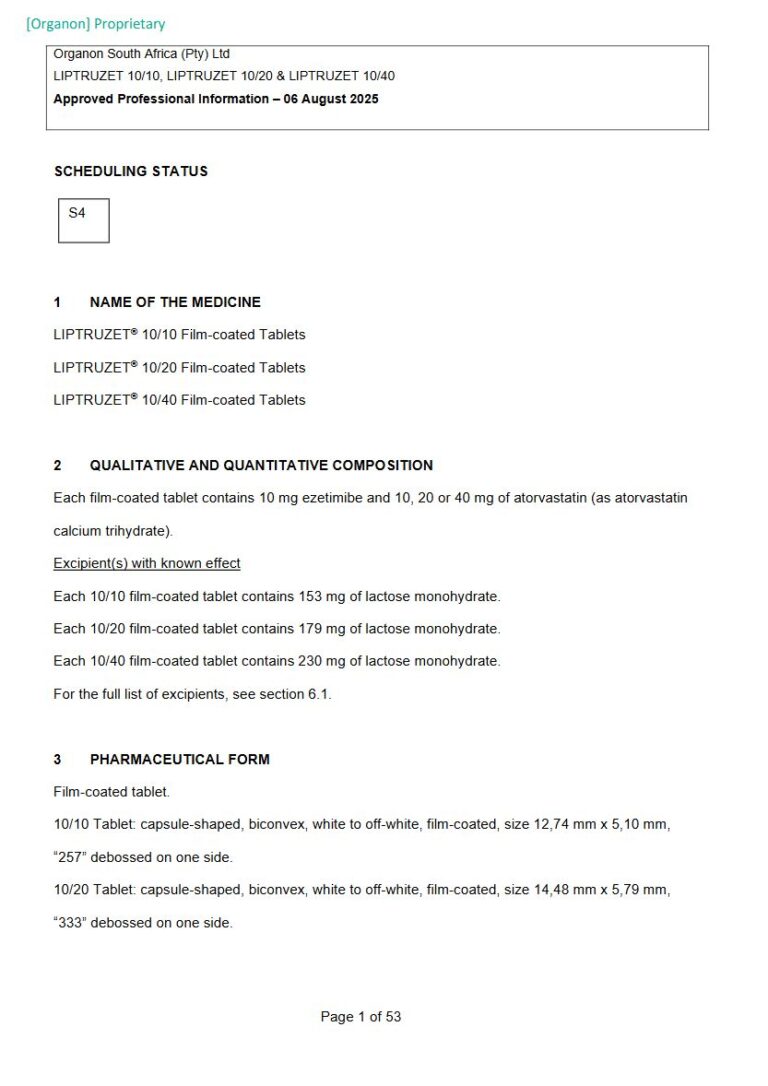
Liptruzet 10, 20 or 40 mg FC Tablets
PDF Leaflet Revision Date: 06 August 2025
Clinical Summary
Quick overview from the medicine insert
Indication
Adjunctive therapy for hypercholesterolaemia and prevention of cardiovascular events.
Dosage (summary)
10/10 mg to 10/40 mg once daily, individualized based on response.
Special Populations
- Elderly
- Hepatic impairment
- Renal impairment
Pregnancy & Breastfeeding
Contraindicated in pregnancy and breastfeeding.
Key Drug Interactions
- CYP3A4 inhibitors
- Fibrates
- Warfarin
Contraindications
- Active liver disease
- Hypersensitivity
- Pregnancy
- Breastfeeding
Common side effects
- Diarrhoea
- Myalgia
- Dizziness
Counselling Points
- Report muscle pain or weakness
- Monitor liver function tests
- Use effective contraception during treatment
Serious warnings
- Risk of myopathy/rhabdomyolysis
- Liver enzyme elevations
Important Disclaimer
The Liptruzet 10, 20 or 40 mg FC Tablets professional information leaflet below is the property of Organon South Africa and is provided on Medinsert exactly as issued, with no.. alterations or editorial changes. We make every effort to keep content current by updating documents as soon as new versions become available. Medinsert serves as a trusted access point for healthcare professionals, but does not replace official sources or clinical judgement. For more details, please read our full disclaimer. read more>>
 Healthcare Professionals Only
This content is for registered healthcare professionals
Sign in or create a free account to read the full package insert.
Free for HPCSA-registered professionals. Powered by Medinsert.
Clinical Particulars
Section 4 of the official insert — extracted exactly as issued, no alterations
4.1 Therapeutic indications
Prevention of Cardiovascular Events
nLIPTRUZET is indicated to reduce the risk of cardiovascular events (see section 5.1) in patients with coronary heart disease (CHD) and a history of acute coronary syndrome (ACS), either previously treated with a statin or not.
nHypercholesterolaemia
nLIPTRUZET is indicated as adjunctive therapy to diet for use in adults with primary (heterozygous familial and non-familial) hypercholesterolaemia or mixed hyperlipidaemia where use of a combination product is appropriate.
n- n
- Patients not appropriately controlled with a statin alone. n
- Patients already treated with a statin and ezetimibe. n
Homozygous Familial Hypercholesterolaemia (HoFH)
nLIPTRUZET is indicated as adjunctive therapy to diet for use in adults with HoFH. Patients may also receive adjunctive treatments (e.g. low-density lipoprotein [LDL] apheresis).
4.2 Posology and method of administration
Posology
nHypercholesterolaemia and/or Coronary Heart Disease (with ACS History)
nThe patient should be on an appropriate lipid-lowering diet and should continue on this diet during treatment with LIPTRUZET.
nThe dose range of LIPTRUZET is 10/10 mg/day through 10/40 mg/day. The typical dose is 10/10 once a day. The patientu2019s low-density lipoprotein cholesterol (LDL-C) level, coronary heart disease risk status and response to current cholesterol-lowering therapy should be considered when starting therapy or adjusting the dose.
nThe dose of LIPTRUZET should be individualised based on the known efficacy of the various dose strengths of LIPTRUZET (see section 5.1, Table 4 ) and the response to the current cholesterol-lowering therapy. Adjustment of dose should be made at intervals of 4 weeks or more.
nHomozygous Familial Hypercholesterolaemia
nThe dose of LIPTRUZET in patients with homozygous FH is 10/10 to 10/40 mg daily. LIPTRUZET may be used as an adjunct to other lipid-lowering treatments (e.g. LDL apheresis) in these patients or if such treatments are unavailable.
nCo-administration with other medicines
nDosing of LIPTRUZET should occur either u2265 2 hours before or u2265 4 hours after administration of a bile acid sequestrant.
nIn patients taking hepatitis C antiviral agents elbasvir/grazoprevir concomitantly with LIPTRUZET, the dose of LIPTRUZET should not exceed 10/20 mg/day (see sections 4.4 and 4.5).
nSpecial Populations
nElderly
nNo dose adjustment is required for older patients (see section 5.2).
nPaediatric population
nThe safety and efficacy of LIPTRUZET in children has not been established (see section 5.2). No data are available.
nHepatic impairment
nLIPTRUZET should be used with caution in patients with hepatic impairment (see sections 4.4 and 5.2). LIPTRUZET is contraindicated in patients with active liver disease (see section 4.3).
nRenal impairment
nNo dose adjustment is required for renally impaired patients (see section 5.2).
nMethod of administration
nLIPTRUZET is for oral administration. LIPTRUZET can be administered as a single dose at any time of the day, with or without food.
4.3 Contraindications
Hypersensitivity to the active substances or to any of the excipients listed in section 6.1.
nTherapy with LIPTRUZET is contraindicated during pregnancy and breastfeeding and in women of child-bearing potential not using appropriate contraceptive measures (see section 4.6).
nLIPTRUZET is contraindicated in patients with active liver disease or unexplained persistent elevations in serum transaminases exceeding 3 times the upper limit of normal (ULN).
nLIPTRUZET is contraindicated in patients treated with the hepatitis C antivirals glecaprevir/pibrentasvir.
4.4 Special warnings and precautions for use
Myopathy/Rhabdomyolysis
nIn post-marketing experience with ezetimibe, cases of myopathy and rhabdomyolysis have been reported. Most patients who developed rhabdomyolysis were taking a statin concomitantly with ezetimibe. However, rhabdomyolysis has been reported very rarely with ezetimibe monotherapy and very rarely with the addition of ezetimibe to other agents known to be associated with increased risk of rhabdomyolysis.
nLIPTRUZET contains atorvastatin. Atorvastatin, like other HMG-CoA reductase inhibitors, may in rare occasions affect the skeletal muscle and cause myalgia, myositis and myopathy that may progress to rhabdomyolysis, a potentially life-threatening condition characterised by markedly elevated creatine phosphokinase (CPK) levels (u02c3 10 times ULN), myoglobinaemia and myoglobinuria, which may lead to renal failure.
nBefore the treatment
nLIPTRUZET should be prescribed with caution in patients with pre-disposing factors for rhabdomyolysis. A CPK level should be measured before starting treatment in the following situations:
n- n
- renal impairment n
- hypothyroidism n
- personal or familial history of hereditary muscular disorders n
- previous history of muscular toxicity with a statin or fibrate n
- previous history of liver disease and/or where substantial quantities of alcohol are consumed n
- in elderly (age > 70 years), the necessity of such measurement should be considered, according to the presence of other predisposing factors for rhabdomyolysis n
- situations where an increase in plasma levels may occur, such as interactions (see section 4.5) and special populations including genetic subpopulations (see section 5.2). n
In such situations, the risk of treatment should be considered in relation to possible benefit, and clinical monitoring is recommended.
nIf CPK levels are significantly elevated (> 5 times ULN) at baseline, treatment should not be started.
nCreatine phosphokinase measurement
nCreatine phosphokinase (CPK) should not be measured following strenuous exercise or in the presence of any plausible alternative cause of CPK increase as this makes value interpretation difficult. If CPK levels are significantly elevated at baseline (> 5 times ULN), levels should be remeasured within 5 to 7 days later to confirm the results.
nWhilst on treatment
n- n
- Patients must be asked to promptly report muscle pain, cramps or weakness especially if accompanied by malaise or fever or if muscle signs and symptoms persist after discontinuing LIPTRUZET. n
- If such symptoms occur whilst a patient is receiving treatment with LIPTRUZET, their CPK levels should be measured. If these levels are found to be significantly elevated (> 5 times ULN), treatment should be stopped. n
- If muscular symptoms are severe and cause daily discomfort, even if the CPK levels are elevated to u2264 5 times ULN, treatment discontinuation should be considered. n
- If symptoms resolve and CPK levels return to normal, then re-introduction of LIPTRUZET or introduction of another statin-containing product may be considered at the lowest dose and with close monitoring. n
- LIPTRUZET must be discontinued if clinically significant elevation of CPK levels (> 10 times ULN) occur or if rhabdomyolysis is diagnosed or suspected. n
- There have been very rare reports of an immune-mediated necrotising myopathy (IMNM) during or after treatment with some statins. IMNM is clinically characterised by persistent proximal muscle weakness and elevated serum creatine kinase, which persist despite discontinuation of statin treatment. n
Due to the atorvastatin component of LIPTRUZET, the risk of rhabdomyolysis is increased when LIPTRUZET is administered concomitantly with certain medicinal products that may increase the plasma concentration of atorvastatin such as potent inhibitors of CYP3A4 or transport proteins (e.g. ciclosporin, telithromycin, clarithromycin, delavirdine, stiripentol, ketoconazole, voriconazole, itraconazole, posaconazole and HIV protease inhibitors including ritonavir, lopinavir, atazanavir, indinavir, darunavir, tipranavir/ritonavir, etc.). The risk of myopathy may also be increased with the concomitant use of gemfibrozil and other fibric acid derivatives, antivirals for the treatment of hepatitis C (HCV) (boceprevir, telaprevir, elbasvir/grazoprevir), erythromycin or niacin. If possible, alternative (non-interacting) therapies should be considered instead of these medicinal products (see section 4.8).
nIn cases where co-administration of these medicinal products with LIPTRUZET is necessary, the benefit and the risk of concurrent treatment should be carefully considered. When patients are receiving medicinal products that increase the plasma concentration of atorvastatin, a lower maximum dose of LIPTRUZET is recommended. In addition, in the case of potent CYP3A4 inhibitors, a lower starting dose of LIPTRUZET should be considered and appropriate clinical monitoring of these patients is recommended (see section 4.5).
nAtorvastatin must not be co-administered with systemic formulations of fusidic acid or within 7 days of stopping fusidic acid treatment. In patients where the use of systemic fusidic acid is considered essential, statin treatment should be discontinued throughout the duration of fusidic acid treatment. There have been reports of rhabdomyolysis (including some fatalities) in patients receiving fusidic acid and statins in combination (see section 4.5). The patient should be advised to seek medical advice immediately if they experience any symptoms of muscle weakness, pain or tenderness.
nStatin therapy may be re-introduced 7 days after the last dose of fusidic acid.
nIn exceptional circumstances, where prolonged systemic fusidic acid is needed, e.g. for the treatment of severe infections, the need for co-administration of LIPTRUZET and fusidic acid should only be considered on a case by case basis and under close medical supervision.
nDaptomycin
nCases of myopathy and/or rhabdomyolysis have been reported with HMG-CoA reductase inhibitors (e.g. atorvastatin and ezetimibe/atorvastatin) co-administered with daptomycin. Caution should be used when prescribing HMG-CoA reductase inhibitors with daptomycin, as either agent can cause myopathy and/or rhabdomyolysis when given alone. Consideration should be given to temporarily suspend LIPTRUZET in patients taking daptomycin unless the benefits of concomitant administration outweigh the risk. Consult the prescribing information of Daptomycin to obtain further information about this potential interaction with HMG-CoA reductase inhibitors (e.g. atorvastatin and ezetimibe/atorvastatin) and for further guidance related to monitoring (see section 4.5).
nMyasthenia Gravis/Ocular Myasthenia
nThere is a risk of myasthenia gravis and ocular myasthenia with the use of statin-containing medicines, such as LIPTRUZET.
nIn a few cases, statins, including atorvastatin as contained in LIPTRUZET, have been reported to induce new onset or aggravate pre-existing myasthenia gravis or ocular myasthenia (see section 4.8). LIPTRUZET should be discontinued in case of aggravation of symptoms. There have been reports of recurrences of these conditions when the same or a different statin was (re-) administered.
nLiver Enzymes
nIn controlled co-administration trials in patients receiving ezetimibe and atorvastatin, consecutive transaminase elevations (u2265 3 times the upper limit of normal [ULN]) have been observed (see section 4.8). Liver function tests should be performed before the initiation of treatment and periodically thereafter. Patients who develop any signs or symptoms suggestive of liver injury should have liver function tests performed. Patients who develop increased transaminase levels should be monitored until the abnormality(ies) resolve. Should an increase in transaminases of greater than 3 times the ULN persist, reduction of dose or withdrawal of LIPTRUZET is recommended.
nLIPTRUZET should be used with caution in patients who consume substantial quantities of alcohol and/or have a history of liver disease.
nHepatic Insufficiency
nDue to the unknown effects of the increased exposure to ezetimibe in patients with moderate or severe hepatic insufficiency, LIPTRUZET is not recommended (see section 5.2).
nFibrates
nThe safety and efficacy of ezetimibe administered with fibrates have not been established; therefore, co-administration of LIPTRUZET and fibrates is not recommended (see section 4.5).
nCiclosporin
nCaution should be exercised when initiating LIPTRUZET in the setting of ciclosporin. Ciclosporin concentrations should be monitored in patients receiving LIPTRUZET and ciclosporin (see section 4.5).
nAnticoagulants
nIf LIPTRUZET is added to warfarin, another coumarin anticoagulant or fluindione, the International Normalised Ratio (INR) should be appropriately monitored (see section 4.5).
nStroke Prevention by Aggressive Reduction in Cholesterol Levels (SPARCL)
nIn a post-hoc analysis of stroke subtypes in patients without coronary heart disease (CHD) who had a recent stroke or transient ischaemic attack (TIA) there was a higher incidence of haemorrhagic stroke in patients initiated on atorvastatin 80 mg compared to placebo. The increased risk was particularly noted in patients with prior haemorrhagic stroke or lacunar infarct at study entry. For patients with prior haemorrhagic stroke or lacunar infarct, the balance of risks and benefits of atorvastatin 80 mg is uncertain, and the potential risk of haemorrhagic stroke should be carefully considered before initiating treatment (see section 5.1).
nInterstitial lung disease
nExceptional cases of interstitial lung disease have been reported with some statins, especially with long term therapy (see section 4.8). Presenting features can include dyspnoea, non-productive cough and deterioration in general health (fatigue, weight loss and fever). If it is suspected a patient has developed interstitial lung disease, statin therapy should be discontinued.
nDiabetes mellitus
nSome evidence suggests that statins as a class raise blood glucose and in some patients at high risk of future diabetes, may produce a level of hyperglycaemia where formal diabetes care is appropriate. This risk, however, is outweighed by the reduction in vascular risk with statins and therefore should not be a reason for stopping statin treatment. Patients at risk (fasting glucose 5,6 to 6,9 mmol/L, BMI > 30kg/m 2 , raised triglycerides, hypertension) should be monitored both clinically and biochemically according to national guidelines.
nExcipients
nLIPTRUZET contains lactose. Patients with rare hereditary problems of galactose intolerance, the Lapp lactase deficiency or glucose-galactose malabsorption should not take this medicine.
4.5 Interaction with other medicines and other forms of interaction
Multiple mechanisms may contribute to potential interactions with HMG Co-A reductase inhibitors. Drugs or herbal products that inhibit certain enzymes (e.g. CYP3A4) and/or transporter (e.g. OATP1B) pathways may increase atorvastatin plasma concentrations and may lead to an increased risk of myopathy/rhabdomyolysis.
nConsult the prescribing information of all concomitantly used drugs to obtain further information about their potential interactions with atorvastatin and/or the potential for enzyme or transporter alterations and possible adjustments to dose and regimens.
nPharmacodynamic interactions
nAtorvastatin is metabolised by cytochrome P450 3A4 (CYP3A4) and is a substrate of the hepatic transporters, organic anion-transporting polypeptide 1B1 (OATP1B1) and 1B3 (OATP1B3) transporter. Metabolites of atorvastatin are substrates of OATP1B1. Atorvastatin is also identified as a substrate of the multi-drug resistance protein 1 (MDR1) and breast cancer resistance protein (BCRP), which may limit the intestinal absorption and biliary clearance of atorvastatin (see section 5.2). Concomitant administration of medicinal products that are inhibitors of CYP3A4 or transport proteins may lead to increased plasma concentrations of atorvastatin and an increased risk of myopathy. The risk might also be increased at concomitant administration of LIPTRUZET with other medicinal products that have a potential to induce myopathy, such as fibric acid derivatives and ezetimibe (see section 4.4).
nPharmacokinetic interactions
nLIPTRUZET No clinically significant pharmacokinetic interaction was seen when ezetimibe was co-administered with atorvastatin.
nEffects of other medicinal products on LIPTRUZET
nEzetimibe
nAntacids: Concomitant antacid administration decreased the rate of absorption of ezetimibe but had no effect on the bioavailability of ezetimibe. This decreased rate of absorption is not considered clinically significant.
nCholestyramine: Concomitant cholestyramine administration decreased the mean area under the curve (AUC) of total ezetimibe (ezetimibe + ezetimibe glucuronide) approximately 55 %. The incremental low-density lipoprotein cholesterol (LDL-C) reduction due to adding LIPTRUZET to cholestyramine may be lessened by this interaction (see section 4.2).
nCiclosporin: In a study of 8 post-renal transplant patients with creatinine clearance of > 50 mL/min on a stable dose of ciclosporin, a single 10 mg dose of ezetimibe resulted in a 3,4-fold (range 2,3- to 7,9- fold) increase in the mean AUC for total ezetimibe compared to a healthy control population, receiving ezetimibe alone, from another study (n=17). In a different study, a renal transplant patient with severe renal insufficiency who was receiving ciclosporin and multiple other medicinal products demonstrated a 12-fold greater exposure to total ezetimibe compared to concurrent controls receiving ezetimibe alone. In a two-period crossover study in 12 healthy subjects, daily administration of 20 mg ezetimibe for 8 days with a single 100-mg dose of ciclosporin on Day 7 resulted in a mean 15 % increase in ciclosporin AUC (range 10 % decrease to 51 % increase) compared to a single 100 mg dose of ciclosporin alone. A controlled study on the effect of co-administered ezetimibe on ciclosporin exposure in renal transplant patients has not been conducted. Caution should be exercised when initiating LIPTRUZET
nin the setting of ciclosporin. Ciclosporin concentrations should be monitored in patients receiving LIPTRUZET and ciclosporin (see section 4.4).
nFibrates: Concomitant fenofibrate or gemfibrozil administration increased total ezetimibe concentrations approximately 1,5- and 1,7-fold, respectively. Although these increases are not considered clinically significant, co-administration of LIPTRUZET with fibrates is not recommended (see section 4.4).
nAtorvastatin
nCYP3A4 inhibitors: Potent CYP3A4 inhibitors have been shown to lead to markedly increased concentrations of atorvastatin (see Table 1 and specific information below). Co-administration of potent CYP3A4 inhibitors (e.g. ciclosporin, telithromycin, clarithromycin, delavirdine, stiripentol, ketoconazole, voriconazole, itraconazole, posaconazole, some antivirals used in the treatment of HCV [e.g. elbasvir/grazoprevir] and HIV protease inhibitors including ritonavir, lopinavir, atazanavir, indinavir, darunavir, etc.) should be avoided if possible. In cases where co-administration of these medicinal products with LIPTRUZET cannot be avoided, lower starting and maximum doses of LIPTRUZET should be considered and appropriate clinical monitoring of the patient is recommended (see Table 1 ).
nModerate CYP3A4 inhibitors (e.g. erythromycin, diltiazem, verapamil and fluconazole) may increase plasma concentrations of atorvastatin (see Table 1 ). An increased risk of myopathy has been observed with the use of erythromycin in combination with statins. Interaction studies evaluating the effects of amiodarone or verapamil on atorvastatin have not been conducted. Both amiodarone and verapamil are known to inhibit CYP3A4 activity and co-administration with LIPTRUZET may result in increased exposure to atorvastatin. Therefore, a lower maximum dose of LIPTRUZET should be considered and appropriate clinical monitoring of the patient is recommended when concomitantly used with moderate CYP3A4 inhibitors. Appropriate clinical monitoring is recommended after initiation or following dose adjustments of the inhibitor.
nInhibitors of Breast Cancer Resistant Protein (BCRP): Concomitant administration of products that are inhibitors of BCRP (e.g. elbasvir and grazoprevir) may lead to increased plasma concentrations of atorvastatin and an increased risk of myopathy; therefore, a dose adjustment of atorvastatin should be considered depending on the prescribed dose. Co-administration of elbasvir and grazoprevir with atorvastatin increases plasma concentrations of atorvastatin 1,9-fold (see Table 1 ); therefore, the dose of LIPTRUZET should not exceed 10/20 mg daily in patients receiving concomitant medications with products containing elbasvir or grazoprevir (see sections 4.2 and 4.4).
nInducers of cytochrome P450 3A4: Concomitant administration of atorvastatin with inducers of cytochrome P450 3A4 (e.g. efavirenz, rifampicin, St. John's Wort) can lead to variable reductions in plasma concentrations of atorvastatin. Due to the dual interaction mechanism of rifampicin, (cytochrome P450 3A4 induction and inhibition of hepatocyte uptake transporter OATP1B1), simultaneous co-administration of LIPTRUZET with rifampicin is recommended, as delayed administration of atorvastatin after administration of rifampicin has been associated with a significant reduction in atorvastatin plasma concentrations. The effect of rifampicin on atorvastatin concentrations in hepatocytes is, however, unknown and if concomitant administration cannot be avoided, patients should be carefully monitored for efficacy.
nTransport inhibitors: Inhibitors of transport proteins (e.g. ciclosporin) can increase the systemic exposure of atorvastatin (see Table 1 ). The effect of inhibition of hepatic uptake transporters on atorvastatin concentrations in hepatocytes is unknown. If concomitant administration cannot be avoided, a dose reduction of LIPTRUZET and clinical monitoring for efficacy is recommended (see Table 1 ).
nGemfibrozil/fibric acid derivatives: The use of fibrates alone is occasionally associated with muscle-related events, including rhabdomyolysis. The risk of these events may be increased with the concomitant use of fibric acid derivatives and atorvastatin.
nEzetimibe: The use of ezetimibe alone is associated with muscle-related events, including rhabdomyolysis. The risk of these events may therefore be increased with concomitant use of ezetimibe and atorvastatin. Appropriate clinical monitoring of these patients is recommended.
nColestipol: Plasma concentrations of atorvastatin and its active metabolites were lower (by approx. 25 %) when colestipol was co-administered with atorvastatin. However, lipid effects were greater when atorvastatin and colestipol were co-administered than when either medicinal product was given alone.
nFusidic acid: The risk of myopathy including rhabdomyolysis may be increased by the concomitant administration of systemic fusidic acid with statins. The mechanism of this interaction (whether it is pharmacodynamic or pharmacokinetic or both) is yet unknown. There have been reports of rhabdomyolysis (including some fatalities) in patients receiving this combination. If treatment with systemic fusidic acid is necessary, atorvastatin treatment should be discontinued throughout the duration of the fusidic acid treatment. Also see section 4.4.
nColchicine: Although interaction studies with atorvastatin and colchicine have not been conducted, cases of myopathy have been reported with atorvastatin co-administered with colchicine, and caution should be exercised when prescribing atorvastatin with colchicine.
nDaptomycin: The risk of myopathy and/or rhabdomyolysis may be increased by concomitant administration of HMG-CoA reductase inhibitors and daptomycin. Consideration should be given to suspending LIPTRUZET temporarily in patients taking daptomycin unless the benefits of concomitant administration outweigh the risk (see section 4.4).
nBoceprevir: Exposure to atorvastatin was increased when administered with boceprevir. When co-administration with LIPTRUZET is required, starting with the lowest possible dose of LIPTRUZET should be considered with titration up to desired clinical effect while monitoring for safety, without exceeding a daily dose of 10/20 mg. For patients currently taking LIPTRUZET, the dose of LIPTRUZET should not exceed a daily dose of 10/20 mg during co-administration with boceprevir.
4.6 Fertility, pregnancy and lactation
Women of childbearing potential
nWomen of childbearing potential should use appropriate contraceptive measures during treatment (see section 4.3).
nPregnancy
nAtherosclerosis is a chronic process, and ordinarily discontinuation of lipid-lowering drugs during pregnancy should have little impact on the long-term risk associated with primary hypercholesterolaemia.
nLIPTRUZET is contraindicated during pregnancy (see section 4.3). No clinical data are available on the use of LIPTRUZET during pregnancy. LIPTRUZET should not be used in women who are pregnant, trying to become pregnant or suspect they are pregnant. Treatment with LIPTRUZET should be suspended for the duration of pregnancy or until it has been determined that the woman is not pregnant (see section 4.3).
nThe co-administration of ezetimibe and atorvastatin in pregnant rats indicated that there was a test article-related increase in the skeletal variation u201creduced ossification of the sternebraeu201d in the high dose ezetimibe/atorvastatin group. This may be related to the observed decrease in foetal body weights. In pregnant rabbits a low incidence of skeletal deformities (fused sternebrae, fused caudal vertebrae and asymmetrical sternebrae variation) were observed.
nAtorvastatin
nSafety in pregnant women has not been established. No controlled clinical trials with atorvastatin have been conducted in pregnant women. Rare reports of congenital anomalies following intrauterine exposure to HMG-CoA reductase inhibitors have been received. Animal studies have shown toxicity to reproduction (see section 5.3). Maternal treatment with atorvastatin may reduce the foetal levels of mevalonate which is a precursor of cholesterol biosynthesis.
nEzetimibe
nNo clinical data are available on the use of ezetimibe during pregnancy. Animal studies on the use of ezetimibe in monotherapy have shown no evidence of direct or indirect harmful effects on pregnancy, embryofoetal development, birth or postnatal development (see section 5.3).
nBreastfeeding
nLIPTRUZET is contraindicated during breastfeeding. Because of the potential for serious adverse reactions, women taking LIPTRUZET should not breastfeed their infants. Studies on rats have shown that ezetimibe is secreted into breast milk. In rats, plasma concentrations of atorvastatin and its active metabolites are similar to those in milk. It is not known if the active components of LIPTRUZET are secreted into human breast milk. (See section 4.3.)
nFertility
nNo fertility studies were conducted with LIPTRUZET.
nAtorvastatin
nIn animal studies atorvastatin had no effect on male or female fertility.
nEzetimibe
nEzetimibe had no effect on the fertility of male or female rats.
4.7 Effects on ability to drive and use machines
LIPTRUZET has negligible influence on the ability to drive and use machines. However, when driving vehicles or operating machines, it should be taken into account that dizziness has been reported.
4.8 Undesirable effects
a. Summary of the safety profile
nLIPTRUZET has been associated with adverse reactions, including myopathy/rhabdomyolysis and liver enzyme elevations. Myopathy and rhabdomyolysis, characterized by muscle pain, weakness, and elevated creatine phosphokinase (CPK) levels, can occur early in treatment, especially in patients with predisposing factors. Liver enzyme elevations, indicating potential liver injury, should be monitored periodically. The risk of myasthenia gravis and ocular myasthenia requires discontinuation of LIPTRUZET if symptoms worsen. Frequencies of these adverse reactions are detailed in the Tabulated summary of Adverse Reactions, and relevant risk minimization measures are outlined in section 4.4.
nCommon adverse reactions include diarrhoea and myalgia. Uncommon reactions such as dizziness, insomnia, and abdominal pain may occur. Rare reactions like thrombocytopenia, hypersensitivity, hepatitis, pancreatitis, and interstitial lung disease have been reported with long-term use. Frequencies of these adverse reactions are detailed in the Tabulated summary of Adverse Reactions.
nb. Tabulated summary of adverse reactions
nLIPTRUZET (or co-administration of ezetimibe and atorvastatin equivalent to LIPTRUZET) has been evaluated for safety in more than 2 400 patients in 7 clinical trials. Adverse reactions observed in clinical studies of LIPTRUZET (or co-administration of ezetimibe and atorvastatin equivalent to LIPTRUZET, or ezetimibe or atorvastatin) are listed in Table 3 . These reactions are presented by system organ class and frequency. Frequencies are defined as: very common ( u2265 1/10); common u2265 1/100, < 1/10); uncommon ( u2265 1/1 000, < 1/100); rare (u2265 1/10 000, < 1/1 000); and very rare (< 1/10 000); and not known (cannot be estimated from the available data).
4.9 Overdose
LIPTRUZET
nIn the event of an overdose, symptomatic and supportive measures should be employed. Liver function tests should be performed and serum CPK levels should be monitored.
nEzetimibe
nIn clinical studies, administration of ezetimibe, 50 mg/day to 15 healthy subjects for up to 14 days or 40 mg/day to 18 patients with primary hyperlipidaemia for up to 56 days, was generally well tolerated. A few cases of overdose have been reported; most have not been associated with adverse experiences. Reported adverse experiences have not been serious. In animals, no toxicity was observed after single oral doses of 5 000 mg/kg of ezetimibe in rats and mice and 3 000 mg/kg in dogs.
nAtorvastatin
nDue to extensive atorvastatin binding to plasma proteins, haemodialysis is not expected to significantly enhance atorvastatin clearance.
