
Liraglutide Cipla 6 mg Solution
PDF Leaflet Revision Date: 21 January 2025
Clinical Summary
Quick overview from the medicine insert
Indication
Adjunct to diet and exercise for glycaemic control in type 2 diabetes.
Dosage (summary)
Start with 0.6 mg daily, increase to 1.2 mg after 1 week, max 1.8 mg.
Special Populations
- Elderly
- Hepatic impairment
- Renal impairment
Pregnancy & Breastfeeding
Contraindicated in pregnancy and lactation.
Key Drug Interactions
- Sulphonylureas
- Insulin
- Warfarin
Contraindications
- Hypersensitivity to liraglutide
- History of pancreatitis
- Type 1 diabetes
Common side effects
- Nausea
- Diarrhoea
- Vomiting
- Headache
Counselling Points
- Rotate injection sites
- Monitor for gastrointestinal effects
- Avoid dehydration
Serious warnings
- Risk of pancreatitis
- Hypoglycaemia with sulphonylureas
- Injection site reactions
Important Disclaimer
The Liraglutide Cipla 6 mg Solution professional information leaflet below is the property of Cipla Medpro and is provided on Medinsert exactly as issued, with no.. alterations or editorial changes. We make every effort to keep content current by updating documents as soon as new versions become available. Medinsert serves as a trusted access point for healthcare professionals, but does not replace official sources or clinical judgement. For more details, please read our full disclaimer. read more>>
 Healthcare Professionals Only
This content is for registered healthcare professionals
Sign in or create a free account to read the full package insert.
Free for HPCSA-registered professionals. Powered by Medinsert.
Clinical Particulars
Section 4 of the official insert — extracted exactly as issued, no alterations
4.1 Therapeutic indications
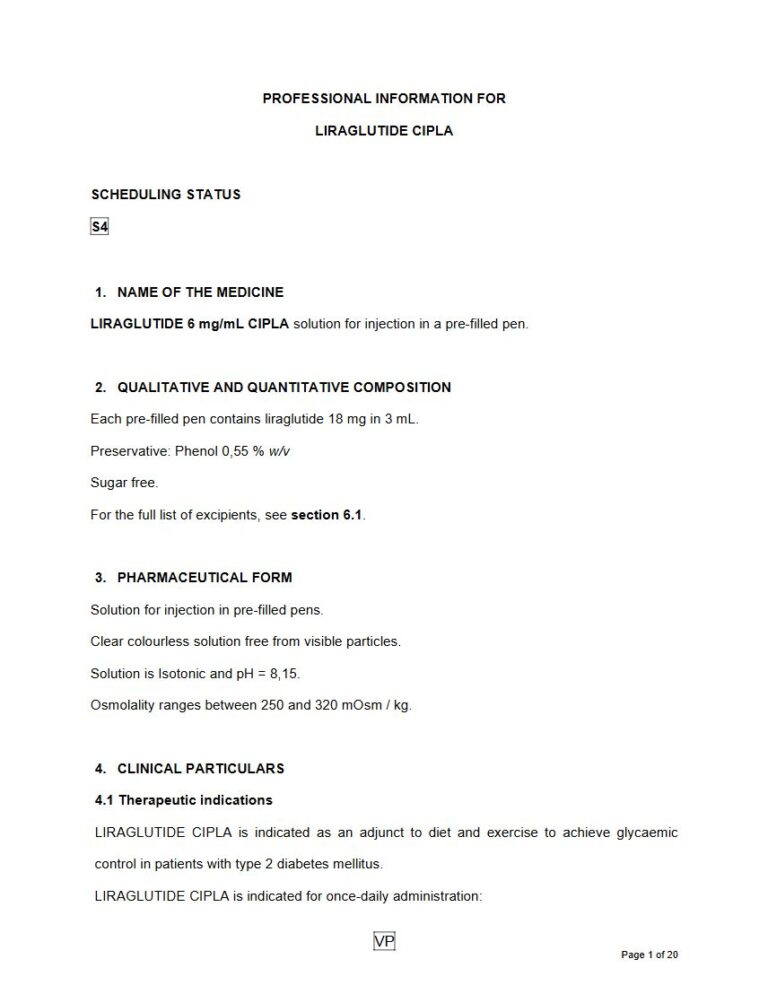
LIRAGLUTIDE CIPLA is indicated as an adjunct to diet and exercise to achieve glycaemic control in patients with type 2 diabetes mellitus. LIRAGLUTIDE CIPLA is indicated for once-daily administration:
- as monotherapy,
- combination therapy with one or more oral antidiabetic medicines (metformin, sulphonylureas or a thiazolidinedione) when previous therapy does not achieve adequate glycaemic control,
- combination therapy with insulin in patients not achieving adequate glycaemic control with LIRAGLUTIDE CIPLA and metformin.
4.2 Posology and method of administration
Posology
Monotherapy
To reduce gastro-intestinal adverse effects for all patients, LIRAGLUTIDE CIPLA should be initiated with a dose of 0,6 mg for at least one week, after which the dose may be increased to 1,2 mg. Based on clinical response and after at least one week the dose can be increased to 1,8 mg to achieve maximum efficacy. Daily doses higher than 1,8 mg are not recommended.
Combination therapy
LIRAGLUTIDE CIPLA can be used in combination with other glucose lowering agents and no dose adjustments are required for metformin, thiazolidinedione and SGLT2i therapy. When LIRAGLUTIDE CIPLA is added to a sulphonylurea or insulin, a reduction in the dose of sulphonylurea or insulin should be considered to reduce the risk of hypoglycaemia (see section 4.4).
Self-monitoring of blood glucose is not needed in order to adjust the dose of LIRAGLUTIDE CIPLA. However, when initiating treatment with LIRAGLUTIDE CIPLA in combination with a sulphonylurea or insulin, blood glucose self-monitoring may become necessary to adjust the dose of the sulphonylurea or insulin.
Incompatibilities
Substances added to LIRAGLUTIDE CIPLA may cause degradation of liraglutide. LIRAGLUTIDE CIPLA must not be mixed with other medicinal products, e.g. infusion fluids.
Special populations
Elderly population: No dosage adjustment is required based on age and gender.
Obesity: Population pharmacokinetic analysis suggests that body mass index (BMI) has no significant effect on the pharmacokinetics of liraglutide.
Hepatic impairment: No dose adjustment is required for patients with hepatic impairment (see section 4.4).
Renal impairment: No dose adjustment is required for patients with mild or moderate or severe renal impairment. There is no therapeutic experience in patients with end-stage renal disease and LIRAGLUTIDE CIPLA is therefore not recommended for use in these patients (see section 4.4).
Paediatric population: LIRAGLUTIDE CIPLA has not been studied in paediatric patients below 18 years of age (see section 4.4).
Method of administration
LIRAGLUTIDE CIPLA must not be administered intravenously or intramuscularly. LIRAGLUTIDE CIPLA is administered once daily at any time, independent of meals, and can be injected subcutaneously in the abdomen, in the thigh or in the upper arm. Injection sites should always be rotated within the same region in order to reduce the risk of cutaneous amyloidosis (see section 4.8). The injection site and timing can be changed without dose adjustment.
4.3 Contraindications
- Patients with known hypersensitivity to liraglutide or to any of the excipients in LIRAGLUTIDE CIPLA (see section 6.1).
- A history of previous pancreatitis.
- Type 1 diabetes mellitus.
- Pregnancy and lactation (see section 4.6).
4.4 Special warnings and precautions for use
- LIRAGLUTIDE CIPLA should not be used in patients with type 1 diabetes mellitus or for the treatment of diabetic ketoacidosis.
- LIRAGLUTIDE CIPLA should not be administered intravenously or intramuscularly.
- LIRAGLUTIDE CIPLA is not a substitute for insulin.
- Safety and efficacy of LIRAGLUTIDE CIPLA in patients below 18 years of age has not been established.
- Patients above 70 years may experience more gastrointestinal effects when treated with LIRAGLUTIDE CIPLA.
- Patients with mild and moderate renal impairment (creatinine clearance 60 to 90 mL/min and 30 to 59 mL/min, respectively) may experience more gastrointestinal effects when treated with LIRAGLUTIDE CIPLA.
- There is no therapeutic experience in patients with end-stage renal disease and LIRAGLUTIDE CIPLA is therefore not recommended for use in these patients.
- There is no therapeutic experience in patients with patients with congestive heart failure New York Heart Association (NYHA) class IV and LIRAGLUTIDE CIPLA is therefore not recommended for use in these patients.
- There is limited experience in patients with inflammatory bowel disease and diabetic gastroparesis and LIRAGLUTIDE CIPLA is therefore not recommended for use in these patients. The use of LIRAGLUTIDE CIPLA is associated with gastrointestinal adverse reactions, including nausea, vomiting and diarrhoea.
- Hypoglycaemia: Patients receiving liraglutide in combination with a sulphonylurea or insulin may have an increased risk of hypoglycaemia. The risk of hypoglycaemia can be lowered by a reduction in the dose of sulphonylurea or insulin.
- Immunogenicity: Consistent with the potentially immunogenic properties of protein and peptide pharmaceuticals, patients may develop anti-liraglutide antibodies following treatment with LIRAGLUTIDE CIPLA. On average, 8,6 % of patients developed antibodies. Antibody formation has not been associated with reduced efficacy of LIRAGLUTIDE CIPLA.
- Injection site reactions: Injection site reaction has been reported in approximately 2 % of subjects receiving liraglutide in long-term (26 weeks or longer) controlled trials. These reactions have usually been mild and did not lead to discontinuation of LIRAGLUTIDE CIPLA.
- Acute pancreatitis: Acute pancreatitis has been observed with the use of GLP-1 receptor agonists. Patients should be informed of the characteristic symptoms of acute pancreatitis. If pancreatitis is suspected, liraglutide should be discontinued; Once acute pancreatitis is confirmed, liraglutide or any other GLP-1 receptor agonist should never again be restarted. Caution should be exercised in patients with a history of pancreatitis.
- Thyroid disease: Thyroid adverse events, such as goitre, have been reported in clinical trials and in particular in patients with pre-existing thyroid disease. Liraglutide should therefore be used with caution in these patients.
- Allergic reactions: Allergic reactions including urticaria, rash and pruritus have been reported from marketed use of liraglutide. Cases of anaphylactic reactions with additional symptoms such as hypotension, palpitations, dyspnoea, oedema have been reported with marketed use of liraglutide (see section 4.3).
- Dehydration: Signs and symptoms of dehydration, including renal impairment and acute renal failure, have been reported in patients treated with liraglutide. Patients treated with LIRAGLUTIDE CIPLA should be advised of the potential risk of dehydration in relation to gastrointestinal side effects and take precautions to avoid fluid depletion.
4.5 Interaction with other medicines and other forms of interaction
In vitro assessment of interaction studies
Liraglutide has shown a low potential involvement in pharmacokinetic interactions with other active substances related to cytochrome P450 (CYP) and plasma protein binding.
In vivo assessment of interaction studies
Interaction has been investigated using paracetamol, digoxin, lisinopril, griseofulvin and atorvastatin representing various degrees of solubility and permeability properties. In addition, the effect of liraglutide on the absorption of ethinyloestradiol and levonorgestrel administered in an oral combination contraceptive medicine has been investigated (see table below).
Product Dose C max Median t max Comments
- Paracetamol Single dose of 1000 mg Decreased by 31 % Delayed up to 15 min No dose adjustment for concomitant use of paracetamol is required
- Atorvastatin Single dose of 40 mg Decreased by 38 % Delayed from 1 h to 3 h No dose adjustment of atorvastatin is required when given with LIRAGLUTIDE CIPLA
- Griseofulvin Single dose of 500 mg Increased by 37 % Did not change Dose adjustments of griseofulvin and other compounds with low solubility and high permeability are not required
- Digoxin Single dose of 1 mg Decreased by 31 % Delayed from 1 h to 1,5 h No adjustment of digoxin dose is required
- Oral Contraception: Single dose Delayed up to 1,5 h for both compounds The contraceptive effect is anticipated to be unaffected when co-administered with LIRAGLUTIDE CIPLA
- Ethinyloestradiol Decreased by 12 %
- Levonorgestrel Decreased by 13 %
The minor delay of gastric emptying caused by liraglutide did not affect the absorption of orally administered medicines to any clinically relevant degree and therefore no dose adjustment is required. Few patients treated with liraglutide reported at least one episode of severe diarrhoea. Diarrhoea may affect the absorption of concomitant oral medicines.
Warfarin and other coumarin derivatives:
No interaction study has been performed. A clinically relevant interaction with active substances with poor solubility or with narrow therapeutic index such as warfarin cannot be excluded. Upon initiation of liraglutide treatment in patients on warfarin or other coumarin derivatives, more frequent monitoring of INR (International Normalised Ratio) is recommended.
Insulin
No pharmacokinetic or pharmacodynamic interactions were observed between liraglutide and insulin detemir when administering a single dose of insulin detemir 0,5 U/kg with liraglutide 1,8 mg at steady state in patients with type 2 diabetes.
4.6 Fertility, pregnancy, and lactation
Pregnancy
LIRAGLUTIDE CIPLA is contraindicated during pregnancy and lactation. There are no adequate data for use of LIRAGLUTIDE CIPLA in pregnant women. Liraglutide crossed the placental barrier in rabbits. Studies in animals have shown reproductive toxicity and LIRAGLUTIDE CIPLA should therefore not be used during pregnancy. The use of insulin is recommended. If a patient wishes to become pregnant, or pregnancy occurs, treatment with LIRAGLUTIDE CIPLA should be discontinued.
Breastfeeding
It is not known whether liraglutide is excreted in human milk. In lactating rats, up to 3 % of the maternal dose was present in breast milk. Women on treatment with LIRAGLUTIDE CIPLA should not breastfeed.
Fertility
Apart from a slight decrease in the number of live implants, animal studies did not indicate harmful effects with respect to fertility.
4.7 Effects on ability to drive and use machines
No studies on the effects on the ability to drive and use machines have been performed. LIRAGLUTIDE CIPLA may affect the ability to drive or use machines. Patients should be advised to ensure that they are aware of the effect of LIRAGLUTIDE CIPLA on their abilities beforehand and to take precautions to avoid hypoglycaemia while driving and using machines, in particular when LIRAGLUTIDE CIPLA is used in combination with a sulphonylurea or insulin (see section 4.8).
4.8 Undesirable effects
Summary of the safety profile
The most frequently reported adverse events during clinical trials were gastrointestinal adverse events: nausea and diarrhoea (reported by > 10 % of patients) and vomiting, dyspepsia, upper abdominal pain, constipation, gastritis, flatulence, abdominal distension, gastro-oesophageal reflux disease and eructation (reported by u2265 1 % and u2264 10 % of patients). Headache and upper respiratory tract infections were common. Furthermore, hypoglycaemia was common and very common especially when LIRAGLUTIDE CIPLA is used in combination with sulphonylurea. Major hypoglycaemia may occur uncommonly and has only been observed when combined with a sulphonylurea. Severe hypoglycaemia may occur uncommonly and has only been observed when combined with a sulphonylurea.
Table 1: Tabulated summary of adverse reactions
Body system/ adverse reaction terms Frequency of occurrence
Reactions Frequent Less Frequent Frequency unknown
Infections and infestations Upper respiratory tract infection. Bronchitis, gastroenteritis, osteomyelitis.
-
Neoplasms benign, malignant and unspecified (incl. cysts and polyps) Papillary thyroid cancer, prostate cancer, breast cancer.
-
Blood and the lymphatic system disorders Thrombocytopenia.
-
Immune system disorders Anaphylactic reaction.
-
Metabolism and nutrition disorders Hypoglycaemia Anorexia Decreased appetite Dehydration.
-
Nervous system disorders Headache. Cerebrovascular accident, syncope.
-
Eye disorders Cataract.
-
Cardiac disorders Increased heart rate*. Angina pectoris, acute myocardial infarction, coronary artery disease, atrial fibrillation, congestive cardiac failure, supraventricular tachycardia.
-
Gastro - intestinal disorders Nausea, diarrhoea, vomiting, dyspepsia, abdominal pain upper, constipation, gastritis, flatulence, abdominal distension, gastro-oesophageal reflux disease, Appendicitis with perforation, inguinal hernia, pancreatitis (Including necrotising pancreatitis).
-
Skin and subcutaneous tissue disorders Rash. Urticaria, pruritus. Cutaneous amyloidosis u2020
-
Musculoskeletal, connective tissue and bone disorders Intervertebral disc protrusion, osteoarthritis.
-
General disorders and administration site conditions Fatigue, injection site reactions. Chest pain, malaise.
-
Renal and urinary disorders Renal failure acute *, renal impairment *.
-
Investigations Increased lipase, increased amylase.
-
Injury, poisoning and procedural complications Fall.
-
*Spontaneous reports u2020 ADR from post marketing sources
Description of selected adverse reactions
Hypoglycaemia Most episodes of confirmed hypoglycaemia in clinical trials were minor. No episodes of severe hypoglycaemia were observed in the trial with liraglutide used as monotherapy. Severe hypoglycaemia may occur uncommonly and has primarily been observed when liraglutide is combined with a sulphonylurea (0,02 events/patient year). Very few episodes (0,001 events/ subject year) were observed with administration of liraglutide in combination with a non-sulphonylurea. As reported in trials, severe hypoglycaemic episodes were reported at a lower rate with liraglutide vs placebo (1,0 vs 1,5 events per 100 patient years of exposure; estimated rate ratio 0,69 [0,51 to 0,93]) (see section 5.1).
For patients treated with premix insulin at baseline and at least for the following 26 weeks, the rate of severe hypoglycaemia for both liraglutide and placebo was 2.2 events per 100 patient years of exposure.
Cholelithiasis and cholecystitis Few cases of cholelithiasis (0,4 %) and cholecystitis (0,1 %) have been reported during long-term, controlled phase 3a clinical trials with liraglutide. As reported in trials, the frequency of cholelithiasis and cholecystitis was 1,5 % and 1,1 % for liraglutide and 1,1 % and 0,7 % for placebo, respectively.
Pancreatitis Few cases of acute pancreatitis (< 0,2 %) have been reported during long-term, controlled phase 3 clinical trials with liraglutide. Pancreatitis was also reported from marketed use. As reported in trials, the frequency of acute pancreatitis confirmed by adjudication was 0,4 % for liraglutide and 0,5 % for placebo, respectively.
Reporting of suspected adverse reactions
Reporting suspected adverse reactions after authorisation of the medicine is important. It allows continued monitoring of the benefit/risk balance of the medicine. Health care providers are requested to report any suspected adverse drug reactions to SAHPRA via the Med Safety APP (Medsafety X SAHPRA) and eReporting platform (who-umc.org) found on the SAHPRA website, or to Cipla Medpro (Pty) Ltd. by email: [email protected] or telephone: 080 222 6662 (toll free).
4.9 Overdose
With overdose, the patients reported severe nausea, vomiting and diarrhoea and severe hypoglycaemia. In the event of overdosage, appropriate supportive treatment should be initiated according to the patientu2019s clinical signs and symptoms. The patient should be observed for clinical signs of dehydration and blood glucose should be monitored.
