
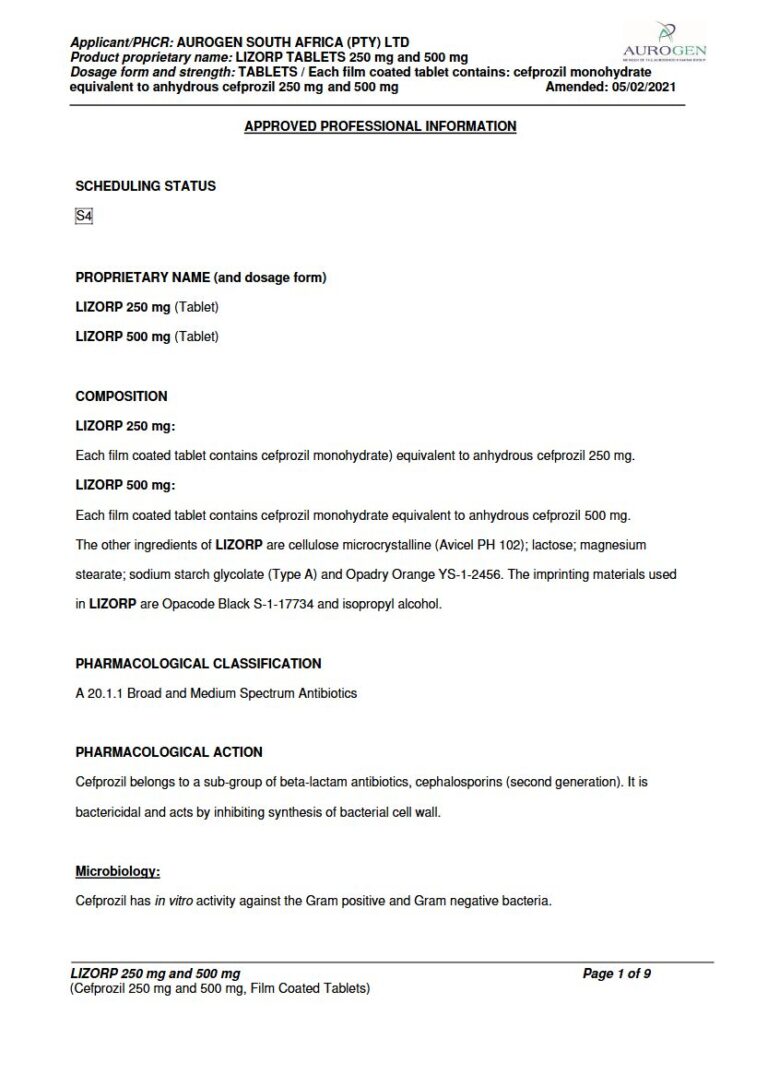
Lizorp 250 mg and 500 mg TABLETS
PDF Leaflet Revision Date: 05 February 2021
Clinical Summary
Quick overview from the medicine insert
Indication
Treatment of mild to moderately severe infections caused by susceptible bacteria.
Dosage (summary)
Adults: 500 mg every 12-24 hours for 10 days depending on infection type.
Special Populations
- Renal impairment
- Hepatic impairment
Pregnancy & Breastfeeding
Safety in pregnancy and lactation not established.
Key Drug Interactions
- Increases risk of bleeding with warfarin
- Nephrotoxicity with aminoglycosides
Contraindications
- Allergy to cephalosporins
- Children under 1 year
- Pregnancy and lactation
Common side effects
- Nausea
- Vomiting
- Diarrhoea
- Eosinophilia
- Dizziness
Counselling Points
- Monitor for allergic reactions
- Report severe diarrhea
- Evaluate renal function during therapy
Serious warnings
- Serious hypersensitivity reactions
- Pseudomembranous colitis risk
Important Disclaimer
The Lizorp 250 mg and 500 mg TABLETS professional information leaflet below is the property of Aurogen South Africa and is provided on Medinsert exactly as issued, with no.. alterations or editorial changes. We make every effort to keep content current by updating documents as soon as new versions become available. Medinsert serves as a trusted access point for healthcare professionals, but does not replace official sources or clinical judgement. For more details, please read our full disclaimer. read more>>
 Healthcare Professionals Only
This content is for registered healthcare professionals
Sign in or create a free account to read the full package insert.
Free for HPCSA-registered professionals. Powered by Medinsert.
Clinical Particulars
Section 4 of the official insert — extracted exactly as issued, no alterations
4.1 Therapeutic indications
LIZORP is indicated for the treatment of patients with mild to moderately severe infections caused by non-penicillinase-producing cephalosporin susceptible strains of the designated micro-organisms listed below:
- Upper respiratory tract: Pharyngitis/tonsilitis caused by Streptococcus pyogenes. NOTE: The usual agent of choice in the treatment and prevention of Streptococcal infections, including the prophylaxis of rheumatic fever, is penicillin. LIZORP is effective in the eradication of Streptococcus pyogenes from the nasopharynx. However, substantial data establishing the efficacy of LIZORP in the subsequent prevention of rheumatic fever are not available at present.
- Otitis media and sinusitis: Otitis media and sinusitis caused by Streptococcus pneumoniae, Haemophilus influenzae and Branhamella catarrhalis. NOTE: In the treatment of otitis media and sinusitis due to beta-lactamase producing organisms, LIZORP had bacteriologic eradication rates somewhat lower than those observed with a product containing a specific beta-lactamase inhibitor. In considering the use of LIZORP, lower overall eradication rates should be balanced against the susceptibility patterns of the common microbes in a given geographic area and the increased potential for toxicity with products containing beta-lactamase inhibitors.
- Lower respiratory tract: Secondary bacterial infection of acute bronchitis and acute bacterial exacerbation of chronic bronchitis caused by Streptococcus pneumonia, Haemophilus influenza (beta-lactamase positive and negative strains) and Branhamella catarrhalis.
- Skin and skin structure: Uncomplicated skin and skin structure infections caused by Staphylococcus aureus (including penicillinase-producing strains) and Streptococcus pyogenes.
- Urinary tract: Uncomplicated urinary tract infections including acute cystitis in women caused by Escherichia coli, Klebsiella pneumonia and Proteus mirabilis. NOTE: Culture and susceptibility testing should be performed when appropriate to determine susceptibility of the causative organism to LIZORP.
4.2 Posology and method of administration
Adults and children over 12 years: LIZORP is administered orally for a period of 10 days in the treatment of infections due to susceptible bacteria in the following:
- Upper respiratory infections: 500 mg every 24 hours
- Lower respiratory infections: 500 mg every 12 hours
- Sinusitis: 250 mg every 12 hours or 500 mg every 12 hours
- Uncomplicated urinary tract infections: 500 mg every 24 hours
- Skin & skin structure infections: 250 mg every 12 hours or 500 mg every 12 or 24 hours
Renal Impairment: LIZORP may be administered to patients with impaired renal function. No dosage adjustment is necessary for patients with creatinine clearance values > 30 ml/min. For those with creatinine clearance values < 30 ml/min, 50 % of the standard dose should be given at the standard dosing interval. LIZORP is in part removed by haemodialysis; therefore, LIZORP should be administered after the completion of haemodialysis.
Hepatic Impairment: No dosage adjustment is necessary for patients with impaired hepatic function.
Children less than 12 years old: This formulation is not suitable for children less than 12 years old.
4.3 Contraindications
LIZORP is contraindicated in patients with known allergy to the cephalosporin class of antibiotics as well as other beta-lactam group of antibiotics, e.g. penicillin, or any component of the formulation (see u201cWARNINGSu201d). Children below the age of 1 year. Pregnancy and lactation.
4.4 Special warnings and precautions for use
Before therapy with LIZORP is instituted, careful inquiry should be made to determine whether the patients have had previous hypersensitivity reactions to LIZORP, other cephalosporins, penicillins, or other medicine. If this product is to be given to penicillin-sensitive patients, caution should be exercised because cross-sensitivity among beta-lactam antibiotics has been documented. If an allergic reaction to LIZORP occurs, discontinue the medication. Serious acute hypersensitivity reactions may require emergency treatment measures.
Paediatric Use: Safety and effectiveness in children below the age of 1 year have not been established. Accumulation of other cephalosporin antibiotics in newborn infants (resulting from prolonged medicine half-life in this age group) has been reported.
4.5 Interactions with other medicines
LIZORP can inhibit vitamin K synthesis by suppressing gut flora which may increase the risk of bleeding. In addition, there have been reports of prothrombin times being increased in patients taking LIZORP tablets and warfarin, in particular. Dosage adjustment of anti-coagulant medicine may be necessary pre- and post-treatment with LIZORP tablets.
Concomitant administration of LIZORP and aminoglycoside antibiotics causes nephrotoxicity.
Laboratory Test Interactions: LIZORP may produce a false positive reaction for glucose in the urine with copper reduction tests (Benedictu2019s or Fehlingu2019s solution or with Clinitest tablets), but not with enzyme-based tests (glucose oxidase) for glycosuria. A false negative reaction may occur in the ferricyanide test for blood glucose. The presence of LIZORP in the blood does not interfere with the assay of plasma or urine creatinine by the alkaline picrate method.
4.6 Fertility, pregnancy and lactation
Safety of use in pregnancy and lactation has not been established (see u201cCONTRAINDICATIONSu201d).
4.7 Effects on ability to drive and use machines
The potential for dizziness should be taken into account before patients on LIZORP drive or use machinery.
4.8 Undesirable effects
Side effects:
- Blood and the lymphatic system disorders: Frequent: Eosinophilia. Less frequent: Neutropenia, thrombocytopenia. Prolonged PT/INR has been observed.
- Immune system disorders: Less frequent: Anaphylaxis, fever, serum sickness. The following side effects have been reported and frequencies are unknown: Angioedema.
- Nervous system disorders: The following side effects have been reported and frequencies are unknown: Dizziness, hyperactivity, headache, nervousness, insomnia, confusion and somnolence.
- Gastrointestinal disorders: Frequent: Nausea, vomiting, diarrhoea, pseudomembranous colitis and abdominal pain.
- Hepato-biliary disorders: Less frequent: Cholestatic jaundice. The following side effects have been reported and frequencies are unknown: Elevations of AST (SGOT), ALT (SGPT), alkaline phosphatase, bilirubin values.
- Skin and subcutaneous tissue disorders: Less frequent: Erythema multiforme, Stevens-Johnson syndrome, superinfection, rash, urticarial, general pruritus.
- Renal and urinary disorders: The following side effects have been reported and frequencies are unknown: Elevations in blood urea and serum creatinine.
- Reproductive system and breast disorders: Less frequent: Vaginitis.
4.9 Overdose
Known symptoms of overdosage and particulars of its treatment (See u201cSIDE EFFECTS AND SPECIAL PRECAUTIONSu201d). In case of severe overdosage, especially in patients with compromised renal function, haemodialysis will aid in the removal of LIZORP from the body.
