
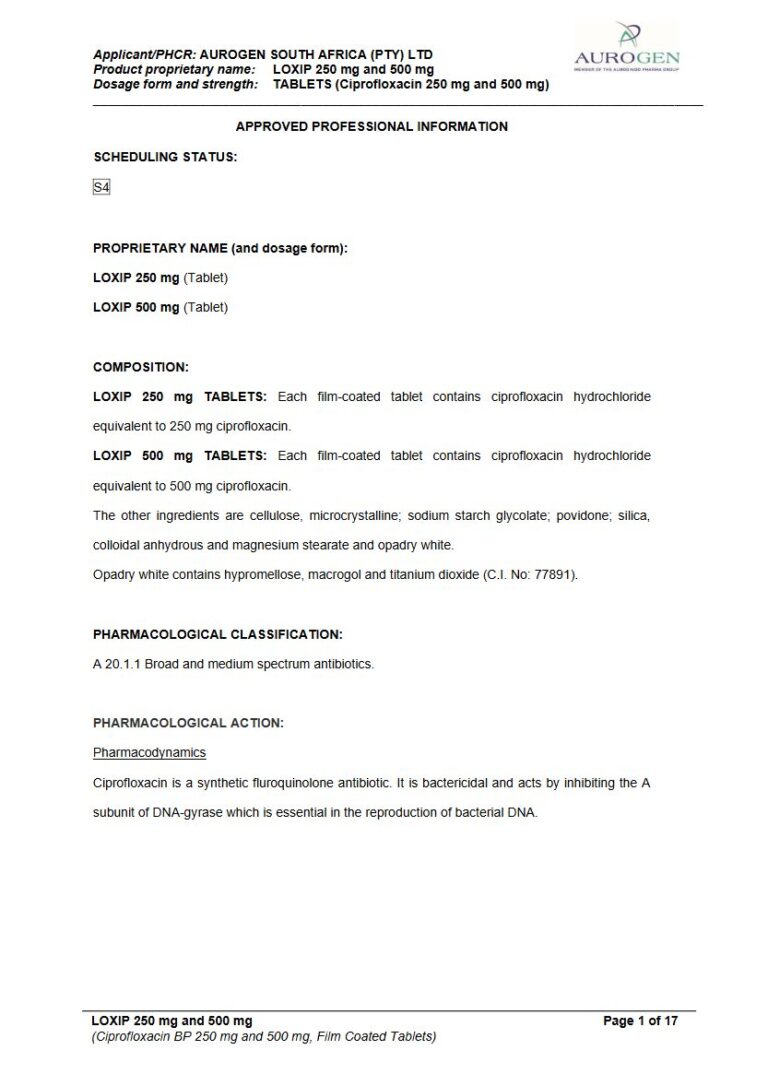
Loxip 250 Mg/500 Mg Tablets
PDF Leaflet Revision Date: 12 September 2023
Clinical Summary
Quick overview from the medicine insert
Indication
Treatment of infections caused by susceptible organisms.
Dosage (summary)
250-750 mg twice daily; adjust for renal impairment.
Onset of Action / Duration
Onset: 0.5-2 hours, Duration: 3-5 hours
Special Populations
- Elderly
- Renal impairment
- Hepatic impairment
Pregnancy & Breastfeeding
Contraindicated in pregnancy and breastfeeding.
Key Drug Interactions
- Theophylline
- Warfarin
- Methotrexate
- NSAIDs
Contraindications
- Hypersensitivity to ciprofloxacin
- Children under 18
Common side effects
- Nausea
- Diarrhea
- Dizziness
- QT prolongation
Counselling Points
- Stay hydrated
- Avoid sunlight exposure
- Monitor blood glucose in diabetics
Serious warnings
- Risk of tendon rupture
- CNS effects
- Severe skin reactions
Important Disclaimer
The Loxip 250 Mg/500 Mg Tablets professional information leaflet below is the property of Aurogen South Africa and is provided on Medinsert exactly as issued, with no.. alterations or editorial changes. We make every effort to keep content current by updating documents as soon as new versions become available. Medinsert serves as a trusted access point for healthcare professionals, but does not replace official sources or clinical judgement. For more details, please read our full disclaimer. read more>>
 Healthcare Professionals Only
This content is for registered healthcare professionals
Sign in or create a free account to read the full package insert.
Free for HPCSA-registered professionals. Powered by Medinsert.
Clinical Particulars
Section 4 of the official insert — extracted exactly as issued, no alterations
4.1 Therapeutic indications
LOXIP is indicated for the treatment of the following infections, when caused by susceptible organisms:
- Lower respiratory tract infections caused by: Enterobacter cloacae, Escherichia coli, Haemophilus influenzae, Haemophilus parainfluenzae, Klebsiella pneumoniae, Proteus mirabilis, Pseudomonas aeruginosa.
- Urinary tract infections caused by: Citrobacter diversus, Citrobacter freundii, Enterobacter cloacae, Escherichia coli, Klebsiella pneumoniae, Morganella morganii, Proteus mirabilis, Providencia rettgeri, Pseudomonas aeruginosa, Serratia marcescens, Staphylococcus epidermidis, Streptococcus faecalis.
- Skin and soft tissue infections caused by: Citrobacter freundii, Enterobacter cloacae, Escherichia coli, Klebsiella pneumoniae, Morganella morganii, Proteus mirabilis, Proteus vulgaris, Providencia stuartii, Pseudomonas aeruginosa, Staphylococcus aureus, Staphylococcus epidermidis, Streptococcus pyogenes.
- Gastro-intestinal infections: Infective diarrhoea caused by Campylobacter jejuni, Escherichia coli, Shigella flexneri and Shigella sonnei.
- Bone Infections: Osteomyelitis due to sensitive Gram-negative organisms.
- Gonorrhoea: (except that is due to N. gonorrhoeae) In the treatment of infections caused by Pseudomonas aeruginosa, an aminoglycoside must be administered concomitantly.
4.2 Posology and method of administration
LOXIP should be swallowed whole with plenty of liquid and may be taken with or without meals. The dosage range is 250 - 750 mg twice daily. The duration of treatment depends upon the severity of the infection, clinical response and bacteriological cultures. For acute uncomplicated cystitis in women, the treatment period is 3 days. Generally, treatment should be continued for at least 3 days after the signs and symptoms of the infection have disappeared. For acute infections the usual treatment period is 5 - 10 days with LOXIP. For severe and complicated infections more prolonged therapy may be required. In streptococcal infections the treatment must last at least 10 days.
Infections of the lower respiratory tract:
- Mild to moderate: 250 - 500 mg twice daily.
- Severe or complicated: 750 mg twice daily.
- In cystic fibrosis patients: 750 mg twice daily. The low body mass of these patients should, however, be taken into consideration when determining dosage (7.5 to 15 mg/kg/day).
Infections of the urinary tract:
- Acute uncomplicated cystitis: 250 mg twice daily.
- Mild to moderate: 250 mg twice daily.
- Severe or complicated: 500 mg twice daily.
Infections of the skin:
- Mild to moderate: 500 mg twice daily.
- Severe or complicated: 750 mg twice daily.
Infectious diarrhoea: 500 mg twice daily.
Bone Infections:
- Mild to moderate: 500 mg twice daily.
- Severe or complicated: 750 mg twice daily. Treatment may be required for 4 - 6 weeks or longer.
Gonorrhoea: A single dose of 250 mg. Elderly patients should be treated with the lowest possible dose.
Impaired Renal or Liver Function:
In patients with reduced renal function, the half-life of ciprofloxacin may be prolonged. The dosage needs to be adjusted as shown below. For patients with renal impaired and hepatic insufficiency, monitoring of medicine serum levels provides the most reliable basis for dose adjustment.
Dose adjustment of ciprofloxacin for patients with renal or hepatic impairment:
- Kidney insufficiency:
- Cl cr > 31 mL/min/1.73mu00b2 Max 800 mg/day intravenously.
- Cl cr < 30 mL/min/1.73mu00b2 Max 400 mg/day intravenously.
- Impaired renal function As in 1.2 above; after dialysis and haemodialysis on dialysis days.
- Renal impairment and CAPD (chronic ambulatory peritoneal dialysis):
- Oral administration of either LOXIP as 500 mg tablets or 2 x 250 mg tablets or LOXIP suspension equivalent to 500 mg LOXIP is indicated.
- For CAPD patients with peritonitis, the recommended daily oral dose is 500 mg four times a day.
- Hepatic impairment: No dose adjustment.
- Hepatic and renal impairment: As in 1.1 and 1.2 above.
4.3 Contraindications
LOXIP is contra-indicated in patients with a history of hypersensitivity to ciprofloxacin, any other quinolones, or any of the inactive ingredients of LOXIP. LOXIP is contra-indicated in children under the age of 18 years and in growing adolescents. Experimental evidence indicates lesions of the cartilage of weight-bearing joints in immature members of certain animal species.
4.4 Special warnings and precautions for use
LOXIP should be used in caution with patients with a history of convulsive disorders. Crystalluria related to the use of LOXIP has been observed. Patients receiving LOXIP should be well hydrated and excessive alkalinity of the urine should be avoided.
Special Precautions:
- Severe infections and/or infections due to Gram-positive or anaerobic bacteria: For the treatment of severe infections, staphylococcal infections and infections involving anaerobic bacteria, LOXIP should be used in combination with an appropriate antibacterial agent.
- Streptococcus pneumonia infections: LOXIP should not be used for treatment of pneumococcal infections due to inadequate efficacy against Streptococcus pneumonia.
- Genital tract infections: Genital tract infections may be caused by fluoroquinolone-resistant Nesseria gonorrhoeae isolates. In genital tract infections thought to be due to N. Gonorrhoeae, LOXIP should not be used.
- Cardiac disorders: LOXIP is associated with cases of QT prolongation. In general, elderly patients may be more susceptible to LOXIP -associated effects on the QT interval. Precaution should be taken when using LOXIP with concomitant medicinal products that can result in prolongation of the QT interval (e.g. class IA or III antidysrhythmics) or in patients with risk factors for torsades de pointes (e.g. known QT prolongation, uncorrected hypokalaemia).
- Hypersensitivity: In some instances, hypersensitivity and allergic reactions already occurred after the first administration and the doctor should be informed immediately. Anaphylactic/anaphylactoid reactions can progress to life threatening shock, even after the first administration. In these cases LOXIP has to be discontinued, medical treatment (e.g. treatment for shock) is required.
- Gastrointestinal system: In the event of severe and persistent diarrhoea during or after treatment a doctor must be consulted, since this symptom can hide a serious intestinal disease (life threatening pseudomembranous colitis with possible fatal outcome), requiring immediate treatment. In such cases, LOXIP must be discontinued and appropriate therapy initiated. Medicines that inhibit peristalsis are contraindicated.
- Musculoskeletal system: At any sign of tendonitis (e.g. painful swelling) the administration of LOXIP should be discontinued, physical exercise should be avoided, and a medical practitioner consulted. Tendon rupture (predominantly Achilles tendon) has been reported predominantly in the elderly on prior systemic treatment with glucocorticoids and in patients with kidney or lung transplant. Close monitoring of these patients is necessary if they are prescribed LOXIP. The risk is still present weeks after completion of treatment.
- Nervous system: In patients with epilepsy and in patients who have suffered from previous CNS-disorders (e.g. lowered convulsion threshold, previous history of convulsion, reduced cerebral blood flow, altered brain structure or stroke), LOXIP should only be used where the benefits of treatment exceed the risks, since these patients are vulnerable because of possible central-nervous side effects. In some instances the CNS reactions already occurred after the first administration of LOXIP. In these cases LOXIP must be discontinued and the medical practitioner informed immediately. Depression or psychosis can progress to result in self endangering behaviour.
- Skin and appendages: LOXIP has been shown to produce photosensitivity reactions. Patients taking LOXIP should avoid direct exposure to excessive sunlight or UV-light. Therapy should be discontinued if photosensitisation (i.e. sunburn-like skin reactions) occurs. Severe cutaneous adverse reactions (SCARS) including toxic epidermal necrolysis (TEN) Stevens Johnson Syndrome (SJS) and drug reaction with no eosinophilia and systemic symptoms (DRESS), which could be life-threatening or fatal, have been reported with LOXIP (see section SIDE-EFFECTS). At the time of prescription, patients should be advised of the signs and symptoms of severe skin reactions and closely monitored. If signs and symptoms suggestive of these reactions appear, LOXIP should be discontinued immediately, and an alternative treatment should be considered. If the patient has developed a serious reaction such as SJS, TEN or DRESS with use of LOXIP, treatment with LOXIP must not be restarted in this patient at any time.
- Cytochrome P450: Ciprofloxacin is known to be a moderate inhibitor of the CYP 450 1A2 enzymes. Care should be taken when other medicines which are metabolised via the same enzymatic pathway (e.g. theophylline, methylxanthines, caffeine, duloxetine, clozapine) are administered concomitantly with LOXIP. Increased plasma concentrations associated with medicine specific side effects may be observed due to inhibition of their metabolic clearance by LOXIP (See u201cINTERACTIONSu201d).
- Disturbances in blood glucose, including both hyperglycaemia and hypoglycaemia have been reported, usually in diabetic patients receiving concomitant treatment with an oral hypoglycaemic medicine or with insulin. Causes of hypoglycaemic coma have been reported. In diabetic patients, careful monitoring of blood glucose is recommended.
- Patients receiving LOXIP should be well hydrated and excessive alkalinity of the urine should be avoided.
- Long-term or repeated administration of LOXIP can lead to superinfections with resistant bacteria or fungi.
4.5 Interactions with other medicines
Concurrent administration with methotrexate may increase the concentration of methotrexate to toxic levels. There is a high risk of tendonitis (see u201cWARNINGS AND SPECIAL PRECAUTIONSu201d). Concurrent administration of LOXIP with theophylline may lead to elevated plasma concentrations of theophylline and prolongation of its elimination half-life. This may result in increased risk of theophylline-related toxicity. If concomitant use cannot be avoided, plasma levels of theophylline should be monitored and dosage adjustments made as appropriate. LOXIP should be administered 1 - 2 hours before, or at least 4 hours after taking iron preparations, antacids containing magnesium, aluminium, calcium or sucralfate, as interference with absorption may occur. This restriction does not apply to antacids belonging to the class of H2-receptor blockers. Concurrent administration of the nonsteroidal anti-inflammatory medicines (NSAIDSs), with quinolones such as LOXIP may increase the risk of central nervous system stimulation and seizures. Monitoring of serum creatinine concentrations is advised in patients on concomitant ciclosporin therapy, as transient increases in serum creatinine concentrations have been observed. The simultaneous administration of LOXIP and warfarin may lead to warfarin toxicity; therefore the INR should be closely monitored. Concurrent administration of LOXIP and glibenclamide can potentiate the action of glibenclamide, leading to hypoglycaemia. Probenecid interferes with renal secretion of LOXIP. Co-administration of probenecid and LOXIP increases the LOXIP serum concentrations. Metoclopramide accelerates the absorption of LOXIP, resulting in a shorter time to reach maximum plasma concentrations. Concurrent administration of LOXIP with ropinirole may lead to elevated plasma concentrations of ropinirole. Monitoring for ropinirole-related side effects and appropriate dose adjustment of ropinirole is recommended during and shortly after co-administration with LOXIP. Concurrent administration of LOXIP with lidocaine (lignocaine) may lead to elevated plasma concentrations of lidocaine and increase in side effects related to lidocaine also occurs. Concurrent administration of LOXIP with clozapine may lead to elevated serum concentrations of clozapine and N-desmethylclozapine. Careful monitoring of clozapine associated adverse effects and appropriate adjustment of clozapine dosage during and shortly after co-administration with LOXIP is advised. Concurrent administration of LOXIP with sildenafil may lead to elevated serum concentrations of sildenafil. Therefore, sildenafil should be used with caution when co-administered with LOXIP.
4.6 Fertility, pregnancy and lactation
Safety in pregnancy and lactation has not been established (See u201cCONTRA-INDICATIONSu201d). On the basis of animal studies, it has been reported that ciprofloxacin, as in LOXIP may cause damage to articular cartilage in the fetus. It has also been reported to cause teratogenic effects in animals. Therefore, LOXIP should not be given to pregnant women.
Lactation: Ciprofloxacin is excreted in breastmilk. LOXIP should not be used during breastfeeding.
4.7 Effects on ability to drive and use machines
The ability to drive a motor vehicle or operate machinery may be impaired by LOXIP, particularly when used in combination with alcohol. Side-effects that may be potentially life-threatening are pancytopenia and bone marrow depression (see u201cSIDE-EFFECTSu201d).
4.8 Undesirable effects
MedDRA system organ class Frequency Adverse reactions Blood and the lymphatic system disorders Frequency unknown Eosinophilia, leucocytopaenia, granulocytopaenia, anaemia, thrombocytopenia, leucocytosis, thrombocytosis, haemolytic anaemia, altered prothrombin values, pancytopenia, bone marrow depression. Immune system disorders Frequency unknown Anaphylactic/anaphylactoid reactions can occur (e.g. facial, vascular and laryngeal oedema, dyspnoea progressing to life-threatening shock), serum sickness-like reaction, in some instances after the first administration. In these cases LOXIP has to be discontinued and appropriate medical treatment instituted Metabolism and nutrition disorders Rare: Less frequent: hypoglycaemia, particularly in diabetic patients Psychiatric disorders Less frequent: Agitation, anxiety states, confusion, disorientation, hallucinations, psychotic reactions (even progressing to self-endangering behaviour), depression, nightmares. Nervous system disorders Less frequent: Headache, migraine, dizziness, tiredness, nervousness and trembling, hypoaesthesia, paraesthesia, dysaesthesia, hyperaesthesia, insomnia, peripheral paralgesia, sweating, unsteady gait, convulsions, increase in intracranial pressure, seizures, peripheral neuropathy and polyneuropathy. Eye disorders Less frequent: Visual disturbances (e.g. diplopia, colour vision). Ear and labyrinth disorders Less frequent: Tinnitus, transient impairment of hearing, vertigo, hearing loss. Cardiac disorders Less frequent: Tachycardia, flushes, QT prolongation, ventricular dysrhythmia, Torsades de Pointes Vascular Disorders Less frequent: syncope, hypotension, vasodilatation and vasculitis. Gastrointestinal disorders Frequent: Impaired taste and smell, nausea, diarrhoea, vomiting, dyspepsia, abdominal pain and flatulence. The development of severe and persistent diarrhoea may indicate pseudomembranous colitis, requiring immediate treatment. In such cases LOXIP must be discontinued and appropriate therapy initiated. Less frequent pancreatitis Hepatobiliary Disorders Unknown frequency Hepatic necrosis, very seldom progressing to hepatic failure, hepatic impairment, jaundice, increase in transaminases and bilirubin. Skin and subcutaneous tissue disorders: Unknown frequency Rashes, pruritus, urticaria and photosensitivity (blisters, sensation of skin burning), erythema nodosum and erythema exsudativum multiforme, Stevens-Johnson syndrome, toxic epidermal necrolysis, punctate skin haemorrhages (petechiae), haemorrhagic bullae and papules with signs of vascular involvement (vasculitis) and Acute generalised exanthematous pustulosis (AGEP), Drug reaction with eosinophilia and systemic symptoms (DRESS). Musculoskeletal, connective tissue and bone disorders: Frequency unknown Joint pain, joint swelling, general feeling of weakness (arthralgia), and myalgia (which may be of special importance in patients with myasthenia gravis) and tendosynovitis, cases of tendon rupture and achillotendonitis, increased muscle tone and cramping. Renal and urinary disorders: Frequency unknown Crystalluria, interstitial nephritis, transient renal impairment including transient renal failure, and haematuria. Investigations Frequency unknown Abnormal prothrombin level, increased amylase, Increased blood alkaline phosphatase, hyperglycaemia. Post-marketing adverse reactions Hyperglycaemia, hyperglycaemic coma.
4.9 Overdose
In the event of acute, excessive oral over-dosage, reversible renal toxicity has been reported. Apart from routine emergency measures, it is recommended to monitor renal function and to administer magnesium- or calcium-containing antacids which reduce the absorption of oral LOXIP. Only a small amount of ciprofloxacin (< 10 %) is removed from the body after haemodialysis or peritoneal dialysis. Treatment is symptomatic and supportive.
