
Measles Rubella Cipla NLT Solution
PDF Leaflet Revision Date: 12 May 2023
Clinical Summary
Quick overview from the medicine insert
Indication
Active immunisation against measles and rubella.
Dosage (summary)
Single dose of 0.5 mL for all ages.
Special Populations
- Immunocompromised patients
- Adolescent and adult females of childbearing age
Pregnancy & Breastfeeding
Contraindicated in pregnancy; no data on breastfeeding.
Key Drug Interactions
- Immunosuppressants
- Immunoglobulins
- Blood products
Contraindications
- Previous anaphylactic reaction
- Severe immunosuppression
- Pregnancy
- Allergy to neomycin or cow's milk
Common side effects
- Injection site pain
- Fever
- Rash
- Arthralgia
Counselling Points
- Inform about potential mild side effects
- Advise to report any severe reactions
- Ensure proper storage and handling of vaccine
Serious warnings
- Observe for 30 mins post-vaccination for allergic reactions
- Do not inject intravascularly
Important Disclaimer
The Measles Rubella Cipla NLT Solution professional information leaflet below is the property of Cipla Medpro and is provided on Medinsert exactly as issued, with no.. alterations or editorial changes. We make every effort to keep content current by updating documents as soon as new versions become available. Medinsert serves as a trusted access point for healthcare professionals, but does not replace official sources or clinical judgement. For more details, please read our full disclaimer. read more>>
 Healthcare Professionals Only
This content is for registered healthcare professionals
Sign in or create a free account to read the full package insert.
Free for HPCSA-registered professionals. Powered by Medinsert.
Clinical Particulars
Section 4 of the official insert — extracted exactly as issued, no alterations
4.1 Therapeutic indications
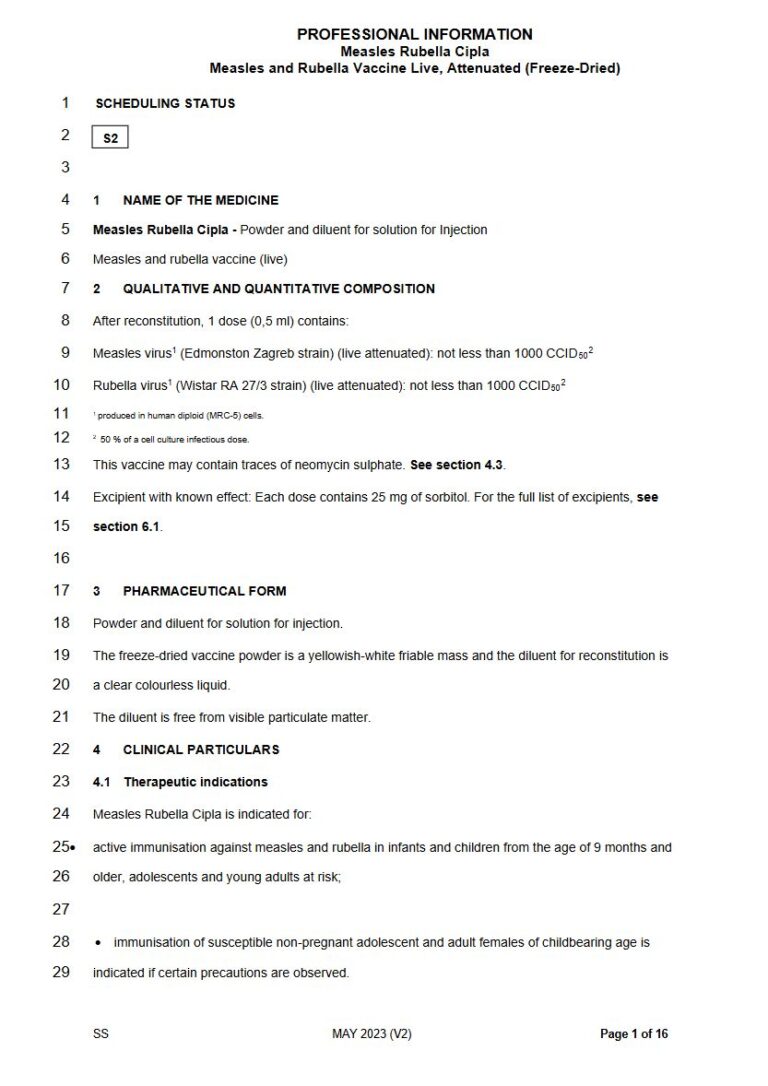
Measles Rubella Cipla is indicated for:
- active immunisation against measles and rubella in infants and children from the age of 9 months and older, adolescents and young adults at risk;
- immunisation of susceptible non-pregnant adolescent and adult females of childbearing age is indicated if certain precautions are observed.
4.2 Posology and method of administration
Posology
The dose for all ages is the same; being a single dose of 0,5 mL of reconstituted vaccine. The reconstituted vaccine is a yellowish to a pale yellow clear liquid. For instructions on the reconstitution of the vaccine before administration, see section 6.6.
Vaccination schedule
The national immunisation guidelines need to be referred to before administration of Measles Rubella Cipla.
Measles:
All children should receive 2 doses of measles-containing vaccine. Depending on the risk of measles infection; one of the following immunisation schedules is to be followed:
- If the risk of measles infection is high, the first dose of Measles Rubella Cipla should be administered at 9 months or shortly thereafter and the second dose should be administered between 15 and 18 months. The minimum interval between doses is 4 weeks.
- If the risk of measles infection is low, the first dose of Measles Rubella Cipla may be administered between 12 to 15 months and the second dose may be administered between 4 to 6 years of age.
Rubella:
All children should receive at least one dose of rubella-containing vaccine. It is given as a combination with measles-containing vaccine with first dose usually given at 9 months or 12 to 15 months and a second dose at 15 to 18 months or 4 to 6 years. Susceptible non-pregnant adolescent and adult females of childbearing age may receive one dose of Measles Rubella Cipla if certain precautions are observed (see section 4.3).
4.3 Contraindications
Measles Rubella Cipla is contraindicated in recipients who:
- have had a previous confirmed anaphylactic reaction to a previous dose of a vaccine containing 76 the same antigens or are hypersensitive to any of the vaccine components, including gelatin. (see 77 section 6.1 );
- are allergic to neomycin; as Measles Rubella Cipla may contain traces of this antibiotic.
- are allergic to cowu2019s milk as there have been a few reports of hypersensitivity with MMR vaccines in these individuals;
- are severely immunosuppressed because of medication (e.g. high dose steroids, alkylating agents and antimetabolites), other therapy such as radiation, or underlying illness (e.g congenital immunodeficiency, leukaemia, lymphoma, generalised malignant disease) or patients with HIV infection who are severely immunocompromised or patients with a family history of altered immunocompetence;
- pregnant, due to the theoretical, but never demonstrated teratogenic risk (see section 4.6);
- have received immunoglobulins or blood products (see sections 4.4 and 4.5).
Measles-containing vaccines such as Measles Rubella Cipla should not be administered to patients with concurrent moderate or severe illnesses, including those with significant fever. There is no evidence that measles or rubella vaccine will suppress the immune system enough to activate latent tuberculosis or augment active tuberculous disease. However, persons with known active tuberculosis should not be vaccinated until treatment has been established. Low grade fever, mild respiratory infections or diarrhoea, and other minor illness should not be considered as contraindications. It is particularly important to immunise children with malnutrition.
4.4 Special warnings and precautions for use
- Measles Rubella Cipla is to be administered by subcutaneous route only;
- After administration of Measles Rubella Cipla; the recipient should remain under observation for at least 30 minutes for possibility of occurrence of rapid allergic reactions;
- Adequate treatment provisions, including epinephrine (adrenalin) injection (1:1000), should be available for immediate use should an anaphylactic or anaphylactoid reaction occur;
- Patients with rare hereditary conditions of sorbitol intolerance should not be vaccinated with Measles Rubella Cipla;
- Immunocompromised patients (whether from disease or treatment) may not develop an optimal immune response after vaccination with Measles Rubella Cipla;
- Measles Rubella Cipla may be used in children with known or suspected HIV infection and who are not severely immunosuppressed;
- For persons with moderate or severe illness, vaccination with Measles Rubella Cipla should be postponed and administered after the patient has recovered;
- Vaccination should be deferred for 3 months or longer following blood or plasma transfusions, or administration of immunoglobulins (see section 4.5);
- In order to improve the traceability of vaccines, the name and batch number of the administered product should be clearly recorded;
- Persons who have had an anaphylactic reaction to gelatin or gelatin-containing products should be evaluated by an allergist prior to receiving gelatin-containing vaccines.
4.5 Interaction with other medicinal products and other forms of interaction
Patients receiving immunosuppressant therapy, including anti-neoplastics or therapeutic doses of corticosteroids may display a reduced response to Measles Rubella Cipla. Measles Rubella Cipla should not be administered for at least 3 months after the use of immunoglobulins or blood products containing immunoglobulins due to the risk of vaccine inactivation. For the same reason, immunoglobulins or blood products should not be administered within two weeks after vaccination. Tuberculin positive individuals may transitionally become tuberculin negative after vaccination. Measles Rubella Cipla can be safely and effectively given simultaneously with DTP, DT, TT, Td, BCG, Polio vaccine (OPV and IPV), Haemophilus influenzae type b, Hepatitis B, Yellow fever vaccine and vitamin A supplementation.
4.6 Fertility, pregnancy and lactation
Pregnancy
Measles Rubella Cipla is contraindicated (see section 4.3 ) in pregnancy.
Breastfeeding
No studies on the effects on lactation have been performed.
Fertility
No human data on the effect of Measles Rubella Cipla on fertility are available.
4.7 Effects on ability to drive and use machines
No studies on the effects on the ability to drive and use of machines have been performed.
4.8 Undesirable effects
a. Summary of the safety profile
The type and rate of severe adverse reactions do not differ significantly from the measles and rubella vaccine reactions described separately.
The measles vaccine may cause within 24 hours of vaccination mild pain and tenderness at the injection site. In most cases these reactions spontaneously resolve within two to three days without further medical attention. A mild fever can occur in 5 to15 % of vaccinees seven to twelve days after vaccination and last for one to two days. Rash occurs in approximately 2 % of recipients, usually starting seven to ten days after vaccination and lasting two days.
The mild side effects occur less frequently after the second dose of a measles-containing vaccine and tend to occur only in persons not protected by the first dose. Encephalitis has been reported following measles vaccination at a frequency of approximately one case per million doses administered although a causal link is not proven.
The rubella component may commonly result in joint symptoms manifested as arthralgias (25 %) and arthritis (10 %) among adolescents and adult females that usually last from a few days to two weeks. Symptoms typically begin one to three weeks after vaccination and last one day to two weeks. These transient reactions seem to occur in non-immunes only, for whom the vaccine is important. Low grade fever and rash, lymphadenopathy, myalgia and paraesthesiae are commonly reported. Thrombocytopenia is rare and has been reported in less than one case per 30 000 doses administered. Anaphylactic reactions are also rare. In susceptible individuals the vaccine may very rarely cause allergic reactions like urticaria, pruritis and allergic rash within 24 hours of vaccination. Clinical experience has exceptionally recorded isolated reactions involving the Central Nervous System (CNS). These more serious reactions have however, not been directly linked to vaccination.
Adverse reactions from clinical trials
Frequencies are reported as:
- Very common; u2265 1/10
- Common; u2265 1/100 to < 1/10
- Uncommon: u2265 1/1 000 to < 1/100
- Very rare: u2264 1/10 000
- Frequency not known (cannot be estimated from the available data)
In controlled clinical studies, signs and symptoms were monitored during a 5 to 6 week follow-up period (trial specific). The safety profile presented below is based on a total of 1444 subjects administered Measles Rubella Cipla in clinical trials. This data is further supported by other clinical study reports.
4.9 Overdose
No cases of overdose have been reported for Measles Rubella Cipla.
