
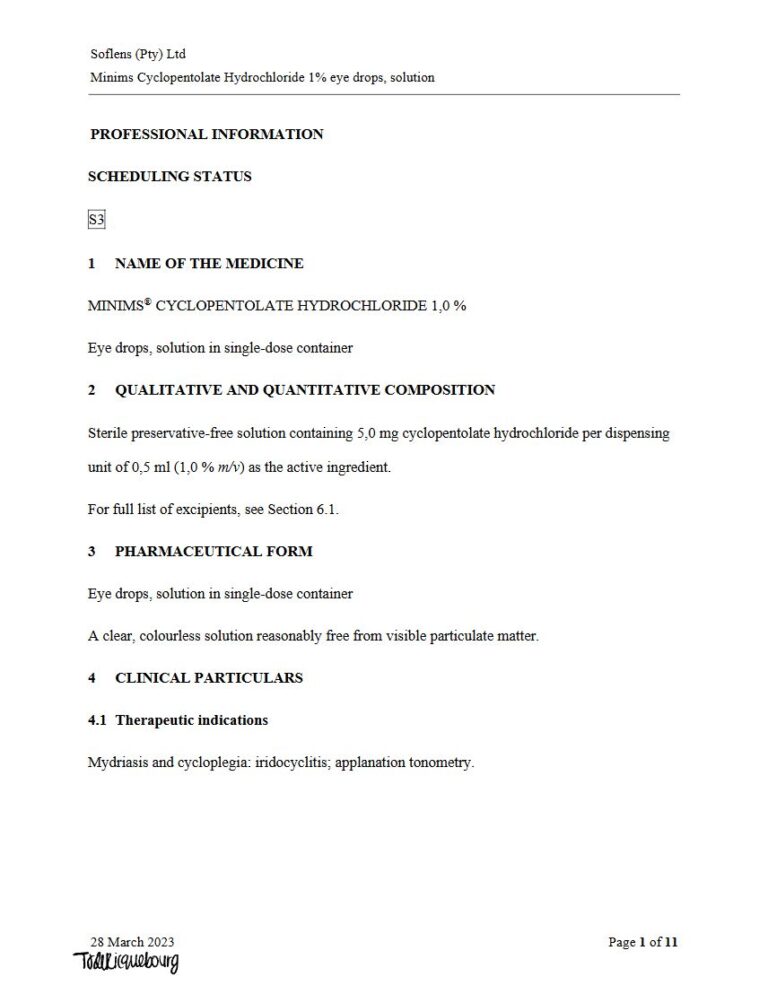
Minims Cyclopentolate Hydrochloride 1,0 % 0,5 ml Eye drops,
PDF Leaflet Revision Date: 28 March 2023
Clinical Summary
Quick overview from the medicine insert
Indication
Mydriasis and cycloplegia for iridocyclitis and applanation tonometry.
Dosage (summary)
Adults: 1 drop for refraction, repeat after 5 mins; for iridocyclitis: 1 drop every 6-8 hours. Children: 1 drop, observe for 45 mins.
Onset of Action / Duration
Onset: 30-60 mins, Duration: 24 hours
Special Populations
- Elderly
- Children under 1 year
- Patients with CNS disorders
Pregnancy & Breastfeeding
Safety in pregnancy and lactation not established.
Key Drug Interactions
- Antiglaucoma agents (carbachol, pilocarpine)
- Ophthalmic cholinesterase inhibitors
Contraindications
- Hypersensitivity to cyclopentolate
- Narrow-angle glaucoma
- Neonates
- Sensitive patients (e.g., infants, elderly)
Common side effects
- Local irritation
- Increased intraocular pressure
- CNS disturbances
Counselling Points
- Avoid driving until vision is clear
- Protect eyes from light
- Do not administer to children under 1 year
Serious warnings
- Risk of systemic toxicity in children
- Caution in angle closure glaucoma
Important Disclaimer
The Minims Cyclopentolate Hydrochloride 1,0 % 0,5 ml Eye drops, professional information leaflet below is the property of Soflens and is provided on Medinsert exactly as issued, with no.. alterations or editorial changes. We make every effort to keep content current by updating documents as soon as new versions become available. Medinsert serves as a trusted access point for healthcare professionals, but does not replace official sources or clinical judgement. For more details, please read our full disclaimer. read more>>
 Healthcare Professionals Only
This content is for registered healthcare professionals
Sign in or create a free account to read the full package insert.
Free for HPCSA-registered professionals. Powered by Medinsert.
Clinical Particulars
Section 4 of the official insert — extracted exactly as issued, no alterations
4.1 Therapeutic indications
Mydriasis and cycloplegia: iridocyclitis; applanation tonometry.
The maximum effect is produced in 30 - 60 minutes after instillation; recovery of accommodation occurs within 24 hours, but may be hastened if one or two drops of a 2 % solution of pilocarpine nitrate are instilled.
4.2 Posology and method of administration
Adults and Children: To be used as directed by the ophthalmologist.
For refraction: Adults: one drop of solution repeated after 5 minutes is usually sufficient, but deeply pigmented eyes may require dose adjustment. Children one year and older: one drop of solution. Children should be observed for 45 minutes after instillation.
For iridocyclitis: Adults, only: In iritis or iridocyclitis one drop of solution is instilled every six to eight hours.
4.3 Contraindications
- Hypersensitivity to cyclopentolate hydrochloride or any other ingredients (see Section 6.1).
- Cyclopentolate hydrochloride should not be administered to patients with narrow-angle glaucoma, or to those with a narrow angle between the iris and the cornea, since its use may increase intra-ocular pressure.
- Cyclopentolate hydrochloride should not be used in neonates.
- Do not use in sensitive patients, especially infants, premature births, small children, adults over 65 years old and patients with Downu2019s syndrome, as well as in children with brain damage (see section 4.4).
- Children below 1 year of age.
- Do not use in children with organic brain syndromes, including congenital or neuro-developmental abnormalities, particularly those predisposing to epileptic seizures.
4.4 Special warnings and precautions for use
MINIMS u00ae Cyclopentolate eye drops are for topical ophthalmic use only. The solution should not be injected.
Complete recovery of accommodation usually occurs within 24 hours, however complete recovery may require several days in some individuals.
Eyes may become sensitive to light while using MINIMS u00ae Cyclopentolate eye drops. Patients should be advised to protect their eyes, e.g. by wearing sunglasses.
Cyclopentolate may cause central nervous system (CNS) disturbances when administered topically to the eye. This is especially true in younger age groups and other patients at special risk, such as debilitated or aged patients, but may occur at any age.
Caution should be observed when considering the use of this medication in those predisposed to angle closure glaucoma. To avoid inducing angle closure glaucoma, an estimation of the depth of the anterior chamber should be made.
Resistance to cycloplegia can occur in young children in patients with dark irides (see Section 4.2).
Caution is advised in hyperaemia as increased systemic absorption may occur.
Systemic absorption of cyclopentolate may be reduced by compressing the lacrimal sac at the medial canthus for a minute during and following the instillation of the drops. This blocks the passage of the drops via the naso-lacrimal duct to the wide absorptive area of the nasal and pharyngeal mucosa. It is especially advisable in children.
Paediatric population: Extreme caution is advised for use in individuals susceptible to belladonna alkaloids because of the increased risk of systemic toxicity. Atropine-like effects have been reported as side effects.
MINIMSu00ae Cyclopentolate eye drops should not be used in new-borns or infants under the age of 1 year due to the increased risk of systemic toxicity (see section 4.3). MINIMSu00ae Cyclopentolate eye drops should be used with caution in children over 1 year of age and with extreme caution in those who are particularly susceptible to severe central nervous system disorders (e.g. epilepsy, brain injury, Downu2019s syndrome) as there is an increased risk of toxicity in the central nervous system, cardiopulmonary, and gastrointestinal, systems due to systemic uptake of cyclopentolate (see section 4.8).
Use of cyclopentolate has been associated with psychotic reactions, and behavioural disturbances in paediatric patients. Increased susceptibility to cyclopentolate has been reported in infants, young children and in children with brain damage. These disturbances include ataxia, incoherent speech, restlessness, hallucinations, hyperactivity, seizures, disorientation as to time and place and failure to recognise people.
Feeding intolerance may follow ophthalmic use of this product in children older than 1 year. It is recommended that feeding be withheld for four (4) hours after examination. Observe children closely for at least 30 minutes.
Cyclopentolate should be used with caution in children as convulsions including grand mal have been reported.
Necrotic colitis in premature children: Particular caution should be used when used in children because cases of necrotic colitis have been reported following administration of cyclopentolate eye drops in premature babies (see section 4.8). Early symptoms may include, but are not limited to, bradycardia, vomiting, food intolerance, increased stomach residues, abdominal distension, and bloody stools. In such a case, immediate medical evaluation is needed.
Parents are advised to avoid contact of the solution with the childu2019s mouth and to wash their hands and the childu2019s hands after administering the drops.
Use in the elderly: MINIMS u00ae Cyclopentolate eye drops should be used with caution in elderly patients where increased intraocular pressure may be encountered and/or where they may be more susceptible to the CNS effects of cyclopentolate.
4.5 Interaction with other medicines and other forms of interaction
Although negligible cyclopentolate passes into the bloodstream after ocular instillation, medicine interactions are nevertheless possible.
The interactions observed with cyclopentolate administered by any route should therefore be taken into account.
Cyclopentolate may interfere with the antiglaucoma action of carbachol or pilocarpine; also, concurrent use of this medication may antagonise the antiglaucoma and miotic action of ophthalmic cholinesterase inhibitors.
4.6 Fertility, pregnancy and lactation
Pregnancy: Safety for use in pregnancy has not been established.
Breastfeeding: It is not known whether cyclopentolate and/or its metabolites are excreted in breast milk. Safety for use in lactation has not been established.
Fertility: No studies have been performed to evaluate the potential fertility impairing effects of cyclopentolate.
4.7 Effects on ability to drive and use machines
MINIMS u00ae Cyclopentolate eye drops may cause transient blurring of vision on instillation. Patients should be advised not to drive or operate hazardous machinery until vision is clear.
4.8 Undesirable effects
Local effects: Eye disorders: Local irritation may result following the use of this product. The frequency of this effect occurring is dependent on the concentration instilled. Allergic conjunctivitis or blepharoconjunctivitis may rarely occur, manifesting as diffusely red eyes with lacrimation and itching. Increased intraocular pressure may occur in predisposed patients. Other local effects include: burning, photophobia, blurred vision, irritation, hyperaemia and punctate keratitis.
Systemic effects: Systemic cyclopentolate toxicity may be dose-related. Systemic adverse effects from cyclopentolate are not uncommon, especially in children, although this information is based on post-marketing reports for which frequencies are not accurately known.
Immune system disorders: Anaphylactic reaction and anaphylactic shock.
Nervous system disorders: Toxicity is usually transient and is manifested mainly by CNS disturbances. These reactions may include ataxia, seizures (especially in children), somnolence, incoherent speech, restlessness, hallucinations, hyperactivity, disorientation with regard to time and place, and failure to recognise people.
Peripheral effects atypical of anti-cholinergics, such as flushing or dryness of the skin and mucous membranes (mouth), as well as temperature changes have also been observed rarely with topical cyclopentolate in children and adults. Other systemic effects include, urinary retention, vertigo, incoordination, giddiness, poor balance and tremor.
Cardiac disorders: Tachycardia.
Gastrointestinal disorders: Necrotising colitis (in preterm infants), constipation, vomiting, gastroenteritis and feeding intolerance in infants.
Skin and subcutaneous tissue disorders: Skin rash.
Paediatric population: The occurrence of systemic adverse effects is higher in children and infants.
Reporting of suspected adverse reactions: Reporting suspected adverse reactions after authorisation of the medicine is important. It allows continued monitoring of the benefit-risk of the medicine. Health care providers are asked to report any suspected adverse reactions to SAHPRA via the u201c6.04 Adverse Drug Reactions Reporting Formu201d, found online under SAHPRAu2019s publications: https://www.sahpra.org.za/Publications/Index/8. Suspected adverse reactions may also be reported directly to the Holder of the Certificate of registration using the following e-mail address: [email protected].
4.9 Overdose
Overdose is rare, but symptoms can include those mentioned under Section 4.8 above. Treatment is supportive, and as required to control symptoms of anticholinergic overdose. Specific therapies may be required, e.g. benzodiazepines for seizures.
