
Miochol-E 20 mg Solution
PDF Leaflet Revision Date: 04 September 2020
Clinical Summary
Quick overview from the medicine insert
Indication
Rapid miosis during anterior segment surgery.
Dosage (summary)
0.5 to 2 mu2113 for satisfactory miosis.
Onset of Action / Duration
Onset: seconds, Duration: short.
Special Populations
- Children
Pregnancy & Breastfeeding
Safety in pregnancy and lactation not established.
Key Drug Interactions
- Anticholinesterases
- Beta blockers
- NSAIDs
Contraindications
- Hypersensitivity to acetylcholine
- Intestinal obstruction
- Asthma
- Cardiovascular disorders
- Pregnancy
Common side effects
- Corneal oedema
- Bradycardia
- Hypotension
Counselling Points
- Prepare solution immediately before use
- Do not re-sterilize
- Discard unused solution
Serious warnings
- Caution in systemic conditions
- Use only after lens delivery in cataract surgery
Important Disclaimer
The Miochol-E 20 mg Solution professional information leaflet below is the property of Soflens and is provided on Medinsert exactly as issued, with no.. alterations or editorial changes. We make every effort to keep content current by updating documents as soon as new versions become available. Medinsert serves as a trusted access point for healthcare professionals, but does not replace official sources or clinical judgement. For more details, please read our full disclaimer. read more>>
 Healthcare Professionals Only
This content is for registered healthcare professionals
Sign in or create a free account to read the full package insert.
Free for HPCSA-registered professionals. Powered by Medinsert.
Clinical Particulars
Section 4 of the official insert — extracted exactly as issued, no alterations
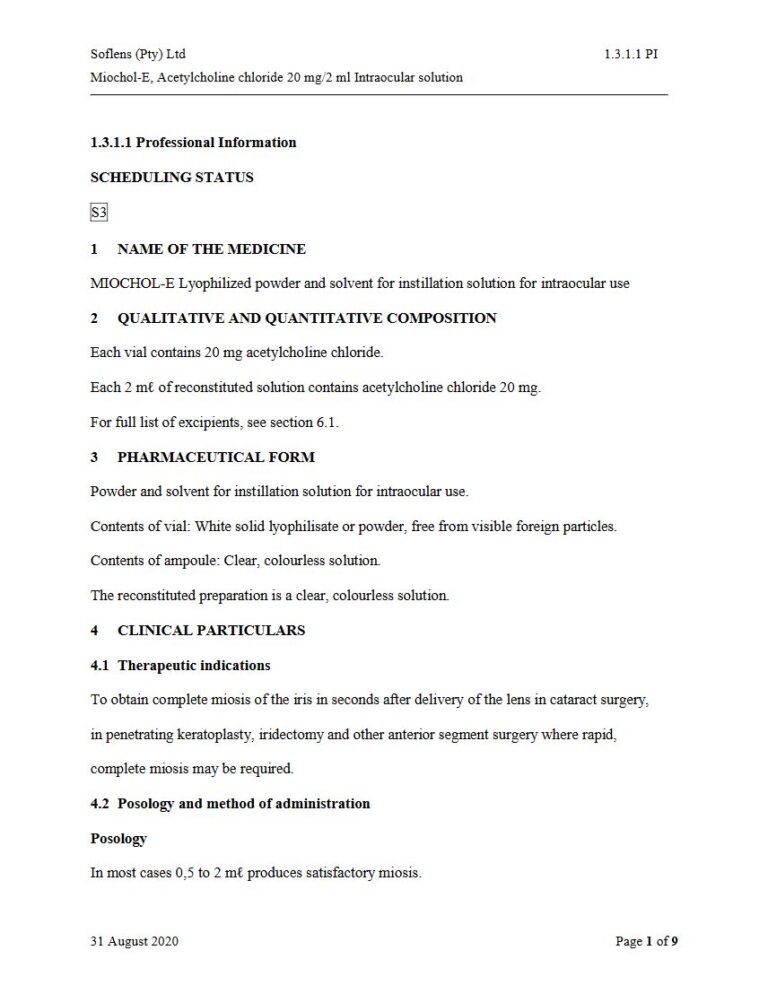
4.1 Therapeutic indications
To obtain complete miosis of the iris in seconds after delivery of the lens in cataract surgery, in penetrating keratoplasty, iridectomy and other anterior segment surgery where rapid, complete miosis may be required.
4.2 Posology and method of administration
Posology
In most cases 0,5 to 2 mu2113 produces satisfactory miosis.
Method of administration
If blister or peelable backing is damaged or broken, sterility of the enclosed bottle cannot be assured. Open under aseptic conditions only. DO NOT GAS STERILISE. The syringe containing the reconstituted preparation must be fitted with a suitable irrigation cannula for intraocular irrigation. The MIOCHOL-E solution is instilled into the anterior chamber before or after securing one or more sutures. Instillation should be gentle and parallel to the iris face and tangential to pupil border. If there are no mechanical hindrances, the pupil is rapidly constricted, and the peripheral iris drawn away from the angle of the anterior chamber. Any anatomical hindrance to miosis may require surgery to permit the desired effect of the agent. The MIOCHOL-E solution need not be flushed from the chamber after miosis occurs. Since the action of acetylcholine is of short duration, pilocarpine may be applied topically before dressing to maintain miosis. In cataract surgery, use MIOCHOL-E only after delivery of the lens.
Paediatric population
The safety and efficacy of MICHOL-E in children has not been established.
Directions for using the product:
STERILE UNLESS PACKAGE OPEN OR BROKEN. Open under aseptic conditions only.
1. Inspect unopened blister to ensure that it is intact. Peel open blister.
2. Aseptically transfer the ampoule, vial and filter hub to sterile field. Maintain asepsis during preparation of solution.
3. Aseptically attach a sterile 18 to 20 gauge, bevelled needle to the luer tip of a sterile disposable syringe with twisting motion to assure secure fit.
4. Break open the ampoule containing the solvent. The One Point Cut (OPC) must be opened as follows: Hold the bottom part of the ampoule with the thumb pointing to the coloured point. Grasp the top of the ampoule with the other hand, positioning the thumb at the coloured point and press back to break at the existing cut under the point.
5. Remove the needle protector and withdraw the solvent from the ampoule into the syringe. Discard ampoule.
6. Remove and discard plastic cap from top of vial.
7. Insert the needle through the centre of the vial stopper.
8. Transfer the solvent from the syringe to the vial.
9. Shake gently to dissolve vial content.
10. Slowly withdraw the solution from the vial through the needle into the syringe.
11. Discard needle.
12. Aseptically open filter hub pouch.
13. Aseptically attach filter hub onto luer tip of syringe with a twisting motion to assure secure fit.
14. Aseptically attach a sterile blunt tip irrigation cannula to male luer of filter prior to intraocular irrigation.
15. Discard appropriately after use. Do not re-use the filter hub.
NOTE:
Aqueous solutions of acetylcholine chloride are unstable. Prepare solution immediately before use. Do not use solution which is not clear and colourless. Discard any solution that has not been used. MIOCHOL-E should not be re-sterilised. The filter hub is recommended only for use with MIOCHOL-E. Aspiration through the filter is not recommended. However, if utilised, discard needle and syringe filter to prevent recontamination of fluids during injection. Do not aspirate and inject through the same filter.
4.3 Contraindications
Hypersensitivity to acetylcholine chloride or any of the ingredients of MIOCHOL-E (see 6.1 List of excipients). Safety and efficacy in children have not been established. See section 4.4 Special warnings and precautions for use.
4.4 Special warnings and precautions for use
If miosis is to be obtained quickly and completely with MIOCHOL-E, obstructions to miosis, such as anterior or posterior synechiae, may require surgery prior to administration of MIOCHOL-E. In cataract surgery, use MIOCHOL-E only after delivery of the lens. The systemic use of choline esters such as in MIOCHOL-E are generally contra-indicated in the following conditions: Intestinal or urinary obstruction or where increased muscular activity of the urinary or gastrointestinal tract is liable to be harmful, asthma and obstructive airways disease, cardiovascular disorders including bradycardia or heart block and recent myocardial infarction, hypotension, vagotonia, epilepsy, parkinsonism, hyperthyroidism, peptic ulceration, and pregnancy. Although acetycholine is normally rapidly hydrolysed in the body, systemic effects have followed topical application of choline esters such as contained in MIOCHOL-E to the eye. Caution is advisable in the above conditions.
4.5 Interaction with other medicines and other forms of interaction
Acetylcholine is hydrolysed in the body by cholinesterase and its effects are significantly prolonged and enhanced if given after anticholinesterases.
Beta blockers: Severe bronchospasm with subsequent pulmonary oedema was reported after intra-ocular injection of acetylcholine chloride in a patient also receiving oral metoprolol.
NSAIDs: Although clinical studies with acetylcholine chloride and animal studies with acetylcholine revealed no interference, and there is no known pharmacological basis for an interaction, there have been reports that acetylcholine has been ineffective when used in patients treated with topical non-steroidal anti-inflammatory agents.
4.6 Fertility, pregnancy and lactation
The safety of this preparation in pregnancy and lactation has not been established. Refer to section 4.4 Special warnings and precautions for use.
4.8 Undesirable effects
Eye disorders
Less frequent: Cases of corneal oedema, corneal clouding and corneal decompensation.
Frequency unknown: Persistent bullous keratopathy, retinal detachment and postoperative iritis.
Systemic disorders
Less frequent: Bradycardia, hypotension, flushing, breathing difficulties and sweating.
Frequency unknown: Nausea and vomiting, abdominal pain, salivation, lachrymation, rhinorrhoea, eructation, diarrhoea, urinary frequency and headache.
Reporting of suspected adverse reactions
Reporting suspected adverse reactions after authorisation of the medicine is important. It allows continued monitoring of the benefit-risk of the medicine. Health care providers are asked to report any suspected adverse reactions to SAHPRA via the u201c6.04 Adverse Drug Reactions Reporting Formu201d, found online under SAHPRAu2019s publications: https://www.sahpra.org.za/Publications/Index/8 Suspected adverse reactions may also be reported directly to the Holder of the Certificate of registration using the following e-mail address: [email protected]
4.9 Overdose
The symptoms of overdosage are likely to be effects resulting from systemic absorption. See section 4.8 Undesirable effects. Atropine sulphate (0,5 to 1 mg) should be given intramuscularly or intravenously and should be readily available to counteract possible overdosage. Epinephrine (adrenaline) (0,1 to 1 mg subcutaneously) is also of value in overcoming severe cardiovascular or bronchoconstrictor responses.
