
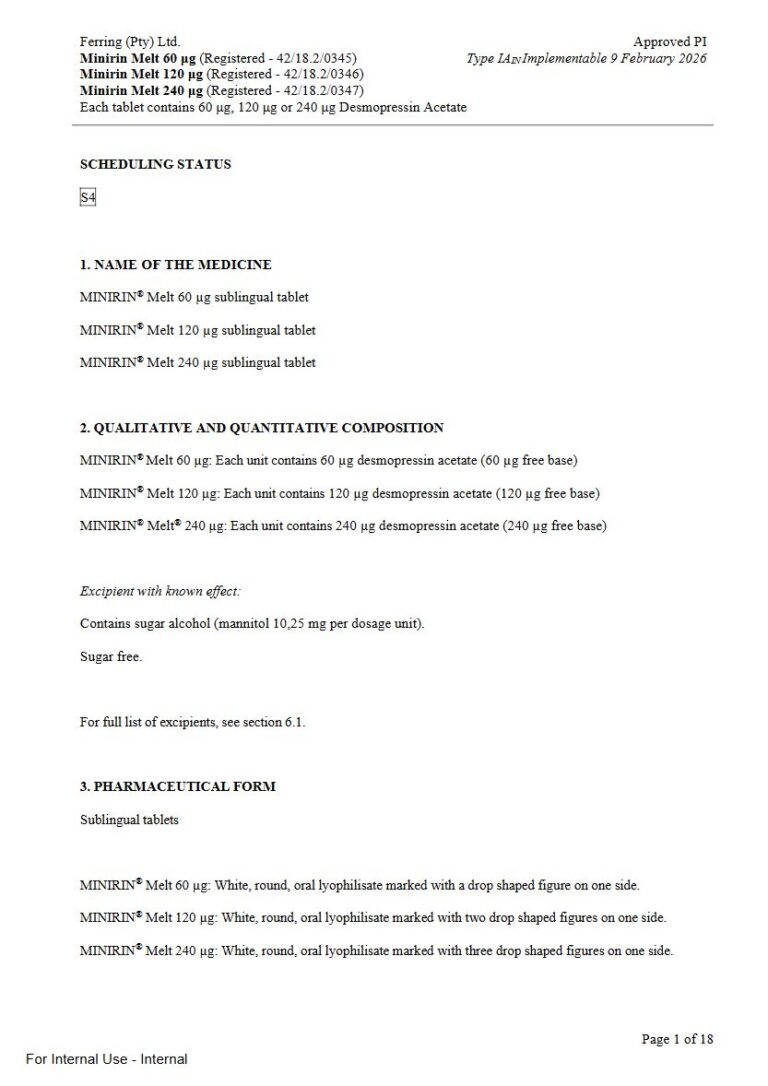
Minirin Melt 60 μg, 120 μg, 240 μg Sublingual tablet
PDF Leaflet Revision Date: 9 February 2026
Clinical Summary
Quick overview from the medicine insert
Indication
Management of central diabetes insipidus and primary nocturnal enuresis in children over 5 years.
Dosage (summary)
Central diabetes insipidus: 60 u03bcg three times daily; Primary nocturnal enuresis: 120 u03bcg at bedtime, may increase to 240 u03bcg.
Special Populations
- Elderly
- Renal impairment
- Hepatic impairment
Pregnancy & Breastfeeding
Safety in pregnancy not established; unknown if excreted in breast milk.
Key Drug Interactions
- Tricyclic antidepressants
- SSRIs
- Carbamazepine
- NSAIDs
Contraindications
- Hypersensitivity to desmopressin
- Nephrogenic diabetes insipidus
- Moderate/severe renal insufficiency
- Known hyponatraemia
Common side effects
- Hyponatraemia
- Headache
- Dizziness
- Nausea
- Vomiting
Counselling Points
- Adhere to fluid restrictions
- Monitor for signs of hyponatraemia
- May cause somnolence and dizziness
Serious warnings
- Risk of water intoxication and hyponatraemia
- Fluid intake must be limited during treatment
Important Disclaimer
The Minirin Melt 60 μg, 120 μg, 240 μg Sublingual tablet professional information leaflet below is the property of Ferring and is provided on Medinsert exactly as issued, with no.. alterations or editorial changes. We make every effort to keep content current by updating documents as soon as new versions become available. Medinsert serves as a trusted access point for healthcare professionals, but does not replace official sources or clinical judgement. For more details, please read our full disclaimer. read more>>
 Healthcare Professionals Only
This content is for registered healthcare professionals
Sign in or create a free account to read the full package insert.
Free for HPCSA-registered professionals. Powered by Medinsert.
Clinical Particulars
Section 4 of the official insert — extracted exactly as issued, no alterations
4.1 Therapeutic indications
MINIRIN u00ae Melt is indicated for:
- Management of central diabetes insipidus.
- The symptomatic short-term (4 - 8 weeks) treatment of primary nocturnal enuresis in children older than 5 years who have normal ability to concentrate urine.
4.2 Posology and method of administration
In the event of signs or symptoms of water retention and/or hyponatraemia (headache, nausea/vomiting, weight gain, and, in severe cases, convulsions) treatment should be interrupted until the patient has fully recovered. When restarting treatment strict fluid restriction should be enforced (see section 4.4). If adequate clinical effect is not achieved within 4 weeks following appropriate dose titration the medication should be discontinued.
Posology
Central diabetes insipidus
Dosage is individual in diabetes insipidus but the total daily sublingual dose normally lies in the range of 120 u03bcg to 720 u03bcg. A suitable starting dose in children and in adults is 60 u03bcg three times daily, administered sublingually. This dosage regimen should then be adjusted in accordance with the patientu2019s response. For the majority of patients, the maintenance dose is 60 u03bcg to 120 u03bcg sublingually three times daily. In the event of signs of water retention/hyponatraemia treatment should be interrupted and the dose should be adjusted (see section 4.4).
Primary nocturnal enuresis
The recommended initial dose is 120 u03bcg at bedtime, administered sublingually. If this is not sufficiently effective, the dose may be increased up to 240 u03bcg sublingually. Fluid restriction should be observed. MINIRIN u00ae Melt is intended for treatment periods of up to 4-8 weeks. The need for continued treatment should be reassessed by means of a period of at least one week without MINIRIN u00ae Melt. The recommended dose may only be administered once in every 24 hours.
Special populations
Elderly: The initiation of treatment in patients > 65 years is not recommended. Should medical practitioners decide to initiate MINIRIN u00ae Melt treatment in these patients then serum sodium should be measured before beginning the treatment and 3 days after initiation or increase in dosage and at other times during the treatment as deemed necessary by the treating medical practitioners.
Renal impairment: See section 5.2
Hepatic impairment: See section 5.2
Paediatric population
MINIRIN u00ae Melt is indicated in Central Diabetes Insipidus and Primary Nocturnal Enuresis. Dose recommendations are the same as in adults.
Method administration
MINIRIN u00ae Melt is placed under the tongue where it dissolves without the need for water.
Food intake may reduce the intensity and duration of the antidiuretic effect at low doses of MINIRIN u00ae Melt (see section 4.5).
4.3 Contraindications
MINIRIN u00ae Melt is contraindicated in cases of:
- Hypersensitivity to desmopressin or to any of the excipients listed in section 6.1.
- Nephrogenic diabetes insipidus is insensitive to ADH. Desmopressin is not effective.
- A history of known or suspected cardiac insufficiency and other conditions requiring treatment with diuretics.
- Moderate or severe renal insufficiency (creatinine clearance below 50 mL/min); including glomerulonephritis/ nephrotic syndrome.
- Habitual or psychogenic polydipsia (resulting in a urine production exceeding 40 mL/kg/24 hours).
- Known hyponatraemia.
- Syndrome of inappropriate ADH secretion (SIADH).
- All oedematous states not associated with an endogenous vasopressin deficiency.
4.4 Special warnings and precautions for use
Excessive water intake (water intoxication) can produce hyponatraemia with associated effects, including convulsions.
When used for primary nocturnal enuresis indication, the fluid intake must be limited to a minimum from 1 hour before until 8 hours after administration. Treatment without concomitant reduction of fluid intake may lead to water retention and/or hyponatraemia with or without accompanying warning signs and symptoms (headache, nausea, vomiting, weight gain, and, in severe cases, convulsions.)
All patients and, if applicable, their guardians should be carefully instructed to adhere to the fluid restrictions while in treatment with MINIRIN u00ae Melt. Severe bladder dysfunction and outlet obstruction should be considered before starting treatment. Elderly patients and patients with low serum sodium levels may have an increased risk of hyponatraemia. Treatment with MINIRIN u00ae Melt should be interrupted during acute intercurrent illnesses characterised by fluid and/or electrolyte imbalance (such as systemic infections, fever, and gastroenteritis). Precaution must be taken in patients at risk for increased intracranial pressure. MINIRIN u00ae Melt should be used with caution in patients with conditions characterised by fluid and/or electrolyte imbalance. Precautions to avoid hyponatraemia including careful attention to fluid restriction and more frequent monitoring of serum sodium must be taken in case of concomitant treatment with medicines, which are known to induce SIADH, e.g. tricyclic antidepressants, selective serotonin reuptake inhibitors, chlorpromazine and carbamazepine, and also in the case of concomitant treatment with NSAIDs.
Pressor effects: MINIRIN u00ae Melt has infrequently produced changes in blood pressure; either as a transient fall in blood pressure in combination with a transient compensatory increase in heart rate or when given in high dosage, as a slight elevation in blood pressure, which disappeared with dose reduction.
Precautions to avoid hyponatraemia must be taken in:
- Conditions characterised by fluid and/or electrolyte imbalance (such as systemic infections, fever, and syndrome of inappropriate ADH secretion).
- Conditions requiring concomitant treatment with diuretic medicines.
- Case of concomitant treatment with medicine, which are known to induce the syndrome of inappropriate ADH secretion, e.g. tricyclic antidepressants, selective serotonin re-uptake inhibitors, chlorpromazine and carbamazepine (see section 4.5).
- Case of concomitant treatment with non-steroid anti-inflammatory drugs (NSAIDs).
4.5 Interaction with other medicines and other forms of interaction
Substances, which are known to induce syndrome of inappropriate ADH secretion (SIADH), e.g. tricyclic antidepressants, selective serotonin reuptake inhibitors, chlorpromazine and carbamazepine, as well as antidiabetic medicines of the sulfonylurea group, may cause an additive antidiuretic effect leading to an increased risk of water retention/hyponatraemia (see section 4.4). Carbamazepine may prolong the action of MINIRIN u00ae Melt. Non-steroid anti-inflammatory drugs (NSAIDs) may induce water retention/hyponatraemia (see section 4.4). Pressor medicines: Large doses of MINIRIN u00ae Melt together with other pressor medicines should only be given with careful monitoring. Concomitant treatment with loperamide may result in a 3-fold increase of MINIRIN u00ae Melt plasma concentrations, which may lead to an increased risk of water retention/hyponatraemia. Although not investigated, other medicines slowing intestinal transport might have the same effect.
It is unlikely that MINIRIN u00ae Melt will interact with medicine affecting hepatic metabolism, since desmopressin has been shown not to undergo significant liver metabolism in in-vitro studies with human microsomes. However formal in-vivo interaction studies have not been performed. The concomitant use of food has not been studied with MINIRIN u00ae Melt, but for the desmopressin tablet dosage form. A standardised 27 % fat meal significantly decreased absorption (rate and extent) of oral desmopressin tablets. No significant effect was observed with respect to pharmacodynamics (urine production or osmolality). Food intake may reduce the intensity and duration of the antidiuretic effect at low oral doses of desmopressin tablets.
4.6 Fertility, pregnancy and lactation
Pregnancy
Safety during pregnancy has not been established.
Breastfeeding
It is not known whether or not MINIRIN u00ae Melt enters the motheru2019s milk but absorption from the childu2019s gastrointestinal tract is unlikely.
Fertility
No data available.
4.7 Effects on ability to drive and use machines
MINIRIN u00ae Melt may cause somnolence and dizziness and may affect the ability to drive and use machines.
4.8 Undesirable effects
Summary of the safety profile
The most serious adverse reaction is hyponatraemia, which may cause headache, abdominal pain, nausea, vomiting, weight increase, dizziness, confusion, malaise, memory impairment, vertigo, falls and in severe cases convulsions and coma.
Adults:
Immune system disorders
Anaphylactic reactions have not been seen in clinical trials but spontaneous reports have been received.
Nervous system disorders
Frequent: Headache, dizziness
Less frequent: Influence of the sleep pattern / consciousness level presenting itself as e.g. insomnia, somnolence or asthenia.
Vascular disorders
Frequent: Hypertension
Gastrointestinal Disorders
Frequent: Nausea, vomiting, abdominal pain, diarrhoea and constipation
Metabolism and Nutrition Disorders
Frequent: Hyponatraemia
Children:
Immune system disorders
Anaphylactic reactions have not been seen in clinical trials but spontaneous reports have been received.
Nervous system disorders
Frequent: Headache
Psychiatric disorders
Less frequent: Lability, aggression, anxiety, mood swings, nightmare. These side effects generally abated after treatment discontinuation.
Gastrointestinal Disorders
Less frequent: Abdominal pain, nausea, vomiting and diarrhoea.
Tabulated summary of adverse reactions
Adults: Based on the frequency of side effects reported in clinical trials with oral desmopressin conducted in adults combined with the post-marketing experience for all adult indications (including central diabetes insipidus). Reactions only seen post-marketing have been added in the u2018Post-marketing datau2019 column.
MedDRA system Organ Class Very common ( u2265 10 %) Common ( u2265 1 %; <10 %) Uncommon ( u2265 0,1 %; <1 %) Rare ( u2265 0,01 %; <0,1 %) Post-marketing data
Immune system disorders Anaphylactic reaction Metabolism and nutrition disorders Hypo-natraemia* Hypo-kalaemia Dehydration**, Hyper-natraemia** Psychiatric disorders Insomnia Confusional state*
Nervous system disorders Headache* Dizziness* Somnolence, Paraesthesia Convulsions*, Asthenia** Coma *
Eye disorders Visual impairment Ear and labyrinth disorders Vertigo* Cardiac disorders Palpitations Vascular disorders Hypertension Orthostatic hypotension Respiratory, thoracic, and mediastinal disorders Dyspnoea Gastro-intestinal disorders Nausea* Abdominal pain*, Diarrhoea, Constipation Vomiting* Dyspepsia, (HLT) Flatulence, bloating and distension Skin and subcutaneous tissue disorders Sweating, Pruritus, Rash, Urticaria Allergic dermatitis Musculo-skeletal and connective tissue disorders Muscle spasms, Myalgia Renal and urinary disorders (HLT) Bladder and urethral symptoms General disorders and administration site conditions (HLT) Oedema, Fatigue Malaise*, Chest pain, Influenza like illness Investigations Weight increased*, increased hepatic enzyme * Hyponatraemia may cause headache, abdominal pain, nausea, vomiting, weight increase, dizziness, confusion, malaise, memory impairment, vertigo, falls and in severe cases convulsions and coma. ** Only seen in the CDI indication
Children and adolescents: Based on the frequency of side effects reported in clinical trials conducted in children and adolescents with oral desmopressin for treatment of primary nocturnal enuresis (N = 1923). Reactions only seen post-marketing have been added in the u2018Post-marketing data columnu2019.
4.9 Overdose
There is no known antidote for MINIRIN u00ae Melt. Treatment is symptomatic and supportive. Overdose of MINIRIN u00ae Melt leads to a prolonged duration of action with an increased risk of water retention and hyponatraemia. Although the treatment of hyponatraemia should be individualised, the following general recommendations can be given:
- discontinue the treatment of desmopressin
- fluid restriction
- symptomatic treatment if needed
Note: Laboratory tests for monitoring the patient include urine volume and osmolality. In some cases, plasma osmolality may be required.
