
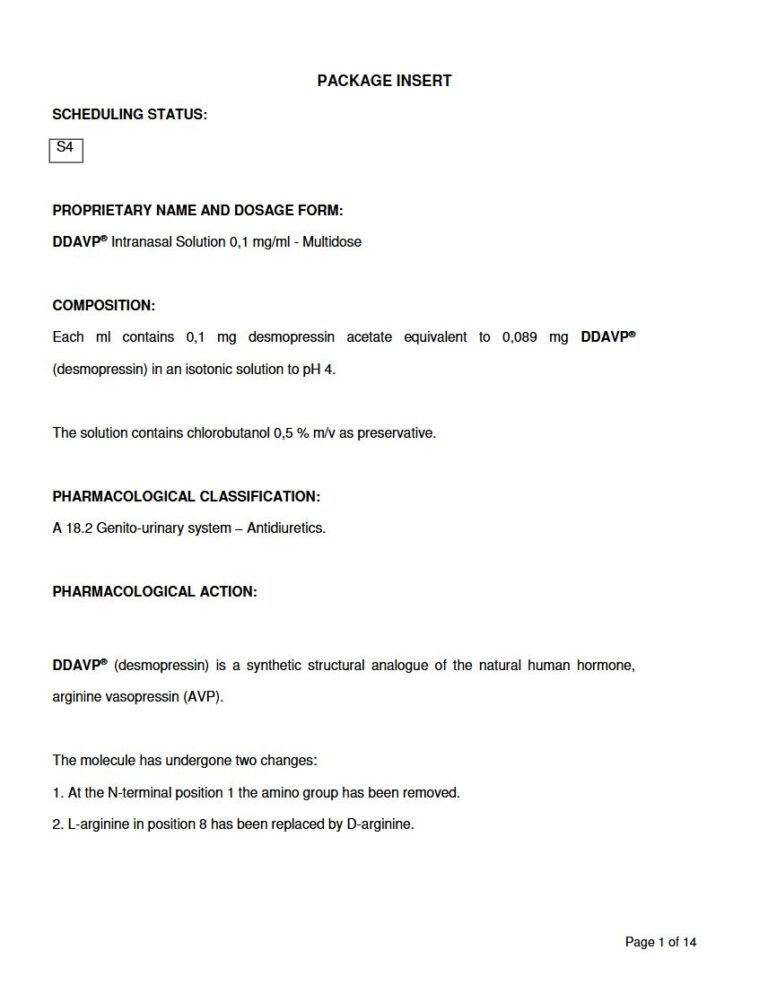
Ddavp Is 0.1 mg / 1ml Intranasal Solution
PDF Leaflet Revision Date: 30 July 2007
Clinical Summary
Quick overview from the medicine insert
Indication
Treatment of vasopressin sensitive central diabetes insipidus.
Dosage (summary)
Adults: 10-20 u03bcg intranasally 1-2 times daily.
Onset of Action / Duration
Onset: 2 hours, Duration: 4-8 hours
Special Populations
- Elderly
- Children
- Renal impairment
Pregnancy & Breastfeeding
Safety in pregnancy and lactation not established; minimal transfer to breast milk.
Key Drug Interactions
- Tricyclic antidepressants
- SSRIs
- NSAIDs
- Carbamazepine
Contraindications
- Renal diabetes insipidus
- Hypersensitivity
- Peripheral vascular disease
- Cardiac insufficiency
- Cirrhosis
- Hypertension
- SIADH
Common side effects
- Nasal congestion
- Epistaxis
- Abdominal pain
- Nausea
- Headache
Counselling Points
- Limit fluid intake before and after administration
- Monitor for signs of hyponatraemia
- Use under adult supervision in children
Serious warnings
- Risk of overhydration
- Monitor fluid intake
- Caution in elderly and children
Important Disclaimer
The Ddavp Is 0.1 mg / 1ml Intranasal Solution professional information leaflet below is the property of Ferring and is provided on Medinsert exactly as issued, with no.. alterations or editorial changes. We make every effort to keep content current by updating documents as soon as new versions become available. Medinsert serves as a trusted access point for healthcare professionals, but does not replace official sources or clinical judgement. For more details, please read our full disclaimer. read more>>
 Healthcare Professionals Only
This content is for registered healthcare professionals
Sign in or create a free account to read the full package insert.
Free for HPCSA-registered professionals. Powered by Medinsert.
Clinical Particulars
Section 4 of the official insert — extracted exactly as issued, no alterations
4.1 Therapeutic indications
a) Diagnosis of central diabetes insipidus: Adult patients should be given a 1 litre oral water load initially and urine flow rate stabilised by giving oral fluids equivalent in volume to the volume of urine passed. The 20 u03bcg DDAVP u00ae is administered intranasally. This will be followed by a sharp decrease in urine flow rate and an increase in urine osmolality within 2 hours if the patient has vasopressin sensitive diabetes insipidus.
b) DDAVP u00ae is indicated for the treatment of vasopressin sensitive central diabetes insipidus or in the treatment of post hypophysectomy polyuria and polydipsia.
c) Renal function testing: Adults and children with normal renal function can be expected to achieve concentrations above 800 mOsm/kg in the period of 5 - 9 hours following intranasal administration of 40 u03bcg and 20 u03bcg DDAVP u00ae, respectively. It is recommended that the bladder should be emptied at the time of DDAVP u00ae administration. A restricted water intake must be observed (see Warnings). In infants normal urine concentration of 600 mOsm/kg should be achieved in the 5-hour period following administration. Infants should be given a 10 u03bcg intranasal dose of DDAVP u00ae and the fluid intake at the two meals after administration restricted to 50 % of the ordinary intake in order to avoid water overload.
d) DDAVP u00ae is indicated for the symptomatic short term (4 - 8 weeks) treatment of primary nocturnal enuresis in both young and adult patients (children older than 5 years) who have normal ability to concentrate urine. Safety in the elderly has not been established.
4.2 Posology and method of administration
To institute therapy with DDAVP u00ae, patients should be withdrawn from previous medication and allowed to establish a baseline polyuria and polydipsia. The stable polyuria is used as a baseline to determine the magnitude and duration of the response to medication. In less severe cases, prior water loading may be desirable to establish a vigorous flow of urine. When the urine osmolality reaches a plateau at the low level (in most cases, less than 100 mOsm per kilogram), the first dose of DDAVP u00ae is administered intranasally. A urine sample is obtained after two hours and hourly thereafter following DDAVP u00ae administration. Samples are measured for volume and osmolality. When the patient has reached the previous baseline urine osmolality and urine flow the medication effect has ceased and the next dose of DDAVP u00ae is administered. The cycle is then repeated until the patient has reached a stable condition.
DDAVP u00ae is dosed individually after testing the effect of different doses on urine osmolality and diuresis (according to the procedure described in the above paragraph). A summary of the therapeutic results in patients who have hitherto been treated with DDAVP u00ae makes the following suggestion of an average dosage possible.
Central diabetes insipidus: Children: 0,05 - 0,1 ml (5 u2013 10 u03bcg) 1 u2013 2 times daily, intranasally. Adults: 0,1 - 0,2 ml (10 - 20 u03bcg) 1 u2013 2 times daily, intranasally.
Intranasal application of DDAVP u00ae: One dose of the solution provides 0,1 ml, which corresponds to 10 u03bcg desmopressin acetate. The intranasal administration is performed with a plastic catheter (rhinyle tube). The rhinyle tube has a graduated scale corresponding to 2,5 u03bcg, 5 u03bcg, 10 u03bcg, 15 u03bcg and 20 u03bcg desmopressin acetate. As the concentration is 100 u03bcg/ml, the dose can be varied between 0,025 - 0,20 ml. If higher doses are needed it is recommended that these be divided into two doses; the one being given in the left nostril and the other in the right.
4.3 Contraindications
DDAVP u00ae must not be used in cases of:
- 1. Renal diabetes insipidus.
- 2. Hypersensitivity to DDAVP u00ae.
- 3. Peripheral vascular disease.
- 4. History of known or suspected cardiac insufficiency and other conditions requiring treatment with diuretic agents.
- 5. Hypersensitivity to the preservative.
- 6. Habitual and psychogenic polydipsia.
- 7. Cirrhosis.
- 8. Hypertension.
- 9. Cerebral vascular disease.
- 10. Moderate or severe renal insufficiency (creatinine clearance below 50 ml/min).
- 11. Known hyponatraemia.
- 12. Syndrome of inappropriate ADH secretion (SIADH).
4.4 Special warnings and precautions for use
Overhydration: The risk of overhydration including cardiac failure should be borne in mind, especially in children or the elderly and when DDAVP u00ae is being used to test renal concentrating capacity or the patient is on fluid supplements either orally or parenterally. Children should be closely observed to avoid over-ingestion of fluid. Excessive water intake can produce hyponatraemia with associated effects, including convulsions.
DDAVP u00ae intranasal solution should be used with caution in:
- the very young and elderly patients.
- conditions characterised by fluid and/or electrolyte imbalance.
- patients at risk for increased intracranial pressure.
DDAVP u00ae intranasal solution should only be used in patients where orally administered formulations are not feasible. When DDAVP u00ae intranasal solution is prescribed it is recommended:
- To start at the lowest dose.
- To ensure compliance with fluid restriction instructions.
- To increase dose progressively, with caution.
- To ensure that in children administration is under adult supervision in order to control the dose intake.
In case of treatment of enuresis the fluid intake must be limited to a minimum and only to satisfy thirst from 1 hour before until 8 hours after administration. Renal concentration capacity testing in children below the age of 1 year should only be performed in hospital and under careful supervision. When used for diagnostic purposes the fluid intake must be limited and not exceed 0,5 litre from 1 hour before until 8 hours after administration.
4.5 Interactions with other medicines
Substances which are known to release antidiuretic hormone, e.g. tricyclic antidepressants, selective serotonin reuptake inhibitors, chlorpromazine and carbamazepine, may cause an additive antidiuretic effect and increase the risk of water retention and dilutional hyponatraemia. This may lead to convulsions. NSAIDs may induce fluid retention/hyponatraemia (see Side effects and special precautions). Indomethacin in combination with DDAVP u00ae increases the magnitude but not the duration, of the response to DDAVP u00ae. Glibenclamide: A few cases, where the antidiuretic response induced by DDAVP u00ae was reduced, were reported. Carbamazepine may also prolong the action of DDAVP u00ae.
Pressor agents u2013 Large doses of DDAVP u00ae together with other pressor agents should only be given with careful monitoring.
4.6 Fertility, pregnancy and lactation
Pregnancy: Safety in pregnancy and lactation has not been established.
Lactation: Results from analysis of milk from nursing mothers receiving a high dose of desmopressin (300 u03bcg intranasally), indicate that the amounts of desmopressin that may be transferred to the child are considerably less than the amounts required to influence diuresis.
4.7 Effects on ability to drive and use machines
Not provided in the text.
4.8 Undesirable effects
Side effects: Treatment without concomitant restriction of water intake may lead to water retention/hyponatraemia with or without accompanying warning signs and symptoms (headache, nausea/vomiting, reduced serum sodium, weight gain, and, in serious cases, convulsions and coma).
Metabolism and nutrition disorders: Very rare (u2264 1/10 000): Hyponatraemia.
Psychiatric disorders: Isolated cases of emotional disturbances in children have been reported but the frequency is unknown.
Respiratory, thoracic and mediastinal disorders: Common (> 1/100, u2264 1/10): Nasal congestion/rhinitis, epistaxis.
Gastrointestinal disorders: Common (> 1/100, u2264 1/10): Abdominal pain, nausea.
General disorders: Common (> 1/100, u2264 1/10): Headache. Isolated cases of allergic skin reactions and more severe general allergic reactions have been reported, but the frequency is unknown.
Excessive doses may cause tachycardia, headaches, mild abdominal cramps, nausea, vomiting, facial flushing, vulva pain and water intoxication from overhydration. In such cases the dosage should be reduced, frequency of administration decreased, or the drug withdrawn according to the severity of the condition.
4.9 Overdose
At high doses, a transient fall in blood pressure with reflex tachycardia and facial flushing may occur at the time of administration. There is no known specific antidote for DDAVP u00ae. Treatment is symptomatic and supportive. Overdosage increases the risk of fluid retention and hyponatraemia. Although the treatment of hyponatraemia should be individualised, the following general recommendations can be given. Asymptomatic hyponatraemia is treated with discontinuation of desmopressin treatment and fluid restriction. Infusion of isotonic or hypertonic sodium chloride may be added in cases with symptoms. When the fluid retention is severe (convulsions and unconsciousness) treatment with furosemide should be added.
