
Pabal 100 micrograms Solution for Injection
PDF Leaflet Revision Date: 29 January 2024
Clinical Summary
Quick overview from the medicine insert
Indication
Prevention of postpartum haemorrhage due to uterine atony.
Dosage (summary)
100 micrograms (1 ml) IV or IM after delivery.
Onset of Action / Duration
Onset: 2 mins, Duration: several hours
Special Populations
- Hepatic impairment
- Renal impairment
Pregnancy & Breastfeeding
Contraindicated in pregnancy; safe for breastfeeding.
Key Drug Interactions
- Ergot-alkaloids
- Prostaglandins
- Inhalation anaesthetics
Contraindications
- Pregnancy
- Hypersensitivity
- Hepatic disease
- Renal disease
- Induction of labour
- Serious cardiovascular disorders
- Epilepsy
Common side effects
- Hypotension
- Headache
- Nausea
- Dizziness
- Flushing
Counselling Points
- Administer only after delivery
- Single dose only
- Monitor for adverse reactions
Serious warnings
- Risk of uterine hyperactivity
- Water intoxication
- Monitor in eclampsia
Important Disclaimer
The Pabal 100 micrograms Solution for Injection professional information leaflet below is the property of Ferring and is provided on Medinsert exactly as issued, with no.. alterations or editorial changes. We make every effort to keep content current by updating documents as soon as new versions become available. Medinsert serves as a trusted access point for healthcare professionals, but does not replace official sources or clinical judgement. For more details, please read our full disclaimer. read more>>
 Healthcare Professionals Only
This content is for registered healthcare professionals
Sign in or create a free account to read the full package insert.
Free for HPCSA-registered professionals. Powered by Medinsert.
Clinical Particulars
Section 4 of the official insert — extracted exactly as issued, no alterations
4.1. Therapeutic indications
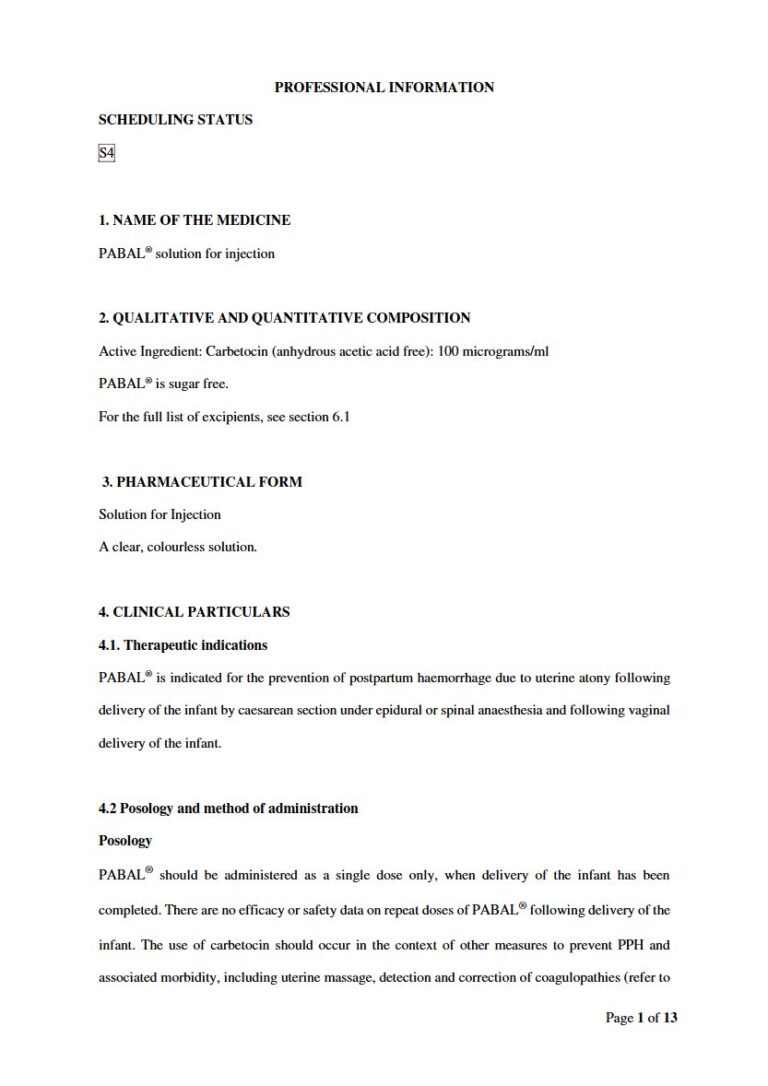
PABAL u00ae is indicated for the prevention of postpartum haemorrhage due to uterine atony following delivery of the infant by caesarean section under epidural or spinal anaesthesia and following vaginal delivery of the infant.
4.2 Posology and method of administration
Posology
PABAL u00ae should be administered as a single dose only, when delivery of the infant has been completed. There are no efficacy or safety data on repeat doses of PABAL u00ae following delivery of the infant. The use of carbetocin should occur in the context of other measures to prevent PPH and associated morbidity, including uterine massage, detection and correction of coagulopathies (refer to local clinical guidelines). Other uterotonic agents should be administered if additional treatment is required to reduce excessive postpartum bleeding and increase uterine tone.
Caesarean section:
A single dose of 100 micrograms (1 ml) of PABAL u00ae (carbetocin injection) should be administered intravenously as a bolus injection, slowly over 1 minute after delivery of the infant.
Vaginal delivery:
A single dose of 100 micrograms (1 ml) of PABAL u00ae (carbetocin injection) should be administered after delivery of the infant for the active management of the third stage of labour as an intramuscular injection or intravenously as a bolus injection slowly over 1 minute.
Method of administration
For intravenous or intramuscular administration. PABAL u00ae must only be administered after delivery of the infant, and as soon as possible after delivery, preferably before the delivery of the placenta. PABAL u00ae should not be mixed with other infusion fluids. PABAL u00ae should be inspected visually for particulate matter and discoloration prior to administration. The product should not be used if particulate matter or discoloration is observed.
Caesarean section under epidural or spinal anaesthesia:
Withdraw 1 ml of PABAL u00ae containing 100 micrograms carbetocin and administer only by intravenous injection slowly, over 1 minute.
Vaginal delivery:
Withdraw 1 ml of PABAL u00ae containing 100 micrograms carbetocin and administer by intramuscular injection.
For intravenous administration, PABAL u00ae must be administered slowly, over 1 minute.
Paediatric Population
PABAL u00ae is not intended for use in children below 12 years of age.
4.3. Contraindications
PABAL u00ae is contraindicated in the following conditions:
- During pregnancy and labour before delivery of the infant.
- Hypersensitivity to carbetocin, oxytocin or any of the excipients listed in section 6.1.
- Hepatic or renal disease.
- Induction of labour.
- Serious cardiovascular disorders.
- Epilepsy.
4.4 Special warnings and precautions for use
The use of PABAL u00ae at any stage before delivery of the infant is not appropriate because its uterotonic activity persists for several hours. This is in marked contrast to the rapid reduction of effect observed after discontinuation of an oxytocin infusion.
In case of persistent vaginal or uterine bleeding after administration of PABAL u00ae the cause must be determined. Consideration should be given to causes such as retained placental fragments, perineal, vaginal and cervix lacerations, inadequate repair of the uterus, or disorders of blood coagulation.
PABAL u00ae is intended for single administration only, intramuscular or intravenous injection. In case of intravenous administration, it must be administered slowly over 1 minute. In case of persisting uterine hypotonia or atonia and the consequent excessive bleeding, additional therapy with another uterotonic should be considered. There are no data on additional doses of carbetocin or on the use of carbetocin following persisting uterine atony after oxytocin.
The risk of water intoxication cannot be excluded. Animal studies have shown carbetocin to possess some antidiuretic activity and therefore the possibility of hyponatraemia cannot be excluded, particularly in patients also receiving large volumes of intravenous fluids. The early signs of drowsiness, listlessness and headache should be recognised to prevent convulsions and coma.
In general, PABAL u00ae should be used cautiously in the presence of migraine, asthma and cardiovascular disease or any state in which a rapid addition to extracellular water may produce a hazard for an already overburdened system. The decision of administering PABAL u00ae can be made by the medical practitioner after carefully weighing the potential benefit PABAL u00ae may provide in these particular cases.
No data is available on the use of carbetocin (e.g., PABAL u00ae ) in patients with eclampsia. Patients with eclampsia and pre-eclampsia should be carefully monitored.
Specific studies have not been undertaken in gestational diabetes mellitus.
4.5 Interaction with other medicines and other forms of interaction
During clinical trials, PABAL u00ae has been administered in association with a number of analgesics, spasmolytics and medicines used for epidural or spinal anaesthesia, and no drug interactions have been identified. Specific interaction studies have not been undertaken.
Since PABAL u00ae is closely related in structure to oxytocin, the occurrence of interactions known to be associated with oxytocin cannot be excluded: severe hypertension has been reported when oxytocin was given 3 to 4 hours following prophylactic administration of a vasoconstrictor in conjunction with caudal-block anaesthesia.
During combination with ergot-alkaloids, such as methylergometrine, oxytocin and carbetocin may enhance the blood pressure enhancing effect of these medicines. If oxytocin or methylergometrine are administered after PABAL u00ae there may be a risk of cumulative exposure.
Since it has been found that prostaglandins potentiate the effect of oxytocin, it is expected that this can also occur with carbetocin. Therefore, it is not recommended that prostaglandins and PABAL u00ae be used together. If they are concomitantly administered, the patient should be carefully monitored.
Some inhalation-anaesthetics, such as halothane and cyclopropane may enhance the hypotensive effect and weaken the effect of carbetocin e.g. PABAL u00ae on the uterus. Dysrhythmias have been reported for oxytocin during concomitant use.
4.6 Fertility, pregnancy and lactation
Pregnancy
PABAL u00ae is contraindicated during pregnancy and must not be used for the induction of labour (see section 4.3).
Breastfeeding
Small amounts of PABAL u00ae have been shown to pass from plasma into breast milk of nursing women (See section 5.2). The small amounts transferred into colostrum or breast milk after a single injection of PABAL u00ae, and subsequently ingested by the infant are assumed to be degraded by enzymes in the gut. Breastfeeding does not need to be restricted after the use of PABAL u00ae.
4.7 Effects on ability to drive and use machines
Not relevant
4.8 Undesirable effects
The adverse events observed with PABAL u00ae during the clinical trials were of the same type and frequency as the adverse events observed with oxytocin:
Intravenous Administration* - Tabulated summary of adverse reactions:
System Organ Class Very common u2265 1/10 Common u2265 1/100 and < 1/10 Not known (cannot be estimated from the available data)
Blood and lymphatic system disorders Anaemia
Immune system disorders Hypersensitivity (including anaphylactic reaction)
Nervous system disorders Headache, tremor Dizziness
Cardiac disorders Dysrhythmia**, Bradycardia tachycardia**, myocardial ischaemia**, and QT prolongation**
Vascular disorders Hypotension, flushing
Respiratory, thoracic and mediastinal disorders Chest pain, dyspnoea
Gastrointestinal disorders Nausea, abdominal pain Metallic taste, vomiting
Skin and subcutaneous tissue disorders Pruritus
Musculoskeletal and connective tissue disorders Back pain
General disorders and administration site conditions Feeling of warmth Chills, pain
*Based on studies in caesarean section ** Reported with oxytocin (closely related in structure to carbetocin)
In the clinical trials sweating was reported as sporadic cases.
Intramuscular administration** u2013 Tabulated summary of adverse reactions
System Organ Class Uncommon u2265 1/1 000 and <1/100 Rare u2265 1/ 10 000 and < 1/ 1 000 Not known (cannot be estimated from the available data)
Blood and lymphatic system disorders Anaemia
Immune system disorders Hypersensitivity (including anaphylactic reaction)
Nervous system disorders Headache, dizziness Tremor
Cardiac disorders Tachycardia Bradycardia dysrhythmia***, myocardial ischaemia***, and QT prolongation***
Vascular disorders Hypotension Flushing
Respiratory, thoracic and mediastinal disorders Chest pain Dyspnoea
Gastrointestinal disorders Nausea, abdominal pain, vomiting
Skin and subcutaneous tissue disorders Pruritus
Musculoskeletal and connective tissue disorders Back pain, muscular weakness
Renal and urinary disorders Urinary retention
General disorders and administration site conditions Chills, pyrexia, pain
** Based on studies in vaginal delivery *** Reported with oxytocin (closely related in structure to carbetocin)
Reporting of suspected adverse reactions
Reporting suspected adverse reactions after authorisation of the medicine is important. It allows continued monitoring of the benefit/risk balance of the medicine. Healthcare providers are asked to report any suspected adverse reactions to SAHPRA via the u201c6.04 Adverse Drug Reactions Reporting Formu201d, found online under SAHPRAu2019s publications: https://www.sahpra.org.za/Publications/Index/8
4.9 Overdose
Overdosage of PABAL u00ae may produce uterine hyperactivity whether or not due to hypersensitivity to this medicine. Hyperstimulation with strong (hypertonic) or prolonged (tetanic) contraction resulting from PABAL u00ae overdose can lead to uterine rupture or postpartum haemorrhage.
As carbetocin is an analogue of oxytocin, the possibility of an overdosage of PABAL u00ae leading to hyponatraemia and water intoxication, especially when associated with excessive concomitant fluid intake, cannot be excluded.
Treatment of overdosage of PABAL u00ae consists of symptomatic and supportive therapy. When signs or symptoms of overdosage occur oxygen should be given to the mother. In cases of water intoxication, it is essential to restrict fluid intake, promote diuresis, correct electrolyte imbalance, and control convulsions that may eventually occur.
