
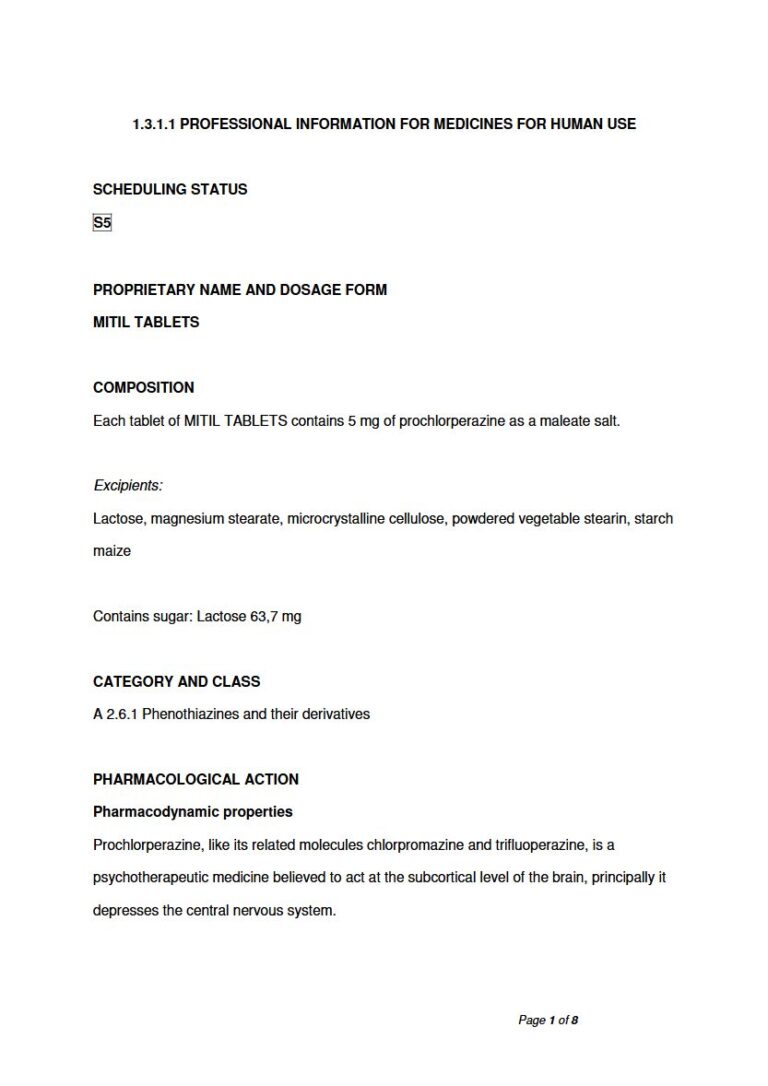
Mitil 5mg Tablet
PDF Leaflet Revision Date: 20 April 1977
Clinical Summary
Quick overview from the medicine insert
Indication
Control of mild to moderate mental and emotional disturbances, nausea, vomiting, and vertigo.
Dosage (summary)
5-10 mg 2-3 times daily for nausea; 20 mg for migraine; 12.5 mg twice daily for psychoses.
Special Populations
- Elderly
- Debilitated patients
- Children under 10 kg
Pregnancy & Breastfeeding
Safety not established; best avoided in pregnancy and lactation.
Key Drug Interactions
- CNS depressants may enhance effects
- Reduces antihypertensive action of guanethidine
- Increased risk of extrapyramidal effects with metoclopramide
Contraindications
- CNS depression or coma
- Bone marrow suppression
- Phaeochromocytoma
- Children under 10 kg
Common side effects
- Dry mouth
- Constipation
- Blurred vision
- Hypotension
- Extrapyramidal symptoms
Counselling Points
- Avoid alcohol and CNS depressants
- Caution when driving or operating machinery
- Regular eye examinations recommended
Serious warnings
- May cause drowsiness and impaired concentration
- Severe dystonic reactions in children
- Monitor haematological parameters in long-term use
Important Disclaimer
The Mitil 5mg Tablet professional information leaflet below is the property of Aspen Pharmacare and is provided on Medinsert exactly as issued, with no.. alterations or editorial changes. We make every effort to keep content current by updating documents as soon as new versions become available. Medinsert serves as a trusted access point for healthcare professionals, but does not replace official sources or clinical judgement. For more details, please read our full disclaimer. read more>>
 Healthcare Professionals Only
This content is for registered healthcare professionals
Sign in or create a free account to read the full package insert.
Free for HPCSA-registered professionals. Powered by Medinsert.
Clinical Particulars
Section 4 of the official insert — extracted exactly as issued, no alterations
4.1 Therapeutic indications
MITIL TABLETS are used in the control of mild and moderate mental and emotional disturbances, characterised by anxiety, tension and agitation. These tablets are used in the treatment of Meniereu2019s syndrome, labyrinthitis, vertigo and migraine. It is also particularly effective for the prevention and treatment of nausea and vomiting.
4.2 Posology and method of administration
Tablets are not suitable for many paediatric patientsu2019 requirements and should not be given to children weighing less than 10 kg. Geriatric, emaciated and debilitated patients usually required a lower initial dose, the dosage being gradually increased as needed and tolerated.
PREVENTION OF NAUSEA AND VOMITING: 5 mg to 10 mg (1 to 2 tablets) of MITIL TABLETS two or three times a day.
TREATMENT OF NAUSEA AND VOMITING: 20 mg (4 tablets) of MITIL TABLETS given orally; further doses may be given as required.
TREATMENT OF MIGRAINE: 20 mg (4 tablets) of MITIL TABLETS at once followed, if required, by 10 mg (2 tablets) of MITIL TABLETS two hours later. In an established attack if the patient is unable to retain tablets, treatment may be administered in a different form (25 mg of prochlorperazine maleate suppository).
TREATMENT OF VERTIGO AS WELL AS THAT ASSOCIATED WITH Mu00c9NIu00c8RES DISEASE: 15 mg to 30 mg (3 to 6 tablets) of MITIL TABLETS in divided doses; after several weeks the dose may gradually be reduced to 5 mg to 10 mg (1 to 2 tablets) of MITIL TABLETS daily.
TREATMENT OF PSYCHOSES: 12,5 mg (2u00bd tablets) of MITIL TABLETS twice a day for seven days adjusted gradually to 75 mg to 100 mg (15 to 20 tablets) of MITIL TABLETS daily according to the response. Some patients may be maintained on doses of 25 mg to 50 mg (5 to 10 tablets) of MITIL TABLETS daily.
TREATMENT OF NON-PSYCHOTIC ANXIETY DISORDERS: 5 mg to 10 mg (1 to 2 tablets) of MITIL TABLETS up to 3 to 4 times daily.
4.3 Contraindications
Contraindicated in patients with pre-existing central nervous system depression or coma, bone marrow suppression, or phaeochromocytoma. Central nervous system depression may be enhanced by other medicines with central nervous system-depressant properties including alcohol, general anaesthetics, hypnotics and sedatives, and opioid anaesthetics. Phenothiazines effects on the vomiting centre may mask the symptoms of overdosage of other medicines, or of disorders such as gastrointestinal obstruction. Should not be given to children weighing under 10 kg. Safety in pregnancy and lactation has not yet been established therefore MITIL TABLETS are best avoided.
4.4 Special warnings and precautions for use
Usage of MITIL TABLETS may lead to drowsiness and impaired concentration which is aggravated by the simultaneous intake of alcohol or other central nervous system depressant medicines. Severe dystonic reactions have followed the use of MITIL TABLETS, particularly in children and adolescents. It should therefore be used with extreme care in children. Geriatric, emaciated, or debilitated patients usually required a lower initial dose, the dosage being gradually increased as needed and tolerated. Use with caution in patients with impaired liver, kidney, cardiovascular, cerebrovascular, and respiratory function and in those with closed-angle glaucoma, Parkinsonism, diabetes mellitus, hypothyroidism, myasthenia gravis, or prostatic hypertrophy. Care is required in epileptic patients receiving anticonvulsant therapy as phenothiazines may lower the seizure threshold. Elderly and debilitated patients may be more prone to the adverse effects of MITIL TABLETS. Regular eye examinations and the monitoring of haematological parameters is advisable for patients receiving long term MITIL TABLETS therapy. Mild symptoms resembling the withdrawal symptoms of dependence have been seen following the abrupt withdrawal of phenothiazines from patients receiving prolonged maintenance therapy.
4.5 Interactions with other medicines
Most common interactions encountered with phenothiazines are adverse effects resulting from concomitant administration of medicines with similar pharmacological action. When given with other hypotensives a severe hypotensive effect can be produced. Phenothiazines reduce the antihypertensive action of guanethidine and other adrenergic neurone blockers. May also potentiate the adverse effects of other antimuscarinics. Concomitant administration of metoclopramide may increase the risk of neuroleptic-induced extrapyramidal effects, and antiarrhythmics which prolong the QT interval may increase the likelihood of ventricular arrhythmias.
4.6 Fertility, pregnancy and lactation
Safety in pregnancy and lactation has not yet been established therefore MITIL TABLETS are best avoided (see CONTRAINDICATIONS).
4.7 Effects on ability to drive and use machines
Usage of MITIL TABLETS may lead to drowsiness and impaired concentration which is aggravated by the simultaneous intake of alcohol or other central nervous system depressant medicines. Patients should be warned against operating vehicles or machinery, or performing potentially hazardous tasks.
4.8 Undesirable effects
Dry mouth, constipation, difficulty with micturition, blurred vision, and mydriasis may occur. Tachycardia and electrocardiographic changes may also occur. Hypotension (usually postural) is common. Other side effects include delirium, agitation and, rarely, catatonic-like states, insomnia, depression, miosis, EEG changes and convulsions, nasal congestion, minor abnormalities in liver function tests, inhibition of ejaculation, impotence, and priapism. Hypersensitivity reactions include urticaria, exfoliative dermatitis, erythema multiforme, and contact sensitivity. A syndrome resembling systemic lupus erythematosus has been reported. Photosensitivity reactions, jaundice and deposition of pigment in the skin, or more frequently in the eyes, may occur. Haematological disorders such as haemolytic anaemia, aplastic anaemia, thrombocytopenic purpura, a potentially fatal agranulocytosis (have occurred within 4 to 10 weeks of starting treatment) and mild leucopenia may occur. Extrapyramidal dysfunction can result in the following disorders: acute dystonia, a Parkinsonism-like syndrome, and akathisia; late effects include tardive dyskinesia and perioral tremor. Endocrine and metabolic functions may be altered resulting in the following: amenorrhoea, galactorrhoea, gynaecomastia, weight gain, hyperglycaemia and altered glucose tolerance. Body temperature regulation is impaired and may result in both hypo- or hyperthermia depending on environment.
4.9 Overdose
Acute hypotension, and severe extrapyramidal reactions. In severe overdosage the stomach should be emptied by aspiration and lavage. Emetics are generally of little value. Treatment should be symptomatic.
