
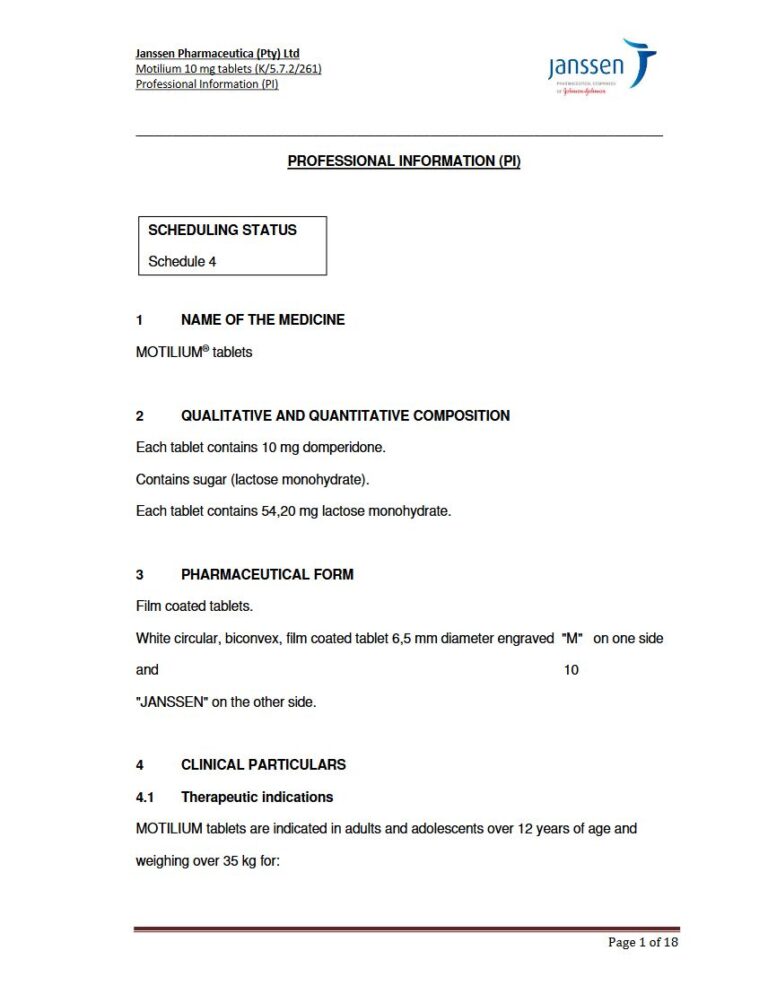
Motilium 10 mg FC tablets.
PDF Leaflet Revision Date: 12 May 2022
Clinical Summary
Quick overview from the medicine insert
Indication
Short-term management of delayed gastric emptying, nausea, and vomiting.
Dosage (summary)
Adults: 10 mg three times daily, max 30 mg/day.
Onset of Action / Duration
Onset: 30 mins, Duration: up to 4 weeks.
Special Populations
- Renal impairment
- Hepatic impairment
Pregnancy & Breastfeeding
Safety not established; contraindicated in breastfeeding.
Key Drug Interactions
- CYP3A4 inhibitors
- QT prolonging agents
Contraindications
- Hypersensitivity
- Prolactinoma
- Severe hepatic impairment
Common side effects
- Headache
- Somnolence
- Diarrhoea
- Rash
Counselling Points
- Take before meals
- Avoid driving until effects known
- Monitor for cardiac symptoms
Serious warnings
- Increased risk of serious cardiac events in older patients
Important Disclaimer
The Motilium 10 mg FC tablets. professional information leaflet below is the property of Janssen Pharmaceutica and is provided on Medinsert exactly as issued, with no.. alterations or editorial changes. We make every effort to keep content current by updating documents as soon as new versions become available. Medinsert serves as a trusted access point for healthcare professionals, but does not replace official sources or clinical judgement. For more details, please read our full disclaimer. read more>>
 Healthcare Professionals Only
This content is for registered healthcare professionals
Sign in or create a free account to read the full package insert.
Free for HPCSA-registered professionals. Powered by Medinsert.
Clinical Particulars
Section 4 of the official insert — extracted exactly as issued, no alterations
4.1 Therapeutic indications
MOTILIUM tablets are indicated in adults and adolescents over 12 years of age and weighing over 35 kg for:
- Short-term management (not exceeding 7 days) of delayed gastric emptying of functional origin with gastro-oesophageal reflux and/or dyspepsia.
- Short term management (not exceeding 7 days) for control of nausea and vomiting of central or local origin.
- As an anti-emetic in patients receiving cytostatic and radiation therapy for up to 4 weeks.
- Facilitation of radiological examination of the upper gastro-intestinal tract administered at the time before the examination as directed by the radiologist.
4.2 Posology and method of administration
Posology
Adults and adolescents > 12 years of age and > 35 kg
It is recommended to take oral MOTILIUM 15 u2013 30 minutes before meals. If taken after meals, absorption of the medicine is somewhat delayed. The dose of MOTILIUM film coated tablets should be the lowest effective dose for the individual situation (typically 30 mg/day) with a maximum daily oral dose of 30 mg. If the conditions mentioned under indications are not resolved within the time frames indicated, patients should be re-evaluated and the need for continued treatment be assessed.
Formulation (domperidone per unit)
Dosage Maximum dose per day
Film-coated tablets (10 mg/tablet) 1 tablet three times per day 30 mg (3x10 mg tablet).
Paediatrics
The efficacy of domperidone was not demonstrated in children less than or equal to 12 years of age (see section 5.1). The safety of MOTILIUM in adolescents weighing u2264 35 kg has not been established.
Special populations
Renal impairment
Since the elimination half-life of domperidone is prolonged in severe renal impairment (serum creatinine > 6 mg/100 mL, i.e. > 0,6 mmol/L), the dosing frequency of MOTILIUM should be reduced to once or twice daily, depending on the severity of the impairment, and the dose may need to be reduced. Patients with severe renal impairment should be reviewed regularly.
Hepatic impairment
MOTILIUM is contraindicated for patients with moderate (Child-Pugh 7 to 9) or severe (Child-Pugh > 9) hepatic impairment (see section 4.3). Dose adjustment is not required for patients with mild (Child-Pugh 5 to 6) hepatic impairment (see section 5.2, Pharmacokinetic properties).
4.3 Contraindications
MOTILIUM is contraindicated in the following situations:
- Known hypersensitivity to domperidone or any of its excipients.
- Prolactin-releasing pituitary tumour (prolactinoma).
- Co-administration with other potent CYP3A4 inhibitors which have been shown to cause QT interval prolongation such as fluconazole, itraconazole, ketoconazole, voriconazole, posaconazole, clarithromycin, erythromycin, azithromycin, roxithromycin, amiodarone, telithromycin, amprenavir, atazanavir, fosamprenavir, indinavir, nelfinavir, ritonavir, saquinavir and quinolones (see sections 4.4 and 4.5).
- Co-administration with medicines known to induce Torsades de Pointes and/or prolong the QT interval e.g. cisapride, class 1A antidysrythmics.
- Hypokalaemia, hypomagnesaemia
- Bradycardia or heart block
- Pre-existing cardiac disease
- Known congenital long QT interval or family history thereof.
- Whenever stimulation of gastric motility might be dangerous, e.g. in the presence of gastro-intestinal haemorrhage, mechanical obstruction or perforation.
- In patients with moderate (child pugh score 7 u2013 9) or severe (child pugh score > 9) hepatic impairment (see section 5.2).
4.4 Special warnings and precautions for use
MOTILIUM film coated tablets are unsuitable for use in children weighing less than 35 kg.
Cardiac effects
Epidemiological studies have shown that MOTILIUM is associated with an increased risk of serious ventricular dysrhythmias or sudden cardiac death (see section 4.8). These studies suggested that this increased risk may be higher in patients older than 60 years of age or in patients taking oral doses greater than 30 mg per day. Therefore, MOTILIUM should be used with caution in older patients.
Medicine interaction potential
The main metabolic pathway of domperidone is through CYP3A4. In vitro and human data show that the concomitant use of medicines that significantly inhibit this enzyme may result in increased plasma levels of domperidone. Co-administration of MOTILIUM with potent CYP3A4 inhibitors which have been shown to cause QT interval prolongation is contraindicated (see section 4.3). Caution should be exercised when MOTILIUM is co-administered with potent CYP3A4 inhibitors which have not been shown to cause QT interval prolongation and patients should be monitored closely for signs and symptoms of adverse reactions (see section 4.8). Caution should be exercised when MOTILIUM is co-administered with medicines which have been shown to cause QT interval prolongation and patients should be monitored closely for signs or symptoms of cardiovascular adverse reactions (see section 4.8). Examples include:
- Anti-dysrhythmias class IA (e.g. disopyramide, quinidine)
- Anti-dysrhythmias class III (e.g. amiodarone, dofetilide, dronedarone, ibutilide, sotalol)
- Certain antipsychotics (e.g. haloperidol, pimozide, sertindole)
- Certain antidepressants (e.g. citalopram, escitalopram)
- Certain antibiotics (e.g. levofloxacin, moxifloxacin and quinolones)
- Certain antifungal medicines (e.g. pentamidine)
- Certain antimalarial medicines (e.g. halofantrine)
- Certain gastro-intestinal medicines (e.g. dolasetron)
- Certain medicines in cancer (e.g. toremifene, vandetanib)
- Certain other medicines (e.g. bepridil, methadone)
The above list is representative and not exhaustive.
Domperidone base
Antacids and anti-secretory medicines should not be taken simultaneously with oral formulations of MOTILIUM as they lower the oral bioavailability of MOTILIUM. When used concomitantly, MOTILIUM should be taken before meals and antacids or anti-secretory medicines after meals.
Excipients
MOTILIUM film coated tablets contain lactose. Patients with rare hereditary conditions of galactose intolerance e.g. galactosaemia, Lapp lactase deficiency, glucose-galactose malabsorption or fructose intolerance should not take MOTILIUM. MOTILIUM film coated tablets contains lactose, which may have an effect on the glycaemic control of patients with diabetes mellitus.
4.5 Interaction with other medicines and other forms of interaction
The main metabolic pathway of domperidone is through CYP3A4. In vitro and human data show that the concomitant use of medicines that significantly inhibit this enzyme may result in increased plasma levels of domperidone. When MOTILIUM was co-administered with potent CYP3A4 inhibitors which have been shown to cause QT interval prolongation, clinically relevant changes in QT intervals were observed. Therefore, co-administration of MOTILIUM with certain medicines is contraindicated (see section 4.3). Caution should be exercised when MOTILIUM is co-administered with potent CYP3A4 inhibitors which have not been shown to cause QT interval prolongation or medicines which have been shown to cause QT interval prolongation (see section 4.4). Concomitant administration of anti-cholinergic medicines (e.g. dextromethorphan, diphenhydramine) may antagonise the anti-dyspeptic effects of MOTILIUM.
Since MOTILIUM has gastro-kinetic effects, it could influence the absorption of concomitant orally administered medicines, particularly those with sustained release or enteric coated formulations. However, in patients already stabilised on digoxin or paracetamol, concomitant administration of MOTILIUM did not influence the blood levels of these medicines. MOTILIUM may also be given with:
- Neuroleptics, the action of which it does not potentiate.
- Dopaminergic agonists (bromocriptine, L-dopa), whose unwanted peripheral effects such as digestive disorders, nausea and vomiting it suppresses without counteracting their central properties.
Reduced gastric acidity impairs the absorption of MOTILIUM. Oral bioavailability is decreased by prior concomitant administration of cimetidine and sodium bicarbonate. As MOTILIUM interferes with serum prolactin levels, it may interfere with other hypoprolactinaemic agents and with some diagnostic tests.
4.6 Fertility, pregnancy and lactation
The safety of use during pregnancy and lactation has not been established. Domperidone is excreted in human breast milk therefore women on treatment with MOTILIUM should not breastfeed their babies.
4.7 Effects on ability to drive and use machines
Dizziness and somnolence have been observed following use of MOTILIUM (see section 4.8). Therefore, patients should be advised not to drive or use machinery or engage in other activities requiring mental alertness and coordination until they have established how MOTILIUM affects them.
4.8 Undesirable effects
Clinical Trial Data
The adverse drug reactions are ranked by frequency, using the following convention: Very common (u22651/10); common (u22651/100, <1/10); uncommon (u22651/1 000, < 1/100); rare (u22651/10 000, < 1/1 000); very rare (< 1/10 000), including isolated reports.
Psychiatric disorders
Common: Depression, anxiety, libido decreased/loss of libido.
Nervous system disorders
Common: Headache, somnolence, akathisia.
Gastro-intestinal disorders
Common: Diarrhoea.
Immune system disorders
Uncommon: Hypersensitivity.
Skin and subcutaneous tissue disorders
Common: Rash, pruritus.
Uncommon: Urticaria.
Reproductive system and breast disorders
Common: Breast enlargement/ gynaecomastia, breast tenderness, galactorrhoea, amenorrhoea, breast pain, menstruation irregular, lactation disorder.
Uncommon: Breast discharge, breast swelling.
General disorders and Administration site conditions
Common: Asthenia. Dry mouth has also been reported.
Postmarketing data
In addition to the adverse effects reported during clinical studies and listed above, the following adverse drug reactions have been reported postmarketing:
Immune System Disorders
Anaphylactic reaction (including anaphylactic shock).
Psychiatric Disorders
Agitation, nervousness.
Nervous System Disorders
Dizziness, extrapyramidal disorder, convulsion.
Cardiac Disorders
Sudden cardiac death, serious ventricular dysrhythmias (see section 4.4).
Skin and Subcutaneous Tissue Disorders
Angioedema.
Renal and Urinary Disorders
Urinary retention.
Investigations
Abnormal liver function test, increased blood prolactin.
Paediatric population
Although not approved for paediatric use, inappropriate/inadvertent ingestion in children resulted in extrapyramidal disorders and central nervous system related effects of convulsions, agitation and somnolence. See overdose.
Reporting of suspected adverse reactions
Reporting suspected adverse reactions after authorisation of the medicinal product is important. It allows continued monitoring of the benefit/risk balance of the medicine. Health care providers are asked to report any suspected adverse reactions to SAHPRA via the : 6.04 Adverse Drug Reactions Reporting Form, found online under SAHPRAu2019s publications: https://www.sahpra.org.za/Publications/Index/8.
4.9 Overdose
Symptoms and signs
Overdose has been reported primarily in infants and children. Symptoms of overdosage may include agitation, altered consciousness, convulsion, disorientation, somnolence and extrapyramidal reactions.
Treatment
There is no specific antidote to domperidone. Symptomatic and supportive therapy is indicated. Close medical supervision and supportive therapy is recommended. Anticholinergic or anti-Parkinson medicines may be helpful in controlling the extrapyramidal reactions.
It is advisable to contact a poison control centre without delay to obtain the latest recommendations for the management of an overdose.
