
Motivom 10 Odt 10 mg tablet
PDF Leaflet Revision Date: 26 June 2025
Clinical Summary
Quick overview from the medicine insert
Indication
Short-term management of delayed gastric emptying and control of nausea/vomiting.
Dosage (summary)
Adults: 10 mg 3-4 times daily, max 40 mg/day.
Special Populations
- Renal impairment
- Hepatic impairment
Pregnancy & Breastfeeding
Safety in pregnancy not established; breastfeeding not recommended.
Key Drug Interactions
- QTc prolonging medicines
- CYP3A4 inhibitors
Contraindications
- Hypersensitivity to domperidone
- Prolactinoma
- Moderate/severe hepatic impairment
Common side effects
- Dry mouth
- Somnolence
- Headache
- Diarrhoea
Counselling Points
- Take 15-30 mins before meals
- Report any cardiac symptoms
- Avoid driving until effects known
Serious warnings
- Risk of QT prolongation
- Use caution in elderly patients
Important Disclaimer
The Motivom 10 Odt 10 mg tablet professional information leaflet below is the property of Activo Health and is provided on Medinsert exactly as issued, with no.. alterations or editorial changes. We make every effort to keep content current by updating documents as soon as new versions become available. Medinsert serves as a trusted access point for healthcare professionals, but does not replace official sources or clinical judgement. For more details, please read our full disclaimer. read more>>
 Healthcare Professionals Only
This content is for registered healthcare professionals
Sign in or create a free account to read the full package insert.
Free for HPCSA-registered professionals. Powered by Medinsert.
Clinical Particulars
Section 4 of the official insert — extracted exactly as issued, no alterations
4.1 Therapeutic indications
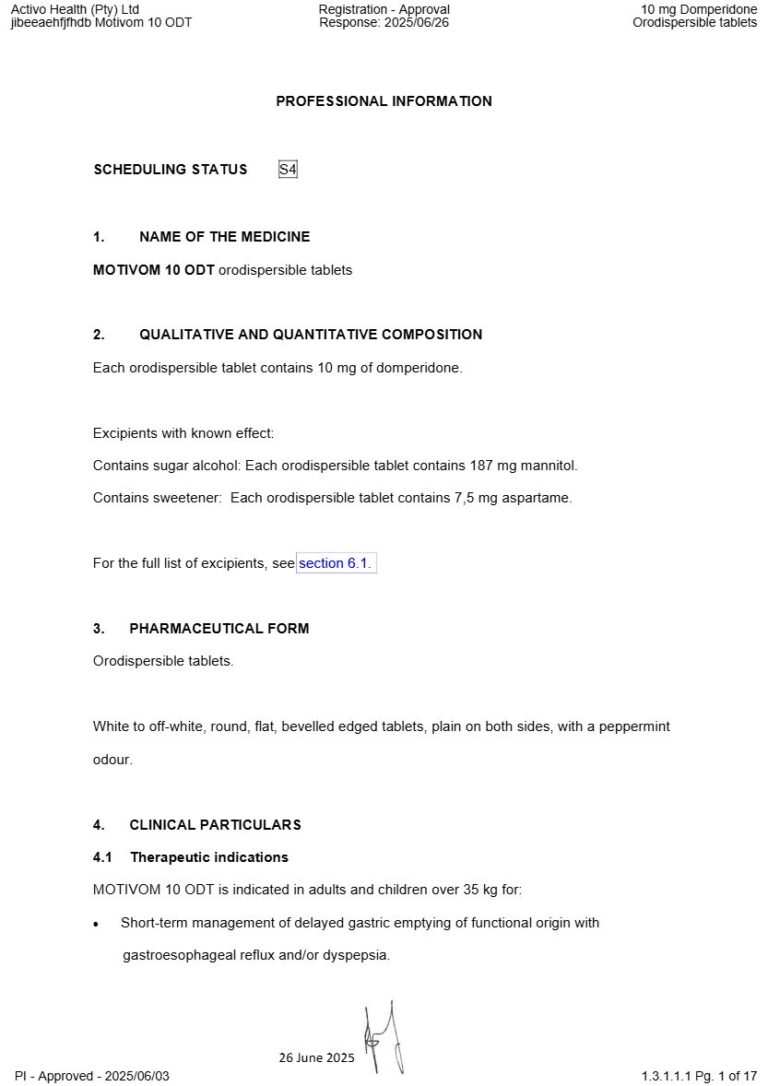
MOTIVOM 10 ODT is indicated in adults and children over 35 kg for:
- Short-term management of delayed gastric emptying of functional origin with gastroesophageal reflux and/or dyspepsia.
- Control of nausea and vomiting of central or local origin.
- As an anti-emetic in patients receiving cytostatic and radiation therapy.
- Facilitation of radiological examination of the upper gastrointestinal tract.
4.2 Posology and method of administration
Posology
Adults and adolescents u2265 12 years of age and weighing u2265 35 kg, and children weighing u2265 35 kg
The dose of MOTIVOM 10 ODT should be the lowest effective dose for the individual situation (typically 30 mg/day) with a maximum daily oral dose of 40 mg. Usually, the maximum treatment duration should not exceed one week for the treatment of acute nausea and vomiting. If nausea and vomiting persist for longer than one week, patients should consult their doctors. For other indications, the initial duration of treatment is up to four weeks. If treatment exceeds four weeks, patients should be re-evaluated and the need for continued treatment reassessed.
Formulation (domperidone per unit)
Dosage Maximum dose per day
Orodispersible tablet (10 mg per tablet) 1 tablet three to four times per day 40 mg (4 x 10 mg tablet)
Special populations
Renal impairment
Since the elimination hatf-life of domperidone is prolonged in severe renal impairment (serum creatinine > 6 mg/100 mL, i.e.> 0,6 mmol/L), the dosing frequency of MOTIVOM 10 ODT should be reduced to once or twice daily, depending on the severity of the impairment, and the dose may need to be reduced. Patients with severe renal impairment should be reviewed regularly.
Hepatic impairment
MOTIVOM 10 ODT is contraindicated for patients with moderate (Child-Pugh 7 to 9) or severe (Child-Pugh > 9) hepatic impairment (see section 4.3). Dose adjustment is not required for patients with mild (Child-Pugh 5 to 6) hepatic impairment (see section 5.2).
Paediatric population
Tablets are unsuitable for use in children weighing less than 35 kg.
Method of administration
MOTIVOM 10 ODT is for oral administration. The orodispersible tablet dissolves rapidly in the mouth with the help of the saliva, and can be taken with or without water. When taken without water, the MOTIVOM 10 ODT tablet should be placed on the tongue and dissolved in the mouth before swallowing. If convenient, a glass of water can be taken afterwards. It is recommended to take MOTIVOM 10 ODT, 15 u2013 30 minutes before meals. If taken after meals, absorption of the medicine is somewhat delayed.
4.3 Contraindications
MOTIVOM 10 ODT is contraindicated in the following situations:
- Known hypersensitivity to domperidone or any of the excipients in MOTIVOM 10 ODT (see section 6.1).
- Prolactin-releasing pituitary tumour (prolactinoma).
- When stimulation of the gastric motility could be harmful e.g., in patients with gastrointestinal haemorrhage, mechanical obstruction or perforation.
- In patients with moderate or severe hepatic impairment (see section 5.2).
- In patients who have known existing prolongation of cardiac conduction intervals, particularly QTc or family history thereof, patients with significant electrolyte disturbances or underlying cardiac diseases, such as congestive heart failure (see section 4.4).
- Hypokalaemia, hypomagnesaemia, hyperkalaemia.
- Bradycardia or heart block.
- Co-administration with medicines known to induce torsades de pointes and/or with QT-prolonging medicines (see sections 4.4 and 4.5).
- Co-administration with potent CYP3A4 inhibitors (regardless of their QT prolonging effects) (see section 4.5).
4.4 Special warnings and precautions for use
Cardiovascular effects
Domperidone has been associated with prolongation of the QT interval on the electrocardiogram. During post-marketing surveillance, there have been cases of QT prolongation and torsades de pointes in patients taking domperidone, as in MOTIVOM 10 ODT. These reports included patients with confounding risk factors, electrolyte abnormalities and concomitant treatment which may have been contributing factors (see section 4.3 and 4.8).
Epidemiological studies showed that domperidone was associated with an increased risk of serious ventricular dysrhythmias or sudden cardiac death (see section 4.8). A higher risk was observed in patients older than 60 years of age, patients taking daily doses greater than 30 mg, and patients concurrently taking QT-prolonging medicines or CYP3A4 inhibitors. Therefore, MOTIVOM 10 ODT should be used with caution in older patients.
MOTIVOM 10 ODT should be used at the lowest effective dose in adults and adolescents 12 years of age and older (see section 4.2).
MOTIVOM 10 ODT is contraindicated in patients with known existing prolongation of cardiac conduction intervals, particularly QTc, in patients with significant electrolyte disturbances (hypokalaemia, hyperkalaemia, hypomagnesaemia), or bradycardia, or in patients with underlying cardiac diseases such as congestive heart failure due to increased risk of ventricular dysrhythmia (see section 4.3.). Electrolyte disturbances (hypokalaemia, hyperkalaemia, hypomagnesaemia) or bradycardia are known to be conditions increasing the prodysrhythmic risk.
Treatment with MOTIVOM 10 ODT should be stopped if signs or symptoms occur that may be associated with cardiac dysrhythmia, and the patient should consult their medical practitioner. Patients should be advised to promptly report any cardiac symptoms.
Use with apomorphine
MOTIVOM 10 ODT is contraindicated with QT prolonging medicines, including apomorphine.
Renal impairment
The elimination half-life of domperidone is prolonged in severe renal impairment. For repeated administration, the dosing frequency of MOTIVOM 10 ODT should be reduced to once or twice daily depending on the severity of the impairment. The dose may also need to be reduced.
Children
MOTIVOM 10 ODT is unsuitable for use in children weighing less than 35 kg.
MOTIVOM 10 ODT contains aspartame
Aspartame is a source of phenylalanine. It may be harmful if you have phenylketonuria (PKU), a rare genetic disorder in which phenylalanine builds up because the body cannot remove it properly.
4.5 Interaction with other medicines and other forms of interaction
The main metabolic pathway of MOTIVOM 10 ODT is through CYP3A4. In vitro data suggest that the concomitant use of medicines that significantly inhibit this enzyme may result in increased plasma levels of domperidone. Increased risk of occurrence of QT-interval prolongation, due to pharmacodynamic and/or pharmacokinetic interactions.
Concomitant use of the following substances is contraindicated:
- QTc prolonging medicines:
- antidysrhythmics class IA (e.g., disopyramide, hydroquinidine, quinidine)
- antidysrhythmics class III (e.g., amiodarone, dofetilide, dronedarone, ibutilide, sotalol)
- certain antipsychotics (e.g., haloperidol, pimozide, sertindole)
- certain antidepressants (e.g., citalopram, escitalopram)
- certain antibiotics (e.g., erythromycin, levofloxacin, moxifloxacin, spiramycin)
- certain antifungal medicines (e.g., pentamidine)
- certain antimalarial medicines (in particular halofantrine, lumefantrine)
- certain gastrointestinal medicines (e.g., cisapride, dolasetron, prucalopride)
- certain antihistaminics (e.g., mequitazine, mizolastine)
- certain medicines used in cancer (e.g., toremifene, vandetanib, vincamine)
- certain other medicines (e.g., bepridil, diphemanil, methadone) (see section 4.3)
- apomorphine (see section 4.4).
Potent CYP3A4 inhibitors (regardless of their QT prolonging effects), i.e.:
- protease inhibitors
- systemic azole antifungals
- some macrolides (erythromycin, clarithromycin, telithromycin) (see section 4.3).
Concomitant use of the following substances is not recommended:
- Moderate CYP3A4 inhibitors i.e. diltiazem, verapamil and some macrolides (see section 4.3).
Concomitant use of the following substances requires caution in use:
Caution with bradycardia and hypokalaemia-inducing medicines, as well as with the following macrolides involved in QT-interval prolongation: azithromycin and roxithromycin (clarithromycin is contraindicated as it is a potent CYP3A4 inhibitor).
The above list of substances is representative and not exhaustive.
Separate in vivo pharmacokinetic/pharmacodynamic interaction studies with oral ketoconazole or oral erythromycin in healthy subjects confirmed a marked inhibition of domperidone's CYP3A4 mediated first pass metabolism by these medicines. With the combination of oral domperidone 10 mg four times daily and ketoconazole 200 mg twice daily, a mean QTc prolongation of 9,8 msec was seen over the observation period, with changes at individual time points ranging from 1,2 to 17,5 msec. With the combination of domperidone 10 mg four times daily and oral erythromycin 500 mg three times daily, mean QTc over the observation period was prolonged by 9,9 msec, with changes at individual time points ranging from 1,6 to 14,3 msec. Both the C max and AUC (area under the curve) of domperidone at steady state were increased approximately three-fold in each of these interaction studies. In these studies, domperidone monotherapy at 10 mg given orally four times daily resulted in increases in mean QTc of 1,6 msec (ketoconazole study) and 2,5 msec (erythromycin study), while ketoconazole monotherapy (200 mg twice daily) led to increases in QTc of 3,8 and 4,9 msec, respectively, over the observation period.
Antacids and antisecretory medicines
Antacids and antisecretory medicines should not be taken simultaneously with oral formulations of MOTIVOM 10 ODT as they lower the oral bioavailability of domperidone. When used concomitantly, MOTIVOM 10 ODT should be taken before meals and antacids or anti-secretory medicines after meals. Reduced gastric acidity impairs the absorption of domperidone. Oral bioavailability is decreased by prior concomitant administration of cimetidine and sodium bicarbonate.
Anticholinergic medicines
Concomitant administration of anticholinergic medicines (e.g., dextromethorphan, diphenhydramine) may antagonise the anti-dyspeptic effects of MOTIVOM 10 ODT.
Prolactin levels
MOTIVOM 10 ODT interferes with serum prolactin levels and may interfere with other hypoprolactinaemic medicines and with some diagnostic tests.
General
Since MOTIVOM 10 ODT has gastrokinetic effects, it could influence the absorption of concomitant orally administered medicines, particularly those with sustained release or enteric coated formulations. However, in patients already stabilised on digoxin or paracetamol, concomitant administration of domperidone did not influence the blood levels of these medicines.
MOTIVOM 10 ODT may also be given with:
- Neuroleptics, the action of which it does not potentiate.
- Dopaminergic agonists (e.g. bromocriptine) and L-dopa, whose unwanted peripheral effects, such as digestive disorders, nausea and vomiting, it suppresses without counteracting their central properties.
4.6 Fertility, pregnancy and lactation
Pregnancy
Safety of use during pregnancy has not been established.
Breastfeeding
Domperidone is excreted in human milk and breastfed infants receive less than 0,1 % of the maternal weight-adjusted dose. Occurrence of adverse effects, in particular cardiac effects cannot be excluded after exposure via breast milk. Breastfeeding is not recommended for mothers who are taking MOTIVOM 10 ODT. Caution should be exercised in case of QTc prolongation risk factor in breastfed infants.
Fertility
No data is available on fertility.
4.7 Effects on ability to drive and use machines
MOTIVOM 10 ODT may cause dizziness or somnolence (see section 4.8). Patients should be advised not to drive or use machinery or engage in other activities requiring mental alertness and coordination until they have established how MOTIVOM 10 ODT affects them.
4.8 Undesirable effects
The safety of domperidone, as in MOTIVOM 10 ODT, was evaluated in clinical trials and in post marketing experience. The clinical trials included patients with dyspepsia, gastroesophageal reflux disorder (GORD), irritable bowel syndrome (IBS), nausea and vomiting or other related conditions. Studies in diabetic gastroparesis or symptoms secondary to chemotherapy or parkinsonism were excluded.
Immune system disorders:
- Less frequent: hypersensitivity
Psychiatric disorders:
- Frequent: depression
- Less frequent: loss of libido, anxiety
Nervous system disorders:
- Frequent: akathisia, somnolence, headache
Gastrointestinal disorders:
- Frequent: dry mouth, diarrhoea
Skin and subcutaneous tissue disorders:
- Frequent: rash, pruritus
- Less frequent: urticaria
Reproductive system and breast disorders:
- Frequent: breast enlargement/gynaecomastia, amenorrhoea, irregular menstruation, lactation disorder, breast tenderness, breast pain, galactorrhoea
- Less frequent: breast discharge, breast swelling
General disorders and administration site conditions:
- Frequent: asthenia
Post-marketing experience:
The following reactions have been reported post-marketing:
Immune system disorders:
- Frequency unknown: anaphylactic reaction (including anaphylactic shock), angioedema
Psychiatric disorders:
- Frequency unknown: agitation, nervousness
Nervous system disorders:
- Frequency unknown: convulsion, extrapyramidal disorder, dizziness
Eye disorders:
- Frequency unknown: oculogyric crisis
Cardiac disorders:
- Frequency unknown: ventricular dysrhythmias (see section 4.4), sudden cardiac death, QTc prolongation, torsade de pointes
Renal and urinary disorders:
- Frequency unknown: urinary retention
Investigations:
- Frequency unknown: abnormal liver function tests, increased blood prolactin
Description of selected adverse events
In clinical studies where domperidone, as in MOTIVOM 10 ODT, was used at higher dosages, for longer duration and for additional indications including diabetic gastroparesis, the frequency of adverse events (apart from dry mouth) was considerably higher. This was particularly evident for pharmacologically predictable events related to increased prolactin. In addition to the reactions listed above, akathisia, breast discharge, breast enlargement, breast swelling, depression, hypersensitivity, lactation disorder, and irregular menstruation were also noted.
Reporting of suspected adverse reactions
Reporting suspected adverse reactions after authorisation of MOTIVOM 10 ODT is important. It allows continued monitoring of the benefit/risk balance of MOTIVOM 10 ODT. Health care providers are requested to report any suspected adverse reactions to SAHPRA via the Med Safety APP (Medsafety X SAHPRA) and eReporting platform (who-umc.org) found on the SAHPRA website.
4.9 Overdose
Symptoms
Symptoms of over dosage may include agitation, altered consciousness, convulsions, disorientation, somnolence and extrapyramidal reactions.
Treatment
There is no specific antidote to MOTIVOM 10 ODT, but in the event of overdose, standard symptomatic treatment should be given immediately. Administration of activated charcoal, may be useful. Electrocardiogram (ECG) monitoring should be undertaken, because of the possibility of QT interval prolongation. Close medical supervision and supportive therapy is recommended.
Anticholinergic, anti-parkinson medicines may be helpful in controlling the extrapyramidal reactions.
