
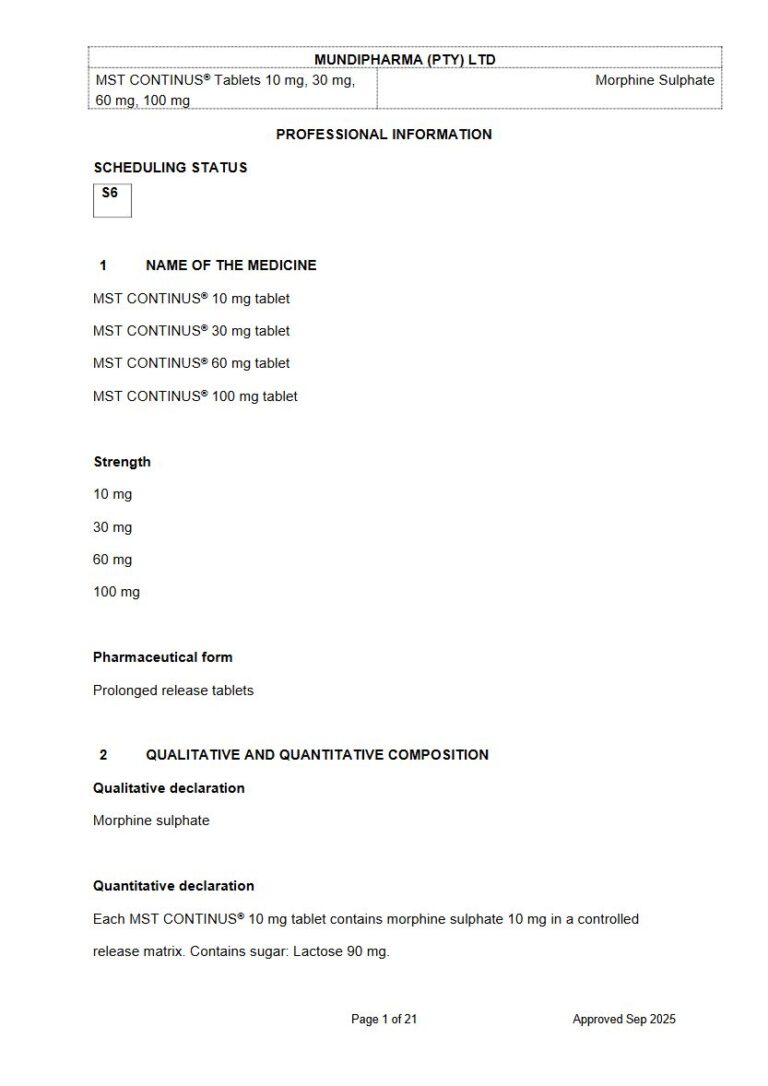
Mst Continus 10 Mg/30 Mg/60 Mg/100 Mg Prolonged-Release Tablets
PDF Leaflet Revision Date: 5 September 2025
Clinical Summary
Quick overview from the medicine insert
Indication
Relief of severe and intractable pain not controlled with non-narcotic analgesics.
Dosage (summary)
Start with 10 mg or 30 mg tablets twice daily, adjust based on pain severity.
Special Populations
- Elderly
- Renal impairment
- Hepatic impairment
Pregnancy & Breastfeeding
Contraindicated during pregnancy and lactation; may cause withdrawal in infants.
Key Drug Interactions
- CNS depressants
- Alcohol
- MAO inhibitors
Contraindications
- Hypersensitivity to morphine
- Respiratory depression
- Acute alcoholism
- Pregnancy
- Paediatric use
Common side effects
- Nausea
- Vomiting
- Constipation
- Drowsiness
- Confusion
Counselling Points
- Swallow tablets whole
- Avoid alcohol
- Monitor for signs of misuse or dependence
Serious warnings
- Risk of respiratory depression
- Potential for abuse and dependence
- Do not chew or crush tablets
Important Disclaimer
The Mst Continus 10 Mg/30 Mg/60 Mg/100 Mg Prolonged-Release Tablets professional information leaflet below is the property of Mundipharma and is provided on Medinsert exactly as issued, with no.. alterations or editorial changes. We make every effort to keep content current by updating documents as soon as new versions become available. Medinsert serves as a trusted access point for healthcare professionals, but does not replace official sources or clinical judgement. For more details, please read our full disclaimer. read more>>
 Healthcare Professionals Only
This content is for registered healthcare professionals
Sign in or create a free account to read the full package insert.
Free for HPCSA-registered professionals. Powered by Medinsert.
Clinical Particulars
Section 4 of the official insert — extracted exactly as issued, no alterations
4.1 Therapeutic indications
For the relief of severe and intractable pain not controlled with non-narcotic analgesics.
4.2 Posology and method of administration
Posology
MST CONTINUS u00c6 tablets should be taken twice daily.
The dosage is dependent upon the severity of pain and the patientu2019s previous history of analgesic therapy. A patient with intractable pain due to cancer, will normally be started on a dosage of one or two MST CONTINUS u00c6 10 mg tablets twice daily. Increases in pain or tolerance to the medicine will require increases in dosage using MST CONTINUS u00c6 10 mg, 30 mg, 60 mg and 100 mg tablets alone or in combination. When substituting MST CONTINUS u00c6 tablets for parenteral morphine, patients should be given a sufficiently increased dosage to compensate for the reduction in analgesic effects associated with orally administered morphine.
Method of administration
MST CONTINUS u00c6 tablets should be swallowed whole and not chewed.
4.3 Contraindications
- Hypersensitivity to morphine sulphate or any of the excipients (see section 6.1);
- Phaeochromocytoma;
- Respiratory depression, obstructive airways disease;
- Acute alcoholism and consumption of alcoholic beverages while on MST CONTINUS u00c6 therapy (see section 4.4);
- Head injuries and conditions in which intracranial pressure is raised;
- After operation of the biliary tract;
- Acute bronchial asthma or heart failure secondary to chronic lung disease;
- Paralytic ileus, delayed gastric emptying;
- Acute hepatic disease;
- Concurrent administration of monoamine oxidase inhibitors (MAO-I) or within two weeks of discontinuation of treatment with them (see section 4.5);
- Comatose patients, pre-operative use, or for the first 24 hours post-operatively;
- Pregnancy and lactation;
- Paediatric use.
4.4 Special warnings and precautions for use
MST CONTINUS u00c6 IS A SUSTAINED RELEASE FORMULATION. THE TABLETS MUST BE SWALLOWED WHOLE AND MUST NOT BE CHEWED, CRUSHED, OR DISSOLVED DUE TO THE RISK OF RAPID RELEASE AND ABSORPTION OF A POTENTIALLY FATAL DOSE OF MORPHINE (see section 4.9).
MST CONTINUS u00c6 must be administered with caution in patients with:
- Severely impaired respiratory function
- Respiratory depression (see below)
- Severe cor pulmonale
- Sleep apnoea
- CNS depressants co-administration (see section 4.5)
- Medicine dependence, tolerance and potential for abuse (see below)
- Medicine withdrawal syndrome (see below)
- Hypotension with hypovolemia
- Biliary tract disorder
Opioids may cause sleep-related breathing disorders including central sleep apnoea (CSA) and sleep-related hypoxemia. Opioid use may increase the risk of CSA in a dose-dependent manner in some patients. Opioids may also cause worsening of pre-existing sleep apnoea (see section 4.8). In patients who present with CSA, consider decreasing the total opioid dosage.
Alcohol: MST CONTINUS u00c6 should be used with particular care in patients with a history of alcohol and drug abuse (see Section 4.8 c).
CNS depressants co-administration: Concomitant use of MST CONTINUS u00c6 and central nervous system depressants such as benzodiazepines, anaesthetics, hypnotics and phenothiazines may result in sedation, respiratory depression, coma and death. If a decision is made to prescribe Morphine concomitantly with sedative medicines, the lowest effective dose should be used, and the duration of treatment should be as short as possible. Patients should be monitored closely for signs and symptoms of respiratory depression and sedation. In this respect, it is strongly recommended to inform patients and their caregivers to be aware of these symptoms (see section 4.5).
Patients must not consume alcoholic beverages while on MST CONTINUS u00c6 therapy. Additionally, patients must not use prescription or non-prescription medications containing alcohol while on MST CONTINUS u00c6 therapy (see section 4.3).
4.5 Interaction with other medicines and other forms of interaction
Alcohol: See section 4.4.
MAO Inhibitors: Monoamine oxidase inhibitors (MAOIs) markedly potentiate the action of morphine. MST CONTINUS u00c6 should not be used in patients taking MAOIs or within two weeks of discontinuation of treatment with them (see section 4.3).
Central nervous system (CNS) depressants: The depressant effects of morphine are enhanced by depressants of the central nervous system such as alcohol, other opioids, anaesthetics, hypnotics and sedatives (including benzodiazepines), tricyclic antidepressants, antipsychotics, gabapentin and phenothiazines. Interactive effects resulting in an increased risk of respiratory depression, hypotension, profound sedation, coma or death may occur if these medicines are taken in combination with the usual doses of MST CONTINUS u00c6. The dose and duration of concomitant use should be limited. (see Section 4.4).
Muscle relaxants: MST CONTINUS u00c6 may enhance the degree of respiratory depression induced by neuromuscular blocking agents.
Mixed agonist/antagonist opioid analgesics: Mixed agonist/antagonist opioid analgesics (e.g. buprenorphine, nalbuphine, pentazocine) should not be administered to a patient who has received a course of therapy with a pure opioid agonist analgesic such as MST CONTINUS u00c6.
Histamine H2 receptor antagonists: Cimetidine inhibits the metabolism of some opioids. Concomitant administration of morphine and cimetidine has been reported to precipitate apnoea, confusion and muscle twitching in an isolated report. Patients should be monitored for increased respiratory and CNS depression when receiving cimetidine concomitantly with MST CONTINUS u00c6.
Antibacterial agents: Rifampicin may reduce the plasma concentration of morphine.
Antiviral agents: Although there are no pharmacokinetic data available for concomitant use of ritonavir with MST CONTINUS u00c6, ritonavir induces the hepatic enzymes responsible for the glucuronidation of morphine, and may possibly decrease plasma concentrations of morphine.
Metoclopramide: Metoclopramide may increase the rate of onset and degree of sedation when given concomitantly with delayed release morphine such as MST CONTINUS u00c6.
4.6 Fertility, pregnancy and lactation
Pregnancy: MST CONTINUS u00c6 tablets are contraindicated during pregnancy and lactation (see section 4.3). Infants born to mothers taking MST CONTINUS u00c6 may suffer withdrawal reactions.
Fertility: Animal studies have shown that morphine may reduce fertility (see section 5.3).
4.7 Effects on ability to drive and use machines
Ambulant patients should be warned against driving or handling dangerous machinery as MST CONTINUS u00c6 may modify the patient's reactions to a varying extent depending on the dosage and susceptibility. If affected, patients should not drive or operate machinery.
4.8 Undesirable effects
a. Summary of safety profile
Frequent side effects are nausea, vomiting, constipation, drowsiness, confusion and headache. Tolerance to these effects generally develops with long-term use, but not to constipation.
b. Tabulated list of adverse reactions
Undesirable Effects Common Uncommon Unknown
Immune system disorders Anaphylactic reaction Anaphylactoid reaction Hypersensitivity
Psychiatric disorders Confusion Insomnia Agitation Medicine dependence Dysphoria Euphoria Hallucinations Mood altered Thinking disturbances
Nervous system disorders Dizziness Headache Convulsions Hyperalgesia Allodynia
Involuntary muscle contractions Somnolence Hypertonia Paraesthesia Syncope Sleep apnoea syndrome
Eye disorders Eye pain Miosis Visual disturbance
Ear and labyrinth disorders Vertigo
Cardiac disorders Bradycardia Palpitations Tachycardia
Vascular disorders Facial flushing Hypotension Hypertension
Respiratory, thoracic and mediastinal disorders Bronchospasm Cough decreased Pulmonary oedema Respiratory depression
Gastrointestinal disorders Abdominal pain Anorexia Dyspepsia Constipation Dry mouth Nausea Vomiting Gastrointestinal disorders Ileus Taste perversion
Hepatobiliary disorders Exacerbation of pancreatitis Biliary pain Increased hepatic enzymes Sphincter of Oddi dysfunction
Skin and subcutaneous tissue disorders Hyperhidrosis Rash Dry skin Pruritus Urticaria
Renal and urinary disorders Difficulty in micturition Uretric spasm Urinary retention
Reproductive system and breast disorders Abnormal ejaculation Amenorrhoea Decreased libido Erectile dysfunction
General disorders and administration site conditions Asthenia Fatigue Malaise Pruritus Medicine tolerance Medicine withdrawal syndrome
Medicine withdrawal syndrome neonatal Hypothermia Peripheral oedema
Adverse events identified through post marketing experience
Adverse Event Rare Gastrointestinal disorders Increased risk of abdominal pain, including pancreatitis has been reported.
c. Tolerance, dependence and withdrawal: The patient may develop tolerance to morphine with chronic use and require progressively higher doses of MST CONTINUS u00c6 to maintain pain control. Prolonged use of MST CONTINUS u00c6 may lead to physical dependence and a withdrawal syndrome may occur upon abrupt cessation of therapy. When a patient no longer requires therapy with morphine, it may be advisable to taper the dose gradually to prevent symptoms of withdrawal. MST CONTINUS u00c6 has an abuse profile similar to other strong agonist opioids. MST CONTINUS u00c6 may be sought and abused by people with latent or manifest addiction disorders. There is potential for development of psychological dependence (addiction) to opioid analgesics, including morphine. MST CONTINUS u00c6 should be used with particular care in patients with a history of alcohol and drug abuse. Abuse of oral dosage forms by parenteral administration can be expected to result in serious adverse events, which may be fatal. Hyperalgesia, that will not respond to a further dose increase of morphine sulphate, may occur in particular in high doses. A morphine sulphate dose reduction or change in opioid may be required.
4.9 Overdose
Crushing and taking the contents of MST CONTINUS u00c6, a prolonged-release dosage form, leads to the release of the morphine in an immediate fashion; this might result in a fatal overdose.
Symptoms: Acute overdosage with MST CONTINUS u00c6 is manifested by respiratory depression, somnolence progressing to stupor or coma, pneumonia aspiration, skeletal muscle flaccidity, cold and clammy skin, pin-point pupils, rhabdomyolysis progressing to renal failure and, in some cases, pulmonary oedema, bradycardia, hypotension with circulatory failure, coma and death.
Treatment: Activated charcoal may be given by mouth in conscious patients if a substantial overdose has been ingested within 1 hour or so; it should be considered in all patients if a substantial amount of a sustained release product has been ingested. Primary attention should be given to the re-establishment of a patent airway and institution of assisted or controlled ventilation when an overdose of an extended-release formulation such as MST CONTINUS u00c6 has been ingested. Intensive supportive therapy may be required to correct respiratory failure and shock. The specific antagonist naloxone is used to counteract, very rapidly, the severe respiratory depression and coma produced by excessive doses of opioid analgesics. Administer 400 u03bcg naloxone intravenously and repeat at intervals of 2 to 3 minutes if necessary.
