
Mycobutin 150 Mg Capsules
PDF Leaflet Revision Date: 24 April 2024
Clinical Summary
Quick overview from the medicine insert
Indication
Treatment and prophylaxis of tuberculosis and atypical mycobacterial infections.
Dosage (summary)
1 capsule (150 mg) daily for pulmonary TB; 2-3 capsules daily for multidrug-resistant TB; 3-4 capsules daily for MAC infections.
Special Populations
- Severe hepatic impairment
- Severe renal impairment
- Elderly
Pregnancy & Breastfeeding
Safety in pregnancy and lactation not established.
Key Drug Interactions
- Clarithromycin
- Protease inhibitors
- Antiretrovirals
Contraindications
- Hypersensitivity to rifabutin
- HIV patients on clarithromycin
Common side effects
- Leukopenia
- Nausea
- Increased hepatic enzymes
- Rash
Counselling Points
- Monitor for skin reactions.
- Urine may turn red-orange.
- Use alternative contraception methods.
Serious warnings
- Risk of uveitis
- Clostridium difficile-associated diarrhea
- Severe cutaneous adverse reactions
Important Disclaimer
The Mycobutin 150 Mg Capsules professional information leaflet below is the property of Pfizer Laboratories and is provided on Medinsert exactly as issued, with no.. alterations or editorial changes. We make every effort to keep content current by updating documents as soon as new versions become available. Medinsert serves as a trusted access point for healthcare professionals, but does not replace official sources or clinical judgement. For more details, please read our full disclaimer. read more>>
 Healthcare Professionals Only
This content is for registered healthcare professionals
Sign in or create a free account to read the full package insert.
Free for HPCSA-registered professionals. Powered by Medinsert.
Clinical Particulars
Section 4 of the official insert — extracted exactly as issued, no alterations
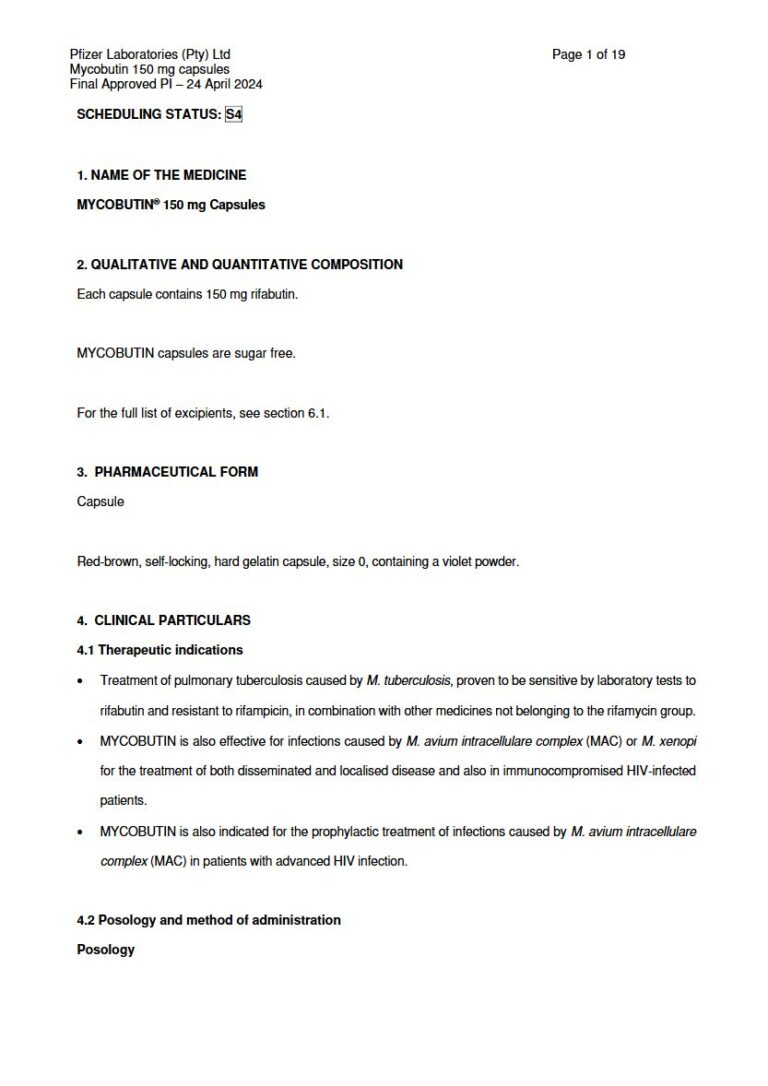
4.1 Therapeutic indications
u2022 Treatment of pulmonary tuberculosis caused by M. tuberculosis , proven to be sensitive by laboratory tests to rifabutin and resistant to rifampicin, in combination with other medicines not belonging to the rifamycin group.
u2022 MYCOBUTIN is also effective for infections caused by M. avium intracellulare complex (MAC) or M. xenopi for the treatment of both disseminated and localised disease and also in immunocompromised HIV-infected patients.
u2022 MYCOBUTIN is also indicated for the prophylactic treatment of infections caused by M. avium intracellulare complex (MAC) in patients with advanced HIV infection.
4.2 Posology and method of administration
Posology MYCOBUTIN can be administered as a single daily dose, independent of meals. In all cases MYCOBUTIN is to be administered in combination regimens.
Newly diagnosed pulmonary tuberculosis with resistance to only rifampicin 1 capsule (150 mg) daily for 6 months.
Chronic, multidrug-resistant pulmonary tuberculosis 2 to 3 capsules (300 u2013 450 mg) daily for up to 6 months after negative sputum cultures are obtained.
Atypical mycobacterial infections (MAC and M. xenopi) 3 to 4 capsules (450 u2013 600 mg) daily for up to 6 months after negative cultures are obtained.
Prophylaxis of MAC in patients with advanced HIV infections 2 capsules (300 mg) daily.
The above doses are indicated in adults with a body mass of greater than 35 kg. No specific dosage alterations are proposed in the elderly.
Method of administration For oral use.
4.3 Contraindications
u2022 Hypersensitivity to rifabutin, other rifamycins (e.g. rifampicin) or any of the excipients of MYCOBUTIN listed in section 6.1.
u2022 HIV-infected patients taking clarithromycin.
u2022 For concomitant medicines not recommended with MYCOBUTIN, see section 4.5.
4.4 Special warnings and precautions for use
MYCOBUTIN may impart a red-orange colour to the urine and possibly to skin and body secretions (saliva, sputum and tears).
Soft contact lenses These may be permanently stained by MYCOBUTIN administration.
MYCOBUTIN should always be given in combination with other anti-mycobacterial medicines not belonging to the family of rifamycins.
It is recommended that liver enzymes, white blood cell and platelet counts be monitored during therapy with MYCOBUTIN.
When MYCOBUTIN is used concomitantly with clarithromycin for MAC treatment, a decreased dose of MYCOBUTIN is recommended due to the increase in plasma concentrations of MYCOBUTIN (see sections 4.2 and 4.5).
Due to the possible occurrence of uveitis, patients should also be carefully monitored when MYCOBUTIN is given in combination with clarithromycin (or other macrolides) and/or fluconazole (and related compounds). If uveitis is suspected, the patient should be referred to an ophthalmologist and, if considered necessary, treatment with MYCOBUTIN should be suspended (see sections 4.8 and 4.5).
Protease inhibitors act as substrates or inhibitors of cytochrome (CYP)450 3A4 mediated metabolism. Therefore, due to significant interactions between protease inhibitors and MYCOBUTIN, their concomitant use should be based on the overall assessment of the patient and patient-specific medicine profile (see section 4.5).
MYCOBUTIN is a CYP450 3A inducer. Therefore, co-administration with antiretroviral products including but not limited to bictegravir, rilpivirine, or doravirine is not recommended due to the expected decrease in plasma concentrations of the antiretrovirals which may lead to loss of virologic response and possible development of resistance (see Section 4.5).
For further recommendations, please refer to the most recent prescribing information of the antiretrovirals or contact the specific manufacturer.
Clostridium difficile- associated diarrhoea (CDAD) has been reported with use of MYCOBUTIN, and may range in severity from mild diarrhoea to fatal colitis. Treatment with MYCOBUTIN alters the normal flora of the colon leading to overgrowth of C. difficile . C. difficile produces toxins A and B which contribute to the development of CDAD. Hypertoxin-producing strains of C. difficile cause increased morbidity and mortality, as these infections can be refractory to antimicrobial therapy and may require colectomy. CDAD must be considered in all patients who present with diarrhoea following MYCOBUTIN use. Careful medical history is necessary since CDAD has been reported to occur over two months after the administration of antibacterial medicines such as MYCOBUTIN.
There have been reports of severe cutaneous adverse reactions (SCARs), such as Stevens Johnson syndrome (SJS), toxic epidermal necrolysis (TEN), drug reaction with eosinophilia and systemic symptoms (DRESS), and acute generalized exanthematous pustulosis (AGEP) with anti-tuberculosis medicines (see section 4.8). If patients develop a skin rash they should be monitored closely and suspect medicine(s) discontinued if lesions progress. Identifying the specific medicine is difficult, as multiple anti-tuberculosis medicines are prescribed in association concurrently.
Specifically, for DRESS, a multi-system potential life-threatening SCAR, time to onset of the first symptoms may be prolonged. DRESS is a clinical diagnosis, and its clinical presentation remains the basis for decision making. An early withdrawal of the suspect medicines is essential because of the syndromeu2019s mortality and visceral involvement (e.g., liver, bone marrow or kidney).
Co-administration of ritonavir is not recommended because it substantially increases the plasma concentration of MYCOBUTIN (see section 4.5). High plasma concentrations of MYCOBUTIN may increase the risk of side effects.
If a patient on MYCOBUTIN develops active tuberculosis, other anti-tuberculosis medicine should be added.
Special populations Severe hepatic impairment For patients with severe liver insufficiency a dose reduction should be considered. Mild hepatic impairment does not require a dose modification.
Severe renal impairment (creatinine clearance below 30 mL/min) A dosage reduction of 50 % is required. Mild to moderate renal impairment does not require any dosage adjustment.
Paediatric population Safety and efficacy in children and adolescents have not been established.
Excipients MYCOBUTIN contains less than 1 mmol sodium (23 mg) per capsule, that is to say essentially u2018sodium - freeu2019.
4.5 Interactions with other medicines
Multiple dosing of MYCOBUTIN has been associated with induction of hepatic metabolic enzymes of the CYP450 3A subfamily. MYCOBUTINu2019s predominant metabolite (25 -O-desacetyl rifabutin; LM 565), may also contribute to this effect. Metabolic induction due to MYCOBUTIN is likely to produce a decrease in circulating levels of concomitantly administered medicines (especially those metabolised by the CYP450 3A pathway).
Kinetic data suggest that enzymatic induction by MYCOBUTIN is complete within 5 days and is dose- independent over the 300 to 600 mg dose-range. Similarly, concomitant medicines that competitively inhibit the CYP450 3A activity may increase circulating levels of MYCOBUTIN.
Table 1 summarises the results and magnitude of the pertinent medicine interactions assessed with MYCOBUTIN. The clinical relevance of these interactions and subsequent dose modifications should be judged in light of the population studied, severity of the disease, patientu2019s medicine profile, and the likely impact on the risk/benefit ratio.
The following table provides details of the possible effects of co-administration, on MYCOBUTIN and the co- administered medicine and risk-benefit statement.
Table 1: MYCOBUTIN interaction studies: Co- administered medicines Effect on MYCOBUTIN Effect on co- administered medicine Comments ANTIVIRALS Amprenavir 2,9-fold increase in AUC, 2,2-fold increase in C max No significant change in kinetics A 50 % reduction in the MYCOBUTIN dose is recommended when combined with amprenavir. Increased monitoring for adverse reactions is warranted.
Bictegravir No data 38 % decrease in AUC 56 % decrease in C min 20 % decrease in C max Although not studied, co-administration of MYCOBUTIN with a medicine containing bictegravir/emtricitabine /tenofovir alafenamide is not recommended due to an expected decrease in tenofovir alafenamide in addition to the reported reduction in bictegravir.
Delavirdine No data Oral clearance increased 5-fold resulting in significantly lower mean trough plasma concentrations (18 uf0b1 15 to 1,0 uf0b1 0,7 uf06d M) Study conducted in HIV-1 infected patients. MYCOBUTIN is not recommended for patients dosed with delavirdine mesylate 400 mg every 8 hours.
Didanosine No significant change in kinetics No significant change in kinetics at steady-state
Doravirine No data 50% decrease in AUC 68% decrease in C24 No significant changes in Cmax If concomitant use is necessary, increase the doravirine dosage as instructed in doravirine- containing product prescribing information.
Fosam- prenavir/ ritonavir 64 % increase in AUC* 35 % increase in AUC and 36 % increase in C max , no effect C trough (amprenavir) Dosage reduction of MYCOBUTIN by at least 75 % (to 150 mg every other day or three times per week) is recommended when combined with fosamprenavir.
Indinavir 173 % increase in AUC, 134 % increase in C max 34 % decrease in AUC, 25 % decrease in C max Dose reduction of MYCOBUTIN to half the standard dose and increase of indinavir from 800 mg to 1 000 mg every 8 hours are recommended when MYCOBUTIN and indinavir are co- administered.
Lopinavir/ ritonavir 5,7-fold increase in AUC, 3,4 fold increase in C max * No significant change in lopinavir kinetics Dosage reduction of MYCOBUTIN by 50 % of the dose of 300 mg/day is recommended (i.e. a maximum dose of 150 mg once daily). Increased monitoring for adverse reactions e.g. nausea, leukopenia, uveitis, is warranted. Further dosage reduction of MYCOBUTIN may be necessary.
Saquinavir No data 40 % decrease in AUC
Rilpivirine No data 42 % decrease in AUC Although not studied, co- administration of MYCOBUTIN with a medicine containing rilpivirine/tenofovir alafenamide/ emtricitabine is not recommended due to an expected decrease in tenofovir alafenamide in addition to the reported reduction in rilpivirine.
Ritonavir 4-fold increase in AUC, 2,5-fold increase in C max No data In the presence of ritonavir the subsequent risk of side effects, including uveitis may be increased. If a protease inhibitor is required in a patient treated with rifabutin, medicines other than ritonavir should be considered (see section 4.4).
Tipranavir/ ritonavir 2,9-fold increase in AUC, 1,7-fold increase in C max No significant change in tipranavir kinetics Therapeutic medicine monitoring of MYCOBUTIN is recommended.
Zidovudine No significant change in kinetics Approximately 32 % decrease in C max and AUC A clinical study has shown that these changes are of no clinical relevance.
ANTIFUNGALS Fluconazole 82 % increase in AUC No significant change in steady- state plasma concentrations
Itraconazole No data 70 u2013 75 % decrease in C max and AUC One case report suggests a kinetic interaction resulting in an increase in serum MYCOBUTIN levels and a risk for developing uveitis in the presence of itraconazole.
Keto- conazole No data No data Co-administration is not recommended. If concomitant use is clinically warranted, carefully monitor patients for increased MYCOBUTIN levels or adverse reactions and for reduced ketoconazole efficacy
Posa- conazole 31 % increase in C max , 72 % increase in AUC 43 % decrease in C max , 49 % decrease in AUC If the medicines are co- administered, patients should be monitored for adverse events associated with MYCOBUTIN administration.
Voriconazole 195 % increase in C max , 331 % increase in AUC ** MYCOBUTIN (300 mg once daily) decreased the C max and AUC of voriconazole administered orally at 200 mg twice daily by 69 % and 78 %, respectively. During co- administration with MYCOBUTIN, the C max and AUC of voriconazole at 350 mg twice daily were 96 % and 68 % of the levels when administered alone at 200 mg twice daily. At a voriconazole dose of 400 mg twice daily, C max and AUC were 104 % and 87 % higher, If the benefit outweighs the risk, MYCOBUTIN may be co-administered with voriconazole if the maintenance dose of voriconazole is increased to 5 mg/kg intravenously every 12 hours or from 200 mg to 350 mg orally, every 12 hours (100 mg to 200 mg orally, every 12 hours in patients less than 40 kg). Careful monitoring of full blood counts and adverse events to MYCOBUTIN (e.g. uveitis) is recommended when MYCOBUTIN is co-administered with voriconazole.
ANTI-PCP (Pneumocystis jiroveci pneumonia) Dapsone No data Approximately 27 u2013 40 % decrease in AUC Study conducted in HIV- infected patients (rapid and slow acetylators).
Sulfa- methoxazole - trimethoprim No significant change in C max and AUC Approximately 15 u2013 20 % decrease in AUC In another study, only trimethoprim (not sulfamethoxazole) had 14 % decrease in AUC and 6 % decrease in C max but were not considered clinically significant.
ANTI-MAC (Mycobacterium avium intracellulare complex) Azithromycin No phar- macokinetic interaction No pharmacokinetic interaction The combination of MYCOBUTIN and azithromycin resulted in a high frequency of adverse effects.
ANTI-TB (tuberculosis) Ethambutol No data No significant change in AUC or C max
Isoniazid No data Pharmacokinetics not affected
Pyra- zinamide No data No data
OTHER Methadone No data No significant effect No apparent effect of MYCOBUTIN on either peak levels of methadone or systemic exposure based upon AUC. MYCOBUTIN kinetics not evaluated.
Oral contra- ceptives No data No data Contraceptive cover may not be adequate during concomitant therapy with MYCOBUTIN; therefore, patients should be advised to use other methods of contraception.
Tacrolimus No data No data MYCOBUTIN decreases tacrolimus trough blood levels.
Theophylline No data No significant change in AUC or C max compared with baseline AUC u2013 Area under the concentration vs. time curve C max u2013 Maximum serum concentration * Medicine plus active metabolite
4.6 Fertility, pregnancy and lactation
Safety in pregnancy and lactation has not been established.
4.7 Effects on ability to drive and use machines
MYCOBUTIN is not expected to have any adverse effects on the ability to drive and use machines.
4.8 Undesirable effects
The tolerability of MYCOBUTIN in multiple medicine regimens has been assessed in long-term studies with daily dosages up to 600 mg in both immunocompetent and immunocompromised patients, suffering from tuberculosis and non-tuberculous mycobacteriosis. MYCOBUTIN was often given in the studies in tuberculosis as part of a multi-medicine regimen, and it was not always possible to define with certainty a medicine-event relationship.
Tabulated summary of adverse reactions Side effects identified through clinical trials or post-marketing surveillance by system organ class are listed below. The table below contains side effects categorised as follows utilising the incidence rates: very common ( uf0b3 1/10), common ( uf0b3 1/100 to uf03c 1/10); uncommon ( uf0b3 1/1 000 to uf03c 1/100); rare ( uf0b3 1/10 000 to uf03c 1/1 000); very rare ( uf03c 1/10 000).
MedDRA system organ class Frequency Undesirable effects Blood and Very common Leukopenia
lymphatic system disorders Common Anaemia Uncommon Pancytopenia, thrombocytopenia, eosinophilia Immune system disorders Uncommon Hypersensitivity Eye disorders Uncommon Corneal deposits Gastrointestinal disorders Common Nausea, vomiting Hepato-biliary disorders Common Increased hepatic enzymes Uncommon Jaundice Skin and subcutaneous tissue disorders Common Rash Uncommon Skin pigmentation/ discolouration Musculoskeletal and connective tissue disorders Common Myalgia Uncommon Arthralgia General disorders and administration site conditions Common Pyrexia The frequency and severity of haematologic reactions could be increased by combined administration of isoniazid. Anti-tuberculosis medicine SCARs Anti-tuberculosis medicine use may lead to the occurrence of medicine reaction with eosinophilia and systemic symptoms (DRESS) as well as other SCARs such as SJS, TEN, and AGEP (see section 4.4).
Post-marketing experience Skin discolouration has been reported. Mild to severe, reversible uveitis has been reported when MYCOBUTIN was used at 300 mg as monotherapy in MAC prophylaxis. MYCOBUTIN in combination with clarithromycin for MAC treatment was more frequently associated with uveitis (see section 4.4). Corneal deposits have been reported during routine ophthalmologic surveillance of HIV-positive paediatric patients receiving MYCOBUTIN as part of a multiple medicine regimen for MAC prophylaxis. The deposits are tiny, almost transparent, asymptomatic peripheral and central corneal deposits, and do not impair vision. Anaphylactic shock has occurred with other antibiotics of the same class.
The table below contains side effects from post-marketing data. MedDRA system organ class Side effects Blood and lymphatic system disorders Agranulocytosis, lymphopenia, granulocytopenia, neutropenia, decreased white blood cell count, decreased neutrophil count, decreased platelet count Immune system disorders Bronchospasm Eye disorders Uveitis Gastrointestinal disorders Clostridium difficile colitis, tongue discolouration, tooth discolouration Hepato-biliary disorders Abnormal hepatic function Skin and subcutaneous tissue disorders Erythema/ dermatitis Investigations Increased alkaline phosphatase/ALT/AST
4.9 Overdose
Symptoms as under section 4.8. Supportive care and symptomatic treatment are indicated.
