
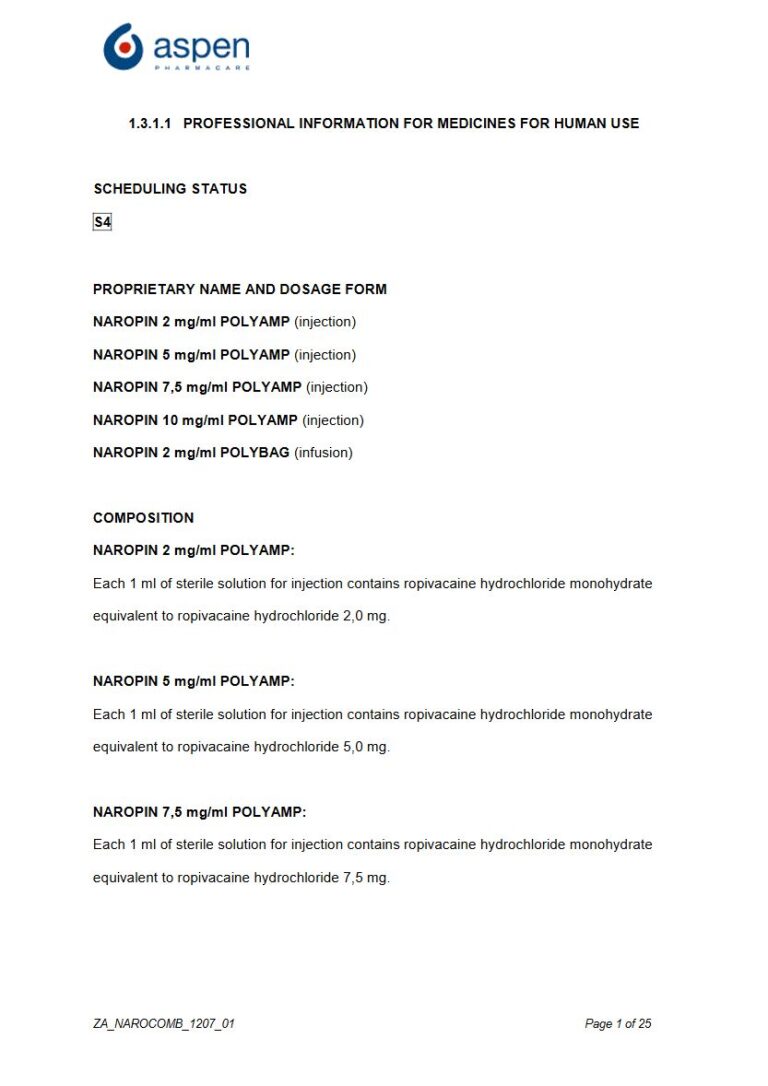
Naropin 2mg / 5mg / 7.5mg / 10mg injection
PDF Leaflet Revision Date: 27 July 2012
Clinical Summary
Quick overview from the medicine insert
Indication
Indicated for surgical anaesthesia and acute pain management.
Dosage (summary)
Adults: 2-10 mg/ml; Children: 2-5 mg/ml based on age and weight.
Onset of Action / Duration
Onset: 10-20 mins, Duration: 3-6 hours.
Special Populations
- Elderly
- Paediatric patients
- Hepatic impairment
- Renal impairment
Pregnancy & Breastfeeding
Safety in pregnancy and lactation not established; use with caution.
Key Drug Interactions
- CYP1A2 inhibitors (e.g., fluvoxamine)
- Other amide-type local anaesthetics
Contraindications
- Hypersensitivity to amide local anaesthetics
- Uncorrected hypotension
- Infection at injection site
Common side effects
- Hypotension
- Nausea
- Bradycardia
- Urinary retention
Counselling Points
- Monitor for CNS toxicity signs
- Avoid rapid injection
- Ensure resuscitation equipment is available
Serious warnings
- Risk of systemic toxicity
- Cardiac arrest possible
- Epidural/spinal haematomas with anticoagulants
Important Disclaimer
The Naropin 2mg / 5mg / 7.5mg / 10mg injection professional information leaflet below is the property of Aspen Pharmacare and is provided on Medinsert exactly as issued, with no.. alterations or editorial changes. We make every effort to keep content current by updating documents as soon as new versions become available. Medinsert serves as a trusted access point for healthcare professionals, but does not replace official sources or clinical judgement. For more details, please read our full disclaimer. read more>>
 Healthcare Professionals Only
This content is for registered healthcare professionals
Sign in or create a free account to read the full package insert.
Free for HPCSA-registered professionals. Powered by Medinsert.
Clinical Particulars
Section 4 of the official insert — extracted exactly as issued, no alterations
4.1 Therapeutic indications
NAROPIN is indicated for:
Adults: 2 mg/ml, 7,5 mg/ml, 10 mg/ml.
- Surgical anaesthesia:
- Epidural block for surgery, including Caesarean section
- Minor nerve block and infiltration anaesthesia
- Major nerve block
- Acute pain management:
- Continuous epidural infusion or intermittent bolus administration e.g. postoperative or labour pain
- Minor nerve block and infiltration analgesia
- Continuous peripheral nerve block infusion or intermittent injections, e.g. postoperative pain management
Children (1 to 12 years of age): 2 mg/ml and 5 mg/ml.
- Acute pain management in paediatrics:
- Caudal epidural block
- Peripheral nerve block for per and postoperative pain management.
4.2 Posology and method of administration
NAROPIN should only be used by or under the supervision of clinicians experienced in regional anaesthesia. NAROPIN should not be administered intravenously. Careful aspiration before and during injection is recommended to prevent intravascular injection. The patientu2019s vital functions should be observed closely during the injection. If toxic symptoms occur, the injection should be stopped immediately.
In order to avoid intravascular injection, aspiration should be repeated prior to and during administration of the main dose, which should be injected slowly or in incremental doses, at a rate of 25 to 50 mg/min, while closely observing the patientu2019s vital functions and maintaining verbal contact. When an epidural dose is to be injected, a standard test dose technique is advised. An inadvertent intravascular injection may be recognised by a temporary increase in heart rate and an accidental intrathecal injection by signs of a spinal block. If toxic symptoms occur, the injection should be stopped immediately.
4.3 Contraindications
NAROPIN solutions are contraindicated in patients with known hypersensitivity to local anaesthetics of the amide-type. Intravenous regional anaesthesia (Bieru2019s block). Obstetric paracervical anaesthesia. Local anaesthetics are contraindicated for epidural and spinal anaesthesia in patients with uncorrected hypotension. Local anaesthetic techniques must not be used when there is inflammation and/or sepsis in the region of the proposed injection and/or in the presence of septicaemia.
General contraindications related to epidural anaesthesia, regardless of the local anaesthetic used should be taken into account. Until further experience has been documented NAROPIN is not recommended in children under the age of 1 year. NAROPIN 7,5 mg/ml and 10 mg/ml should not be used in children below the age of 12 years as safety and efficacy have not been established.
4.4 Special warnings and precautions for use
Safe use of NAROPIN in lactating or pregnant women, other than those in labour, has not been established (see HUMAN REPRODUCTION). NAROPIN should not be used for major nerve blocks unless the patients are in an optimal and haemodynamically stable condition. NAROPIN should be administered in incremental doses, since NAROPIN should not be injected rapidly in large doses. It is not recommended for emergency situations, where a fast onset of surgical anaesthesia is necessary.
Local anaesthetics should only be employed by clinicians who are well versed in the diagnosis and management of dose related toxicity and other acute emergencies which might arise from the block to be employed, then only after insuring the immediate (without delay) availability of oxygen, other resuscitative medicines, cardiopulmonary resuscitative equipment, and the personnel resources needed for proper management of toxic reactions and related emergencies. Delay in proper management of dose related toxicity, under-ventilation from any cause and/or altered sensitivity may lead to the development of acidosis, cardiac arrest and possibly, death.
Solutions of NAROPIN should not be used for the production of obstetrical paracervical block anaesthesia, retrobulbar block, or spinal anaesthesia (subarachnoid block) due to insufficient data to support such use. Intravenous regional anaesthesia (Bier block) should not be performed due to a lack of clinical experience and a risk of attaining toxic blood levels of NAROPIN.
It is essential that aspiration for blood, or cerebrospinal fluid (where applicable), be done prior to injecting any local anaesthetic, both the original dose and all subsequent doses, to avoid intravascular or subarachnoid injection. However a negative aspiration does not ensure against an intravascular or subarachnoid injection.
NAROPIN should be used with caution in patients receiving local anaesthetics and agents structurally related to amide-type local anaesthetics, since the toxic effects of these medicines are additive (see INTERACTIONS).
Major peripheral nerve blocks may imply the administration of a large volume of local anaesthetic in highly vascularised areas, often close to large vessels where there is an increased risk of intravascular injection and/or rapid systemic absorption, which can lead to high plasma concentrations.
NAROPIN should not be given to patients with pre-existing abnormal neurological pathology, e.g. myasthenia gravis. Epidural, caudal and spinal anaesthesia should not be used in serious diseases of the CNS or of the spinal cord, e.g. meningitis, spinal fluid block, cranial or spinal haemorrhage, tumours, poliomyelitis, syphilis, tuberculosis or metastatic lesions of the spinal cord.
WHEN ANY LOCAL ANAESTHETIC AGENT IS USED, RESUSCITATIVE EQUIPMENT AND MEDICINES, INCLUDING OXYGEN, SHOULD BE IMMEDIATELY AVAILABLE IN ORDER TO MANAGE POSSIBLE ADVERSE REACTIONS INVOLVING THE CARDIOVASCULAR, RESPIRATORY OR CENTRAL NERVOUS SYSTEMS. BECAUSE OF THE POSSIBILITY OF HYPOTENSION AND BRADYCARDIA FOLLOWING MAJOR BLOCKS, AN IV CANNULA SHOULD BE INSERTED BEFORE THE LOCAL ANAESTHETIC IS INJECTED. INJECTION SHOULD ALWAYS BE MADE SLOWLY WITH FREQUENT ASPIRATIONS TO AVOID INADVERTENT INTRAVASCULAR INJECTION, WHICH CAN PRODUCE TOXIC EFFECTS.
Patients receiving major blocks should be in an optimal and haemodynamically stable condition.
4.5 Interactions with other medicines
NAROPIN should be used with caution in patients receiving other local anaesthetic or agents structurally related to amide-type local anaesthetics, e.g. certain antidysrhythmics, such as lidocaine and mexiletin, since the systemic toxic effects are additive. Specific interaction studies with NAROPIN and antidysrhythmic medicines class III (e.g. amiodarone) have not been performed, but caution is advised.
In healthy volunteers, ropivacaine clearance was reduced by up to 77 % during co-administration of fluvoxamine, a potent competitive inhibitor of P4501A2. CYP1A2 is involved in the formation of 3-hydroxy-ropivacaine, a major metabolite. Thus strong inhibitors of CYP1A2, such as fluvoxamine and enoxacin, given concomitantly with NAROPIN can cause a metabolic interaction leading to an increased ropivacaine plasma concentration. Prolonged administration of NAROPIN should therefore be avoided in patients treated with strong inhibitors of CYP1A2 such as fluvoxamine and enoxacin.
4.6 Fertility, pregnancy and lactation
Safe use of NAROPIN in lactating or pregnant women, other than those in labour, has not been established. Foetal bradycardia frequently follows paracervical block with some amide-type local anaesthetics (such as NAROPIN) and may be associated with foetal acidosis. Added risk appears to be present in prematurity, toxaemia of pregnancy and foetal distress. Until further clinical experience in pregnancy is gained, the use of NAROPIN is not recommended (see WARNINGS AND SPECIAL PRECAUTIONS).
4.7 Effects on ability to drive and use machines
Besides the direct anaesthetic effect, NAROPIN may have an effect on mental function and coordination even in the absence of overt central nervous system toxicity and may temporarily impair locomotion and alertness.
4.8 Undesirable effects
The effects of systemic overdose and unintentional intravascular injections can be serious (see KNOWN SYMPTOMS OF OVERDOSAGE AND PARTICULARS OF ITS TREATMENT). In children the most commonly reported adverse events (> 1 %) are vomiting, nausea and pruritus. NAROPIN may cause acute toxic effects after high doses or if very rapidly rising blood levels occur due to accidental intravascular injection or overdose. One case of convulsions has been observed after an unintended intravascular injection at an attempted brachial plexus block with 200 mg.
Side effects reported after use of NAROPIN include physiological effects of the nerve block itself, e.g. hypotension, bradycardia and urinary retention after epidural and intrathecal block, and events caused directly by needle puncture (e.g. spinal haematoma, postdural puncture headache), or indirectly by introduction of micro-organisms (e.g. meningitis and epidural abscess).
The table of adverse reactions includes reactions caused by the medicine per se and also frequently associated physiological side effects. The percentage of patients that can be expected to experience adverse reactions varies with the route of administration of NAROPIN. Systemic adverse reactions of NAROPIN usually occur because of inadvertent intravascular injection, excessive dosage or rapid absorption.
Table of adverse reactions (pooled data from all types of blocks):
- Very common: (u2265 1/10) Vascular disorders: Hypotension Gastrointestinal disorders: Nausea
- Common: (u2265 1/100) Nervous system disorders: Paraesthesia, dizziness, headache Cardiac disorders: Bradycardia, tachycardia Vascular disorders: Hypertension Gastrointestinal disorders: Vomiting Renal and urinary disorders: Urinary retention General disorders and administration site conditions: Temperature elevation, rigor, back pain
- Uncommon: (u2265 1/1 000) Psychiatric disorders: Anxiety Nervous system disorder: Symptoms of CNS toxicity (convulsions, grand mal convulsions, seizures, light headedness, circumoral paraesthesia, numbness of the tongue, hyperacusis, tinnitus, visual disturbances, dysarthria, muscular twitching, tremor**), hypoaesthesia Vascular disorders: Syncope Respiratory, thoracic and mediastinal disorders: Dyspnoea General disorders and administration site conditions: Hypothermia
- Rare: (u2265 1/10 000) Cardiac disorders: Cardiac arrest, cardiac arrhythmias General disorder and administration site conditions: Allergic reactions (anaphylactic reactions, angio-oedema, angioneurotic oedema and urticaria)
** These symptoms usually occur because of inadvertent intravascular injection, overdose or rapid absorption.
Class-related adverse reactions: This section includes complications related to the anaesthetic technique regardless of the local anaesthetic used. Neurological complications: Neuropathy and spinal cord dysfunctions (e.g. anterior spinal artery syndrome, arachnoiditis, cauda equina damage), have been associated with epidural anaesthesia.
Total spinal block: Total spinal block may occur if an epidural dose is inadvertently administered intrathecally.
4.9 Overdose
Accidental intravascular injections of NAROPIN may cause immediate (within seconds to a few minutes) systemic toxic reactions. In the event of overdose, systemic toxicity appears later (15 to 60 minutes after injection) due to the slower increase in local anaesthetic blood concentration (see SIDE EFFECTS and WARNINGS AND SPECIAL PRECAUTIONS).
Acute systemic toxicity: Systemic toxic reactions primarily involve the central nervous system (CNS) and the cardiovascular system (CVS). Such reactions are caused by high blood concentration of a local anaesthetic, which may appear due to (accidental) intravascular injection, overdose or exceptionally rapid absorption from highly vascularised areas. Central nervous system toxicity is a graded response with symptoms and signs of escalating severity. The first symptoms are usually light-headedness, circumoral paraesthesia, numbness of the tongue, hyperacusis, tinnitus and visual disturbances. Dysarthria, muscular twitching or tremors are more serious and precede the onset of generalised convulsions. These signs must not be mistaken for neurotic behaviour. Unconsciousness and grand mal convulsions may follow which may last from a few seconds to several minutes. Hypoxia and hypercarbia occur rapidly following convulsions due to the increased muscular activity, together with the interference with respiration and possible loss of functional airways. In severe cases apnoea may occur. Acidosis hyperkalaemia, hypocalcaemia and hypoxia increase and extend the toxic effects of local anaesthetics.
Recovery is due to redistribution of NAROPIN from the central nervous system and subsequent metabolism and excretion. Recovery may be rapid unless large amounts of the medicine have been injected.
Cardiovascular system toxicity may be seen in severe cases and is generally preceded by signs of toxicity in the central nervous system. In patients under heavy sedation or receiving a general anaesthetic, prodromal CNS symptoms may be absent. Hypotension, bradycardia, dysrhythmia and even cardiac arrest may occur as a result of high systemic concentrations of local anaesthetics, but in rare cases cardiac arrest has occurred without prodromal CNS effects.
In children, early signs of local anaesthetic toxicity may be difficult to detect since they may not be able to verbally express them, or if they are under general anaesthesia.
Treatment of acute systemic toxicity: If signs of acute systemic toxicity appear, injection of NAROPIN should be stopped immediately and CNS symptoms (convulsion, CNS depression) must promptly be treated with appropriate airway/respiratory support and the administration of anticonvulsant medicines. If circulatory arrest should occur, immediate cardiopulmonary resuscitation should be instituted. Optimal oxygenation and ventilation and circulatory support as well as treatment of acidosis are of vital importance. If cardiovascular depression occurs (hypotension, bradycardia), appropriate treatment with intravenous fluids, vasopressor, and/or inotropic agents should be considered. Children should be given doses commensurate with age and weight. Should cardiac arrest occur, a successful outcome may require prolonged resuscitative efforts.
