
Neomercazole 5 mg Tablets
PDF Leaflet Revision Date: 25 September 2020
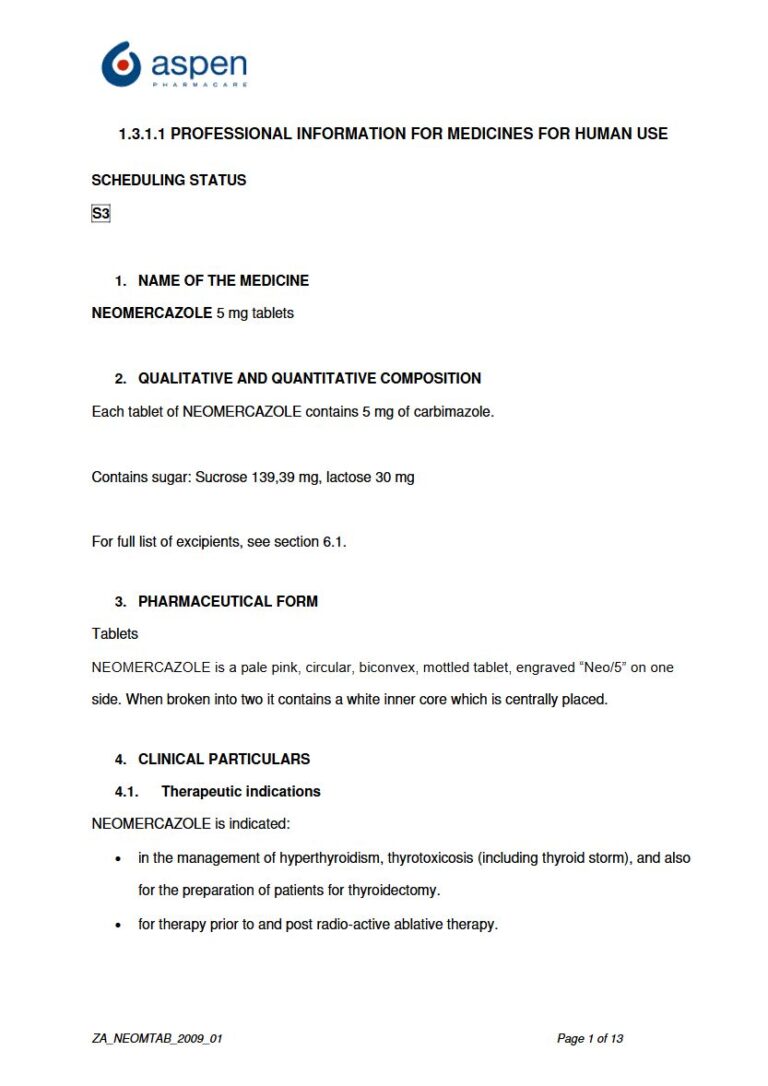
Clinical Summary
Quick overview from the medicine insert
Indication
Management of hyperthyroidism and preparation for thyroidectomy.
Dosage (summary)
10 mg to 60 mg daily, titrated based on thyroid function.
Special Populations
- Hepatic impairment
- Renal impairment
Pregnancy & Breastfeeding
Contraindicated in pregnancy and breastfeeding; teratogenic effects noted.
Key Drug Interactions
- Anticoagulants
- Theophylline
- Iodine-containing medications
Contraindications
- Hypersensitivity to carbimazole
- Severe hepatic insufficiency
- Agranulocytosis
- Acute pancreatitis
Common side effects
- Agranulocytosis
- Nausea
- Headache
- Rash
Counselling Points
- Report signs of infection immediately
- Use effective contraception
- Avoid breastfeeding while on treatment
Serious warnings
- Risk of agranulocytosis
- Monitor liver function
- Caution in tracheal obstruction
Important Disclaimer
The Neomercazole 5 mg Tablets professional information leaflet below is the property of Pharmacare Limited and is provided on Medinsert exactly as issued, with no.. alterations or editorial changes. We make every effort to keep content current by updating documents as soon as new versions become available. Medinsert serves as a trusted access point for healthcare professionals, but does not replace official sources or clinical judgement. For more details, please read our full disclaimer. read more>>
 Healthcare Professionals Only
This content is for registered healthcare professionals
Sign in or create a free account to read the full package insert.
Free for HPCSA-registered professionals. Powered by Medinsert.
Clinical Particulars
Section 4 of the official insert — extracted exactly as issued, no alterations
4.1. Therapeutic indications
NEOMERCAZOLE is indicated:
- in the management of hyperthyroidism, thyrotoxicosis (including thyroid storm), and also for the preparation of patients for thyroidectomy.
- for therapy prior to and post radio-active ablative therapy.
4.2. Posology and method of administration
Posology
Adults
NEOMERCAZOLE should only be administered if hyperthyroidism has been confirmed by laboratory tests.
10 mg to 60 mg daily according to the severity of the disorder. The dose should be gradually reduced to the smallest amount which will control the disease. Daily dosage should be divided and titrated against thyroid function until the patient is euthyroid in order to reduce the risk of over-treatment and resultant hypothyroidism. Serial thyroid function monitoring is recommended, together with appropriate dosage modification in order to maintain a euthyroid state.
Paediatric population
No data are available.
Method of administration
For oral administration.
4.3. Contraindications
NEOMERCAZOLE is contraindicated in:
- Patients with hypersensitivity to carbimazole or to any excipients in NEOMERCAZOLE (see section 6.1).
- Use with other thiourea antithyroid medicines.
- Serious pre-existing haematological conditions, such as agranulocytosis. Fatalities with NEOMERCAZOLE-induced agranulocytosis have been reported (see sections 4.4 and 4.8).
- Severe hepatic insufficiency, severe hepatic impairment.
- Pregnancy and lactation and in women intending to become pregnant (see section 4.6).
- Acute pancreatitis after the administration of carbimazole or its active metabolite.
NEOMERCAZOLE should be given with the utmost caution, or not at all, if there is any degree of tracheal obstruction, as high dosages may produce thyroid enlargement and obstructive symptoms may become marked.
4.4. Special warnings and precautions for use
As fatalities with dose-related agranulocytosis have been reported and early treatment of agranulocytosis is essential, it is important that patients should be warned to report the incidence of mouth ulcers or sore throat, bruising or bleeding, malaise or fever, as they may precede abnormal findings in the blood by several days and should be instructed to stop the NEOMERCAZOLE and seek medical advice immediately. In such patients, blood cell counts should be performed immediately, particularly where there is any clinical evidence of infection. Treatment should be discontinued if there is any clinical or laboratory evidence of neutropenia.
Following the onset of any signs and symptoms of hepatic disorder (pain in the upper abdomen, anorexia, general pruritus) in patients, NEOMERCAZOLE should be stopped and liver function tests performed immediately. NEOMERCAZOLE should be used with caution in patients with mild-moderate hepatic insufficiency. If abnormal liver function is discovered, the treatment should be stopped. The half-life may be prolonged due to the liver disorder.
NEOMERCAZOLE should be temporarily stopped at the time of administration of radiation. Acute pancreatitis may develop during treatment with NEOMERCAZOLE. If acute pancreatitis occurs, treatment with NEOMERCAZOLE should be discontinued immediately and further use of carbimazole and/or its metabolite is contraindicated. Re-exposure may result in recurrence of acute pancreatitis, with decreased time to onset, therefore NEOMERCAZOLE and/or its metabolites must not be given to patients with a history of acute pancreatitis that occurred following administration of NEOMERCAZOLE (see section 4.3).
Patients experiencing myalgia after the intake of NEOMERCAZOLE should have their creatine phosphokinase levels monitored. It is recommended to increase the precautions with regard to use of NEOMERCAZOLE in non-compliant patients, patients who are confused or have poor memory, and patients with galactose intolerance. Precaution should be taken in patients with intrathoracic goitre, which may worsen during initial treatment with NEOMERCAZOLE. Tracheal obstruction may occur due to intrathoracic goitre. Thyroid function must be checked before the initiation of therapy and regularly thereafter. Women of childbearing potential should use effective contraception and not plan to become pregnant when treated with NEOMERCAZOLE (see section 4.6).
Paediatric population
No data are available.
Excipients
Patients with rare hereditary problems of galactose intolerance, total lactase deficiency, glucose-galactose malabsorption, fructose intolerance or sucrase-isomaltase insufficiency should not take this medicine.
4.5. Interaction with other medicines and other forms of interaction
Medicines/laboratory interactions
NEOMERCAZOLE may interact adversely with other medicines. Particular care is required in cases of concurrent administration of medicine capable of inducing agranulocytosis. Cross-sensitivity with other anti-thyroid medicines may occur. Iodine or iodine excess may decrease the response to NEOMERCAZOLE, requiring an increase in dosage or longer duration of therapy with antithyroid medicines. Amiodarone contains 37 % iodine by weight, and therefore its use significantly increases iodine intake. Iodine deficiency may increase response to antithyroid medicines, requiring a decrease in dosage or shorter duration of therapy. As thyroid status and metabolism of patient decreases toward normal, response to oral anticoagulants may decrease. Since NEOMERCAZOLE is a vitamin K antagonist, the effect of anticoagulants could be intensified. Adjustment of oral anticoagulant dosage on the basis of prothrombin time/INR is recommended. Serum concentrations of digoxin and digitoxin have been reported to increase as the thyroid and metabolic status of patients taking antithyroid medicines decreased, reduction in dosage of any digitalis glycoside may be necessary as patients become euthyroid.
NEOMERCAZOLE may decrease thyroidal uptake of sodium iodide I 131, a rebound increase in uptake may occur up to 5 days after sudden withdrawal of NEOMERCAZOLE.
The serum level of theophylline can increase and toxicity may develop if hyperthyroidic patients are treated with NEOMERCAZOLE without reducing the theophylline dosage.
Laboratory value alterations
With diagnostic test results: NEOMERCAZOLE may decrease thyroidal uptake of sodium iodide I 123 or I 131, or pertechnetate, withdrawal of NEOMERCAZOLE 5 days or more before radioactive iodine uptake tests is necessary to prevent interference.
With physiology laboratory test values: Alanine aminotransferase (ALT [SGPT]) serum concentrations, alkaline phosphatase serum concentrations, aspartate aminotransferase (AST [SGOT]) serum concentrations, bilirubin serum concentrations, lactate dehydrogenase (LDH) serum concentrations and prothrombin time (PT) may be increased, and may indicate hepatoxicity and be associated with splenomegaly.
4.6. Fertility, pregnancy and lactation
The use of NEOMERCAZOLE and/or its metabolites is contraindicated in women planning to become pregnant, are pregnant or breastfeeding their babies. NEOMERCAZOLE is teratogenic and should not be used in pregnancy. Women should not plan to become pregnant when treatment with NEOMERCAZOLE is considered/planned. A medically supervised pregnancy test (blood/urine) should be done 24 hours prior to treatment with NEOMERCAZOLE.
Women of childbearing potential
Women of childbearing potential should use effective contraception and not plan to become pregnant when treated with NEOMERCAZOLE (see section 4.4).
Pregnancy
If a woman becomes pregnant while on treatment with NEOMERCAZOLE, the possibility of a medical abortion should be considered if there is evidence of harm to the embryo. If treatment cannot be delayed until after birth, the woman should be treated with an alternative medicine that is safer to use in pregnancy. If the safe/safer alternative is not available, is contraindicated or not tolerated, both partners should be counselled and signed written consent to continue treatment with NEOMERCAZOLE be obtained. If treatment with NEOMERCAZOLE should be continued, the lowest dose should be considered and treatment monitored. NEOMERCAZOLE crosses the placenta and may cause foetal and/or neonatal hypothyroidism and/or goitre. Cases of congenital malformations have been observed following the use of NEOMERCAZOLE or its active metabolite methimazole during pregnancy. Cases of renal, skull, cardiovascular congenital defects, choanal atresia aplasia cutis, exomphalos, gastrointestinal malformation, umbilical malformation and duodenal atresia have been reported.
Breastfeeding
NEOMERCAZOLE is secreted in breast milk and mothers on treatment with NEOMERCAZOLE must not breastfeed their infants. The infants may develop hypothyroidism with or without a goitre. Mothers must not donate their breastmilk to a breastmilk bank whilst on treatment with NEOMERCAZOLE.
Fertility
No data are available.
4.7. Effects on ability to drive and use machines
NEOMERCAZOLE has no or negligible influence. The effect on the ability to drive and use machines is not known.
4.8. Undesirable effects
a) Summary of the safety profile
Adverse effects occur most frequently during the first 8 weeks of treatment.
b) Tabulated list of adverse reactions
System organ class
Frequent
Less frequent
Frequency unknown (cannot be estimated from the available data)
Blood and the lymphatic system disorders
Bone-marrow depression including neutropenia, eosinophilia, leucopenia and agranulocytosis. Fatalities with NEOMERCAZOLE-induced agranulocytosis have been reported
Pancytopenia/aplastic anaemia, thrombocytopenia, haemolytic anaemia
Immune system disorders
Angioedema, multi-system hypersensitivity reactions such as cutaneous vasculitis, liver, lung and renal effects
Nervous system disorders
Headache
Paraesthesias
Vascular disorders
Vasculitis, bleeding
Gastrointestinal disorders
Gastrointestinal disturbances (including nausea, vomiting and gastric discomfort)
Taste disturbances, acute pancreatitis
Hepato-biliary disorders
Jaundice, abnormal liver function tests, hepatitis, cholestatic jaundice; in these cases of hepatic disorder NEOMERCAZOLE should be withdrawn and not re-introduced
Skin and subcutaneous tissue disorders
Rash, pruritus, skin pigmentation, urticaria
Abnormal hair loss
Musculoskeletal and connective tissue disorders
Myopathy, arthralgia. Patients experiencing myalgia after the intake of NEOMERCAZOLE should have their creatine phosphokinase levels monitored
Lupus-like syndrome
Renal and urinary disorders
Nephritis
Pregnancy, puerperium and perinatal conditions
Teratogenicity
General disorders and administrative site conditions
Fever
Injury, poisoning and procedural complications
Bruising
4.9. Overdose
Symptoms
Overdosage or accidental poisoning may result in hypothyroidism and goitre.
Treatment
If blood dyscrasias occur, the medicines should be immediately withdrawn. Further treatment is symptomatic and supportive.
