
Orencia _ 250 Mg Solution
PDF Leaflet Revision Date: 20 January 2026
Clinical Summary
Quick overview from the medicine insert
Indication
For adult rheumatoid arthritis and juvenile idiopathic arthritis.
Dosage (summary)
Adults: 30 min IV infusion based on weight; Pediatric: 10 mg/kg for <75 kg, adult dosing for u226575 kg.
Special Populations
- Renal impairment
- Hepatic impairment
Pregnancy & Breastfeeding
Not recommended during pregnancy or breastfeeding.
Key Drug Interactions
- TNF blocking agents
- Anakinra
Contraindications
- Hypersensitivity to abatacept
- Active tuberculosis
Common side effects
- Headache
- Nausea
- Upper respiratory tract infection
Counselling Points
- Monitor for infections
- Avoid live vaccines
- Do not use siliconized syringes
Serious warnings
- Risk of serious infections
- Anaphylaxis possible
Important Disclaimer
The Orencia _ 250 Mg Solution professional information leaflet below is the property of Equity Pharmaceuticals and is provided on Medinsert exactly as issued, with no.. alterations or editorial changes. We make every effort to keep content current by updating documents as soon as new versions become available. Medinsert serves as a trusted access point for healthcare professionals, but does not replace official sources or clinical judgement. For more details, please read our full disclaimer. read more>>
 Healthcare Professionals Only
This content is for registered healthcare professionals
Sign in or create a free account to read the full package insert.
Free for HPCSA-registered professionals. Powered by Medinsert.
Clinical Particulars
Section 4 of the official insert — extracted exactly as issued, no alterations
4.1 Therapeutic indications
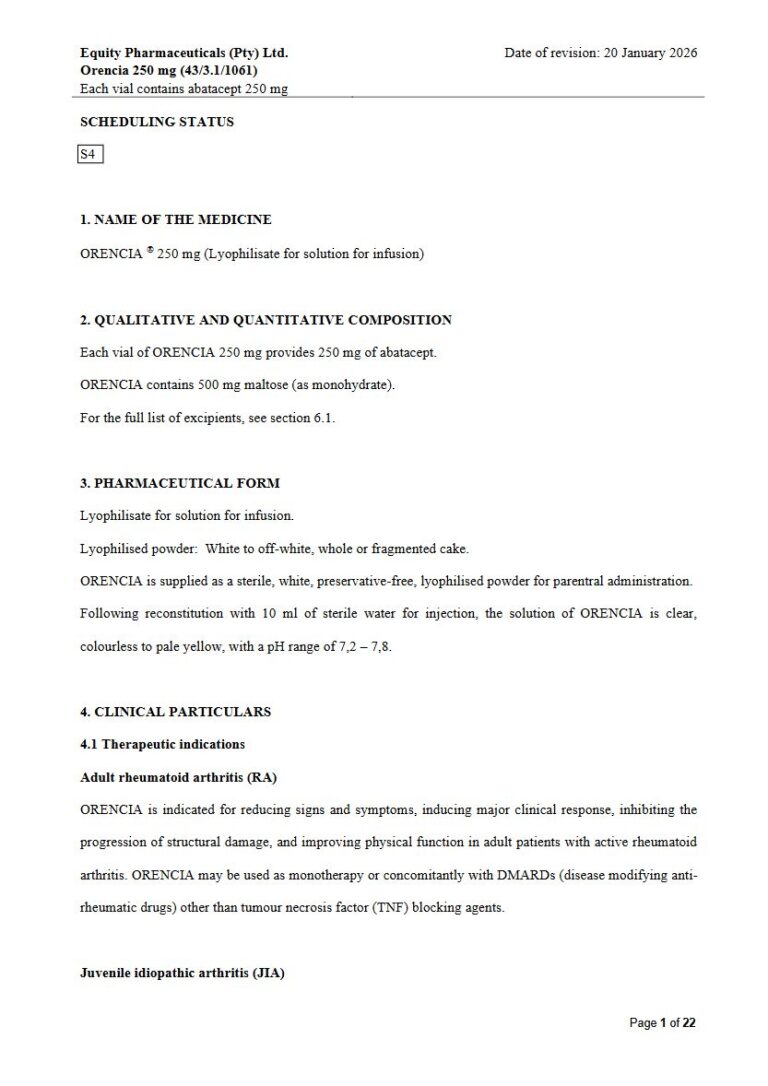
Adult rheumatoid arthritis (RA) ORENCIA is indicated for reducing signs and symptoms, inducing major clinical response, inhibiting the progression of structural damage, and improving physical function in adult patients with active rheumatoid arthritis. ORENCIA may be used as monotherapy or concomitantly with DMARDs (disease modifying anti- rheumatic drugs) other than tumour necrosis factor (TNF) blocking agents.
Juvenile idiopathic arthritis (JIA) ORENCIA is indicated for reducing signs and symptoms in paediatric patients 6 years of age and older with moderately to severely active polyarticular juvenile idiopathic arthritis. ORENCIA may be used as an adjunct therapy with other antirheumatic agents. ORENCIA should not be administered concomitantly with TNF antagonists. ORENCIA is not recommended for use concomitantly with other biologic rheumatoid arthritis therapy such as anakinra.
4.2 Posology and method of administration
Posology ORENCIA should NOT be used with siliconised syringes. For adult patients with RA, ORENCIA should be administered as a 30 minute intravenous infusion utilising the weight range-based dosing specified in Table 1. Following the initial administration, ORENCIA should be given at 2 and 4 weeks after the first infusion, and every 4 weeks thereafter. ORENCIA may be used as monotherapy or concomitantly with DMARDs other than TNF antagonists.
For paediatric juvenile idiopathic arthritis, a dose calculated based on each patientu2019s body weight is used (see below under Paediatric and adolescent).
Table 1: Dose of ORENCIA
- Body Weight of Patient
- Dose
- Number of Vials a
- < 60 kg
- 500 mg
- 2
- 60 to 100 kg
- 750 mg
- 3
- > 100 kg
- 1 g
- 4
a Each vial provides 250 mg of abatacept for administration.
Special populations Renal impairment, hepatic impairment As ORENCIA has not been studied in these patients, no dose recommendations can be made.
Geriatric No dose adjustment is required.
Paediatric and adolescent population Juvenile Idiopathic Arthritis: The recommended dose of ORENCIA for patients 6 to 17 years of age with juvenile idiopathic arthritis who weigh less than 75 kg is 10 mg/kg calculated based on the patientu2019s body weight at each administration. Paediatric patients weighing 75 kg or more should be administered ORENCIA following the adult dosing regimen, not to exceed a maximum dose of 1000 mg. ORENCIA should be administered as a 30-minute intravenous infusion. Following the initial administration, ORENCIA should be given at 2 and 4 weeks after the first infusion and every 4 weeks thereafter. Any unused portions in the vials must be immediately discarded. (See section 4.4).
Concomitant therapy MTX, other non-biologic DMARDs, corticosteroids, salicylates, nonsteroidal anti-inflammatory drugs (NSAIDs), or analgesics may be used during treatment with ORENCIA.
Method of administration Use aseptic technique. ORENCIA is provided as a lyophilised powder in preservative-free, single-use vials. Each vial of ORENCIA must be reconstituted with 10 ml of sterile water for injection. Immediately after reconstitution, the product must be further diluted to 100 ml with 0,9 % sodium chloride injection. The infusion of the fully diluted ORENCIA solution must be completed within 24 hours of reconstitution of the ORENCIA vials. The fully diluted ORENCIA solution may be stored at room temperature (up to 25 u221eC) or refrigerated at 2 u221eC to 8 u221eC before use (see section 6.3).
Refer to Table 1 for the dose and number of ORENCIA vials required. Each ORENCIA vial provides 250 mg of abatacept for administration. Reconstitute the ORENCIA powder in each vial with 10 ml of sterile water for injection using the SILICONE- FREE DISPOSABLE SYRINGE PROVIDED WITH EACH VIAL and an 18-21 gauge needle. Remove the flip-top from the vial and wipe the top with an alcohol swab. Insert the syringe needle into the vial through the center of the rubber stopper and direct the stream of sterile water for injection to the glass wall of the vial. Do not use the vial if the vacuum is not present. To minimise foam formation in solutions of ORENCIA, the vial should be rotated with gentle swirling until the contents are completely dissolved. Avoid prolonged or vigorous agitation. DO NOT SHAKE. Upon complete dissolution of the lyophilised powder, the vial should be vented with a needle to dissipate any foam that may be present. The solution should be clear and colourless to pale yellow. Do not use if opaque particles, discolouration, or other foreign particles are present. After reconstitution, the concentration of abatacept in the vial will be 25 mg/ml. The reconstituted ORENCIA solution must be further diluted to 100 ml as follows: From a 100 ml infusion bag or bottle, withdraw a volume of 0,9 % sodium chloride injection equal to the volume of the reconstituted ORENCIA vials (for 2 vials remove 20 ml, for 3 vials remove 30 ml, for 4 vials remove 40 ml). Slowly add the reconstituted ORENCIA solution from each vial to the infusion bag or bottle using a SILICONE-FREE DISPOSABLE SYRINGE PROVIDED WITH EACH VIAL. Gently mix. DO NOT SHAKE THE BAG OR BOTTLE. The concentration of the fully diluted ORENCIA solution in the infusion bag or bottle will be approximately 5, 7,5 or 10 mg of abatacept per ml of solution depending on whether 2, 3 or 4 vials of ORENCIA are used. Any unused portions in the vials must be immediately discarded. Prior to administration, the ORENCIA solution should be inspected visually for particulate matter and discolouration. Discard the solution if any particulate matter or discolouration is observed. The entire, fully diluted ORENCIA solution should be administered over a period of 30 minutes and must be administered with an infusion set and a sterile, non-pyrogenic, low-protein-binding filter (pore size of 0,2 to 1,2 u03bcm). ORENCIA should not be infused concomitantly in the same intravenous line with other agents. No physical or biochemical compatibility studies have been conducted to evaluate the co-administration of ORENCIA with other agents.
4.3 Contraindications
- ORENCIA should not be administered to patients with known hypersensitivity to ORENCIA or any of its components.
- Active or dormant untreated tuberculosis.
- ORENCIA should NOT be used during pregnancy or if a woman plans to become pregnant, or by mothers who are breastfeeding their infants (see section 4.6).
4.4 Special warnings and precautions for use
Combination with TNF blocking agents There is limited experience with the use of ORENCIA in combination with TNF blocking agents. In intravenous placebo-controlled clinical trials in patients with adult RA, patients receiving concomitant ORENCIA and TNF blocking agent therapy experienced more infections (24 %) and serious infections (2,2 %) compared to patients treated with only TNF blocking agents (19 % and 0,8 %, respectively). Concurrent therapy with ORENCIA and a TNF blocking agent is not recommended. While transitioning from TNF blocking agent therapy to ORENCIA therapy, patients should be monitored for signs of infection.
Hypersensitivity Hypersensitivity reactions including anaphylactic reactions have been reported with intravenous ORENCIA administration, in clinical trials, where patients were not required to be pretreated to prevent hypersensitivity reactions. Other events potentially associated with medicine hypersensitivity, such as hypotension, urticaria, and dyspnoea that occurred within 24 hours of ORENCIA infusion, may occur.
Anaphylaxis or anaphylactoid reactions can occur after the first infusion and can be life-threatening. In postmarketing experience, a case of fatal anaphylaxis following the first infusion of ORENCIA has been reported. If an anaphylactic or other serious allergic reaction occurs, administration of IV ORENCIA should be stopped immediately with appropriate therapy instituted, and the use of ORENCIA should be permanently discontinued.
Effects on the immune system The possibility exists for ORENCIA to affect vaccination responses and host defenses against infections and malignancies. Infections Serious infections, including sepsis and pneumonia, have been reported in patients receiving ORENCIA. Some of these infections have been fatal. Medical practitioners should exercise caution when considering the use of ORENCIA in patients with a history of recurrent infections, underlying conditions which may predispose them to infections, or chronic, latent, or localised infections. Patients who develop a new infection while undergoing treatment with ORENCIA should be monitored closely. Administration of ORENCIA should be discontinued if a patient develops a serious infection. A higher rate of serious infections has been observed in adult RA patients treated with concurrent TNF blocking agents and ORENCIA. When treating patients with therapies that modulate the immune system, it is appropriate to screen and monitor for tuberculosis infections. ORENCIA has not been studied in patients with a positive tuberculosis screen, and the safety of ORENCIA in individuals with latent tuberculosis is unknown (see section 4.3).
Before starting treatment with ORENCIA, all patients must be evaluated for both active and inactive (u201clatentu201d) tuberculosis. This evaluation should include a detailed medical history with personal history of tuberculosis or possible previous contact with tuberculosis and previous and/or current immunosuppressive therapy. Appropriate screening tests, i.e. tuberculin skin test and chest x-ray should be performed in all patients (local recommendations may apply). Prescribers are reminded of the risk of false negative tuberculin skin test results especially in patients who are severely ill or immunocompromised. If active tuberculosis is diagnosed, ORENCIA treatment should not be initiated (see section 4.3). If inactive (u201clatentu201d) tuberculosis is diagnosed, prophylactic anti-tuberculosis therapy must be started before the initiation of ORENCIA, and in accordance with local recommendations. In this situation, the benefit/risk balance of ORENCIA therapy should be carefully considered. Patients must be monitored closely for infections, including miliary tuberculosis, while on and after treatment with ORENCIA.
In clinical trials with ORENCIA, patients were not screened for HIV infection, however patients with known HIV infection were excluded from study. Anti-rheumatic therapies have been associated with hepatitis B reactivation. Therefore, screening for viral hepatitis should be performed in accordance with guidelines before starting therapy with ORENCIA. In clinical studies with ORENCIA, patients who screened positive for hepatitis were excluded from study.
Progressive multifocal leukoencephalopathy (PML) Cases of progressive multifocal leukoencephalopathy (PML) have been reported in patients receiving abatacept mostly in combination with other immunosuppressive medication. PML can be fatal and should be considered in the differential diagnosis in immunosuppressed patients with new onset or worsening neurological, psychiatric and cognitive symptoms. If symptoms suggestive of PML occur during ORENCIA therapy, treatment with ORENCIA should be discontinued and appropriate diagnostic measures initiated.
Malignancies The potential role of long-term use (> 42 months) of ORENCIA in the development of malignancies in humans is unknown. The frequencies of malignancies in the placebo-controlled clinical trials in adult RA up to 14 months were similar for ORENCIA-treated patients and placebo-treated patients (1,2 % and 0,9 %, respectively) (see section 4.8). There have been reports of non-melanoma skin cancers in patients receiving ORENCIA. Periodic skin examinations are recommended for all patients, particularly those with risk factors for skin cancer.
Immunisations Live vaccines should not be given concurrently with ORENCIA or within 3 months of its discontinuation. No data are available on the secondary transmission of infection from persons receiving live vaccines to patients receiving ORENCIA. Medicines that affect the immune system, including ORENCIA, may blunt the effectiveness of some immunisations. Patients treated with TRADEMARK may receive concurrent non-live vaccines. Responses to pneumococcal and inactivated influenza vaccines have been studied in subjects receiving ORENCIA. Pneumococcal vaccination with the standard 23-valent vaccine was studied in healthy subjects to assess the effect of ORENCIA on the antibody response to pneumococcal vaccine. This study suggested that ORENCIA may blunt the effectiveness of the immune response but did not significantly inhibit the ability of healthy subjects to develop a clinically significant or positive immune response (at least a 2-fold increase above baseline) to 23-valent pneumococcal vaccines. ORENCIA was evaluated in an open-label study in RA patients administered the 23-valent pneumococcal vaccine. After pneumococcal vaccination, a majority of ORENCIA-treated patients (62/112) were able to mount an adequate immune response of at least a 2-fold increase in antibody titers to pneumococcal polysaccharide vaccine. ORENCIA was also evaluated in an open-label study in rheumatoid arthritis patients administered the seasonal influenza trivalent virus vaccine. After influenza vaccination, 73 of 119 ORENCIA-treated patients without protective antibody levels at baseline were able to mount an adequate immune response of at least a 4-fold increase in antibody titers to trivalent influenza vaccine.
It is recommended that patients with juvenile idiopathic arthritis be brought up to date with all immunisations in agreement with current immunisation guidelines prior to initiating ORENCIA therapy.
Blood glucose testing The glucose dehydrogenase pyrroloquinolinequinone (GDH-PQQ) based glucose monitoring systems may react with the maltose present in ORENCIA, resulting in falsely elevated blood glucose readings on the day of infusion. Patients that require blood glucose monitoring should be advised to consider methods that do not react with maltose. For details on blood glucose determining tests, the local laboratories should be contacted.
Paediatric use The safety and efficacy of ORENCIA in paediatric patients below 6 years of age have not been established. Therefore, ORENCIA is not recommended for use in patients below the age of 6 years. Safety and efficacy of ORENCIA in paediatric patients for uses other than juvenile idiopathic arthritis have not been established.
4.5 Interaction with other medicines and other forms of interaction
Formal interaction studies have not been conducted with ORENCIA. Concurrent administration of a TNF blocking agent with ORENCIA has been associated with an increased risk of serious infections. Concurrent therapy with ORENCIA and TNF blocking agents is not recommended. There is insufficient experience to assess the safety and efficacy of ORENCIA administered concurrently with other biologic rheumatoid arthritis therapy, such as anakinra, and therefore such use is not recommended. ORENCIA has not been studied in combination with agents which deplete lymphocyte count. Such combination therapy could potentiate the effects of ORENCIA on the immune system.
Effect of other medicines on abatacept The majority of patients in the placebo-controlled clinical trials received concomitant DMARDs, NSAIDs, and/or corticosteroids. Most patients were taking MTX. Other less frequently used concomitant DMARDs included chloroquine/hydroxychloroquine, sulfasalazine and leflunomide. There is limited experience with abatacept in combination with other DMARDs such as azathioprine, gold and anakinra. Population pharmacokinetic analyses revealed that MTX, NSAIDs, corticosteroids, and TNF blocking agents did not influence abatacept clearance.
Other interactions Blood Glucose Testing: Parenteral medicines containing maltose can interfere with the readings of blood glucose monitors that use test strips with glucose dehydrogenase pyrroloquinolinequinone (GDH-PQQ). The GDH-PQQ based glucose monitoring systems may react with the maltose present in ORENCIA, resulting in falsely elevated blood glucose readings on the day of infusion. When receiving ORENCIA, patients that require blood glucose monitoring should only use methods that do not react with maltose, such as those based on glucose dehydrogenase nicotine adenine dinucleotide (GDH-NAD), glucose oxidase, or glucose hexokinase test methods (see section 4.4 Blood Glucose Testing).
4.6 Fertility, pregnancy and lactation
Pregnancy There are no studies in pregnant women. ORENCIA should NOT be used during pregnancy, or if a woman is planning to become pregnant. Abatacept may cross the placenta into the serum of infants born to women treated with abatacept during pregnancy. Consequently, these infants may be at increased risk for infection. The safety of administering live vaccines to infants exposed to abatacept in utero is unknown. Administration of live vaccines to infants exposed to abatacept in utero is not recommended for 10 weeks following the motheru2019s last exposure to abatacept during pregnancy.
Breastfeeding Abatacept has been shown to be present in rat milk. It is not known whether abatacept is excreted in human milk. Mothers should be instructed not to breastfeed if they are receiving ORENCIA.
4.7 Effects on ability to drive and use machines
Dizziness and reduced visual acuity have been reported as common and uncommon adverse reactions respectively, from patients treated with ORENCIA, therefore if a patient experiences such symptoms, driving and use of machinery should be avoided.
4.8 Undesirable effects
CLINICAL TRIAL EXPERIENCE IN ADULT RA ORENCIA has been studied in patients with active rheumatoid arthritis in placebo-controlled clinical trials (2653 patients with ORENCIA, 1485 with placebo). In placebo-controlled clinical trials with ORENCIA administered intravenously, adverse drug reactions (ADRs) (adverse events at least possibly causally-related to treatment) were reported in 49,4 % of ORENCIA-treated patients and 45,8 % of placebo-treated patients. The most frequently reported ADRs (u2265 5 %) among ORENCIA-treated patients were headache and nausea. The proportion of patients who discontinued treatment due to ADRs was 3,0 % for ORENCIA-treated patients and 2,0 % for placebo-treated patients. Listed below are ADRs that occurred with greater frequency (difference > 0,2 %) in ORENCIA-treated patients than in placebo-treated patients. Also listed are ADRs from clinical trials at least possibly causally-related to ORENCIA displayed by system organ class and frequency. The list is presented by system organ class and frequency, using the following categories: very common (u2265 10 %); common (u2265 1 %; < 10 %); uncommon (u2265 0,1 %; < 1 %); rare (u2265 0,01 %; < 0,1 %).
Side Effects in Placebo-Controlled Trials Infections and infestations Very common Upper respiratory tract infection (including tracheitis, nasopharyngitis, and sinusitis) Common Lower respiratory tract infection (including bronchitis), urinary tract infection, herpes infections (including herpes simplex, oral herpes and herpes zoster), pneumonia Uncommon Tooth infection, infected skin ulcer, onychomycosis, rhinitis, ear infection, pyelonephritis. Neoplasms benign and malignant (including cysts and polyps) Uncommon Basal cell carcinoma Blood and the lymphatic system disorders Uncommon Thrombocytopenia, leukopenia Immune system disorders Uncommon Hypersensitivity Psychiatric disorders Uncommon Depression, anxiety, sleep disorder (including insomnia) Nervous system disorders Common Headache, dizziness Uncommon Paraesthesia Eye disorders Uncommon Conjunctivitis, reduced visual acuity Ear and labyrinth disorders Uncommon Vertigo Cardiac disorders Uncommon Tachycardia, bradycardia, palpitations Vascular disorders Common Hypertension Uncommon Hypotension, hot flush, flushing Respiratory, thoracic and mediastinal disorders Common Cough Uncommon Chronic obstructive pulmonary disease exacerbation Gastrointestinal disorders Common Abdominal pain, diarrhoea, nausea, dyspepsia, mouth ulceration, aphthous stomatitis Uncommon Gastritis Skin and subcutaneous tissue disorders Common Rash (including dermatitis), Uncommon Increased tendency to bruise, alopecia, dry skin, hyperhidrosis, erythema, acne Musculoskeletal, connective tissue and bone disorders Uncommon Arthralgia, pain in extremity Reproductive system and breast disorders Uncommon Amenorrhoea, menorrhagia General disorders and administration site conditions Common Fatigue, asthenia Uncommon Influenza-like illness Investigations Common Increased blood pressure, abnormal liver function test (including increased transaminases) Uncommon Decreased blood pressure, increased weight Infections In the placebo-controlled trials with durations of 6 to 14 months, infections at least possibly related to treatment were reported in 22,7 % of ORENCIA-treated patients and 20,5 % of placebo patients. Serious infections at least possibly related to treatment were reported in 1,5 % of ORENCIA-treated patients and 1,1 % of placebo patients. The type and frequency of serious infections was similar between the TRADEMARK and placebo treatment groups. Malignancies In placebo-controlled clinical trials with durations of up to 14 months, malignancies were reported in 1,2 % (31/2653) of ORENCIA-treated patients and in 0,9 % (14/1485) of placebo-treated patients. In the cumulative period in 7044 patients treated with ORENCIA during 21011 patient-years the incidence rate of malignancy was 1,2 (1,1, 1,4) per 100 patient-years, and the annualised incidence rate remained stable. The most frequently reported malignancy in the placebo-controlled clinical trials was non-melanoma skin cancer; 0.6 (0.3, 1.0) per 100 patient-years for abatacept-treated patients, 0.4 (0.1, 0.9) per 100 patient-years for placebo-treated patients, and 0.5 (0.4, 0.6) per 100 patient-years in the cumulative period. The most frequently reported solid organ cancer in placebo-controlled clinical trials was lung cancer (0.17 (0.05, 0.43) per 100 patient-years for abatacept-treated patients, 0 for placebo-treated patients, and 0.12 (0.08, 0.17) per 100 patient-years in the cumulative period. The most common haematologic malignancy was lymphoma (0.04 (0, 0.24) per 100 patient-years for abatacept-treated patients, 0 for placebo-treated patients, and 0.06 (0.03, 0.1) per 100 patient-years in the cumulative period Infusion-related reactions and hypersensitivity reactions In the clinical studies with ORENCIA, pre-medication to prevent hypersensitivity was not required. Acute infusion-related events (reported within 1 hour of the start of the infusion) were more common in the ORENCIA-treated patients than the placebo patients (5,2 % for ORENCIA, 3,7 % for placebo). The most frequently reported event (> 1,0 %) was dizziness (1,5 % for ORENCIA, 1,0 % for placebo). Acute infusion-related events that were reported in > 0,1 % and u2264 1 % of patients treated with ORENCIA included cardiopulmonary symptoms such as hypotension, decreased blood pressure, tachycardia, bronchospasm, and dyspnoea; other symptoms included myalgia, nausea, erythema, flushing, urticaria, hypersensitivity, pruritus, throat tightness, chest discomfort, chills, infusion site extravasation, infusion site pain, infusion site swelling, infusion related reaction, and rash. Most of these reactions were mild to moderate. In ORENCIA and placebo groups, there were discontinuations due to an acute infusion-related event (0,3 % for ORENCIA, 0,1 % for placebo). Cases of hypersensitivity have been reported, including anaphylactic reactions. Other events potentially associated with medicine hypersensitivity, such as hypotension, urticaria, and dyspnoea, that occurred within 24 hours of ORENCIA infusion, have also been reported.
4.9 Overdose
Doses up to 50 mg/kg have been administered intravenously without apparent toxic effect. In case of overdosage, it is recommended that the patient be monitored for any signs or symptoms of adverse reactions and appropriate symptomatic treatment instituted.
