
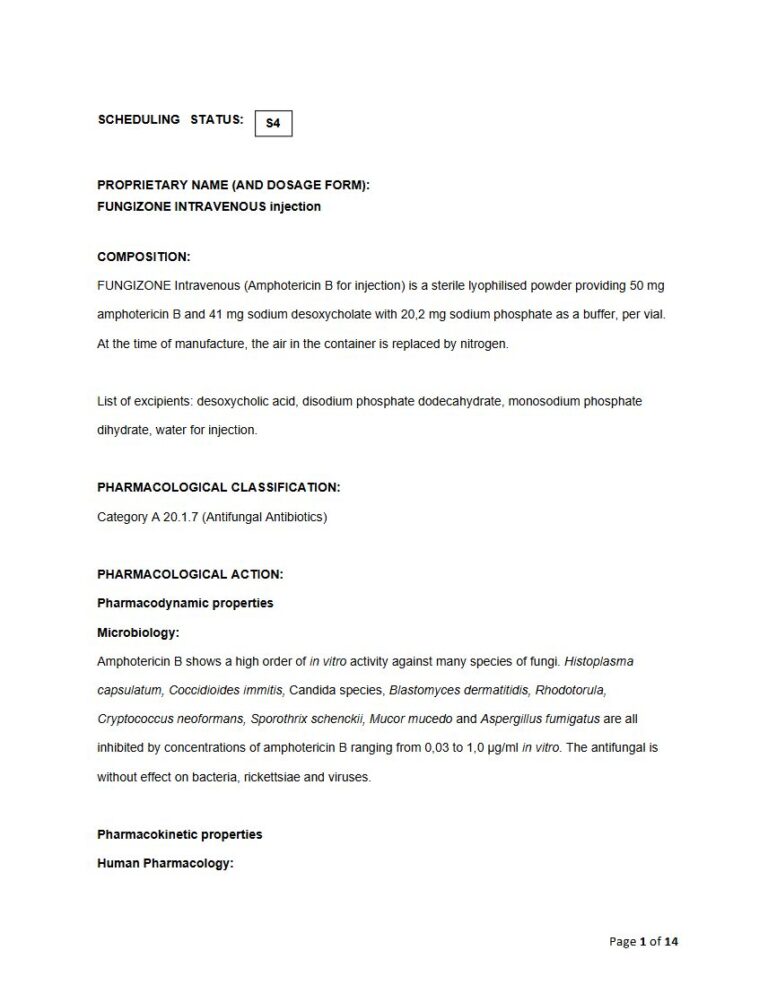
Fungizone Intravenous Injection 50 mg Injection
PDF Leaflet Revision Date: 12 April 2019
Clinical Summary
Quick overview from the medicine insert
Indication
Treatment of progressive, potentially life-threatening fungal infections.
Dosage (summary)
Initial dose: 0.25 mg/kg/day, may increase to 0.5-1.5 mg/kg based on tolerance.
Special Populations
- Renal impairment
- Hepatic impairment
Pregnancy & Breastfeeding
Safety in pregnancy not established; avoid breastfeeding.
Key Drug Interactions
- Nephrotoxic medications
- Corticosteroids
- Flucytosine
- Imidazoles
Contraindications
- Hypersensitivity to amphotericin B or components
Common side effects
- Nausea
- Vomiting
- Chills
- Hypokalaemia
- Hypotension
Counselling Points
- Administer under close supervision
- Monitor for intolerance
- Avoid rapid infusion
Serious warnings
- Potentially fatal cardiac arrest with overdose
- Monitor renal function
Important Disclaimer
The Fungizone Intravenous Injection 50 mg Injection professional information leaflet below is the property of Equity Pharmaceuticals and is provided on Medinsert exactly as issued, with no.. alterations or editorial changes. We make every effort to keep content current by updating documents as soon as new versions become available. Medinsert serves as a trusted access point for healthcare professionals, but does not replace official sources or clinical judgement. For more details, please read our full disclaimer. read more>>
 Healthcare Professionals Only
This content is for registered healthcare professionals
Sign in or create a free account to read the full package insert.
Free for HPCSA-registered professionals. Powered by Medinsert.
Clinical Particulars
Section 4 of the official insert — extracted exactly as issued, no alterations
4.1 Therapeutic indications
FUNGIZONE Intravenous is indicated primarily in patients with progressive, potentially life-threatening fungal infections such as cryptococcosis (torulosis); North American blastomycosis; the disseminated forms of moniliasis (candidiasis), coccidioidomycosis and histoplasmosis; mucormycosis (phycomycosis) caused by susceptible species of the genera Mucor, Rhizopus, Absidia, Entomophthora, and Basidiobolus; sporotrichosis (Sporothrix schenckii); aspergillosis (Aspergillus fumigatus).
Amphotericin B may be helpful in the treatment of American mucocutaneous leishmaniasis, but is not the medicine of choice in primary therapy.
4.2 Posology and method of administration
FUNGIZONE Intravenous should be administered by slow intravenous infusion. Intravenous infusion should be given over a period of approximately two to six hours observing the usual precautions for intravenous therapy. The recommended concentration for intravenous infusion is 0,1 mg/ml (1 mg/10 ml).
Dosage must be adjusted to the specific requirements of each patient since tolerance to FUNGIZONE Intravenous varies individually. Therapy is usually instituted with a daily dose of 0,25 mg/kg of body mass and gradually increased as tolerance permits.
Though not proven to be a reliable predictor of intolerance, an initial test dose (1 mg in 20 ml of 5 % dextrose solution) administered intravenously over 20 to 30 minutes may be preferred.
The patient's temperature, pulse, respiration, and blood pressure should be recorded every 30 minutes for 2 to 4 hours. (Note: See 'Intolerance Therapy' under WARNINGS AND SPECIAL PRECAUTIONS).
A patient with severe rapidly progressing fungal infection, with good cardiopulmonary and renal function and who tolerates the test dose without a severe reaction, may then receive 0,3 mg/kg FUNGIZONE intravenously over a period of 2 to 6 hours. In patients with cardiac or renal impairment or a severe reaction to the test dose, therapy should be initiated with smaller daily doses (i.e. 5 to 10 mg).
Doses may gradually be increased by 5 to 10 mg per day to a final daily dosage of 0,5 to 0,7 mg/kg. There are insufficient data presently available to define total dosage requirements and duration of treatment necessary for eradication of mycoses such as mucormycosis. The optimal dose is unknown.
Total daily dosage may range up to 1,0 mg/kg per day, or up to 1,5 mg/kg on alternate days, in severe infections caused by less susceptible pathogens. Several months of therapy are usually necessary; a shorter period of therapy may produce an inadequate response and lead to relapse.
Caution: Under no circumstances should a total daily dosage of 1,5 mg/kg be exceeded. FUNGIZONE Intravenous overdoses can result in potentially fatal cardiac or cardio-respiratory arrest (see KNOWN SYMPTOMS OF OVERDOSAGE AND PARTICULARS OF ITS TREATMENT).
The duration of treatment for deep-seated mycoses may be 6 to 12 weeks or longer.
Note: If symptoms of intolerance (See SIDE-EFFECTS) develop, they may be made less severe by additional therapy methods (See WARNINGS AND SPECIAL PRECAUTIONS - Concomitant Medication: Intolerance Therapy).
4.3 Contraindications
FUNGIZONE Intravenous is contraindicated in patients who have shown hypersensitivity to it or any other component in the formulation unless, in the opinion of the physician, the condition requiring treatment is life-threatening and amenable only to FUNGIZONE Intravenous therapy.
Paediatric Use: Safety and effectiveness in paediatric patients have not been established through adequate and well-controlled studies. Systemic fungal infections have been treated in paediatric patients without reports of unusual side effects.
4.4 Special warnings and precautions for use
FUNGIZONE Intravenous should be administered intravenously only, and be given to patients under close clinical supervision by medically trained personnel. FUNGIZONE Intravenous should be used primarily for treatment of patients with progressive and potentially fatal fungal infections; it should not be used to treat the common clinically inapparent forms of fungal disease which show only positive skin or serologic tests.
FUNGIZONE Intravenous may be the only effective treatment available for a potentially fatal disease. In each case, therefore, its possible life saving effect must be balanced against its untoward and dangerous effects. Hence, FUNGIZONE Intravenous should be used parenterally only in hospitalised patients or those under close clinical observation by medically trained personnel and should be reserved for those patients in whom a diagnosis of the progressive, potentially fatal forms of susceptible mycotic infections has been made.
Exercise caution to prevent inadvertent FUNGIZONE Intravenous overdose, which can result in potentially fatal cardiac or cardio-respiratory arrest. Verify the product name and dosage pre-administration, especially if the dose prescribed exceeds 1,5 mg/kg. (See DOSAGE AND DIRECTIONS FOR USE and KNOWN SYMPTOMS OF OVERDOSAGE AND PARTICULARS OF ITS TREATMENT.)
Acute reactions including chills, fever, anorexia, nausea, vomiting, headache, myalgia, arthralgia, and hypotension are common when FUNGIZONE Intravenous is given intravenously. Rapid intravenous infusion, over less than one hour, particularly in patients with renal insufficiency, has been associated with hyperkalaemia and arrhythmias, and should, therefore, be avoided (see DOSAGE AND DIRECTIONS FOR USE).
Leukoencephalopathy has been reported following use of FUNGIZONE Intravenous in patients who received total body irradiation. Renal function and serum electrolytes (particularly magnesium, sodium and potassium) should be monitored frequently during FUNGIZONE Intravenous therapy. Laboratory facilities must be available to perform blood urea nitrogen and serum creatinine or endogenous creatinine clearance tests. These determinations should be made at least weekly during therapy. If the blood urea nitrogen exceeds 40 mg per 100 ml or the serum creatinine exceeds 3,0 mg per 100 ml the medicine should be discontinued or the dosage markedly reduced until renal function is improved. It is also advisable to monitor liver function, as well as weekly haemograms. Whenever medication is interrupted for a period longer than 7 days, therapy should be resumed by starting with the lowest dosage level, i.e. 0,25 mg/kg of body mass, and increased gradually as outlined under DOSAGE AND DIRECTIONS FOR USE.
4.5 Interactions with other medicines
When administered concurrently, the following medicines may interact with FUNGIZONE Intravenous: Other nephrotoxic medication, such as cisplatin, pentamidine, aminoglycosides, and cyclosporine, may enhance the potential for renal toxicity, and thus should be used concomitantly only with great caution. Corticosteroids, corticotropin (ACTH) and diuretics may potentiate amphotericin B-induced hypokalaemia (see WARNINGS AND SPECIAL PRECAUTIONS).
Agents whose effects or toxicity may be increased by hypokalaemia e.g. digitalis glycosides, skeletal muscle relaxants and antiarrhythmic agents.
Flucytosine - concomitant use may increase the toxicity of flucytosine possibly by increasing its cellular uptake and/or impairing its renal excretion. Leukocyte transfusions - though not observed in all studies, acute pulmonary reactions have been observed in patients given FUNGIZONE Intravenous during or shortly after leukocyte transfusions, thus it is advisable to separate these infusions as far as possible and to monitor pulmonary function.
Imidazoles - (e.g. ketoconazole, itraconazole, miconazole, clotrimazole, fluconazole). In vitro studies and animal studies with the combination of FUNGIZONE Intravenous and imidazoles suggest that imidazoles may induce fungal resistance to FUNGIZONE Intravenous. Combination therapy should be administered with caution, especially in immunocompromised patients.
4.6 Fertility, pregnancy and lactation
Pregnancy: Safety of use in pregnancy has not been established.
Lactation: It is not known whether FUNGIZONE Intravenous is excreted in breastmilk. Mothers on FUNGIZONE Intravenous should therefore not breast-feed a baby.
4.7 Effects on ability to drive and use machines
Not stated in the document.
4.8 Undesirable effects
The table below lists all adverse events for FUNGIZONE Intravenous and is presented by system organ class and frequency, which is defined using the following convention: very common (> 1/10), common (> 1/100 to 1/1 000 to 1/10 000 to < 1/1 000), very rare (< 1/10 000), and not known (cannot be estimated from the available data).
SYSTEM ORGAN CLASS FREQUENCY MedDRA Term
Blood and Lymphatic System Disorders Common Anaemia Not known Agranulocytosis, coagulopathy, eosinophilia, leukocytosis, leukopenia, thrombocytopenia
Immune System Disorders Not known Anaphylactoid/anaphylactic reactions
Nervous System Disorders Not known Convulsions, headache, encephalopathy, neurologic symptoms, neuropathy peripheral
Eye Disorders Not known Vision blurred, diplopia
Ear and Labyrinth Disorders Not known Deafness, tinnitus, vertigo
Cardiac Disorders Not known Arrhythmias, including ventricular fibrillation, cardiac arrest, cardiac failure
Gastrointestinal Disorders Very common Nausea, vomiting Not known Dyspepsia, haemorrhagic gastroenteritis, upper abdominal pain, diarrhoea, melena
General Disorders and Administration Site Conditions Very common Chills, pyrexia (b) Uncommon Flushing Not known Pain, malaise, injection site pain with or without phlebitis or thrombophlebitis
Hepatobiliary Disorder Common Abnormal hepatic function Not known Acute liver failure, jaundice
Investigations Very common Hypokalaemia (a), increased blood creatinine (a) Not known Hyperkalemia, decreased weight
Metabolism and Nutrition Disorders Common Hypomagnesaemia Not known Anorexia
Renal and Urinary Disorders Very common (a) Abnormal renal function test includes: uraemia, hyposthenuria, renal tubular acidosis, and nephrocalcinosis Not known Hypocalcaemia
Respiratory, Thoracic and Mediastinal Disorders Very common Dyspnoea Not known Allergic alveolitis, bronchospasm, non-cardiogenic pulmonary edema
Skin and Subcutaneous Tissue Disorders Common Rash Not known Rash maculopapular, pruritus, skin exfoliation, toxic epidermal necrolysis, Stevens-Johnson syndrome
Musculoskeletal and Connective Tissue Disorders Not known Arthralgia, myalgia
Vascular Disorders Very common Hypotension Not known Hypertension, shock
a These usually improve with interruption of therapy. However, some permanent impairment often occurs, especially in those patients receiving large cumulative amounts (over 5 g) of amphotericin B. Concomitant diuretic therapy may increase the risk for renal impairment, whereas sodium repletion or supplementation may reduce the occurrence of nephrotoxicity (see WARNINGS AND SPECIAL PRECAUTIONS and INTERACTIONS).
b Sometimes accompanied by shaking chills usually occurring 15 to 20 minutes after initiation of treatment.
4.9 Overdose
Treatment of overdosage should be symptomatic and supportive. FUNGIZONE Intravenous overdoses can result in fatal cardiac or cardio-respiratory arrest. If an overdose is suspected, discontinue therapy and monitor the patient's clinical status (e.g. cardio-respiratory, renal and liver function, haematologic status, serum electrolytes) and administer supportive therapy as required. Amphotericin B is not haemodialysable. Prior to reinstituting therapy, the patient's condition should be stabilised (including correction of electrolyte deficiencies, etc.).
