
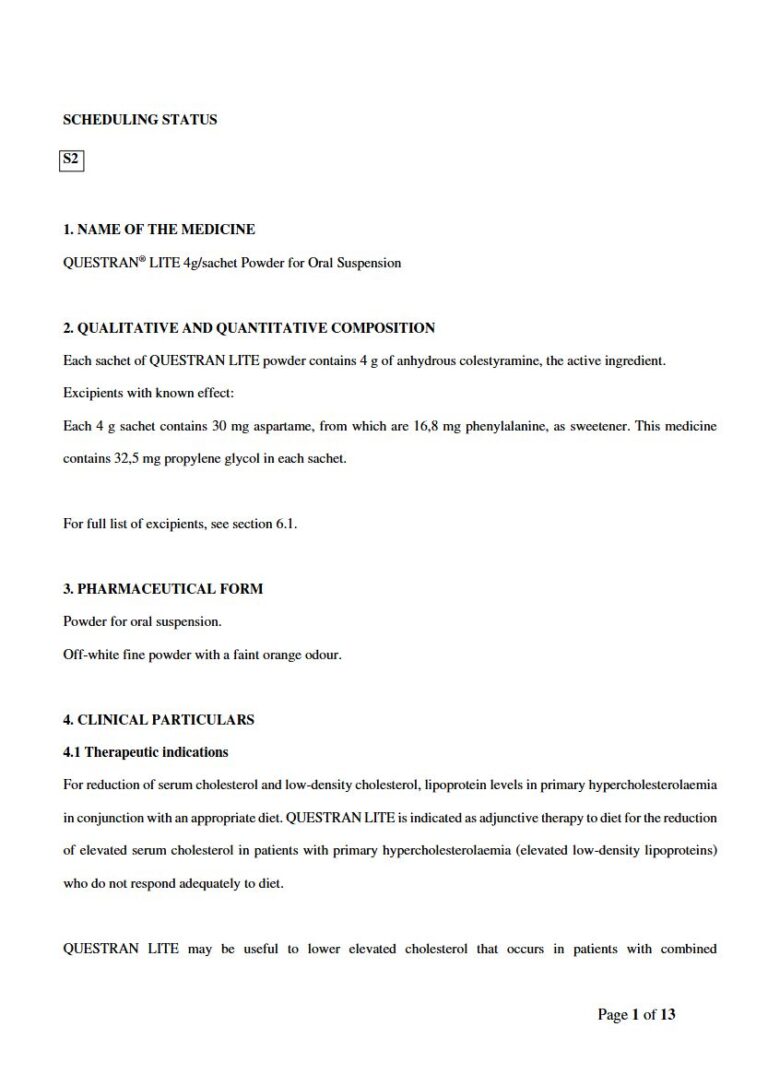
Questran Lite 4g/sachet Powder for Oral Suspension
PDF Leaflet Revision Date: 05 April 2024
Clinical Summary
Quick overview from the medicine insert
Indication
Adjunctive therapy for reduction of serum cholesterol in primary hypercholesterolaemia.
Dosage (summary)
Adults: Start with 4 g once or twice daily, max 24 g/day.
Onset of Action / Duration
Onset: 3 days for diarrhoea relief.
Pregnancy & Breastfeeding
Safety not established; may interfere with fat-soluble vitamin absorption.
Key Drug Interactions
- May bind to other medicines; take 1 hour before or 4-6 hours after QUESTRAN LITE.
Contraindications
- Hypersensitivity to colestyramine or ingredients.
- Complete biliary obstruction.
Common side effects
- Constipation
- Abdominal discomfort
- Flatulence
- Nausea
Counselling Points
- Mix with water before ingestion.
- Monitor cholesterol levels regularly.
- Report any gastrointestinal issues.
Serious warnings
- May cause hyperchloraemic acidosis in high doses.
- Monitor for vitamin deficiencies with long-term use.
Important Disclaimer
The Questran Lite 4g/sachet Powder for Oral Suspension professional information leaflet below is the property of Equity Pharmaceuticals and is provided on Medinsert exactly as issued, with no.. alterations or editorial changes. We make every effort to keep content current by updating documents as soon as new versions become available. Medinsert serves as a trusted access point for healthcare professionals, but does not replace official sources or clinical judgement. For more details, please read our full disclaimer. read more>>
 Healthcare Professionals Only
This content is for registered healthcare professionals
Sign in or create a free account to read the full package insert.
Free for HPCSA-registered professionals. Powered by Medinsert.
Clinical Particulars
Section 4 of the official insert — extracted exactly as issued, no alterations
4.1 Therapeutic indications
For reduction of serum cholesterol and low-density cholesterol, lipoprotein levels in primary hypercholesterolaemia in conjunction with an appropriate diet. QUESTRAN LITE is indicated as adjunctive therapy to diet for the reduction of elevated serum cholesterol in patients with primary hypercholesterolaemia (elevated low-density lipoproteins) who do not respond adequately to diet. QUESTRAN LITE may be useful to lower elevated cholesterol that occurs in patients with combined hypercholesterolaemia and hypertriglyceridaemia, but it is not indicated where hypertriglyceridaemia is the abnormality of most concern. For the reduction of pruritus associated with partial biliary obstruction e.g. as in cholestatic jaundice. For the treatment of diarrhoea due to bile acid malabsorption. (See section 4.4: Oral rehydration therapy).
4.2 Posology and method of administration
Posology Hypercholesterolaemia and hyperlipoproteinaemia may be manifestations of altered metabolism resulting from either dietary excesses or diseases such as hypothyroidism, diabetes, nephrosis, pancreatitis or biliary cirrhosis. The primary objective of therapy should be to control any underlying disease. Proper diet and weight control in these patients is also essential.
Adults: To reduce cholesterol: Begin with one 4 g sachet (see section 6.6 once or twice daily). The dose can be increased to 8 g (two sachets) in the morning and in the evening. If necessary, medication may be increased to the maximum of 24 g of colestyramine per day. It is recommended that increases in dose be gradual. If dose increases are necessary, they should be done gradually, and with periodic assessment of lipid/lipoprotein levels at intervals of not less than 4 weeks. The suggested time of administration is mealtime, but this may be modified to avoid interference with the absorption of other medicines. Although the recommended dosing schedule is twice daily, QUESTRAN LITE may be administered in 1 u2013 4 doses per day. No more than 24 g (6 sachets) of the active ingredient a day, should be administered as larger doses of QUESTRAN LITE may interfere with normal fat absorption.
To relieve pruritus due to partial biliary obstruction: 4 g (one sachet) or 8 g (two sachets) daily.
To relieve diarrhoea induced by bile acid malabsorption: The initial dosage of QUESTRAN LITE should be 4 g (one sachet) three times a day, with subsequent adjustment as needed. NOTE IN ALL PATIENTS PRESENTING WITH DIARRHOEA INDUCED BY BILE ACID MALABSORPTION, A RESPONSE SHOULD BE SEEN WITHIN 3 DAYS. IF THIS IS NOT THE CASE, ALTERNATE THERAPY SHOULD BE INITIATED.
To familiarise the patient with QUESTRAN LITE and to minimise gastrointestinal side effects, it is desirable to begin all therapy with one dose of QUESTRAN LITE daily. The dosage is then increased within a day or two to the starting dose for effective control. NOTE QUESTRAN LITE SHOULD NOT BE TAKEN IN ITS DRY FORM. ALWAYS MIX QUESTRAN LITE WITH WATER OR OTHER FLUIDS BEFORE INGESTING.
One 4 g sachet = 4.68 g QUESTRAN LITE powder = 4 g anhydrous colestyramine
Patients with renal impairment There are no special dose recommendations for this patient group.
Patients with hepatic impairment There are no special dose recommendations for this patient group.
Paediatric population The precise dosage for children has not yet been established.
Method of administration To be taken orally. Place the contents of a 4 g sachet QUESTRAN LITE on the surface of 115 - 170 mL of water or beverage, such as milk, fruit juice or broth. Use more water or beverage for the two sachets (200 - 300 mL). Stir to a uniform suspension. QUESTRAN LITE may also be used with pulpy fruits, such as apple sauce or crushed pineapple.
4.3 Contraindications
QUESTRAN LITE is contraindicated in patients who have shown hypersensitivity to colestyramine or to any of the other ingredients in the formulation (see section 6.1). QUESTRAN LITE is contraindicated in patients with complete biliary obstruction.
4.4 Special warnings and precautions for use
QUESTRAN LITE should not be used in patients with exudative or bloody diarrhoea. As a precautionary measure, since QUESTRAN LITE may bind to other medicine given concurrently, patients should take other medicine at least one hour before or 4 - 6 hours after QUESTRAN LITE to avoid impeding their absorption, or at as great an interval as possible.
General Before instituting therapy with QUESTRAN LITE, diseases contributing to increased blood cholesterol such as hypothyroidism, diabetes mellitus, nephrotic syndrome, dysproteinaemias and obstructive liver disease should be investigated and specifically treated. In addition, prior to instituting therapy with QUESTRAN LITE, an attempt should be made to control serum cholesterol by appropriate dietary regimen, weight reduction and the treatment of any underlying disorder which might be the cause of the hypercholesterolaemia. Serum cholesterol levels should be determined frequently during the first few months of therapy and periodically thereafter. A favourable trend in cholesterol reduction should occur during the first month of QUESTRAN LITE therapy. The therapy should be continued to sustain cholesterol reduction. Serum triglyceride levels should be measured periodically to detect whether significant changes have occurred.
IF ADEQUATE CHOLESTEROL REDUCTION IS NOT ATTAINED, THERAPY WITH QUESTRAN LITE SHOULD BE DISCONTINUED.
There is a possibility that prolonged use of QUESTRAN LITE in high doses may produce hyperchloraemic acidosis since it is the chloride form of an anion exchange resin. This is especially true in younger and smaller patients where the relative dosage may be higher as well as in patients with renal impairment. QUESTRAN LITE may produce or aggravate pre-existing constipation or related conditions such as haemorrhoids. In patients with constipation, the dosage of QUESTRAN LITE should be decreased since it may produce impaction. In patients presenting with clinically symptomatic coronary artery disease, where straining of the stool is to be avoided, the dosage of QUESTRAN LITE should be titrated to avert constipation.
Chronic use of QUESTRAN LITE may be associated with increased bleeding tendency due to hypoprothrombinaemia associated with vitamin K deficiency. This will usually respond promptly to parenteral vitamin K administration; recurrences can be prevented by oral administration of vitamin K. Reduction of serum or red cell folate has been reported and treatment with folic acid should be considered in these cases. QUESTRAN LITE should be used with caution in patients with peptic ulcers or with a history of peptic ulcer disease as it might aggravate or activate this condition.
Oral rehydration therapy In patients with diarrhoea, fluid and electrolyte depletion may occur. Administration of appropriate fluid and electrolyte replacement is the most important measure.
Laboratory tests Serum cholesterol levels should be determined frequently during the first few months of therapy and periodically thereafter. Serum triglyceride levels should be measured periodically to detect whether significant changes have occurred.
Phenylketonurics: QUESTRAN LITE contains aspartame, which provides the equivalent of 3,6 mg of phenylalanine per gram of powder. This medicine contains 32,5 mg propylene glycol per sachet. Propylene glycol at doses exceeding 1 mg / kg / day in neonates and 50 mg / kg / day in children younger than 5 years should be avoided. Concomitant use of other substrates for the enzyme alcohol dehydrogenase such as ethanol can induce serious side effects. For propylene glycol at doses exceeding 50 mg / kg / day, medical monitoring is required in patients with impaired renal or hepatic function.
4.5 Interaction with other medicines and other forms of interaction
SINCE QUESTRAN LITE MAY BIND OTHER MEDICINES GIVEN CONCURRENTLY, PATIENTS SHOULD TAKE OTHER MEDICINE AT LEAST ONE HOUR BEFORE OR 4 - 6 HOURS AFTER QUESTRAN LITE TO AVOID IMPEDING THEIR ABSORPTION, OR AT AS GREAT AN INTERVAL AS POSSIBLE. Since colestyramine is an anion-exchange resin, QUESTRAN LITE has a strong affinity for acidic materials. QUESTRAN LITE may delay or reduce the absorption of concomitant oral medicine such as amiodarone, phenobarbitone, valproate, penicillin G, tetracycline, vancomycin, methotrexate, propranolol, ursodeoxycholic acid, ezetimibe, ethinylestradiol, phenprocoumon, warfarin, digoxin, leflunomide, mycophenolate, furosemide, acetylsalicylic acid, diclofenac, meloxicam, piroxicam, sulindac, tenoxicam, spironolactone, chlorothiazide, hydrochlorothiazide, levothyroxine, liothyronine, thyroid extract. The discontinuance of QUESTRAN LITE (colestyramine) could pose a hazard to health if a potentially toxic medicine such as digoxin has been titrated to a maintenance level while the patient was taking QUESTRAN LITE. QUESTRAN LITE in combination with spironolactone may increase the potential for the development of hyperchloraemic acidosis. Also, QUESTRAN LITE may interfere with the pharmacokinetics of medicines (e.g., oestrogens) that undergo enterohepatic recirculation. Absorption of fat-soluble vitamins: Because it sequesters bile acids, QUESTRAN LITE may interfere with normal fat absorption. QUESTRAN LITE may prevent absorption of fat-soluble vitamins, such as vitamins A, D and K. Therefore, when QUESTRAN LITE is to be given for long periods, daily water miscible or parenteral supplements of vitamins A, D and K should be considered.
4.6 Fertility, pregnancy and lactation
The safety of QUESTRAN LITE in pregnancy and lactation has not been established and the possibility of interference with absorption of fat-soluble vitamins should be considered (see section 4.3).
4.7 Effects on ability to drive and use machines
QUESTRAN LITE is not expected to have an effect on the ability to drive and use machines.
4.8 Undesirable effects
a) Summary of safety profile The most common adverse reaction is constipation. Predisposing factors for most of these complaints when QUESTRAN LITE is used as cholesterol lowering medicine are: high dose and increased age (more than 60 years old). Most instances of constipation are mild, transient and controlled with conventional therapy. Some patients require a temporary decrease in dosage or discontinuation of therapy. Frequency categories are defined according to the following convention: very common (u2265 1/10), common (u2265 1/100 to < 1/10), uncommon (u2265 1/1,000 to < 1/100), rare (u2265 1/10,000 to < 1/1,000), very rare (< 1/10,000), not known (cannot be estimated from the available data).
b) Tabulated list of adverse reactions
System Organ Class Frequency Adverse Reaction(s) Blood and lymphatic system disorders Uncommon Bleeding tendencies due to hypoprothrombinaemia (Vitamin K deficiency) Metabolism and nutrition disorders Uncommon Vitamin A deficiency, vitamin D deficiency, hyperchloremic acidosis in children and patients with renal impairment (see section 4.4) Eye disorders Uncommon Night blindness (Vitamin A deficiency) Gastrointestinal disorders Very common Constipation Uncommon Abdominal discomfort, flatulence, nausea, vomiting, diarrhoea, heartburn, anorexia, dyspepsia, steatorrhea, tongue irritation, perianal irritation Rare Intestinal obstruction Hepatobiliary disorders Not known Biliary colic Skin and subcutaneous tissue disorders Uncommon Rash, irritation of skin Musculoskeletal and connective tissue disorders Uncommon Osteoporosis Renal and urinary disorders Not known Calcified material has occasionally been observed in the biliary tree (including calcification of the gallbladder) Reports of intestinal obstruction have been received post-marketing, including two deaths in paediatric patients. Calcified material has occasionally been observed in the biliary tree, including calcification of the gallbladder, in patients to whom colestyramine has been given. However, this may be a manifestation of the liver disease and not medicine related. One patient experienced biliary colic on each of three occasions on which he took colestyramine. One patient diagnosed as acute abdominal symptom complex was found to have a u2018pasty massu2019 in the transverse colon on X-ray Other events (not necessarily medicine related) reported in patients taking QUESTRAN LITE include: System Organ Class Adverse Reaction(s) Blood and lymphatic system disorders Decreased or increased prothrombin time, ecchymoses, anaemia, swollen glands Nervous system disorders Headache, anxiety, vertigo, dizziness, syncope, drowsiness, femoral nerve pain, paraesthesia Eye disorders Uveitis Ear and labyrinth disorders Tinnitus Respiratory, thoracic and mediastinal disorders Asthma, wheezing, shortness of breath Gastrointestinal disorders GI-rectal bleeding, black stools, haemorrhoidal bleeding, bleeding from known duodenal ulcer, dysphagia, hiccups, ulcer attack, sour taste, pancreatitis, rectal pain, diverticulitis, eructation Skin and subcutaneous tissue disorders Urticaria, oedema Musculoskeletal, connective tissue and bone disorders Backache, muscle and joint pains, arthritis Renal and urinary disorders Haematuria, dysuria, burnt odour to urine, diuresis Reproductive system and breast disorders Increased libido General disorders and administration site reactions Weight loss, weight gain, dental bleeding, dental caries, fatigue Investigations Liver function abnormalities Reporting of suspected adverse reactions Reporting suspected adverse reactions after authorisation of the medicine is important. It allows continued monitoring of the benefit/risk balance of the medicine. Healthcare providers are asked to report any suspected adverse reactions to SAHPRA via the u201c6.04 Adverse Drug Reactions Reporting Formu201d, found online under SAHPRAu2019s publications: https://www.sahpra.org.za/Publications/Index/8
4.9 Overdose
Should overdosage occur, the chief potential harm would be obstruction of the gastrointestinal tract. The location of such potential obstruction, the degree of obstruction and the presence or absence of normal gut motility would determine treatment. Other possible side effects of overdosage may include constipation, abdominal discomfort, flatulence, nausea, vomiting, diarrhoea, heartburn, dyspepsia and steatorrhoea, biliary colic, rash and irritation of skin, tongue and perianal area. Treatment is symptomatic and supportive.
