
Ozurdex 700 _g per implan Intravitreal implant in applicator
PDF Leaflet Revision Date: 12 May 2023
Clinical Summary
Quick overview from the medicine insert
Indication
Treatment of visual impairment due to DME, macular oedema from BRVO/CRVO, and non-infectious uveitis.
Dosage (summary)
One implant administered intra-vitreally; retreatment after ~6 months if needed.
Special Populations
- Elderly
- Renal impairment
- Hepatic impairment
Pregnancy & Breastfeeding
Not recommended during pregnancy or breastfeeding due to potential risks.
Key Drug Interactions
- CYP450 3A4 inhibitors may increase corticosteroid effects
- Caution with anticoagulants and anti-platelets
Contraindications
- Hypersensitivity to dexamethasone
- Active ocular infections
- Uncontrolled glaucoma
- Aphakic eyes with posterior capsule rupture
Common side effects
- Increased intraocular pressure
- Cataract
- Conjunctival haemorrhage
- Visual disturbance
Counselling Points
- Monitor for signs of infection
- Report visual changes immediately
- Avoid driving until vision stabilizes
Serious warnings
- Risk of endophthalmitis
- Increased intraocular pressure
- Potential for implant migration
Important Disclaimer
The Ozurdex 700 _g per implan Intravitreal implant in applicator professional information leaflet below is the property of AbbVie and is provided on Medinsert exactly as issued, with no.. alterations or editorial changes. We make every effort to keep content current by updating documents as soon as new versions become available. Medinsert serves as a trusted access point for healthcare professionals, but does not replace official sources or clinical judgement. For more details, please read our full disclaimer. read more>>
 Healthcare Professionals Only
This content is for registered healthcare professionals
Sign in or create a free account to read the full package insert.
Free for HPCSA-registered professionals. Powered by Medinsert.
Clinical Particulars
Section 4 of the official insert — extracted exactly as issued, no alterations
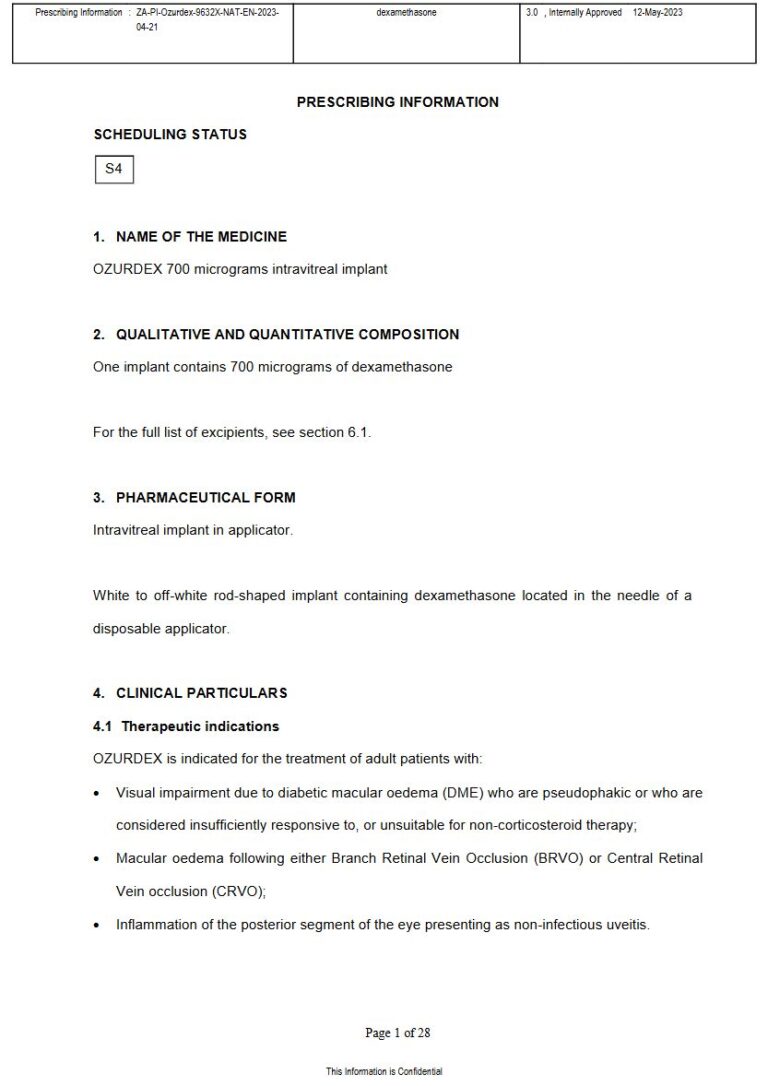
4.1 Therapeutic indications
OZURDEX is indicated for the treatment of adult patients with:
- Visual impairment due to diabetic macular oedema (DME) who are pseudophakic or who are considered insufficiently responsive to, or unsuitable for non-corticosteroid therapy;
- Macular oedema following either Branch Retinal Vein Occlusion (BRVO) or Central Retinal Vein occlusion (CRVO);
- Inflammation of the posterior segment of the eye presenting as non-infectious uveitis.
4.2 Posology and method of administration
OZURDEX must be administered by a qualified ophthalmologist experienced in intravitreal injections.
Posology
The recommended dose is one OZURDEX implant to be administered intra-vitreally to the affected eye. Administration to both eyes concurrently is not recommended.
DME
Patients treated with OZURDEX who have experienced an initial response and who in the ophthalmologistu2019s opinion may benefit from retreatment without being exposed to significant risk may be considered for retreatment. Retreatment may be performed after approximately 6 months if the patient experiences decreased vision and/or an increase in retinal thickness, secondary to recurrent or worsening diabetic macular oedema. There is no experience of the efficacy or safety of repeat administrations in DME beyond 7 implants.
RVO and Uveitis
Repeat doses should be considered when a patient experiences a response to treatment followed subsequently by a loss in visual acuity and in the ophthalmologistu2019s opinion may benefit from retreatment without being exposed to significant risk. Patients who experience and retain improved vision should not be retreated. Patients who experience deterioration in vision, which is not slowed by OZURDEX, should not be retreated. There is only very limited information on repeat dosing intervals less than 6 months.
For information concerning the current safety experience of repeat administrations beyond 2 implants in posterior segment non-infectious uveitis and Retinal Vein Occlusion, see section 4.8. Patients should be monitored following the injection to permit early treatment if an infection or increased intraocular pressure occurs (see section 4.4).
Special populations
Elderly
No dosage adjustment is required for older patients (u2265 65 years old).
Renal impairment
OZURDEX has not been studied in patients with renal impairment.
Hepatic impairment
OZURDEX has not been studied in patients with hepatic impairment.
Paediatric population
There is no relevant indication for the use of OZURDEX in children below 18 years of age.
Method of Administration
Single-use intravitreal implant in applicator for intravitreal use only. Each applicator can only be used for the treatment of a single eye. The intravitreal injection procedure should be carried out under controlled aseptic conditions which include the use of sterile gloves, a sterile drape, and a sterile eyelid speculum (or equivalent) (see section 4.4). A broad-spectrum topical antimicrobial should be given prior to and on the day of the injection procedure. The patient should be instructed to self-administer broad spectrum antimicrobial drops daily for 3 days before and after each injection. Before the injection, the periocular skin, eyelid and ocular surface should be disinfected (using for example drops of povidone iodine 5 % solution on the conjunctiva as it was done in the clinical trials for the approval of OZURDEX) and adequate local anaesthesia should be administered. Remove the foil pouch from the carton and examine for damage. Then, in a sterile field, open the foil pouch and gently place the applicator on a sterile tray. Carefully remove the cap from the applicator. Once the foil pouch is opened the applicator should be used immediately. Hold the applicator in one hand and pull the safety tab straight off the applicator. Do not twist or flex the tab. With the bevel of the needle up away from the sclera, advance the needle about 1 mm into the sclera then redirect toward the centre of the eye into the vitreous cavity until the silicone sleeve is against the conjunctiva. Slowly press the actuator button until an audible click is noted. Before withdrawing the applicator from the eye, make sure that the actuator button is fully pressed and has locked flush with the applicator surface. Remove the needle in the same direction as used to enter the vitreous. For instructions on the administration of the intravitreal implant, see section 6.6. Immediately after injecting OZURDEX, use indirect ophthalmoscopy in the quadrant of injection to confirm successful implantation. Visualisation is possible in the large majority of cases. In cases in which the implant cannot be visualised, take a sterile cotton bud and lightly depress over the injection site to bring the implant into view. Following the intravitreal injection patients should continue to be treated with a broad-spectrum antimicrobial. Following the intravitreal injection, patients should be monitored for elevation in intraocular pressure and for endophthalmitis (see section 4.4). Monitoring may consist of a check for perfusion of the optic nerve head immediately after the injection, tonometry within 30 minutes following the injection and biomicroscopy between two and seven days following the injection. Patients must be instructed to report any symptoms suggestive of endophthalmitis without delay. Each applicator can only be used for the treatment of a single eye.
4.3 Contraindications
- Hypersensitivity to dexamethasone or to any of the ingredients of OZURDEX, listed in section 6.1.
- Active or suspected ocular or periocular infection, including most viral diseases of the cornea and conjunctiva, including active epithelial herpes simplex keratitis (dendritic keratitis) and a history thereof, vaccinia, varicella, mycobacterial infections and fungal diseases. Corticosteroids should be used cautiously in patients with a history of ocular herpes simplex and not be used in active ocular herpes simplex.
- Advanced glaucoma (where the disease cannot be adequately controlled by medications alone) or uncontrolled glaucoma.
- Patients with hypersensitivity to any of the ingredients.
- Aphakic eyes with rupture of the posterior lens capsule.
- Eyes with Anterior Chamber Intraocular Lens (ACIOL), iris or transscleral fixated IOLs and ruptured posterior lens capsule.
- Communication between vitreous cavity and anterior chamber.
4.4 Special warnings and precautions for use
Intravitreal injection of OZURDEX, has been associated with endophthalmitis, intraocular inflammation, increased intraocular pressure and retinal detachment. Proper aseptic injection techniques must always be used. In addition, patients must be monitored following the injection to permit early treatment if an infection or increased intraocular pressure occurs. Monitoring may consist of a check for perfusion of the optic nerve head immediately after the injection, tonometry within 30 minutes following the injection, and biomicroscopy between two and seven days following the injection. Patients must be instructed to report any symptoms suggestive of endophthalmitis or any of the other above-mentioned events without delay, e.g. eye pain, blurred vision etc. All patients with a posterior capsule tear, e.g. those with a posterior lens (e.g. due to cataract surgery), and/or those who have an iris opening to the vitreous cavity (e.g. due to iridectomy) with or without a history of vitrectomy, are at risk of implant migration into the anterior chamber. These patients should be closely monitored to allow for early diagnosis and management of device migration. Implant migration to the anterior chamber may lead to corneal oedema. Persistent severe corneal oedema could progress to the need of corneal transplantation. Other than those patients contra-indicated where OZURDEX should not be used (see section 4.3), OZURDEX should be used with caution and only following a careful risk benefit assessment. These patients should be closely monitored to allow for early diagnosis and management for any signs of implant migration. Use of OZURDEX, may induce cataracts (including posterior subcapsular cataracts), increased IOP, steroid induced glaucoma and may result in secondary ocular infections. In the 3-year DME clinical studies, at baseline 87 % of patients with a phakic study eye treated with OZURDEX had pre-existing lens opacification e.g. early cataract. 59,2 % of patients with a phakic study eye treated with OZURDEX underwent cataract surgery in the study eye (see section 4.8). After the first injection the incidence of cataract appears higher in patients with non-infectious uveitis of the posterior segment compared with BRVO/CRVO patients. In BRVO/CRVO clinical studies, cataract was reported more frequently in patients with phakic lens receiving a second injection (see section 4.8). One patient out of 368 required cataract surgery during the first treatment and three patients out of 302 during the second treatment. In the non-infectious uveitis study, one patient out of the 62 phakic patients underwent cataract surgery after a single injection. The prevalence of conjunctival haemorrhage in patients with non-infectious uveitis of the posterior segment appears to be higher compared with BRVO/CRVO and DME. This could be attributable to the intravitreous injection procedure or to concomitant use of topical and/or systemic corticosteroid or non-steroidal anti-inflammatory medications. No treatment is required since spontaneous resolution occurs. Increases in intraocular pressure (IOP) may occur. The rise in IOP is transient and usually manageable with IOP lowering medication (see section 4.8). Of the patients experiencing an increase of IOP of u2265 10 mmHg from baseline, the greatest proportion showed this IOP increase between 45 and 60 days following an injection. Therefore, regular monitoring of IOP, irrespective of baseline IOP, is required and any elevation of intraocular pressure should be managed appropriately post injection as needed. Patients of less than 45 years of age with macular oedema following Retinal Vein Occlusion or inflammation of the posterior segment of the eye presenting as non-infectious uveitis are more likely to experience increases in IOP. Corticosteroids should be used cautiously in patients with a history of ocular viral (e.g. herpes simplex) infection and not be used in active ocular herpes simplex. The safety and efficacy of OZURDEX administered to both eyes concurrently have not been studied. Therefore administration to both eyes concurrently is not recommended. If bilateral treatment is performed at the same time, this could lead to an increased systemic exposure. OZURDEX has not been studied in patients with macular oedema secondary to RVO with significant retinal ischaemia. Therefore OZURDEX is not recommended.
4.5 Interactions with other medicines
No formal interaction studies have been performed. Systemic absorption of dexamethasone is minimal with OZURDEX and no interactions are anticipated. Co-administration with inhibitors of CYP450 3A4 may increase the plasma concentrations and pharmacologic effects of corticosteroids, which are primarily metabolized by the isoenzyme. The interaction has been reported with potent inhibitors such as clarithromycin, erythromycin, itraconazole, nefazodone, cobicistat, and ritonavir during concomitant use of various corticosteroids, including inhaled, nasal, and ophthalmic formulations. Systemic corticosteroid adverse effects may occur following intensive or long-term continuous ophthalmic corticosteroid therapy. Cushing's syndrome and adrenal insufficiency have been attributed to the interaction. Anti-coagulant therapy was used in 1,7 % of patients with macular oedema due to retinal vein occlusion; there were no reports of haemorrhagic adverse events in these patients. Anti-platelet medicinal products, such as clopidogrel, were used at some stage during the clinical studies in over 40 % of patients. In clinical trial patients receiving anti-platelet therapy, haemorrhagic adverse events were reported in a higher proportion of patients injected with OZURDEX (27 %) compared with the control group (20 %). The most common haemorrhagic adverse reaction reported was conjunctival haemorrhage (24 %). Anti-coagulant or anti-platelet therapy should not be used within two weeks before the injection of OZURDEX. OZURDEX should be used with great caution in patients taking anti-coagulant or anti-platelet medicinal products, and only if the expected benefits outweigh the potential risks to the patient. Systemic medicines which induce cytochrome P450 3A4 (CYP 3A4) enzyme activity (e.g., barbiturates, phenytoin, carbamazepine, rifampin) may enhance the metabolism of corticosteroids and require that the dosage of the corticosteroid be increased. Medicines which inhibit CYP 3A4 (e.g., ketoconazole, macrolide antibiotics such as erythromycin) have the potential to result in increased plasma concentrations of corticosteroids. Dexamethasone is a moderate inducer of CYP 3A4. Co-administration with other medicines that are metabolised by CYP 3A4 (e.g., indinavir, erythromycin) may increase their clearance, resulting in decreased plasma concentration. Plasma dexamethasone concentration following intravitreal administration of OZURDEX is expected to be significantly lower (at or below the limit of detection) compared to oral and IV administration, and therefore, is not expected to result in significant drug-drug interaction systemically.
4.6 Fertility, pregnancy and lactation
Pregnancy
Safety in pregnancy has not been established. OZURDEX is not recommended during pregnancy. Studies in animals have shown teratogenic effects following topical ophthalmic administration (see section 5.3). There are no adequate data from the use of intravitreally administered dexamethasone in pregnant women. Long-term systemic treatment with glucocorticoids during pregnancy increases the risk for intra-uterine growth retardation and adrenal insufficiency of the new-born child. Therefore, although the systemic exposure of dexamethasone would be expected to be very low after local, intraocular treatment, OZURDEX is not recommended during pregnancy unless the potential benefit justifies the potential risk to the foetus.
Breastfeeding
Safety in lactation has not been established. OZURDEX is not recommended during breastfeeding.
Fertility
There is no fertility data available.
4.7 Effects on ability to drive and use machines
Patients may experience temporary visual blurring after receiving OZURDEX by intravitreal injection (see section 4.8). They should not drive or use machines until this has resolved.
4.8 Undesirable effects
Tabulated list of adverse reactions
The adverse reactions considered related to OZURDEX treatment from the Phase III clinical trials (DME, BRVO/CRVO and uveitis) and spontaneous reporting are listed by MedDRA System organ class in the table below using the following convention: Very Common (u22651/10); Common (u22651/100 to <1/10); Uncommon (u22651/1,000 to <1/100); Rare (u22651/10,000 to <1/1,000); Very Rare (<1/10,000). Within each frequency grouping, adverse reactions are presented in order of decreasing seriousness.
Table 1
System organ class Frequency Adverse Reaction / Side Effect
Nervous system disorders Common Headache Uncommon Migraine
Eye disorders Very common Increased intraocular pressure, cataract, conjunctival haemorrhage* Common Ocular hypertension, subcapsular cataract, vitreous haemorrhage*, reduced visual acuity*, visual impairment/ disturbance, vitreous detachment*, vitreous floaters*, vitreous opacities*, blepharitis, eye pain*, photopsia*, conjunctival oedema*, conjunctival hyperaemia
Uncommon Necrotising retinitis, endophthalmitis*, glaucoma, retinal detachment*, retinal tear*, hypotony of the eye* anterior chamber inflammation*, anterior chamber cells/flares*, abnormal sensation in eye*, eyelid pruritus, scleral hyperaemia*
General disorders and administration site conditions Uncommon Device dislocation* (migration of implant) with or without corneal oedema, complication of device insertion resulting in ocular tissue injury* (implant misplacement)
* Indicates adverse reactions considered to be related to the intravitreal injection procedure (the frequency of these adverse reactions is proportional to the number of treatments given)
Description of selected adverse reactions
Diabetic Macular Oedema
The clinical safety of OZURDEX in patients with diabetic macular oedema was assessed in two Phase III randomised, double-masked, sham-controlled studies. In both studies, a total of 347 patients were randomised and received OZURDEX and 350 patients received sham. The most frequently reported adverse reactions across the entire study period in the study eye of patients who received OZURDEX were cataract and elevated IOP (see below). In the 3-year DME clinical studies, at baseline, 87 % of patients with a phakic study eye treated with OZURDEX had some degree of lens opacification / early cataract. The incidence of all observed cataract types (i.e. cataract cortical, cataract diabetic, cataract nuclear, cataract subcapsular, cataract lenticular, cataract) was 68 % in OZURDEX treated patients with a phakic study eye across the 3-year studies. Fifty nine percent (59 %) of patients with a phakic study eye required cataract surgery by the 3-year final visit, with the majority performed in the 2nd and 3rd years.
Mean IOP in the study eye at baseline was the same in both treatment groups (15,3 mmHg). The mean increase from baseline IOP did not exceed 3,2 mmHg across all visits in the OZURDEX group with the mean IOP peaking at the 1,5 month visit post injection, and returning to approximately baseline levels by month 6 following each injection. The rate and magnitude of IOP elevation following OZURDEX treatment did not increase upon repeated injection of OZURDEX. Twenty eight percent (28 %) of patients treated with OZURDEX had a u2265 10 mm Hg IOP increase from baseline at one or more visits during the study. At baseline 3 % of patients required IOP-lowering medication(s). Overall, 42 % of patients required IOP-lowering medications in the study eye at some stage during the 3-year studies, with the majority of these patients requiring more than one medication. Peak usage (33 %) occurred during the first 12 months and remained similar from year to year. A total of four patients (1 %) treated with OZURDEX had procedures in the study eye for the treatment of IOP elevation. One patient treated with OZURDEX required incisional surgery (trabeculectomy) to manage the steroid-induced IOP elevation, one patient had a trabeculectomy owing to anterior chamber fibrin blocking the aqueous outflow leading to increased IOP, one patient had an iridotomy for narrow angle glaucoma and one patient had iridectomy due to cataract surgery. No patient required removal of the implant by vitrectomy to control IOP.
BRVO/CRVO
The clinical safety of OZURDEX in patients with macular oedema following central or branch retinal vein occlusion has been assessed in two Phase III randomised, double-masked, sham-controlled studies, involving 427 patients randomised to receive OZURDEX and 426 to receive sham. A total of 401 patients (94 %) treated with OZURDEX completed the initial treatment period (up to day 180). The majority of patients (47,3 %) experienced at least one adverse event. The most frequently reported events in patients who received OZURDEX were increased intraocular pressure (24,0 %) and conjunctival haemorrhage (14,7 %). The adverse event profile for BRVO patients was similar to that observed for CRVO patients although the overall incidence of adverse events was higher for the subgroup of patients with CRVO. Increased intraocular pressure (IOP) with OZURDEX peaked at day 60 and returned to baseline levels by day 180. Elevations of IOP either did not require treatment or were managed with the temporary use of topical IOP-lowering medications. During the initial treatment period, 0,7 % (3/421) of the patients who received OZURDEX required laser or surgical procedures for management of elevated IOP in the study eye compared with 0,2 % (1/423) with sham. The adverse reaction profile of 341 patients analysed following a second injection of OZURDEX, was similar to that following the first injection. A total of 54 % of patients experienced at least one adverse reaction. The incidence of increased IOP (24,9 %) was similar to that seen following the first injection and likewise returned to baseline by open-label day 180. The overall incidence of cataracts was higher after 1 year compared to the initial 6 months. The use of corticosteroids may produce glaucoma and may enhance the establishment of secondary ocular infections.
Post-approval observational study
The clinical safety of OZURDEX was assessed in a multicentre, 24-month real world observational study in the treatment of macular oedema following RVO and non-infectious uveitis affecting the posterior segment of the eye. The most frequent adverse reactions observed in this study were consistent with the most frequent adverse reactions from clinical trials. Stratifications by injection frequency revealed increases in the incidence of adverse reactions among patients who received > 2 injections compared to patients who received u2264 2 injections. The most frequent adverse reactions for patients who received > 2 injections included cataract [(24,7 %, 44/178) for cataract formation and (32,0 %, 57/178) for cataract progression] based on eyes with phakic lens status at baseline, vitreous haemorrhage (6,0 %, 17/283), and increased IOP (24,0 %, 68/283).
Uveitis
The clinical safety of OZURDEX in patients with inflammation of the posterior segment of the eye presenting as non-infectious uveitis, has been assessed in a single, multicentre, masked, randomised study. A total of 77 patients were randomised to receive OZURDEX and 76 to receive sham. A total of 73 patients (95 %) randomised and treated with OZURDEX completed the 26-week study. The most frequently reported adverse reactions in the study eye of patients who received OZURDEX were conjunctival haemorrhage (30,3 %), increased intraocular pressure (25,0 %) and cataract (11,8 %).
Post-approval observational study
Refer to u2018Post-approval observational studyu2019 under u2018BRVO/CRVOu2019.
Reporting of suspected adverse reactions
Reporting suspected adverse reactions after authorisation of the medicine is important. It allows continued monitoring of the benefit/risk balance of the medicine. Health care providers are asked to report any suspected adverse reactions to SAHPRA via the u201c6.04 Adverse Drug Reactions Reporting Formu201d, found online under SAHPRAu2019s publications: https://www.sahpra.org.za/Publications/Index/8
You can also report side effects to AbbVie (Pty) Ltd via this e-mail address: [email protected]
4.9 Overdose
If an overdose occurs, intraocular pressure should be monitored and treated, if deemed necessary by the attending medical practitioner.
