
Paxlovid 150 mg, 100 mg Tablet
PDF Leaflet Revision Date: 01 January 2024
Clinical Summary
Quick overview from the medicine insert
Indication
Treatment of COVID-19 in adults at risk for severe disease.
Dosage (summary)
300 mg nirmatrelvir + 100 mg ritonavir, orally twice daily for 5 days.
Onset of Action / Duration
Onset: Within 5 days of symptom onset, Duration: 5 days.
Special Populations
- Elderly: No dose adjustment needed.
- Renal impairment: Adjust dose in moderate impairment.
- Hepatic impairment: Contraindicated in severe impairment.
Pregnancy & Breastfeeding
Not recommended during pregnancy; breastfeeding should be discontinued during treatment.
Key Drug Interactions
- Contraindicated with CYP3A substrates (e.g., alfuzosin, pethidine).
- Increases plasma concentrations of CYP3A substrates.
Contraindications
- Severe hepatic impairment.
- Severe renal impairment.
- Hypersensitivity to components.
Common side effects
- Diarrhoea
- Vomiting
- Dysgeusia
Counselling Points
- Take with or without food.
- Do not chew or crush tablets.
- Monitor for adverse reactions.
Serious warnings
- Risk of serious drug interactions.
- Potential for hepatotoxicity.
Important Disclaimer
The Paxlovid 150 mg, 100 mg Tablet professional information leaflet below is the property of Pfizer Laboratories and is provided on Medinsert exactly as issued, with no.. alterations or editorial changes. We make every effort to keep content current by updating documents as soon as new versions become available. Medinsert serves as a trusted access point for healthcare professionals, but does not replace official sources or clinical judgement. For more details, please read our full disclaimer. read more>>
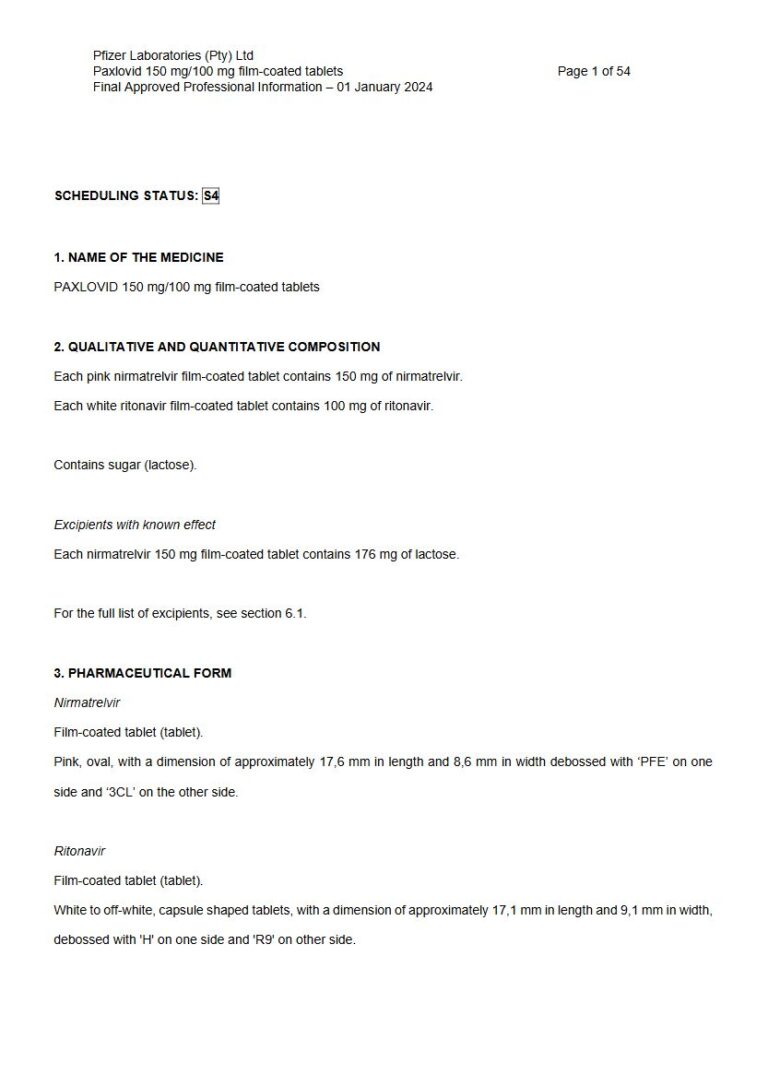 Healthcare Professionals Only
This content is for registered healthcare professionals
Sign in or create a free account to read the full package insert.
Free for HPCSA-registered professionals. Powered by Medinsert.
Clinical Particulars
Section 4 of the official insert — extracted exactly as issued, no alterations
4.1 Therapeutic indications
PAXLOVID is indicated for the treatment of COVID-19 in adults who do not require supplemental oxygen and who are at increased risk for progression to severe COVID-19 (see section 5.1).
4.2 Posology and method of administration
PAXLOVID is nirmatrelvir tablets co-packaged with ritonavir tablets. Nirmatrelvir must be co-administered with ritonavir. Failure to correctly co-administer nirmatrelvir with ritonavir will result in plasma concentrations of nirmatrelvir that will be insufficient to achieve the desired therapeutic effect.
Posology
The recommended dosage is 300 mg nirmatrelvir (two 150 mg tablets) with 100 mg ritonavir (one 100 mg tablet) all taken together orally twice daily for 5 days. PAXLOVID should be given as soon as possible after positive results of direct SARS-CoV-2 viral testing and within 5 days of onset of symptoms. PAXLOVID can be taken with or without food. The tablets should be swallowed whole and not chewed, broken or crushed.
A missed dose should be taken as soon as possible and within 8 hours of the scheduled time, and the normal dosing schedule should be resumed. If more than 8 hours has elapsed, the missed dose should not be taken and the treatment should resume according to the normal dosing schedule.
If a patient requires hospitalisation due to severe or critical COVID-19 after starting treatment with PAXLOVID, the patient should complete the full 5-day treatment course at the discretion of his/her medical practitioner.
Special populations
Elderly
No dose adjustment is currently recommended for elderly patients.
Renal impairment
No dose adjustment is needed in patients with mild renal impairment. In patients with moderate renal impairment, the dose of PAXLOVID should be reduced to nirmatrelvir/ritonavir 150 mg/100 mg (1 tablet of each) twice daily for 5 days. The remaining tablet of nirmatrelvir should be disposed of in accordance with local requirements (see section 6.6). PAXLOVID is not recommended in patients with severe renal impairment or with renal failure as the appropriate dose has not yet been determined (see section 5.2).
Hepatic impairment
No dosage adjustment of PAXLOVID is needed for patients with either mild (Child-Pugh Class A) or moderate (Child-Pugh Class B) hepatic impairment. No pharmacokinetic or safety data are available regarding the use of nirmatrelvir or ritonavir in individuals with severe hepatic impairment (Child-Pugh Class C), therefore, PAXLOVID is contraindicated in patients with severe hepatic impairment.
Concomitant therapy with ritonavir- or cobicistat-containing regimen
No dose adjustment is needed; the dose of PAXLOVID is 300 mg/100 mg twice daily for 5 days. Patients diagnosed with human immunodeficiency virus (HIV) or hepatitis C virus (HCV) infection who are receiving ritonavir- or cobicistat-containing regimen should continue their treatment as indicated.
Paediatric population
The safety and efficacy of PAXLOVID in patients below 18 years of age have not been established.
Method of administration
For oral use.
4.3 Contraindications
PAXLOVID is contraindicated in patients:
- with a history of clinically significant hypersensitivity to the active substances (nirmatrelvir/ritonavir) or to any of the excipients listed in section 6.1.
- with severe hepatic impairment.
- with severe renal impairment.
PAXLOVID is also contraindicated with medicines that are highly dependent on Cytochrome P450 (CYP) CYP3A for clearance and for which elevated plasma concentrations are associated with serious and/or life-threatening reactions. PAXLOVID is also contraindicated with medicines that are potent CYP3A inducers where significantly reduced plasma nirmatrelvir/ritonavir concentrations may be associated with the potential for loss of virologic response and possible resistance.
Table 1: Medicines that are contraindicated for concomitant use with PAXLOVID
| Medicine class | Medicines within class | Clinical comments | |
|---|---|---|---|
| Alpha 1-adrenoreceptor antagonist | alfuzosin | Increased plasma concentrations of alfuzosin may lead to severe hypotension. | |
| Analgesics | pethidine, piroxicam, propoxyphene | Increased plasma concentrations of norpethidine, piroxicam and propoxyphene may result in serious respiratory depression or haematologic abnormalities. | |
| Antianginal | ranolazine | Potentially increased plasma concentrations of ranolazine may result in serious and/or life-threatening reactions. | |
| Anticancer | neratinib, venetoclax | Increased plasma concentrations of neratinib which may increase the potential for serious and/or life-threatening reactions including hepatotoxicity. Increased plasma concentrations of venetoclax which may increase the risk of tumour lysis syndrome at the dose initiation and during the dose-titration phase. | |
| Antidysrhythmics | amiodarone, bepridil, dronedarone, encainide, flecainide, propafenone, quinidine | Potentially increased plasma concentrations of amiodarone, bepridil, dronedarone, encainide, flecainide, propafenone and quinidine may result in dysrhythmias or other serious adverse effects. | |
| Antibiotic | fusidic acid | Increased plasma concentrations of fusidic acid and ritonavir. | |
| Anti-gout | colchicine | Increased plasma concentrations of colchicine may result in serious and/or life-threatening reactions in patients with renal and/or hepatic impairment. | |
| Antihistamines | astemizole, terfenadine | Increased plasma concentrations of astemizole and terfenadine may result in serious dysrhythmias from these medicines. | |
| Antipsychotics/neuroleptics | lurasidone, pimozide, clozapine, quetiapine | Increased plasma concentrations of lurasidone, pimozide and clozapine may result in serious and/or life-threatening reactions. Increased plasma concentrations of quetiapine may lead to coma. | |
| Ergot derivatives | dihydroergotamine, ergonovine, ergotamine, methylergonovine | Increased plasma concentrations of ergot derivatives leading to acute ergot toxicity, including vasospasm and ischaemia. | |
| GI motility medicine | cisapride | Increased plasma concentrations of cisapride, thereby increasing the risk of serious arrhythmias from this medicine. | |
| Lipid-modifying medicines | HMG-CoA reductase inhibitors | lovastatin, simvastatin | Increased plasma concentrations of lovastatin and simvastatin resulting in increased risk of myopathy, including rhabdomyolysis. |
| PDE5 inhibitors | avanafil, vardenafil, sildenafil (Revatio u00ae ) when used for pulmonary arterial hypertension (PAH) | Increased plasma concentrations of avanafil and vardenafil. Increased plasma concentrations of sildenafil can potentially result in visual abnormalities, hypotension, prolonged erection and syncope. | |
| Sedative/hypnotics | clonazepam, diazepam, estazolam, flurazepam, triazolam, oral midazolam | Increased plasma concentrations of clonazepam, diazepam, estazolam, flurazepam, triazolam and oral midazolam can increase risk of extreme sedation and respiratory depression. |
4.4 Special warnings and precautions for use
Risk of serious adverse reactions due to interactions with other medicines
Initiation of PAXLOVID, a CYP3A inhibitor, in patients receiving medicines metabolised by CYP3A or initiation of medicines metabolised by CYP3A in patients already receiving PAXLOVID, may increase plasma concentrations of medicines metabolised by CYP3A. Initiation of medicines that inhibit or induce CYP3A may increase or decrease concentrations of PAXLOVID, respectively. These interactions may lead to:
- Clinically significant adverse reactions, potentially leading to severe, life-threatening or fatal events from greater exposures of concomitant medicines.
- Clinically significant adverse reactions from greater exposures of PAXLOVID.
- Loss of therapeutic effect of PAXLOVID and possible development of viral resistance.
See Table 1 for medicines that are contraindicated for concomitant use with nirmatrelvir/ritonavir (see section 4.3) and Table 2 for potentially significant interactions with other medicines (see section 4.5). Potential for interactions should be considered with other medicines prior to and during PAXLOVID therapy; concomitant medicines should be reviewed during PAXLOVID therapy and the patient should be monitored for the adverse reactions associated with the concomitant medicines. The risk of interactions with concomitant medications during the 5-day treatment period for PAXLOVID should be weighed against the risk of not receiving PAXLOVID.
Hepatotoxicity
Hepatic transaminase elevations, clinical hepatitis and jaundice have occurred in patients receiving ritonavir. Therefore, caution should be exercised when administering PAXLOVID to patients with pre-existing liver diseases, liver enzyme abnormalities or hepatitis.
HIV resistance
As nirmatrelvir is co-administered with ritonavir, there may be a risk of HIV-1 developing resistance to HIV protease inhibitors in individuals with uncontrolled or undiagnosed HIV-1 infection.
Nirmatrelvir tablets contain lactose. Patients with rare hereditary problems of galactose intolerance, total lactase deficiency or glucose-galactose malabsorption should not take PAXLOVID. Nirmatrelvir and ritonavir tablets contain sodium. Nirmatrelvir and ritonavir tablets each contain less than 1 mmol sodium (23 mg) per dose, that is to say essentially u2018sodium-freeu2019.
4.5 Interaction with other medicines and other forms of interaction
PAXLOVID is an inhibitor of CYP3A and may increase plasma concentrations of medicines that are primarily metabolised by CYP3A. Medicines that are extensively metabolised by CYP3A and have high first pass metabolism appear to be the most susceptible to large increases in exposure when co-administered with PAXLOVID. Thus, co-administration of PAXLOVID with medicines highly dependent on CYP3A for clearance and for which elevated plasma concentrations are associated with serious and/or life threatening events is contraindicated (see Table 1, section 4.3).
In vitro study results showed nirmatrelvir may be inducer of CYP3A4, CYP2B6, CYP2C8, and CYP2C9. The clinical relevance is unknown. Based on in vitro data, nirmatrelvir has a low potential to inhibit BCRP, MATE2K, OAT1, OAT3, OATP1B3 and OCT2. There is a potential for nirmatrelvir to inhibit MDR1, MATE1, OCT1 and OATP1B1 at clinically relevant concentrations.
Ritonavir has a high affinity for several cytochrome P450 (CYP) isoforms and may inhibit oxidation with the following ranked order: CYP3A4 > CYP2D6. Ritonavir also has a high affinity for P-glycoprotein (P-gp) and may inhibit this transporter. Ritonavir may induce glucuronidation and oxidation by CYP1A2, CYP2C8, CYP2C9 and CYP2C19 thereby increasing the biotransformation of some medicines metabolised by these pathways and may result in decreased systemic exposure to such medicines, which could decrease or shorten their therapeutic effect.
Co-administration of other CYP3A4 substrates that may lead to potentially significant interaction should be considered only if the benefits outweigh the risks (see Table 2). PAXLOVID is a CYP3A substrate; therefore, medicines that induce CYP3A may decrease plasma concentrations of nirmatrelvir and ritonavir and reduce PAXLOVID therapeutic effect. Medicines listed in Table 1 (section 4.3) and Table 2 are a guide and not considered a comprehensive list of all possible medicines that are contraindicated or may interact with PAXLOVID. The medical practitioner should consult appropriate references for comprehensive information.
4.6 Fertility, pregnancy and lactation
Women of childbearing potential
There are no human data on the use of PAXLOVID during pregnancy to inform the medicine-associated risk of adverse developmental outcomes; women of childbearing potential should avoid becoming pregnant during treatment with PAXLOVID.
Contraception in males and females
Use of ritonavir may reduce the efficacy of combined hormonal contraceptives. Patients using combined hormonal contraceptives should be advised to use an effective alternative contraceptive method or an additional barrier method of contraception during treatment and until after one complete menstrual cycle after stopping PAXLOVID (see section 4.5).
Pregnancy
There are no data from the use of PAXLOVID in pregnant women. PAXLOVID is not recommended during pregnancy and in women of childbearing potential not using effective contraception. There was no nirmatrelvir-related effect on foetal morphology or embryo-foetal viability at any dose tested in rat or rabbit embryo-foetal developmental toxicity studies (see section 5.3). A large number of pregnant women were exposed to ritonavir during pregnancy. These data largely refer to exposures where ritonavir was used in combination therapy and not at therapeutic ritonavir doses but at lower doses as a pharmacokinetic enhancer for other protease inhibitors, similar to the ritonavir dose used for nirmatrelvir/ritonavir. These data indicate no increase in the rate of birth defects compared to rates observed in population-based birth defect surveillance systems. Animal data with ritonavir have shown reproductive toxicity (see section 5.3).
Breastfeeding
There are no data on the use of PAXLOVID in breastfeeding women. It is unknown whether nirmatrelvir is excreted in human or animal milk, and the effects of it on the breastfed newborn/infant, or the effects on milk production. Limited published data reports that ritonavir is present in human milk. There is no information on the effects of ritonavir on the breastfed newborn/infant or the effects of the medicine on milk production. A risk to the newborn/infant cannot be excluded. Breastfeeding should be discontinued during treatment with PAXLOVID and for 7 days after the last dose of PAXLOVID.
Fertility
There are no human data on the effect of PAXLOVID on fertility. No human data on the effect of nirmatrelvir on fertility are available. Nirmatrelvir produced no effects on fertility in rats (see section 5.3). There are no human data on the effect of ritonavir on fertility. Ritonavir produced no effects on fertility in rats.
4.7 Effects on ability to drive and use machines
There are no clinical studies that evaluated the effects of PAXLOVID on ability to drive and use machines.
4.8 Undesirable effects
Summary of the safety profile
The safety of PAXLOVID is based on data from Study C4671005 (EPIC-HR), a Phase 2/3 randomised, placebo-controlled trial in non-hospitalised adult participants with a laboratory confirmed diagnosis of SARS-CoV-2 infection (see section 5.1). A total of 1 349 symptomatic adult participants 18 years of age and older who were at high risk of developing severe COVID-19 illness received at least one dose of either PAXLOVID (nirmatrelvir/ritonavir 300 mg/100 mg) (n=672) or placebo (n=677). Study medicines were to be taken twice daily for up to 5 days.
Adverse reactions in the PAXLOVID group (u2265 1 %) that occurred at a greater frequency than in the placebo group were diarrhoea (3,9 % and 1,9 %, respectively), vomiting (1,3 % and 0,3 %) and dysgeusia (4,8 % and 0,1 %).
Tabulated summary of adverse reactions
The adverse reactions in Table 3 are listed below by system organ class and frequency. Frequencies are defined as follows: Very common (u2265 1/10); common (u2265 1/100 to < 1/10); uncommon (u2265 1/1 000 to < 1/100); rare (u2265 1/10 000 to < 1/1 000); not known (frequency cannot be estimated from the available data).
Table 3: Adverse reactions with PAXLOVID
| System organ class | Frequency | Adverse reaction |
|---|---|---|
| Nervous system disorders | Common | Dysgeusia |
| Gastrointestinal disorders | Common | Diarrhoea, vomiting |
Paediatric population
The safety and efficacy of PAXLOVID in paediatric patients have not been established.
Reporting of suspected adverse reactions
Reporting suspected adverse reactions after authorisation of the medicine is important. It allows continued monitoring of the benefit/risk balance of the medicine. Health care providers are asked to report any suspected adverse reactions to SAHPRA via the u201c6.04 Adverse Drug Reactions Reporting Formu201d, found online under SAHPRAu2019s publications: https://www.sahpra.org.za/Publications/Index/8.
4.9 Overdose
Treatment of overdose with PAXLOVID should consist of general supportive measures including monitoring of vital signs and observation of the clinical status of the patient. There is no specific antidote for overdose with PAXLOVID.
