
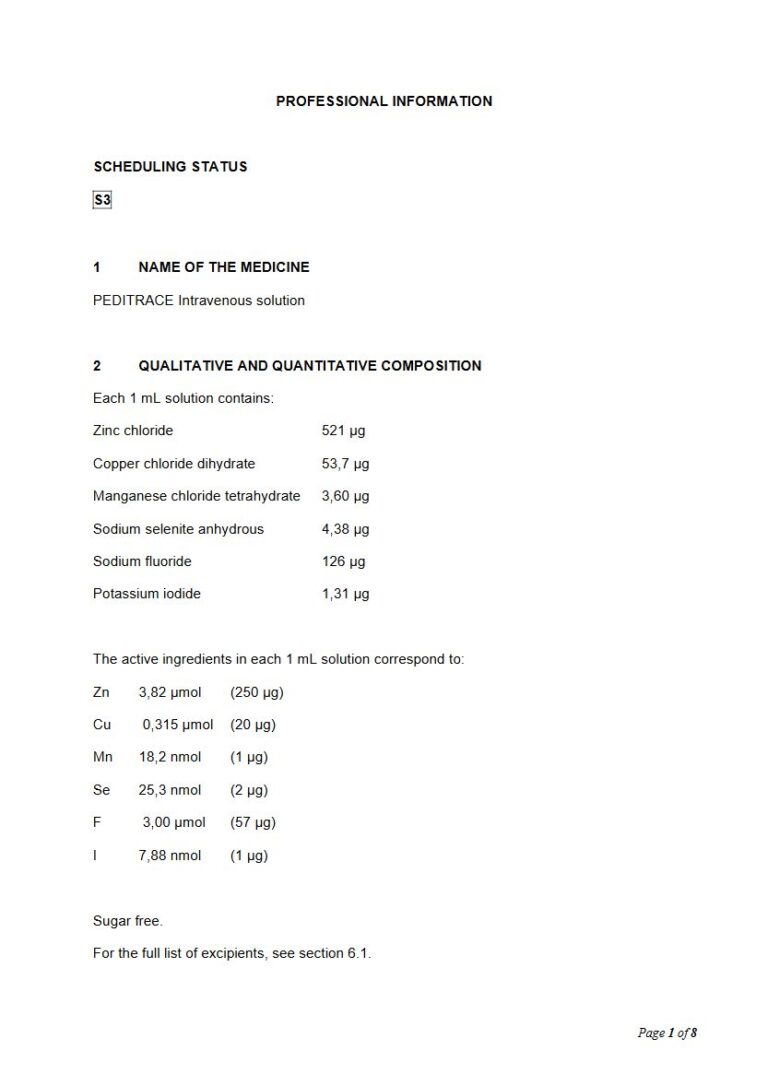
Peditrace 1 mL Intravenous solution
PDF Leaflet Revision Date: 05 March 2026
Clinical Summary
Quick overview from the medicine insert
Indication
Meets basal trace element requirements during intravenous nutrition in infants.
Dosage (summary)
1 mL/kg body weight/day for infants
Special Populations
- Renal impairment
- Hepatic impairment
Pregnancy & Breastfeeding
No data available for pregnancy and breastfeeding.
Key Drug Interactions
- Zinc salt with penicillamine
- Corticosteroids increase urinary copper excretion
Contraindications
- Hypersensitivity to active ingredients
- Allergy to iodine
- Wilsonu2019s disease
- Cholestatic liver disease
Common side effects
- Allergic reactions
- Goitre
- Hypothyroidism
- Superficial thrombophlebitis
Counselling Points
- Do not administer undiluted
- Infuse slowly
- Monitor trace element levels regularly
Serious warnings
- Caution in renal/hepatic impairment
- Monitor manganese levels after 4 weeks
Important Disclaimer
The Peditrace 1 mL Intravenous solution professional information leaflet below is the property of Fresenius Kabi South Africa and is provided on Medinsert exactly as issued, with no.. alterations or editorial changes. We make every effort to keep content current by updating documents as soon as new versions become available. Medinsert serves as a trusted access point for healthcare professionals, but does not replace official sources or clinical judgement. For more details, please read our full disclaimer. read more>>
 Healthcare Professionals Only
This content is for registered healthcare professionals
Sign in or create a free account to read the full package insert.
Free for HPCSA-registered professionals. Powered by Medinsert.
Clinical Particulars
Section 4 of the official insert — extracted exactly as issued, no alterations
4.1 Therapeutic indications
PEDITRACE is indicated to meet the basal requirement of trace elements during intravenous nutrition of premature and full term infants.
4.2 Posology and method of administration
Posology
The basal requirements for infants (<15 kg in weight) of the included trace elements are met by 1 mL of PEDITRACE per kg body weight per day to a maximum dose of 15 mL. The efficacy of a daily dose of 15 mL PEDITRACE in children weighing more than 15 kg has not been established and regular monitoring of trace element plasma levels is recommended. Up to 6 mL PEDITRACE can be added to 100 mL of a glucose solution (50 u2013 500 mg/mL) and given during a minimum infusion period of 8 hours. The infusion should be given at a very slow rate and is best done with an appropriate pump or an automatic drop rate counter.
Method of administration
Intravenous infusion. PEDITRACE must not be given undiluted. For instructions on dilution of the product before administration, see section 6.6.
4.3 Contraindications
PEDITRACE is contraindicated in:
u2022 Patients with hypersensitivity to any of the active ingredients or to the excipients in PEDITRACE (see section 6.1).
u2022 Persons allergic to iodine.
u2022 Wilsonu2019s disease.
u2022 This supplement should be withheld when cholestatic liver disease is present.
4.4 Special warnings and precautions for use
The safety of PEDITRACE in patients with renal or hepatic impairment has not been established. PEDITRACE should be used with caution in patients with impaired biliary and/or renal function. Considerable caution is required in administering PEDITRACE solution to patients with impaired biliary excretion, or compromised liver function, as copper and manganese are normally excreted via the bile. PEDITRACE should also be used with caution in patients with biochemical or clinical evidence of liver dysfunction. Lower dosages should be given when there is impaired renal function. Such patients require careful biochemical monitoring. Selenium and zinc are mainly excreted via the urine. If the treatment is continued for more than 4 weeks, checking of manganese levels is required. Patients with increased losses or requiring prolonged intravenous nutrition should be monitored biochemically to confirm that the requirements are being met appropriately.
PEDITRACE contains sodium and potassium
PEDITRACE contains less than 1 mmol sodium (23 mg) per 10 mL solution, i.e., essentially u2018sodium-freeu2019. PEDITRACE contains less than 1 mmol potassium (39 mg) per 10 mL solution, i.e., essentially u2018potassium-freeu2019.
4.5 Interaction with other medicines and other forms of interaction
Concurrent administration of zinc salt with penicillamine might diminish the effect of penicillamine. Corticosteroids in excess, increase urinary copper excretion.
4.6 Fertility, pregnancy and lactation
Pregnancy
No data available.
Breastfeeding
No data available.
Fertility
No data available.
4.7 Effects on ability to drive and use machines
No data available.
4.8 Undesirable effects
Tabulated list of adverse reactions
System organ class Frequency unknown (cannot be estimated from the available data)
Immune system disorders Allergic reactions - may include urticaria, angioedema, cutaneous haemorrhage or purpuras, fever, arthralgia, lymphadenopathy and eosinophilia.
Endocrine disorders Goitre, hypothyroidism, hyperthyroidism.
Vascular disorders Superficial thrombophlebitis has been observed when glucose containing PEDITRACE was administered. However, it is not possible to deduce whether this reaction is attributable to the trace elements infusion or not.
General disorders and administration site conditions Prolonged administration of iodine may lead to iodism.
Reporting of suspected adverse reactions
Reporting suspected adverse reactions after authorisation of the medicine is important. It allows continued monitoring of the benefit/risk balance of the medicine. Healthcare providers are requested to report any suspected adverse drug reactions to SAHPRA via the Med Safety APP (Medsafety X SAHPRA) and eReporting platform (who-umc.org) found on the SAHPRA website. Healthcare providers are asked to report any suspected adverse drug reactions to the Holder of the Certificate of Registration at the following email address: [email protected] and to the relevant medicines regulatory authority in the country where the product is marketed.
4.9 Overdose
Chronic excessive exposure to manganese is associated with severe extrapyramidal neurological disease. Iodine excess may cause hypothyroidism. Prolonged use of zinc may lead to copper deficiency and anaemia. Selenium toxicity may lead to weakness, anorexia, tremors and sweating. In patients with impaired renal or biliary function, there is an increased risk for accumulation of trace elements. In case of a chronic overload of iron there is a risk of haemosiderosis, which can be treated by venesection in severe and rare cases. Treatment is symptomatic and supportive. When overdosage occurs treatment should be withdrawn.
