
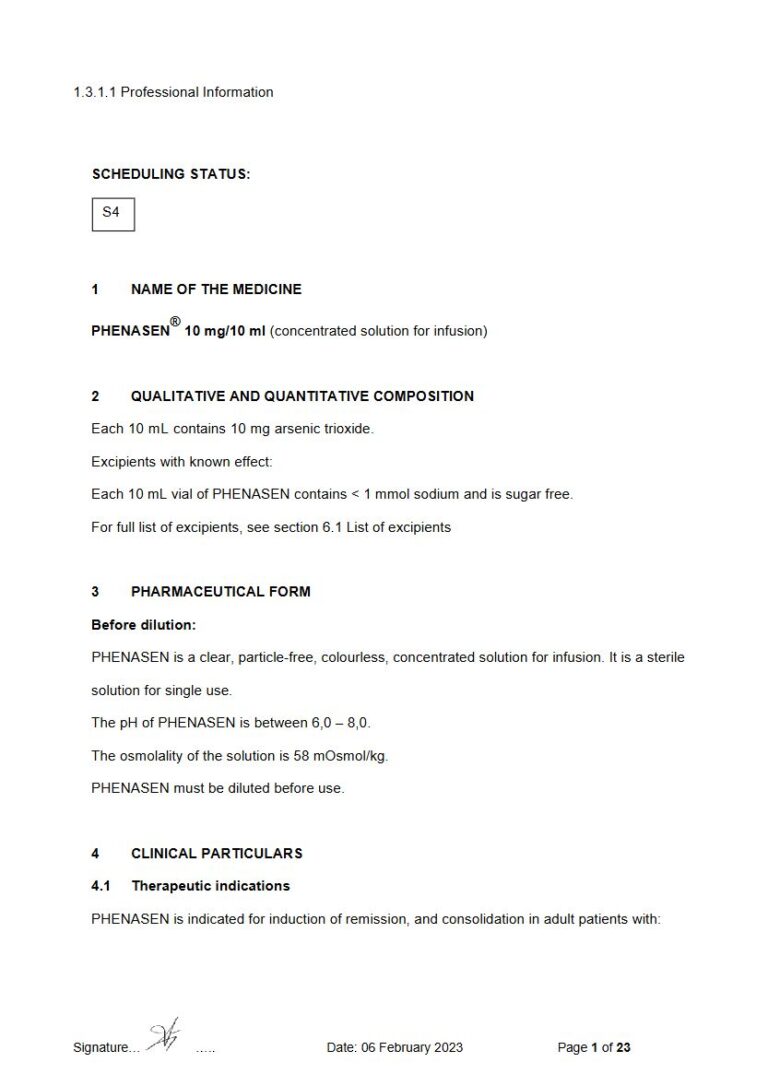
Phenasen 10 mg/10 ml Concentrated solution for infusion)
PDF Leaflet Revision Date: 06 February 2023
Clinical Summary
Quick overview from the medicine insert
Indication
Induction and consolidation treatment for acute promyelocytic leukaemia.
Dosage (summary)
0.15 mg/kg/day IV until hematological CR or max 60 days; consolidation 0.15 mg/kg/day 5 days/week.
Special Populations
- Elderly
- Renal impairment
- Hepatic impairment
Pregnancy & Breastfeeding
Embryotoxic and teratogenic; contraindicated in pregnancy and breastfeeding.
Key Drug Interactions
- QT prolonging medications
- Hepatotoxic medications
Contraindications
- Hypersensitivity to arsenic trioxide
- Heart block
- Congestive cardiac failure
Common side effects
- Leukocytosis
- Hepatotoxicity
- Peripheral neuropathy
- QT prolongation
Counselling Points
- Monitor for signs of APL differentiation syndrome
- Use effective contraception
- Avoid QT prolonging drugs
Serious warnings
- APL differentiation syndrome
- Risk of torsade de pointes
- Potential for sudden death
Important Disclaimer
The Phenasen 10 mg/10 ml Concentrated solution for infusion) professional information leaflet below is the property of Key Oncologics and is provided on Medinsert exactly as issued, with no.. alterations or editorial changes. We make every effort to keep content current by updating documents as soon as new versions become available. Medinsert serves as a trusted access point for healthcare professionals, but does not replace official sources or clinical judgement. For more details, please read our full disclaimer. read more>>
 Healthcare Professionals Only
This content is for registered healthcare professionals
Sign in or create a free account to read the full package insert.
Free for HPCSA-registered professionals. Powered by Medinsert.
Clinical Particulars
Section 4 of the official insert — extracted exactly as issued, no alterations
4.1 Therapeutic indications
PHENASEN is indicated for induction of remission, and consolidation in adult patients with:
- Newly diagnosed low-to-intermediate risk acute promyelocytic leukaemia (APL) (white blood cell count, u2264 10 x 10 3 /u03bcl) in combination with all-trans retinoic acid (ATRA);
- Relapsed/refractory acute promyelocytic leukaemia (APL) (Previous treatment should have included a retinoid and chemotherapy); characterised by the presence of the t(15;17) translocation and/or the presence of the Pro-Myelocytic Leukaemia/Retinoic-Acid-Receptor-alpha (PML/RAR-alpha) gene. The response rate of other acute myelogenous leukaemia subtypes to arsenic trioxide has not been examined.
4.2 Posology and method of administration
PHENASEN must be administered under the supervision of a medical practitioner who is experienced in the management of acute leukaemias, and the special monitoring procedures described in section 4.4 must be followed.
Posology
The same dose is recommended for adults and elderly. Cycles of treatment are given to achieve complete remission (CR), defined as the complete disappearance of all leukaemic myeloblasts and promyelocytes and < 5 % overall myeloblasts by morphological examination of the marrow. After induction of remission, consolidation cycles may be given, and maintenance therapy considered. PHENASEN may be given in combination with all-trans retinoic acid (ATRA) and/or chemotherapy.
In patients with newly diagnosed/ de novo APL combination treatment PHENASEN may be given in combination with all-trans-retinoic acid (ATRA) and/or chemotherapy. Dosage regimens for low to intermediate risk patients are described in Table 1.
Table 1. Dosage regimen for Low-to-intermediate risk patients
Category of patients Treated with Induction (Cycle 1) Consolidation (4 cycles) WBC count u2264 10 x 10 9 /L PHENASEN 0,15 mg/kg/day from day 1 until haematological CR or for a maximum of 60 days. If no haematological CR is achieved by day 60 discontinue treatment. 0,15 mg/kg/day 5 days per week. 4 weeks on and 4 weeks off, for a total of 4 cycles ATRA (Tretinoin) Dose as per the prescribing information of ATRA. Chemotherapy with idarubicin (iv) on Days 2, 4, 6 and 8. The idarubicin dose is age-dependent and given at the induction phase only based on a patientsu2019 ability to tolerate. It is strongly recommended that during induction patients are treated with prednisone (or prednisolone); 1 mg/kg/day for at least 10 days. Aggressive platelet and plasma support should also be considered to maintain haemostatic targets. For patients in CR after the 3 cycles of induction/consolidation, maintenance consisting of ATRA from Day 1u201314, followed by 6-mercaptopurine (6MP) and methotrexate (MTX) both from Day 15-90 (each cycle 3 months) may then be administered for 24 months. In the Lo-Coco trial, marrow samples were collected at the end of the third consolidation cycle and tested by RT-PCR for assessment of molecular remission. Patients who did not achieve molecular remission at the end of the entire consolidation programme were considered as molecular resistant and taken off the treatment.
In patients refractory to, or relapsed from retinoid and anthracycline therapy:
Induction treatment therapy For induction, a daily infusion of 0,15 mg/kg/day is continued until bone marrow remission is obtained. If bone marrow remission is not obtained by day 60, dosing must be discontinued. Consolidation treatment therapy An additional course beginning consolidation of treatment must begin 3-4 weeks after completion of the induction cycle. PHENASEN is to be administered intravenously at a dose of 0,15 mg/kg/day, for 25 doses given 5 days per week followed by 2 days interruption, repeated for 5 weeks.
Special populations
Elderly population: No dosage adjustment is required for this population. Patients with renal impairment: Since no data are available across all renal impairment groups, caution is advised in the use of PHENASEN in patients with renal impairment. In a pharmacokinetic study of arsenic trioxide, the plasma clearance of AsIII was not altered in patients with mild renal impairment (creatinine clearance of 50-80 ml/min) or moderate renal impairment (creatinine clearance of 30-49 ml/min). The plasma clearance of AsIII in patients with severe renal impairment (creatinine clearance less than 30 ml/min) was 40 % lower when compared with patients with normal renal function (see section 4.4). Patients with hepatic impairment: Since no data are available across all hepatic impairment groups and hepatotoxic effects may occur during the treatment with PHENASEN, caution is advised in the use of PHENASEN in patients with hepatic impairment (see section 4.4 and 4.8).
Method of administration PHENASEN must be administered intravenously over 1-2 hours. The infusion duration may be extended up to 4 hours if vasomotor reactions are observed. A central venous catheter is not required. Patients must be hospitalised at the beginning of treatment due to symptoms of disease and to ensure adequate monitoring.
4.3 Contraindications
- Hypersensitivity to arsenic trioxide or any of the excipients, listed in section 6.1
- Patients with heart block or prolonged QT intervals (see section 4.4)
- Patients with congestive cardiac failure (see section 4.4)
- Co-administration with medicines that prolong the QT interval (see section 4.4)
- Pregnancy and lactation (see section 4.6)
4.4 Special warnings and precautions for use
PHENASEN should be administered under the supervision of a medical practitioner experienced in the management of patients with acute leukaemia. Clinically unstable APL patients are especially at risk and will require more frequent monitoring of electrolyte and glycaemia levels as well as more frequent haematologic, hepatic, renal and coagulation parameter tests.
APL Differentiation Syndrome: Some patients with APL treated with PHENASEN experience symptoms similar to a syndrome called retinoic-acid-acute-promyelocytic leukaemia (RA-APL) syndrome or APL differentiation syndrome, characterised by fever, dyspnoea, weight gain, pulmonary infiltrates and pleural or pericardial effusions with or without leukocytosis. This syndrome can be fatal. The first signs that could suggest the development of the APL differentiation syndrome are unexplained fever, dyspnoea and/or weight gain, abnormal chest auscultatory findings or radiographic abnormalities. The management of the syndrome has not been fully studied, but high dose steroids have been used at the first suspicion of the APL differentiation syndrome and appear to mitigate signs and symptoms.
In APML4, an obligatory part of the treatment protocol was use of prednisone or prednisolone, 1 mg/kg/day, on days 1 u2010 10, and beyond day 10 if WCC was elevated > 10 x 10 9 /L or if there were signs of APL differentiation syndrome. The APML4 study protocol included APL differentiation syndrome as the most serious and potentially fatal side effect of ATRA. Whenever the features of APL differentiation syndrome developed, ATRA and/or PHENASEN doses were temporarily ceased or reduced. When it was time to restart ATRA and/or PHENASEN therapy the dose of ATRA was reduced to 25 mg/m 2 /day for 14 days and the dose of arsenic trioxide was reduced to 0,08 mg/kg/day. In particular, the compulsory use of prednisone (or prednisolone) as prophylactic therapy and the delayed introduction of arsenic trioxide on day 9 of the induction therapy was expected to almost completely eliminate the severest form of APL differentiation syndrome.
In Lo-Coco trial, prednisone at a dose of 0,5 mg/kg/day was administered from day 1 until the end of induction therapy as a prophylaxis therapy for APL differentiation syndrome. Where features of APL differentiation syndrome occurred, the dose of PHENASEN was reduced to 0,08 mg/kg/day or ceased temporarily and ATRA was ceased depending on clinical severity. Dexamethasone, 10 mg every 12 hours I.V. was promptly started until the signs and symptoms of APL differentiation syndrome had disappeared for a minimum of 3 days. Furosemide was given when clinically required. As soon as the symptoms of APL differentiation syndrome disappeared and the patientsu2019 clinical conditions improved, the treatment with ATRA and/or arsenic trioxide was resumed at 50 % of the previous dose for the first 7 days. Thereafter, in the absence of worsening of the previous toxicity, ATRA and/or PHENASEN was resumed at full dosage. Whenever the APL differentiation syndrome symptoms reappeared, ATRA and arsenic trioxide doses were reduced as described above.
Electrocardiagram (ECG) Abnormalities PHENASEN can cause QT interval prolongation and complete atrioventricular block. QT prolongation can lead to a torsade de pointes -type ventricular dysrhythmia, which can be fatal. The risk of torsade de pointes is related to the extent of QT prolongation, concomitant administration of QT prolonging medicines, a history of torsade de pointes, pre-existing QT interval prolongation, congestive heart failure, administration of potassium-depleting diuretics, or other conditions that result in hypokalaemia or hypomagnesaemia. One patient (also receiving amphotericin B) had torsade de pointes during induction therapy for relapsed APL with arsenic trioxide.
QT/QTc Prolongation: QT prolongation should be expected during treatment with PHENASEN and torsades de pointes as well as complete heart block has been reported. Over 460 ECG tracings from 40 patients with refractory or relapsed APL treated with arsenic trioxide were evaluated for QTc prolongation. Sixteen of 40 patients (40 %) had at least one ECG tracing with a QTc interval greater than 500 msec. Prolongation of the QTc was observed between 1 and 5 weeks after PHENASEN infusion, and then returned towards baseline by the end of 8 weeks after PHENASEN infusion. In these ECG evaluations, women did not experience more pronounced QT prolongation than men, and there was no correlation with age.
Complete AV block: Complete AV block has been reported with arsenic trioxide in the published literature including a case of a patient with APL.
ECG and Electrolytes: Monitoring Recommendations Patients with congestive heart failure should not be administered PHENASEN. Prior to initiating therapy with arsenic trioxide, a 12-lead ECG should be performed and serum electrolytes (potassium, calcium and magnesium) and creatinine should be assessed; pre-existing electrolyte abnormalities should be corrected and, if possible, medicines that are known to prolong the QT interval should be discontinued. For QTc greater than 500 msec, corrective measures should be completed and the QTc reassessed with serial ECGs prior to considering using PHENASEN. During therapy with PHENASEN, potassium concentrations should be kept above 4 mmol/L and magnesium concentrations should be kept above 0,8 mmol/L. Patients who reach an absolute QT interval > 500 msec must be reassessed and PHENASEN therapy should be discontinued. If syncope, rapid or irregular heart beat develops, the patient should be hospitalised for monitoring and serum electrolytes should be assessed. PHENASEN therapy should be discontinued until the QTc interval regresses to below 460 msec, electrolyte abnormalities are corrected, and the syncope and irregular heartbeat cease. If PHENASEN therapy is recommenced, extreme caution and close monitoring is required. After recovery, treatment should be resumed at 50 % of the preceding daily dose. If QTc prolongation does not recur within 7 days of restarting treatment at the reduced dose, treatment with arsenic trioxide can be resumed at 0,11 mg/kg body weight per day for a second week. The daily dose can be escalated back to 100 % of the original dose if no prolongation occurs. There are no data on the effect of arsenic trioxide on the QTc interval during the infusion. Electrocardiograms must be obtained twice weekly, and more frequently for clinically unstable patients, during induction and consolidation.
Peripheral neuropathy Peripheral neuropathy has been associated with the use of PHENASEN. In the largest case series (Soignet SL, 2001) one patient (out of 40) experienced grade 3 neuropathy and required discontinuation of PHENASEN treatment. Patients should be monitored periodically for symptoms or signs of neuropathy. Patients on continuing PHENASEN treatment may be at greater risk.
Hepatotoxicity (Grade 3 or greater) In newly diagnosed patients with low to intermediate risk APL, 63,2 % developed grade 3 or 4 hepatic toxic effects during induction or consolidation treatment with arsenic trioxide in combination with ATRA (see section 4.8). However toxic effects resolved with temporary discontinuation of either arsenic trioxide, ATRA or both (see section 4.2). Treatment with arsenic trioxide must be discontinued before the scheduled end of therapy at any time that a hepatotoxicity grade 3 or greater on the National Cancer Institute Common Toxicity Criteria is observed. As soon as bilirubin and/or SGOT and/or alkaline phosphatase are decreased to below 4 times the normal upper level, treatment with arsenic trioxide should be resumed at 50 % of the previous dose during the first 7 days. Thereafter, in absence of worsening of the previous toxicity, arsenic trioxide should be resumed at full dosage. In case of reappearance of hepatotoxicity, arsenic trioxide must be permanently discontinued.
Patients with hepatic impairment: Since no data are available across all hepatic impairment groups and hepatotoxic effects may occur during the treatment with PHENASEN, caution is advised in the use of PHENASEN in patients with hepatic impairment (see section 4.4 on hepatotoxicity and section 4.8).
Hyperleukocytosis PHENASEN has been investigated in 40 relapsed or refractory APL patients, previously treated with an anthracycline and a retinoid regimen, in an open-label, single-arm, non-comparative study (Soignet SL, 2001). Patients received PHENASEN 0,15 mg/kg/day intravenously over 1 to 2 hours daily until the bone marrow was cleared of leukaemic cells or up to a maximum of 60 days. In this study in relapsed or refractory APL patients, treatment with PHENASEN was associated with the development of hyperleukocytosis (u2265 10 x 10 9 /L) in some patients. There did not appear to be a relationship between baseline white blood cell (WBC) counts and development of hyperleukocytosis nor did there appear to be a correlation between baseline WBC count and peak WBC counts. Hyperleukocytosis was never treated with additional chemotherapy and resolved on continuation of PHENASEN. WBC counts during consolidation were not as high as during induction treatment and were 50 x10 9 /L. Hydroxyurea was discontinued when WBC count decreased to < 10 x10 9 /L.
Patients with renal impairment Since no data are available across all renal impairment groups, caution is advised in the use of PHENASEN in patients with renal impairment. The experience in patients with severe renal impairment is insufficient to determine if dose adjustment is required. The use of arsenic trioxide in patients on dialysis has not been studied.
Paediatric Use There are limited clinical data on the paediatric use of PHENASEN. Of 5 patients below the age of 18 years (age range: 5 to 16 years) who received a dose of 0,15 mg/kg/day for relapsed/refractory APL, 3 achieved a complete response. In two published studies in children with de novo APL (age range 5 u2013 15 years; 11 and 19 children respectively) treated with single agent PHENASEN, 89,5 % and 91,0 % of the children achieved CR, with overall response reaching 91 % at 30 months and 84 % at 5 years respectively. Safety and effectiveness in paediatric patients below the age of 5 years has not been studied.
Use in the Elderly There is limited clinical data on the use of arsenic trioxide in the elderly population. Elderly patients have a greater risk of reduced renal function. Because renal excretion is the main route of elimination of arsenic, particular caution is needed in these patients.
Laboratory tests The patientu2019s electrolyte, and glycaemia levels, as well as haematologic, hepatic, renal and parameter tests must be monitored at least twice weekly, and more frequently for clinically unstable patients during the induction phase and at least weekly during the consolidation phase. ECGs should be obtained weekly, and more frequently for clinically unstable patients, during induction and consolidation.
Development of second primary malignancies The active ingredient of PHENASEN, arsenic trioxide, is a human carcinogen. Monitor patients for the development of second primary malignancies.
Encephalopathy Cases of encephalopathy were reported with treatment with arsenic trioxide. Wernicke encephalopathy after arsenic trioxide treatment was reported in patients with vitamin B1 deficiency. Patients at risk of B1 deficiency should be closely monitored for signs and symptoms of encephalopathy after arsenic trioxide initiation. Some cases recovered with vitamin B1 supplementation.
Sodium content PHENASEN contains less than 1 mmol sodium (23 mg) per 10 mL, that is to say essentially u2018sodium-freeu2019.
4.5 Interaction with other medicines and other forms of interaction
No formal assessments of pharmacokinetic interactions between arsenic trioxide and other therapeutic medicinal products have been conducted. Medicines known to cause QT/QTc interval prolongation, hypokalemia or hypomagnesaemia. QT/QTc prolongation is expected during treatment with arsenic trioxide, and torsade de pointes and complete heart block have been reported. Patients who are receiving, or who have received, medicines known to cause hypokalemia or hypomagnesaemia, such as diuretics or amphotericin B, may be at higher risk for torsade de pointes. Caution is advised when arsenic trioxide is co-administered with other medicinal products known to cause QT/QTc interval prolongation such as macrolide antibiotics, the antipsychotic thioridazine, ziprasidone or pimozide, or medicines known to cause hypokalemia or hypomagnesaemia. Additional information about QT prolonging medicines, is provided in section 4.4.
Medicines known to cause hepatotoxic effects: Hepatotoxic effects may occur during the treatment with arsenic trioxide, caution is advised when arsenic trioxide is co-administered with other medicinal products known to cause hepatotoxic effects (see section 4.4 and 4.8). Other antileukaemic medicinal products: The influence of arsenic trioxide on the efficacy of other antileukaemic medicinal products is unknown.
4.6 Fertility, pregnancy and lactation
Contraception in males and females Due to the genotoxic risk of arsenic compounds, women of childbearing potential and men must use effective contraceptive measures while they are being treated with PHENASEN and for 6 months following completion of treatment. Men should use effective contraceptive measures and be advised to not father a child while receiving PHENASEN and for 3 months following completion of treatment.
Pregnancy PHENASEN has been shown to be embryotoxic and teratogenic in animal studies. There are no studies in pregnant women using PHENASEN. PHENASEN should not be given to patients who are pregnant (see section 4.3). If a patient becomes pregnant while taking this product, the patient must be informed of the potential harm to the foetus. Pregnancy test prior to the treatment with PHENASEN should be performed.
Breastfeeding Arsenic is excreted in human milk. Because of the potential for serious adverse reactions in nursing infants and children from PHENASEN, breastfeeding must be discontinued prior to and throughout administration and for two weeks after the last dose.
Fertility No clinical or non-clinical fertility studies have been conducted with arsenic trioxide.
4.7 Effects on ability to drive and use machines
PHENASEN can cause seizures and headache and may have an influence on mental and/or physical abilities to perform or execute tasks or activities requiring mental alertness, judgment and/or sound coordination and vision.
4.8 Undesirable effects
a. Summary of the safety profile Death Sudden death, sometimes early in the treatment with arsenic trioxide has occurred. Autopsies have sometimes failed to identify a cause of sudden death. Cerebral haemorrhage has been the cause of death in three patients. Another patient on whom an autopsy was not performed became asystolic and died while on continuous cardiac telemetry. The level of arsenic trioxide excreted in the urine does not seem to be related as a cause of death.
Adverse reactions are ranked below by system organ class and frequencies described as follows: very common (u2265 1/10); common (u2265 1/100 < 1/10); uncommon (u2265 1/1 000 to < 1/100) and rare (u2265 1/10 000 to < 1/1 000).
Table 2: Tabulated list of adverse reactions
Body System Undesirable effect Very common Common Uncommon Rare Infections and Infestations: Infection Blood and the lymphatic system disorders: Leukocytosis, neutropenia, thrombocytopenia Febrile neutropenia (all grades and Grade > 3 frequencies), haemorrhage, thrombosis Leucopenia, vasculitis Immune system disorders: Immune suppression causing herpes zoster Metabolism and nutrition disorders: Hepatotoxicity Hypokalaemia, hyperglycaemia, increase in AST, ALT, GGT or bilirubin, liver dysfunction Hypermagnesaemia, hypernatraemia, ketoacidosis Nervous system disorders: Headache, insomnia, peripheral neuropathy, paraesthesia, mood alteration, musculoskeletal pain, seizures Cardiac disorders: Dysrhythmia including non-sustained ventricular tachycardia, premature ventricular contractions, QTc-prolongation Torsade de pointes, ventricular tachycardia 2 CVA (cerebral vascular accident), pericardial effusion Respiratory, thoracic and mediastinal disorders: Cough, sore throat, dyspnoea, pleuritic pain Pulmonary alveolar haemorrhage, pleural effusion, hypoxia Gastrointestinal disorders: Nausea, vomiting, diarrhoea, abdominal pain, mucositis Skin and subcutaneous tissue disorders: Rash, pruritus Dermatitis, erythema Musculoskeletal, connective tissue and bone disorders: Bone pain, arthralgia, musculoskeletal pain Renal and urinary disorders: Renal failure General disorders and administrative site conditions: Fever 1 Fatigue, APL differentiation syndrome Chest pain, pain Investigations: Alanine amino transferase increased (all Grades), increase in Aspartate amino transferase (all Grades) ECG QT prolongation, increase in Alanine amino transferase (Grades u2265 3), increase in aspartate amino transferase (Grades u2265 3) Hyperbilirubinaemia, hypomagnesaemia
1. Fever and dyspnoea with one or more of weight gain, generalised oedema, respiratory failure or lung infiltrates. Resolved with dexamethasone. 2. A case of torsade de pointes resolved spontaneously.
Reporting of suspected adverse reactions Reporting suspected adverse reactions after authorisation of the medicine is important. It allows continued monitoring of the benefit/risk balance of the medicine. Healthcare professionals are asked to report any suspected adverse reactions to SAHPRA via the u201c6.04 Adverse Drug Reaction Reporting Formu201d, found online under SAHPRAu2019s publications: https://www.sahpra.org.za/Publications/Index/8
4.9 Overdose
If symptoms of serious acute arsenic toxicity appear, the medicine should be immediately discontinued and chelation therapy should be considered. Other anti-arsenical treatment may be considered. The patient requires symptomatic and supportive treatment with close monitoring of their cardiac function and electrocardiogram.
