
Ambisome 50mg injection
PDF Leaflet Revision Date: 20 May 2025
Clinical Summary
Quick overview from the medicine insert
Indication
Empirical treatment of presumed fungal infection and severe systemic mycoses.
Dosage (summary)
3-5 mg/kg/day for systemic infections; 5-10 mg/kg for mucormycosis.
Special Populations
- Paediatric patients
- Elderly
- Renal impairment
Pregnancy & Breastfeeding
Use only if benefits outweigh risks; safety in breastfeeding not established.
Key Drug Interactions
- Nephrotoxic medications
- Corticosteroids
- Digitalis glycosides
Contraindications
- Hypersensitivity to constituents
Common side effects
- Fever
- Chills
- Hypokalaemia
- Headache
Counselling Points
- Monitor for infusion reactions
- Avoid during dialysis
- Contains sucrose
Serious warnings
- Anaphylaxis
- Infusion-related reactions
- Renal toxicity
Important Disclaimer
The Ambisome 50mg injection professional information leaflet below is the property of Key Oncologics and is provided on Medinsert exactly as issued, with no.. alterations or editorial changes. We make every effort to keep content current by updating documents as soon as new versions become available. Medinsert serves as a trusted access point for healthcare professionals, but does not replace official sources or clinical judgement. For more details, please read our full disclaimer. read more>>
 Healthcare Professionals Only
This content is for registered healthcare professionals
Sign in or create a free account to read the full package insert.
Free for HPCSA-registered professionals. Powered by Medinsert.
Clinical Particulars
Section 4 of the official insert — extracted exactly as issued, no alterations
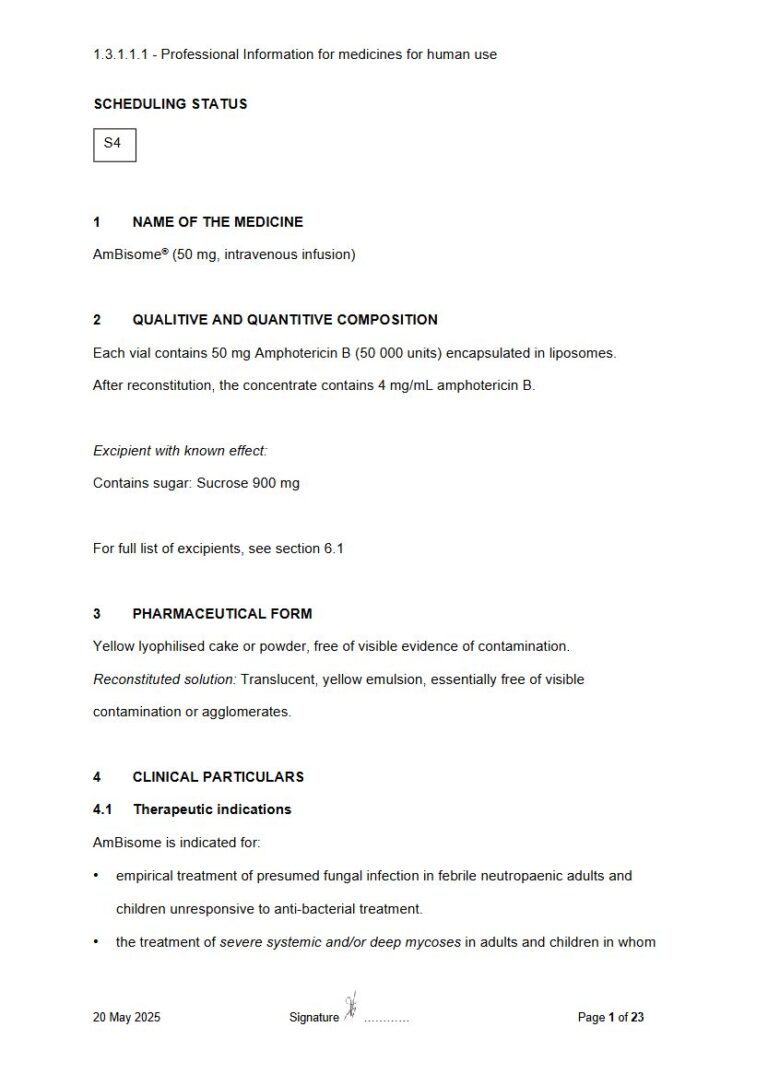
4.1 Therapeutic indications
AmBisome is indicated for:
- empirical treatment of presumed fungal infection in febrile neutropaenic adults and children unresponsive to anti-bacterial treatment.
- the treatment of severe systemic and/or deep mycoses in adults and children in whom toxicity (particularly nephrotoxicity) precludes the use of conventional systemic amphotericin B, or in patients who are resistant to conventional amphotericin B. Fungal infections successfully treated with AmBisome include: disseminated candidiasis, aspergillosis, mucormycosis, chronic mycetoma and cryptococcal meningitis.
- Cryptococcal meningitis in HIV-infected patients.
- primary therapy of visceral leishmaniasis in immunocompetent adults and children and immunocompromised adults (e.g. HIV positive).
AmBisome should not be used to treat the common clinically unapparent forms of fungal disease which show only positive skin or serologic tests.
4.2 Posology and method of administration
Posology
AmBisome should be administered by intravenous infusion over a 30u201360-minute period and the patient closely observed. For doses greater than 5 mg/kg/day, intravenous infusion over a 2-hour period is recommended (see section 4.4). The recommended concentration for intravenous infusion is 0,20 mg/ml to 2,00 mg/ml amphotericin B as AmBisome (see section 6.6).
Adults
Dosage of amphotericin B as AmBisome must be adjusted to the specific requirements of each patient. Treatment of mycoses:
- For treatment of systemic mycotic infections, therapy is usually instituted at a daily dose of 3 to 5 mg/kg of body weight for a minimum of 14 days.
- Mucormycosis: For suspected or confirmed infection, initiate treatment with 5 to 10 mg/kg, administered daily. In patients with brain involvement or solid-organ transplant, dose at 10 mg/kg, administered daily. Avoid slow escalation of doses. The duration of therapy should be determined on an individual basis. Courses of up to 56 days are commonly used in clinical practice; longer durations of therapy may be required for deep seated infections or in cases of prolonged courses of chemotherapy or neutropenia. Doses greater than 5 mg/kg and up to 10 mg/kg have been used in clinical trials and clinical practice. There are limited data on the safety and efficacy of AmBisome for the treatment of mucormycosis at these higher doses, therefore, a benefit:risk assessment should be made on an individual patient level to determine whether the potential benefits of treatment are considered to outweigh the known increased risk of toxicity at higher AmBisome doses (see section 4.4).
- Cryptococcal Meningitis: Single agent therapy: Initiate treatment with 3 to 6 mg/kg/day AmBisome for 14 days. High-dose induction therapy in HIV associated cryptococcal meningitis: Administer a single dose of 10 mg/kg AmBisome on day 1, in combination with daily flucytosine 100 mg/kg and daily fluconazole 1200 mg, both administered for 14 days. After the 2-week induction period, patients should receive fluconazole 800 mg daily for 8 weeks and then at a dose of 200 mg daily thereafter at the treating doctoru2019s discretion.
- Visceral leishmaniasis: a dose of 1,0 to 1,5 mg/kg/day for 21 days or alternatively a dose of 3,0 mg/kg/day for 10 days can be used for treatment of visceral leishmaniasis. In immunocompromised patients (e.g. HIV positive), a dose of 1,0 to 1,5 mg/kg/day for 21 days may be used. Because of the risk of relapse, maintenance therapy or reinduction therapy may be necessary.
- Empirical therapy: Initiate treatment with 3 mg/kg, administered daily for 10 to 14 days, or until resolution of neutropenia.
Special populations
Paediatric Population: Systemic fungal infections and fever of unknown origin have been successfully treated with AmBisome in paediatric patients, without reports of unusual adverse events. AmBisome has been studied in paediatric patients aged one month to 18 years old. Dosage should be calculated on the same per Kg body weight basis as for adults. The safety and efficacy of AmBisome has not been established in infants under one month old.
Elderly Population: No alteration in dose or frequency of dosing is required.
Renal Impairment: AmBisome has been successfully administered to patients with pre-existing renal impairment at doses of 1-5 mg/kg/day in clinical trials and no adjustment in dose or frequency of administration was required (see section 4.4).
Method of administration
- AmBisome should be administered by intravenous infusion over a 30-60-minute period and the patient closely observed. For doses greater than 5 mg/kg/day, intravenous infusion over a 2-hour period is recommended (see section 4.4).
- The recommended concentration for intravenous infusion is 0,20 mg/ml to 2,00 mg/ml amphotericin B as AmBisome (see section 6.6).
- For instructions on reconstitution and dilution of the product before administration (see section 6.6).
- AmBisome is provided as a unit dose product. DO NOT STORE partially used vials for future patient use. Discard any unused portions (see section 6.4).
4.3 Contraindications
u2022 AmBisome is contraindicated in patients who have shown hypersensitivity to any of its constituents unless, in the opinion of the doctor, the condition requiring treatment is life-threatening and amenable only to AmBisome therapy.
4.4 Special warnings and precautions for use
Anaphylaxis and anaphylactoid reactions
- Anaphylaxis and anaphylactoid reactions have been reported in association with AmBisome infusion.
- If a severe anaphylactic/ anaphylactoid reaction occurs, the infusion should be immediately discontinued and the patient should not receive further infusion of AmBisome.
Infusion-related reactions
- Other severe infusion-related reactions can occur during administration of AmBisome (see section 4.8). Although infusion-related reactions are not usually serious, consideration of precautionary measures for the prevention or treatment of these reactions should be given to patients who receive AmBisome therapy.
- Slower infusion rates (over two hours) or routine doses of diphenhydramine, paracetamol, pethidine, and/or hydrocortisone have been reported as successful in their prevention or treatment.
Renal effects
- AmBisome has been shown to be substantially less toxic than conventional amphotericin B; particularly with respect to nephrotoxicity, however, adverse reactions, including renal adverse reactions, may still occur.
- In studies comparing AmBisome 3 mg/kg daily with higher doses (5, 6 or 10 mg/kg daily), it was found that the incidence rates of increased serum creatinine, hypokalaemia and hypomagnesaemia were notably higher in the high dose groups.
- Regular laboratory evaluation of serum electrolytes, particularly potassium and magnesium, as well as renal, hepatic and haematopoietic function should be performed. This is particularly important in patients receiving concomitant nephrotoxic medications (see section 4.5).
- Due to the risk of hypokalaemia, appropriate potassium supplementation may be required during the course of AmBisome administration.
- If clinically significant reduction in renal function or worsening of other parameters occurs, consideration should be given to dose reductions, treatment interruption or discontinuation.
Pulmonary effects
- Acute pulmonary toxicity has been reported in patients given amphotericin B (as sodium deoxycholate complex) during or shortly after leukocyte transfusions.
- It is recommended these infusions are separated by as long a period as possible and pulmonary function should be monitored.
Renal Dialysis Patients
- Data suggest that no dose adjustment is required in patients undergoing haemodialysis or filtration procedures, however, AmBisome administration should be avoided during the procedure.
Patients with Diabetes Mellitus
- It should be noted that AmBisome contains approximately 900 mg of sucrose in each vial.
- Excipients that may have an effect:
- Each vial contains 900 mg of sucrose. Sucrose is metabolised to glucose and fructose. The glucose increases blood glucose concentrations in diabetes mellitus.
- The additive effect of concomitantly administered products containing fructose (or sorbitol) and dietary intake of fructose (or sorbitol) should be taken into account.
- Patients with rare hereditary conditions such as fructose intolerance, glucose-galactose mal-absorption or sucrase-isomaltase insufficiency should not use AmBisome.
- This medicine contains less than 1 mmol sodium (23 mg) per vial, that is to say essentially u2018sodium-freeu2019.
4.5 Interaction with other medicines and other forms of Interaction
No specific interaction studies have been performed with AmBisome. However, the following agents are known to interact with amphotericin B and may interact with AmBisome.
Nephrotoxic medications:
- Concurrent administration of AmBisome with other nephrotoxic agents, for example cyclosporine, aminoglycosides and pentamidine, may enhance the potential for medicine-induced renal toxicity. However, in patients receiving concomitant ciclosporin and/or aminoglycosides, AmBisome has relatively less nephrotoxicity.
- Regular monitoring of renal function is recommended in patients receiving AmBisome with any nephrotoxic medications.
Corticosteroids, corticotrophin (ACTH) and diuretics:
- Concurrent use of corticosteroids, corticotrophin (ACTH) and diuretics (loop and thiazide) may potentiate hypokalaemia.
Digitalis glycosides:
- AmBisome-induced hypokalaemia may potentiate digitalis toxicity.
Skeletal muscle relaxants:
- AmBisome-induced hypokalaemia may enhance the curariform effect of skeletal muscle relaxants (e.g. tubocurarine).
Antifungals:
- Concurrent use with flucytosine may increase the toxicity of flucytosine by possibly increasing its cellular uptake and/or impairing its renal excretion.
Antineoplastic agents:
- Concurrent use of antineoplastic agents may enhance the potential for renal toxicity, bronchospasm and hypotension.
- Antineoplastic agents should be given concomitantly with caution.
Leucocyte transfusions:
- Acute pulmonary toxicity has been reported in patients given amphotericin B (as sodium deoxycholate complex) during or shortly after leukocyte transfusions.
- It is recommended that these infusions are separated by as long a period as possible and pulmonary function should be monitored.
4.6 Fertility, pregnancy and lactation
Women of childbearing potential/ Contraception in males and females
No information available.
Pregnancy
The safety of AmBisome in pregnant women has not been established. AmBisome should only be used during pregnancy if the possible benefits to be derived outweigh the potential risks to the mother and foetus. Systemic fungal infections have been successfully treated in pregnant women with conventional amphotericin B without obvious effect on the foetus, but the number of cases reported is insufficient to draw any conclusions on the safety of AmBisome in pregnancy.
Breastfeeding
Safety in lactation has not been established. It is unknown whether AmBisome is excreted in human breast milk. Breastfeeding during treatment with AmBisome is not recommended.
Fertility
No effect on fertility expected.
4.7 Effects on ability to drive and use machines
No studies on the effects on the ability to drive and use machines have been performed. Some of the undesirable effects of AmBisome may impact the ability to drive and use machines. AmBisome may cause headache and chest tightness or pain (see section 4.8) but may have minimal effect on mental and/or physical abilities to perform or execute tasks or activities requiring mental alertness, judgment and/or sound coordination and vision.
4.8 Undesirable effects
Summary of the safety profile
Fever and chills/rigors are the most frequent infusion-related reactions expected to occur during AmBisome administration. Less frequent infusion-related reactions may consist of one or more of the following symptoms: back pain, chest tightness or pain, dyspnoea, bronchospasm, flushing, tachycardia, and hypotension. These resolved rapidly on stopping the infusion and may not occur with every subsequent dose or when slower infusion rates (over 2 hours) are used. In addition, infusion-related reactions may also be prevented by the use of premedication. However, severe infusion-related reactions may necessitate the permanent discontinuation of AmBisome.
The following adverse reactions have occurred with AmBisome, based on clinical trial data and post-marketing experience. The frequency is based on analysis from pooled clinical trials of 688 AmBisome treated patients. The frequency of adverse reactions identified from post-marketing experience is not known.
Adverse reactions are listed below by body system organ class using MedDRA and are sorted by frequency. Frequencies are defined as:
- Very common: (u2265 1/10)
- Common: (u2265 1/100 to < 1/10)
- Uncommon: (u2265 1/1 000 to < 1/100)
- Very rare (< 1/10 000)
- Not known (cannot be estimated from the available data)
Tabulated list of adverse reactions
| Body System | Undesirable effect | Very common | Common | Uncommon | Not known |
|---|---|---|---|---|---|
| Blood and the lymphatic system disorders: | thrombocytopenia | anaemia | |||
| Immune system disorders: | anaphylactoid reaction | anaphylactic reactions, hypersensitivity | |||
| Metabolism and nutrition disorders: | hypokalaemia | hyponatraemia, hypocalcaemia, hypomagnesaemia, hyperglycaemia | |||
| Nervous system disorders: | headache | convulsions | |||
| Cardiac disorders: | tachycardia | cardiac arrest, dysrhythmia | |||
| Vascular disorders: | hypotension, vasodilatation, flushing | ||||
| Respiratory, thoracic and mediastinal disorders: | dyspnoea | bronchospasm | |||
| Gastrointestinal disorders: | nausea, vomiting | diarrhoea, abdominal pain | |||
| Hepato-biliary disorders: | liver function tests abnormal, hyperbilirubinaemia, alkaline phosphatase increased | ||||
| Skin and subcutaneous tissue disorders: | rash | angioedema | |||
| Musculoskeletal, connective tissue and bone disorders: | back pain | rhabdomyolysis (associated with hypokalaemia), musculoskeletal pain (described as arthralgia or bone pain) | |||
| Renal and urinary disorders: | increased creatinine, blood urea increased | renal failure, renal insufficiency | |||
| General disorders and administrative site conditions: | rigors, pyrexia | chest pain | phlebitis |
Description of selected adverse reactions
Infusion related reactions
- Fever and chills/rigors are the most frequent infusion-related reactions expected to occur during AmBisome administration.
- Less frequent infusion-related reactions may consist of one or more of the following symptoms: chest tightness or pain, dyspnoea, bronchospasm, flushing, tachycardia, hypotension, and musculoskeletal pain (described as arthralgia, back pain, or bone pain). These resolve rapidly on stopping the infusion and may not occur with every subsequent dose or when slower infusion rates (over 2 hours) are used.
- In addition, infusion-related reactions may also be prevented by the use of premedication. however, severe infusion-related reactions may necessitate the permanent discontinuation of AmBisome (see section 4.4).
- In two double-blind, comparative studies, AmBisome treated patients experienced a significantly lower incidence of infusion-related reactions, as compared to patients treated with conventional amphotericin B or amphotericin B lipid complex.
- In pooled study data from randomised, controlled clinical trials comparing AmBisome with conventional amphotericin B therapy in greater than 1 000 patients, reported adverse reactions were considerably less severe and less frequent in AmBisome treated patients, as compared with conventional amphotericin B treated patients.
- A randomized phase III study assessed a single 10 mg/kg dose of AmBisome with a backbone of 14 days flucytosine and fluconazole, compared to the control group (1-week conventional amphotericin B plus flucytosine followed by 1 week of fluconazole) in the treatment of HIV-associated cryptococcal meningitis. The AmBisome treated patients experienced fewer grade 3 or 4 adverse events compared to the control group. The safety profile observed in this patient population was consistent with the overall safety profile for AmBisome.
Renal effects
- Nephrotoxicity occurs to some degree with conventional amphotericin B in most patients receiving the medicine intravenously.
- In two, double-blind studies, the incidence of nephrotoxicity with AmBisome (as measured by serum creatinine increase greater than 2,0 times baseline measurement), is approximately half of that reported for conventional amphotericin B or amphotericin B lipid complex.
Interference with Phosphorus Chemistry Assays
- False elevations of serum phosphate may occur when samples from patients receiving AmBisome are analyzed using the PHOSm assay (e.g. used in Beckman Coulter analyzers including the Synchron LX20).
- This assay is intended for the quantitative determination of inorganic phosphorus in human serum, plasma or urine samples.
Reporting of suspected adverse reactions
Reporting suspected adverse reactions after authorisation of the medicine is important. It allows continued monitoring of the benefit/risk balance of the medicine. Health care providers are asked to report any suspected adverse reactions to SAHPRA via the Med Safety APP (Medsafety X SAHPRA) and eReporting platform (who-umc.org) found on SAHPRA website.
4.9 Overdose
In overdose, side effects can be precipitated and/or be of increased severity (see section 4.8). The toxicity of AmBisome due to overdose has not been defined. If overdose should occur, cease administration immediately. Carefully monitor clinical status including renal and hepatic function, serum electrolytes and haematologic status. Haemodialysis or peritoneal dialysis does not appear to enhance the elimination of AmBisome. Special populations (including paediatric population): No additional information is available in special populations. Treatment should be symptomatic and supportive.
