
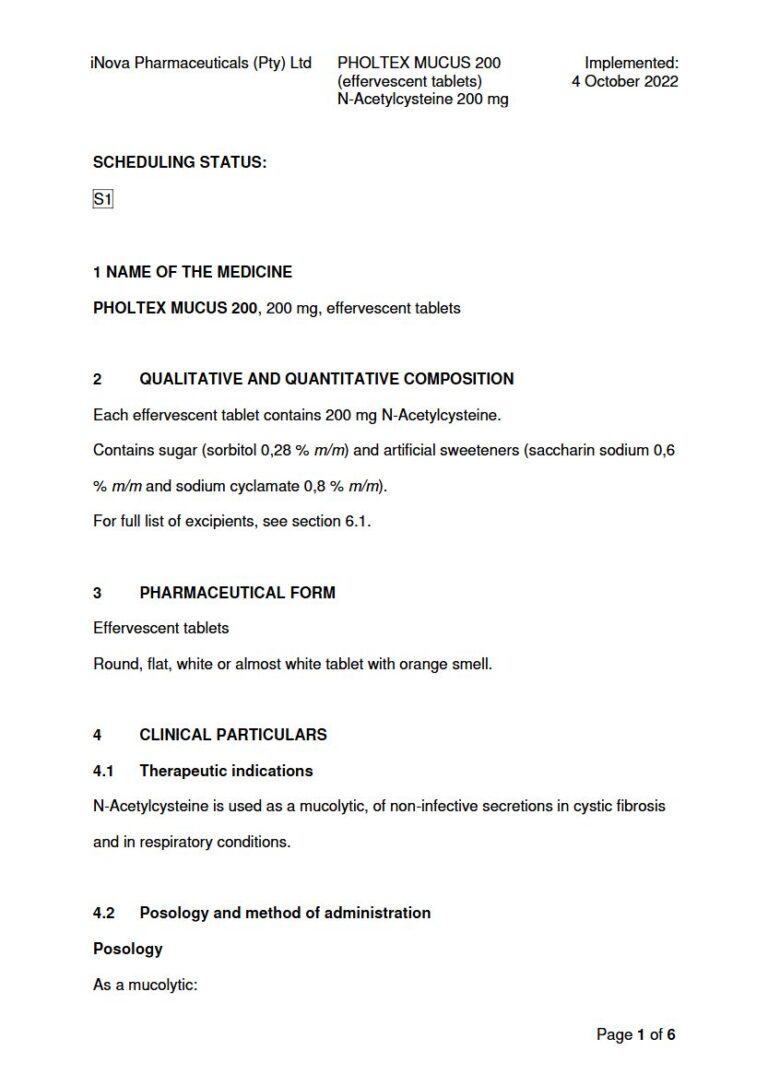
Pholtex Mucus 200 200 mg Effervescent tablets
PDF Leaflet Revision Date: 4 October 2022
Clinical Summary
Quick overview from the medicine insert
Indication
Mucolytic for non-infective secretions in cystic fibrosis and respiratory conditions.
Dosage (summary)
Adults: 200 mg three times daily; Children: Under 2 years: 200 mg once daily, 2-6 years: 200 mg twice daily.
Special Populations
- Asthmatic patients
- History of peptic ulceration
- Sorbitol intolerance
Pregnancy & Breastfeeding
Safety during pregnancy and lactation not established; not advised for breastfeeding women.
Contraindications
- Hypersensitivity to N-Acetylcysteine or ingredients
Common side effects
- Headache
- Drowsiness
- Nausea
- Vomiting
- Bronchospasm
Counselling Points
- Dissolve tablet in water before use
- Report any adverse reactions
Serious warnings
- Use with caution in asthmatic patients
- May disrupt gastric mucosal barrier
Important Disclaimer
The Pholtex Mucus 200 200 mg Effervescent tablets professional information leaflet below is the property of Inova Pharmaceuticals and is provided on Medinsert exactly as issued, with no.. alterations or editorial changes. We make every effort to keep content current by updating documents as soon as new versions become available. Medinsert serves as a trusted access point for healthcare professionals, but does not replace official sources or clinical judgement. For more details, please read our full disclaimer. read more>>
 Healthcare Professionals Only
This content is for registered healthcare professionals
Sign in or create a free account to read the full package insert.
Free for HPCSA-registered professionals. Powered by Medinsert.
Clinical Particulars
Section 4 of the official insert — extracted exactly as issued, no alterations
4.1 Therapeutic indications
N-Acetylcysteine is used as a mucolytic, of non-infective secretions in cystic fibrosis and in respiratory conditions.
4.2 Posology and method of administration
Posology
As a mucolytic:
Adults: 200 mg (1 effervescent tablet) three times daily.
Paediatric population
Children: Under 2 years: 200 mg (1 effervescent tablet) once daily.
2 u2013 6 years: 200 mg (1 effervescent tablet) twice daily.
Method of administration
The effervescent tablets should be dissolved in a glass of water before use.
4.3 Contraindications
Hypersensitivity to N-Acetylcysteine or any of the other ingredients (See section 6.1). Safety during pregnancy and lactation has not been established. (See section 4.6). It is not known whether N-Acetylcysteine is excreted in human milk. It is therefore not advised to administer PHOLTEX MUCUS 200 to breastfeeding women. (See section 4.6).
4.4 Special warnings and precautions for use
N-Acetylcysteine should be used with caution in asthmatic patients and since mucolytics may disrupt the gastric mucosal barrier, it should be used with caution in patients with a history of peptic ulceration. Patients with the rare hereditary condition of sorbitol intolerance should not take PHOLTEX MUCUS 200.
4.5 Interaction with other medicines and other forms of interaction
No data on interaction studies are available.
4.6 Fertility, pregnancy and lactation
Safety during pregnancy and lactation has not been established. It is not known whether N-Acetylcysteine is excreted in human milk. It is therefore not advised to administer PHOLTEX MUCUS 200 to breastfeeding women. (See section 4.3).
4.7 Effects on ability to drive and use machines
PHOLTEX MUCUS 200 does not impair your ability to drive or operate machinery, however caution should be exercised if drowsiness is experienced.
4.8 Undesirable effects
Nervous system disorders:
Less frequent: Headache, drowsiness.
Gastro-intestinal disorders:
Less frequent: Nausea, vomiting, stomatitis.
Respiratory, thoracic and mediastinal disorders:
Less frequent: Bronchospasm, rhinorrhoea.
Ear and labyrinth disorders:
Less frequent: Tinnitus.
Skin and subcutaneous tissue disorders:
Less frequent: Allergic dermatitis (skin rash or hives), urticaria.
Immune system disorders:
Less frequent: Anaphylaxis.
Other:
Less frequent: Chills and fever.
Reporting of suspected adverse reactions
Reporting suspected adverse reactions after authorisation of the medicine is important. It allows continued monitoring of the benefit/risk balance of the medicine. Health care providers are asked to report any suspected adverse reactions to SAHPRA via the u201c6.04 Adverse Drug Reactions Reporting Formu201d, found online under SAHPRAu2019s publications: https://www.sahpra.org.za/Publications/Index/8
4.9 Overdose
See undesirable effects (section 4.8). Treatment should be symptomatic and supportive.
