
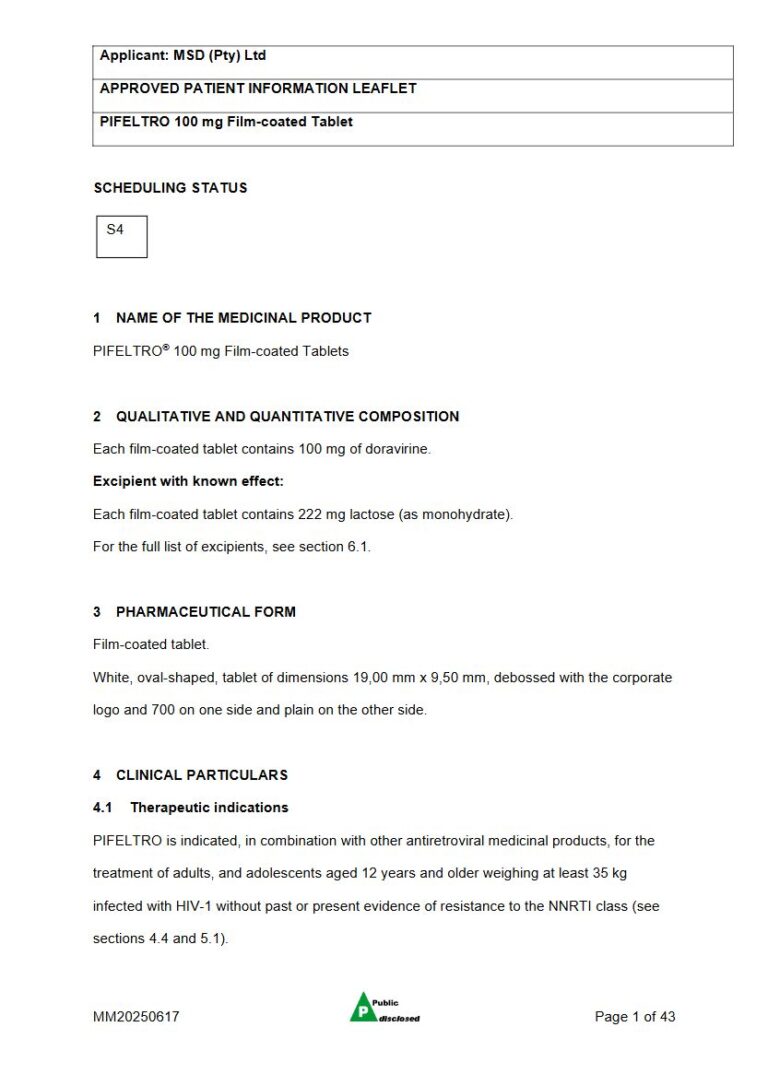
Pifeltro 100 Mg Film-Coated Tablets
PDF Leaflet Revision Date: 17 June 2025
Clinical Summary
Quick overview from the medicine insert
Indication
Treatment of HIV-1 in adults and adolescents aged 12 years and older without NNRTI resistance.
Dosage (summary)
100 mg orally once daily; adjust to twice daily with rifabutin or moderate CYP3A inducers.
Special Populations
- Elderly
- Renal impairment
- Hepatic impairment
Pregnancy & Breastfeeding
Use during pregnancy is not recommended; avoid breastfeeding due to potential HIV transmission.
Key Drug Interactions
- Strong CYP3A inducers
- Rifabutin
- St. John's wort
Contraindications
- Hypersensitivity to doravirine or excipients
- Co-administration with strong CYP3A inducers
Common side effects
- Nausea
- Headache
- Fatigue
- Rash
Counselling Points
- Take once daily with or without food
- Do not double dose if missed
- Report any unusual mood changes or rash
Serious warnings
- Risk of immune reactivation syndrome
- Caution in severe hepatic impairment
Important Disclaimer
The Pifeltro 100 Mg Film-Coated Tablets professional information leaflet below is the property of Msd and is provided on Medinsert exactly as issued, with no.. alterations or editorial changes. We make every effort to keep content current by updating documents as soon as new versions become available. Medinsert serves as a trusted access point for healthcare professionals, but does not replace official sources or clinical judgement. For more details, please read our full disclaimer. read more>>
 Healthcare Professionals Only
This content is for registered healthcare professionals
Sign in or create a free account to read the full package insert.
Free for HPCSA-registered professionals. Powered by Medinsert.
Clinical Particulars
Section 4 of the official insert — extracted exactly as issued, no alterations
4.1 Therapeutic indications
PIFELTRO is indicated, in combination with other antiretroviral medicinal products, for the treatment of adults, and adolescents aged 12 years and older weighing at least 35 kg infected with HIV-1 without past or present evidence of resistance to the NNRTI class (see sections 4.4 and 5.1).
4.2 Posology and method of administration
Therapy should be initiated by a medical practioner experienced in the management of HIV infection.
Posology
The recommended dose is one 100 mg tablet taken orally once daily with or without food.
Dose adjustment
If PIFELTRO is co-administered with rifabutin, one 100 mg tablet of PIFELTRO should be taken twice daily (approximately 12 hours apart) (see section 4.5). Co-administration of doravirine with other moderate CYP3A inducers has not been evaluated, but decreased doravirine concentrations are expected. If co-administration with other moderate CYP3A inducers (e.g. dabrafenib, lesinurad, bosentan, thioridazine, nafcillin, modafinil, telotristat ethyl) cannot be avoided, one 100 mg tablet of PIFELTRO should be taken twice daily (approximately 12 hours apart).
Missed dose
If the patient misses a dose of PIFELTRO within 12 hours of the time it is usually taken, the patient should take as soon as possible and resume the normal dosing schedule. If a patient misses a dose by more than 12 hours, the patient should not take the missed dose and instead take the next dose at the regularly scheduled time. The patient should not take 2 doses at one time.
Special populations
Elderly
No dose adjustment of doravirine is needed in elderly patients (see section 5.2).
Renal impairment
No dose adjustment of doravirine is required in patients with mild, moderate or severe renal impairment. Doravirine has not been studied in patients with end-stage renal disease and has not been studied in dialysis patients (see section 5.2).
Hepatic impairment
No dose adjustment of doravirine is required in patients with mild (Child-Pugh Class A) or moderate (Child-Pugh Class B) hepatic impairment. Doravirine has not been studied in patients with severe hepatic impairment (Child-Pugh Class C). It is not known whether the exposure to doravirine will increase in patients with severe hepatic impairment. Therefore, caution is advised when doravirine is administered to patients with severe hepatic impairment (see section 5.2).
Paediatric population
Safety and efficacy of PIFELTRO in children aged less than 12 years or weighing less than 35 kg have not been established.
Method of administration
PIFELTRO must be taken orally, once daily with or without food and swallowed whole (see section 5.2).
4.3 Contraindications
Hypersensitivity to the active substance or to any of the excipients listed in section 6.1. Co-administration with medicinal products that are strong cytochrome P450 (CYP)3A enzyme inducers is contraindicated as significant decreases in doravirine plasma concentrations are expected to occur, which may decrease the effectiveness of PIFELTRO (see sections 4.4 and 4.5). These medicinal products include, but are not limited, to the following:
- carbamazepine, oxcarbazepine, phenobarbitone, phenytoin
- rifampicin, rifapentine
- St. Johnu2019s wort (Hypericum perforatum)
- mitotane
- enzalutamide
- lumacaftor.
4.4 Special warnings and precautions for use
While effective viral suppression with antiretroviral therapy has been proven to substantially reduce the risk of sexual transmission of HIV-1, a residual risk cannot be excluded. Precautions to prevent transmission should be taken in accordance with national guidelines.
NNRTI substitutions and use of doravirine
Doravirine has not been evaluated in patients with previous virologic failure to any other antiretroviral therapy. NNRTI-associated mutations detected at screening were part of exclusion criteria in the Phase 2b/3-studies. A breakpoint for a reduction in susceptibility, yielded by various NNRTI substitutions, that is associated with a reduction in clinical efficacy has not been established (see section 5.1). There is not sufficient clinical evidence to support the use of doravirine in patients infected with HIV-1 with evidence of resistance to the NNRTI class.
Use with CYP3A inducers
Caution should be given to prescribing doravirine with medicinal products that may reduce the exposure of doravirine (see sections 4.3 and 4.5).
Immune reactivation syndrome
Immune reactivation syndrome has been reported in patients treated with combination antiretroviral therapy. During the initial phase of combination antiretroviral treatment, patients whose immune system responds may develop an inflammatory response to indolent or residual opportunistic infections (such as Mycobacterium avium infection, cytomegalovirus, Pneumocystis jirovecii pneumonia [PJP] or tuberculosis), which may necessitate further evaluation and treatment. Autoimmune disorders (such as Gravesu2019 disease, polymyositis and Guillain-Barru00e9 syndrome) have also been reported to occur in the setting of immune reactivation; however, the time to onset is more variable and can occur many months after initiation of treatment.
Lactose
The tablets contain lactose monohydrate. Patients with rare hereditary problems of galactose intolerance, total lactase deficiency or glucose-galactose malabsorption should not take PIFELTRO.
4.5 Interaction with other medicines and other forms of interaction
Effects of other medicinal products on doravirine
Doravirine is primarily metabolised by CYP3A and medicinal products that induce or inhibit CYP3A are expected to affect the clearance of doravirine (see section 5.2). Doravirine should not be co-administered with medicinal products that are strong CYP3A enzyme inducers as significant decreases in doravirine plasma concentrations are expected to occur, which may decrease the effectiveness of doravirine (see sections 4.3 and 5.2).
Co-administration with the moderate CYP3A inducer rifabutin decreased doravirine concentrations (see Table 1). When doravirine is co-administered with rifabutin, the doravirine dose should be increased to 100 mg twice daily (the doses should be taken approximately 12 hours apart) (see section 4.2).
Co-administration of doravirine with other moderate CYP3A inducers has not been evaluated, but decreased doravirine concentrations are expected. If co-administration with other moderate CYP3A inducers (e.g. dabrafenib, lesinurad, bosentan, thioridazine, nafcillin, modafinil, telotristat ethyl) cannot be avoided, the doravirine dose should be increased to 100 mg twice daily (the doses should be taken approximately 12 hours apart) (see section 4.2).
Co-administration of doravirine and medicinal products that are inhibitors of CYP3A may result in increased plasma concentrations of doravirine. However, no dose adjustment is needed when doravirine is co-administered with CYP3A inhibitors as the plasma levels remain within therapeutically acceptable levels.
Effects of doravirine on other medicinal products
Doravirine at a dose of 100 mg once daily is not likely to have a clinically relevant effect on the plasma concentrations of medicinal products that are dependent on transport proteins for absorption and/or elimination or that are metabolised by CYP enzymes. However, co-administration of doravirine and the sensitive CYP3A substrate midazolam resulted in a 18 % decrease in midazolam exposure, suggesting that doravirine may be a weak CYP3A inducer. Therefore caution should be used when co-administering doravirine with medicinal products that are sensitive CYP3A substrates that also have a narrow therapeutic window (e.g. tacrolimus and sirolimus).
Interactions table
Table 1 shows the established and other potential medicinal product interactions with doravirine but is not all inclusive (increase is indicated as u2191 , decrease is indicated as u2193 and no change as u2194 ).
4.6 Fertility, pregnancy and lactation
Pregnancy
There are no or limited amount of data from the use of doravirine in pregnant women. Antiretroviral pregnancy registry To monitor maternal-foetal outcomes in patients exposed to antiretroviral medicinal products while pregnant, an Antiretroviral Pregnancy Registry has been established. Medical Practitioner are encouraged to register patients in this registry. Animal studies with doravirine do not indicate direct or indirect harmful effects with respect to reproductive toxicity (see section 5.3). As a precautionary measure, it is preferable to avoid the use of doravirine during pregnancy.
Breastfeeding
It is unknown whether doravirine is excreted in human milk. Available pharmacodynamic/toxicological data in animals have shown excretion of doravirine in milk (see section 5.3). Because of the potential for HIV-1 transmission and the potential for serious adverse reactions in breastfeeding infants, mothers should be instructed not to breastfeed if they are receiving PIFELTRO.
Fertility
No human data on the effect of doravirine on fertility are available. Animal studies do not indicate harmful effects of doravirine on fertility at exposure levels higher than the exposure in humans at the recommended clinical dose (see section 5.3).
4.7 Effects on ability to drive and use machines
PIFELTRO may have a minor influence on the ability to drive or use machines. Patients should be informed that fatigue, dizziness and somnolence have been reported during treatment with doravirine (see section 4.8). This should be considered when assessing a patient's ability to drive or operate machinery.
4.8 Undesirable effects
Summary of the safety profile
The most frequently reported adverse reactions considered possibly or probably related to doravirine were nausea (4 %) and headache (3 %).
Tabulated summary of adverse reactions
The adverse reactions with suspected (at least possible) relationship to treatment are listed below by body system organ class and frequency. Within each frequency grouping, undesirable effects are presented in order of decreasing seriousness. Frequencies are defined as very common (u2265 1/10), common (u2265 1/100 to < 1/10), uncommon (u2265 1/1 000 to < 1/100) or rare (u2265 1/10 000 to < 1/1 000).
Table 2: Tabulated summary of adverse reactions associated with doravirine used in combination with other antiretrovirals
| Frequency | Adverse reactions |
|---|---|
| Infections and infestations | Rare rash pustular |
| Metabolism and nutrition disorders | Uncommon hypophosphatemia |
| Rare hypomagnesaemia | |
| Psychiatric disorders | Common abnormal dreams, insomnia |
| Uncommon nightmare, depression, anxiety, irritability, confusional state, suicidal ideation | |
| Rare aggression, hallucination, adjustment disorder, mood altered, somnambulism | |
| Nervous system disorders | Common headache, dizziness, somnolence |
| Uncommon disturbance in attention, memory impairment, paraesthesia, hypertonia, poor quality sleep | |
| Vascular disorders | Uncommon hypertension |
| Respiratory, thoracic and mediastinal disorders | Rare dyspnoea, tonsillar hypertrophy |
| Gastrointestinal disorders | Common nausea, diarrhoea, flatulence, abdominal pain, vomiting |
| Uncommon constipation, abdominal discomfort, abdominal distension, dyspepsia, faeces soft, gastrointestinal motility disorder | |
| Rare rectal tenesmus | |
| Skin and subcutaneous tissue disorders | Common rash |
| Uncommon pruritus | |
| Rare dermatitis allergic, rosacea | |
| Musculoskeletal and connective tissue disorders | Uncommon myalgia, arthralgia |
| Rare musculoskeletal pain | |
| Renal and urinary disorders | Rare acute kidney injury, renal disorder, calculus urinary, nephrolithiasis |
| General disorders and administration site conditions | Common fatigue |
| Uncommon asthenia, malaise | |
| Rare chest pain, chills, pain, thirst | |
| Investigations | Common alanine aminotransferase increased |
| Uncommon lipase increased, aspartate aminotransferase increased, amylase increased, haemoglobin decreased | |
| Rare blood creatine phosphokinase increased |
Paediatric population
The safety of doravirine as a component of doravirine/lamivudine/tenofovir disoproxil was evaluated in 45 HIV-1 infected virologically suppressed or treatment-nau00efve paediatric patients 12 to less than 18 years of age through Week 48 in an open-label trial (IMPAACT 2014 (Protocol 027)). The safety profile in paediatric subjects was similar to that in adults.
4.9 Overdose
There is no information on potential acute symptoms and signs of overdose with doravirine.
