
Proglicem 25 mg Capsules
PDF Leaflet Revision Date: 28 October 2025
Clinical Summary
Quick overview from the medicine insert
Indication
Management of intractable hypoglycaemia.
Dosage (summary)
Adults: 3-8 mg/kg divided into 2-3 doses every 8-12 hours; starting at 3 mg/kg/day.
Special Populations
- Infants
- Newborns
Pregnancy & Breastfeeding
Safety and efficacy not established.
Key Drug Interactions
- Warfarin
- Diphenylhydantoin
- Thiazides
Contraindications
- Functional hypoglycaemia
- Hypersensitivity to diazoxide
Common side effects
- Hyperglycaemia
- Fluid retention
- Dizziness
- Nausea
Counselling Points
- Monitor for signs of fluid retention
- Regular blood tests recommended
Serious warnings
- Monitor blood glucose and blood counts
- Risk of ketoacidosis
Important Disclaimer
The Proglicem 25 mg Capsules professional information leaflet below is the property of Msd and is provided on Medinsert exactly as issued, with no.. alterations or editorial changes. We make every effort to keep content current by updating documents as soon as new versions become available. Medinsert serves as a trusted access point for healthcare professionals, but does not replace official sources or clinical judgement. For more details, please read our full disclaimer. read more>>
 Healthcare Professionals Only
This content is for registered healthcare professionals
Sign in or create a free account to read the full package insert.
Free for HPCSA-registered professionals. Powered by Medinsert.
Clinical Particulars
Section 4 of the official insert — extracted exactly as issued, no alterations
4.1 Therapeutic indications
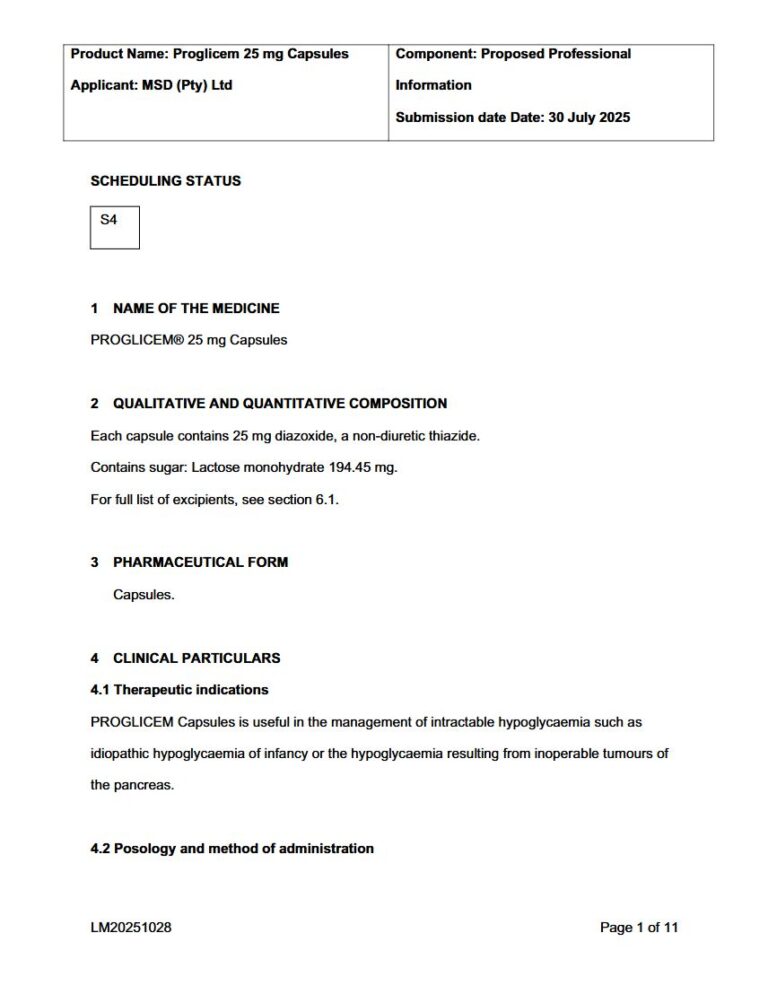
PROGLICEM Capsules is useful in the management of intractable hypoglycaemia such as idiopathic hypoglycaemia of infancy or the hypoglycaemia resulting from inoperable tumours of the pancreas.
4.2 Posology and method of administration
Patients should be under close clinical observation when treatment with PROGLICEM Capsules is initiated. Clinical response and blood glucose levels should be carefully monitored until the patient's condition has stabilised satisfactorily; in most instances this may be accomplished in several days. If administration of PROGLICEM Capsules is not effective after 2 or 3 weeks, the medicine should be discontinued.
Posology
Dosage must be individualised based on the severity of the hypoglycaemic condition, the blood glucose level and the clinical response of the patient. The dosage should be adjusted until the desired clinical and laboratory effects are produced with the least amount of drug.
Adults and children: The usual dose is 3 to 8 mg/kg divided into 2 or 3 equal doses every 8 or 12 hours. In certain instances, patients with refractory hypoglycaemia may require higher doses. The starting dosage is 3 mg/kg/day, divided into 3 equal doses every 8 hours. Thus, an average adult would receive a starting dosage of approximately 200 mg daily.
Special populations
Infants and newborns: The usual dosage is 8 to 15 mg/kg divided into 2 or 3 equal doses every 8 or 12 hours. An appropriate starting dose is 10 mg/kg/day, divided into 3 equal doses every 8 hours. Special care should be taken to assure accuracy of dosage in infants and young children.
Method of administration
For oral use
4.3 Contraindications
The use of PROGLICEM Capsules is contraindicated in patients with functional hypoglycaemia and in patients hypersensitive to diazoxide or any of the excipients listed in section 6.1 or to other thiazides (see section 4.4 and 4.5).
4.4 Special warnings and precautions for use
PROGLICEM Capsules should be used with care in patients with impaired cardiac or cerebral circulation. The antidiuretic property of PROGLICEM Capsules may lead to significant fluid retention, which in patients with compromised cardiac reserve, may precipitate congestive heart failure. Patients should be under close clinical observation when treated with PROGLICEM Capsules. During prolonged therapy, blood-glucose concentrations should be monitored and the blood should be examined regularly for signs of leucopenia and thrombocytopenia. Regular monitoring of urine for sugar and ketones is also recommended (see section 4.8). In children, bone and psychological maturation and growth should be regularly assessed.
The effects of PROGLICEM Capsules on the level of serum uric acid should be kept in mind. Blood tests should be conducted periodically (see section 4.8). Keto-acidosis and non-ketotic hyperosmolar coma have been reported in patients treated with recommended doses of PROGLICEM Capsules, usually during intercurrent illnesses. Prompt recognition and treatment are essential. Since plasma half-life of diazoxide is prolonged in patients with impaired renal function, a reduced dosage should be considered and serum electrolyte levels should be evaluated.
Lactose
Patients with rare hereditary problems of galactose intolerance, total lactase deficiency or glucose-galactose malabsorption should not take this medicine.
4.5 Interaction with other medicines and other forms of interaction
These potential interactions must be considered when administering PROGLICEM Capsules. Since diazoxide is highly bound to serum protein, it may displace other substances which are also protein-bound, such as bilirubin or warfarin, resulting in higher blood levels of these substances. Accordingly, anticoagulant dosage reduction may be required when administered with PROGLICEM Capsules. The possible displacement of bilirubin should be kept in mind, particularly when treating newborns with increased bilirubinaemia.
Medicine interaction has been reported for PROGLICEM Capsules and diphenylhydantoin and their concomitant administration may result in a loss of seizure control. Concomitant administration of thiazides or other commonly used potent diuretics may potentiate the hyperglycaemic and hyperuricaemic effects of PROGLICEM Capsules. In the presence of hypokalaemia, hyperglycaemic effects are also potentiated. Diazoxide induced hyperglycaemia is reversed by the administration of insulin and discontinuation of PROGLICEM Capsules. The inhibition of insulin release by PROGLICEM Capsules is antagonised by alpha-adrenergic blocking agents. The antihypertensive effect of other medicines may be enhanced by concurrent PROGLICEM Capsules.
4.6 Fertility, pregnancy and lactation
Safety and efficacy have not been established.
4.7 Effects on ability to drive and use machines
Certain side effects that have been reported with PROGLICEM Capsules may affect some patientsu2019 ability to drive or operate machinery. Individual responses to PROGLICEM Capsules may vary (see section 4.8).
4.8 Undesirable effects
Tabulated summary of adverse reactions
The table below lists the adverse reactions by system organ class and frequency using the following convention: Very common (u2265 1/10); common (u2265 1/100 to < 1/10); uncommon (u2265 1/1 000 to < 1/100); rare (u2265 1/10 000 to < 1/1 000); very rare (< 1/10 000) and not known (cannot be estimated from the available data).
System organ class Frequency Side effect Cardiac disorders Common Sodium and fluid retention, tachycardia, palpitations, increased levels of serum uric acid, hypotension Rare Chest pain Frequency not known Transient hypertension, pulmonary hypertension, pericardial effusion Metabolism and nutrition disorders Common Hyperglycaemia or glycosuria Frequency not known Diabetic ketoacidosis, hyperosmolar non-ketotic coma, gout Gastrointestinal disorders Common Anorexia, nausea, vomiting, abdominal pain, transient loss of taste Uncommon Diarrhoea Rare Ileus, acute pancreatitis Frequency not known Pancreatic necrosis Blood and lymphatic system disorders Common Thrombocytopenia, with or without purpura, neutropenia Frequency not known Eosinophilia, decreased haemoglobin/haematocrit, excessive bleeding, decreased IgG, lymphadenopathy Investigations Frequency not known Increased serum AST, alkaline phosphatase, decreased creatinine clearance, decreased urinary output. Renal and urinary disorders Frequency not known Uraemia, nephrotic syndrome, haematuria, albuminuria, azotemia Psychiatric disorders Frequency not known Anxiety, insomnia Nervous system disorders Common Dizziness, headache, extrapyramidal signs, polyneuropathy, paraesthesia Skin and subcutaneous tissue disorders Common Hirsutism Frequency not known Pruritus, skin rash, loss of scalp hair Eye disorders Common Blurred vision Frequency not known Cataracts, subconjunctival haemorrhage, ring scotoma, diplopia, lacrimation Musculoskeletal and connective tissue disorders Frequency not known Osteoporosis General disorders and administration site conditions Frequency not known Fever, malaise Infections and infestations Frequency not known Herpes simplex Reproductive system and breast disorders Frequency not known Galactorrhoea Reporting of suspected adverse reactions Reporting suspected adverse reactions after authorisation of the medicine is important. It allows continued monitoring of the benefit/risk balance of the medicine. Health care providers are requested to report any suspected adverse drug reactions to SAHPRA via the Med Safety APP (Medsafety X SAHPRA) and eReporting platform (who-umc.org) found on SAHPRA website.
4.9 Overdose
An overdosage of PROGLICEM Capsules causes marked hyperglycaemia which may be associated with keto-acidosis. It will respond to prompt insulin administration and restoration of fluid and electrolyte balance. Because of the long half-life of this product, symptoms of overdosage require prolonged surveillance for periods up to 7 days, until the blood sugar level stabilises within the normal range. Successful lowering of diazoxide blood levels by peritoneal dialysis and by haemodialysis has been reported.
