
Potassium Chloride 15 %/100 mL Solution
PDF Leaflet Revision Date: 18 November 2024
Clinical Summary
Quick overview from the medicine insert
Indication
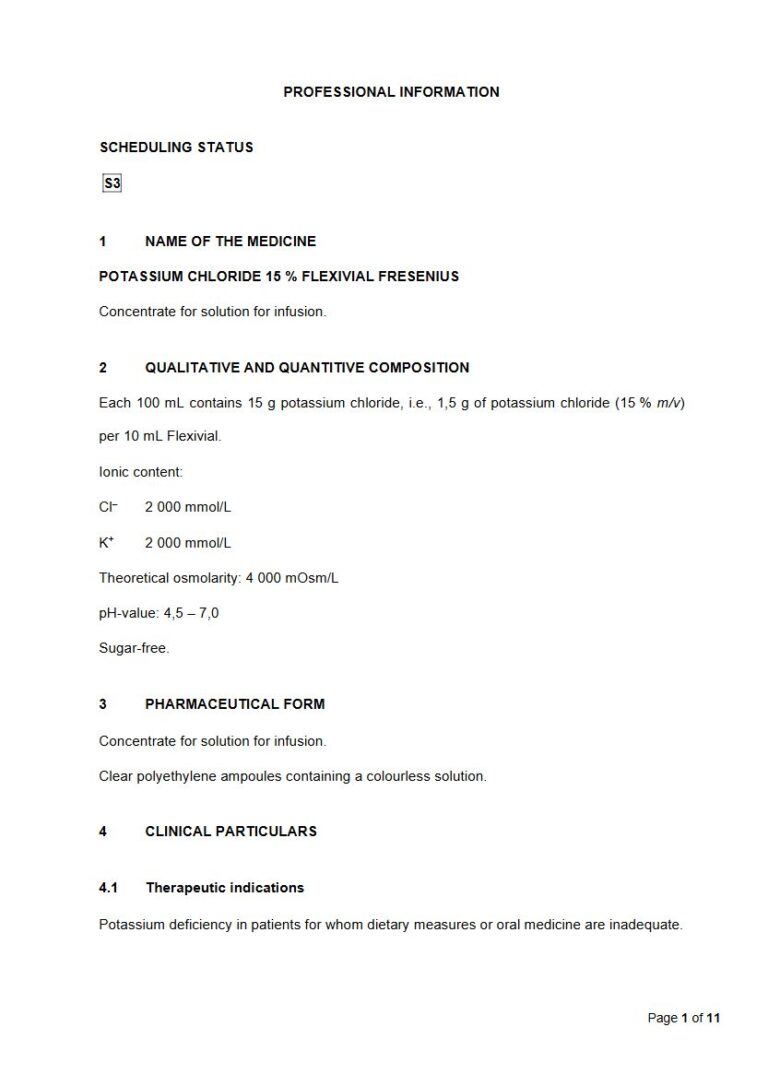
Potassium deficiency in patients for whom dietary measures or oral medicine are inadequate.
Dosage (summary)
IV infusion after dilution; max 150 mmol/day, 10 mmol/h safe rate.
Special Populations
- Renal impairment
Pregnancy & Breastfeeding
Use in pregnancy if clinically needed; excreted in breast milk, risk to infants possible.
Key Drug Interactions
- Potassium-sparing diuretics
- ACE inhibitors
- NSAIDs
Contraindications
- Hypersensitivity to potassium chloride
- Hyperkalaemia
Common side effects
- Hyperkalaemia
- Nausea
- Pain on injection
Counselling Points
- Monitor serum potassium levels regularly
- Infuse slowly, not exceeding 20 mmol/h
- Avoid potassium-rich foods during treatment
Serious warnings
- Must be diluted before IV infusion
- Risk of cardiac arrest with direct injection
Important Disclaimer
The Potassium Chloride 15 %/100 mL Solution professional information leaflet below is the property of Fresenius Kabi South Africa and is provided on Medinsert exactly as issued, with no.. alterations or editorial changes. We make every effort to keep content current by updating documents as soon as new versions become available. Medinsert serves as a trusted access point for healthcare professionals, but does not replace official sources or clinical judgement. For more details, please read our full disclaimer. read more>>
 Healthcare Professionals Only
This content is for registered healthcare professionals
Sign in or create a free account to read the full package insert.
Free for HPCSA-registered professionals. Powered by Medinsert.
Clinical Particulars
Section 4 of the official insert — extracted exactly as issued, no alterations
4.1 Therapeutic indications
Potassium deficiency in patients for whom dietary measures or oral medicine are inadequate.
4.2 Posology and method of administration
Posology
Paediatric population
The safety and efficacy of potassium chloride (as in POTASSIUM CHLORIDE 15 % FLEXIVIAL FRESENIUS) for paediatric patients has not been fully established.
Normal dose for adults: Administer intravenously only after dilution in a suitable solution, up to a maximum concentration of 3 g/L of potassium chloride (or 40 mmol of potassium). For therapy of severe hypokalaemia or diabetic ketoacidosis higher concentrations may be necessary; in this case, the infusion should be into a high blood flow vein and continuous ECG monitoring is advisable.
1 g of potassium chloride corresponds to 13,4 mmol or 524 mg of potassium. Dose is dependent on results of serum electrolyte levels and acid-base-state. The potassium deficit is to be calculated via the following formula:
Potassium deficit (mmol) = kg body weight x 0,2 x 2 x (4,5 mmol/L u2013 serum potassium) (The extracellular volume calculates from body weight in kg x 0,2.)
Normal daily intake is approximately 0,8 to 2 mmol of potassium per kilogram of body weight. The infusion rate should not be fast, a rate of 10 mmol/h is normally considered safe. As a general rule, the rate should never be higher than 20 mmol/h.
The maximum dose for adults should not exceed 150 mmol per day.
Patients with renal impairment
In patients with renal impairment the dose should be reduced.
Method of administration
Intravenous infusion after dilution. The administration via an infusion pump is recommended, especially for solutions with higher concentrations.
4.3 Contraindications
- Hypersensitivity to potassium chloride, or to any of the excipients of POTASSIUM CHLORIDE 15 % FLEXIVIAL FRESENIUS listed in section 6.1.
- Hyperkalaemia.
4.4 Special warnings and precautions for use
POTASSIUM CHLORIDE 15 % FLEXIVIAL FRESENIUS MAY ONLY BE INFUSED AND SHOULD NEVER BE INJECTED DIRECTLY INTO A VEIN. THE SOLUTION MUST NOT BE INJECTED UNLESS DILUTED.
When injected intravenously, an excess of potassium ions produces depression of the heart and may cause cardiac arrest. Poisoning may occur from the intravenous injection of even small doses of potassium ions when excretion is delayed, as in the presence of renal insufficiency.
Direct injection of POTASSIUM CHLORIDE 15 % FLEXIVIAL FRESENIUS concentrate without appropriate dilution may cause instant death.
The administration should be slow (usually 10 mmol/h, not exceeding 20 mmol/h; see section 4.2).
Since adequate urine flow must be ensured, urine flow should be monitored.
Care should be taken in patients with uncompensated cardiac insufficiency, in patients under treatment with digitalis and in patients with severe or complete heart block.
Serum electrolyte levels and acid-base status of the patient should be monitored, and the dose should be adjusted to the needs of the patient. During treatment, plasma potassium concentration must be measured at regular intervals to avoid the development of hyperkalaemia, especially in patients with renal impairment and other conditions often related to hyperkalaemia. ECG monitoring facilities should be available, and patients frequently monitored.
Care should be taken in conditions frequently associated with hyperkalaemia like adrenal insufficiency (Morbus Addison), decreased renal function (renal insufficiency), post-operative oliguria, shock with haemolytic reactions and/or dehydration, metabolic acidosis, patients treated with potassium-sparing diuretics, hyperchloraemia, Gamstorp episodic adynamy, sickle cell anaemia.
Attention should be paid to intravenous administration since extravasation can cause necrotic tissue damages.
Initial potassium replacement therapy should not involve glucose infusions, because glucose may cause a further decrease in the plasma potassium concentration.
Closely monitor patients with cardiac diseases, acute dehydration, heat cramps, extensive tissue destruction as occurs with severe burns, and elderly patients since renal function may be impaired or other conditions predisposing to hyperkalaemia may be present.
4.5 Interaction with other medicines and other forms of interaction
Combinations not recommended (except in cases of severe hypokalaemia):
- Potassium-sparing diuretics (single or combined) such as: amiloride, spironolactone, triamterene, potassium canrenoate, eplerenone; risk of potentially lethal hyperkalaemia, particularly in patients with renal impairment (addition of hyperkalaemic effects).
- Angiotensin converting enzyme inhibitors (ACE), angiotensin II receptor antagonists, non-steroidal anti-inflammatory drugs (NSAIDs), ciclosporin, tacrolimus, suxamethonium: potentially lethal hyperkalaemia, particularly in patients with renal insufficiency (addition of hyperkalaemic effects).
- Blood products, penicillin potassium salts: potential risk of hyperkalaemia due to the amount of potassium present in these products.
Combinations possible with special precautions of use:
- Quinidine: potassium can increase the anti-arrhythmic effects of quinidine.
- Thiazides, adrenocorticoids, glucocorticoids, mineralocorticoids: Effects of the potassium supplement may be decreased.
- Digoxin: hyperkalaemia can be dangerous in digitalized patients.
- Exchange resins: the serum levels of potassium are reduced by sodium replacement of the potassium.
4.6 Fertility, pregnancy and lactation
Women of childbearing potential
No information available
Pregnancy
There are no or limited amount of data from the use of potassium chloride in pregnant women. The use of POTASSIUM CHLORIDE 15 % FLEXIVIAL FRESENIUS concentrate for solution for infusion may be considered during pregnancy if clinically needed.
Breastfeeding
Potassium chloride is excreted in human milk to such an extent that effects on the breastfed newborn/infants are likely. A risk to the newborns/infants cannot be excluded. A decision must be made whether to discontinue breastfeeding or to discontinue/abstain from POTASSIUM CHLORIDE 15 % FLEXIVIAL FRESENIUS concentrate for solution for infusion considering the benefit of breastfeeding for the child and the benefit of therapy for the woman.
Fertility
No information available.
4.7 Effects on ability to drive and use machines.
Potassium Chloride Fresenius 15 % u201cFlexivialu201d should not affect the ability to drive; no data is available.
4.8 Undesirable effects
Excessive intake of potassium may cause hyperkalaemia which may cause neuromuscular and cardiac disorders especially dysrhythmias, and even cardiac arrest may occur. POTASSIUM CHLORIDE 15 % FLEXIVIAL FRESENIUS should be given slowly as high blood concentrations may affect cardiac function.
Further undesirable effects, frequency unknown:
Metabolism and nutrition disorders:
- acidosis,
- hyperchloraemia.
Vascular disorders:
- venous thrombosis.
General disorders and administration site conditions:
- nausea,
- pain on injection,
- necrosis in case of extravasation,
- phlebitis in case of too high local concentrations.
Reporting of suspected adverse reactions
Reporting suspected adverse reactions after authorisation of the medicine is important. It allows continued monitoring of the benefit/risk balance of the medicine. Healthcare providers are requested to report any suspected adverse drug reactions to SAHPRA via the Med Safety APP (Medsafety X SAHPRA) and eReporting platform (who-umc.org) found on SAHPRA website. Healthcare providers are asked to report any suspected adverse drug reactions to the Holder of the Certificate of Registration at the following email address: [email protected] and to the relevant medicineu2019s regulatory authority in the country where the product is marketed.
4.9 Overdose
Overdose causes hyperkalaemia which can produce ECG abnormalities, bradycardia, ventricular fibrillation, other dysrhythmias up to cardiac arrest, confusion, tiredness, diarrhoea, dysphagia, paraesthesia of the extremities, respiratory difficulty, skeletal muscles paralysis and death.
When any of these appear, immediately discontinue the treatment and avoid any potassium containing food and potassium-sparing diuretics.
In cases of severe hyperkalaemia (over 8 mmol K+ /L of plasma) administer IV dextrose (10 to 20 %) with 10 units of insulin for each 50 g of glucose. Use sodium bicarbonate via IV to correct acidosis. Monitor continuously via ECG. If P-wave is absent, administer calcium gluconate 10 % (10 - 20 mL via IV).
In order to remove potassium from the body oral sulphonated sodium polystyrene or retention enemas can be used. Haemodialysis or peritoneal dialysis can also be used.
