
Prevenar 20 20 mg Suspension for injection.
PDF Leaflet Revision Date: 22 July 2025
Clinical Summary
Quick overview from the medicine insert
Indication
Active immunisation against pneumococcal disease in individuals from 6 weeks of age.
Dosage (summary)
0.5 mL for adults and children; specific schedules for infants and children under 5 years.
Special Populations
- Immunocompromised
- Preterm infants
Pregnancy & Breastfeeding
Use in pregnancy only if benefits outweigh risks; unknown if excreted in breast milk.
Key Drug Interactions
- Influenza vaccine
- COVID-19 mRNA vaccine
Contraindications
- Hypersensitivity to components
Common side effects
- Irritability
- Drowsiness
- Pain at injection site
- Decreased appetite
- Fever
Counselling Points
- Monitor for allergic reactions post-vaccination
- Complete vaccination series as recommended
Serious warnings
- Risk of anaphylaxis
- Postpone vaccination during acute severe febrile illness
Important Disclaimer
The Prevenar 20 20 mg Suspension for injection. professional information leaflet below is the property of Pfizer Laboratories and is provided on Medinsert exactly as issued, with no.. alterations or editorial changes. We make every effort to keep content current by updating documents as soon as new versions become available. Medinsert serves as a trusted access point for healthcare professionals, but does not replace official sources or clinical judgement. For more details, please read our full disclaimer. read more>>
 Healthcare Professionals Only
This content is for registered healthcare professionals
Sign in or create a free account to read the full package insert.
Free for HPCSA-registered professionals. Powered by Medinsert.
Clinical Particulars
Section 4 of the official insert — extracted exactly as issued, no alterations
4.1 Therapeutic indications
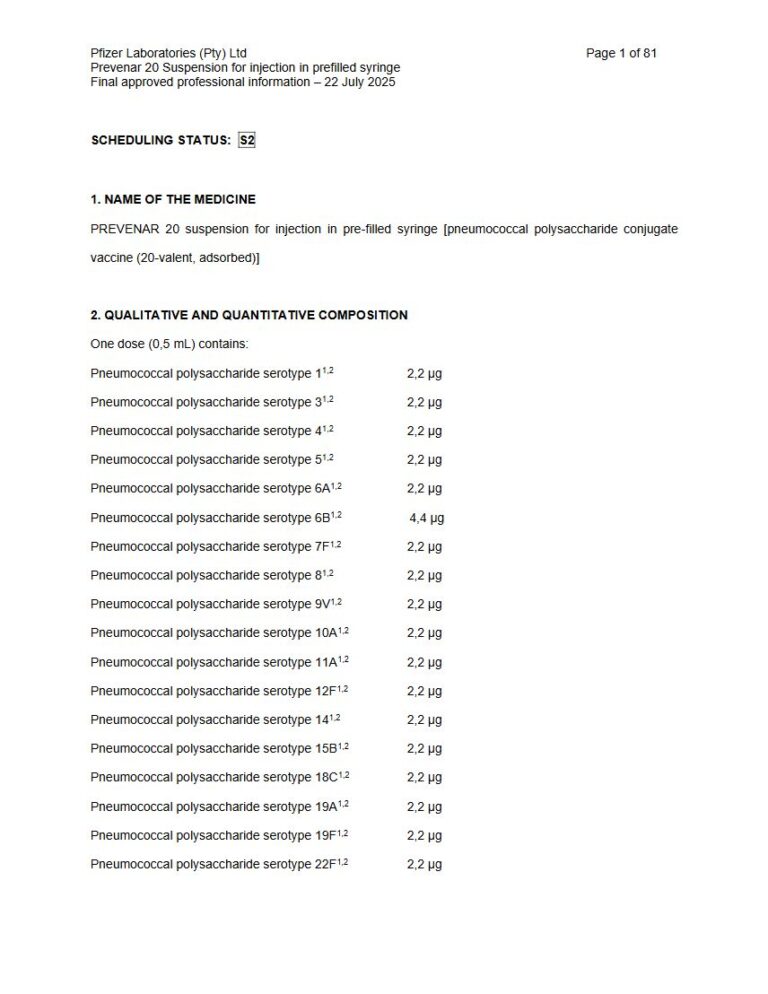
Active immunisation for the prevention of pneumococcal disease caused by Streptococcus pneumoniae serotypes 1, 3, 4, 5, 6A, 6B, 7F, 8, 9V, 10A, 11A, 12F, 14, 15B, 18C, 19A, 19F, 22F, 23F, and 33F in individuals from 6 weeks of age and older. PREVENAR 20 may not prevent disease caused by S. pneumoniae serotypes that are not contained in the vaccine. PREVENAR 20 should be used in accordance with official recommendations.
4.2 Posology and method of administration
Posology
The safety and efficacy of PREVENAR 20 in infants below 6 weeks of age have not been established. No data are available.
Infants and children 6 weeks to less than 5 years of age
It is recommended that infants who receive a first dose of PREVENAR 20 complete the vaccination course with PREVENAR 20.
Vaccination schedule in infants and children 6 weeks to 15 months of age
3-dose series (two-dose primary series followed by a booster dose)
The recommended immunisation series for PREVENAR 20, given as part of a routine infant immunisation program, consists of three doses, each of 0,5 mL. The first dose is usually given at 2 months of age, with a second dose 2 months later. The first dose may be given as early as 6 weeks of age. The third (booster) dose is recommended between 11 and 15 months of age (see section 5.1).
4-dose series (three-dose primary series followed by a booster dose)
PREVENAR 20 may be given as a 4-dose series, each of 0,5 mL. The primary infant series consists of three doses, with the first dose usually given at 2 months of age and with an interval of at least 4 weeks between doses. The first dose may be given as early as 6 weeks of age. The fourth (booster) dose is recommended between 11 and 15 months of age (see section 5.1).
Preterm infants (less than 37 weeks of gestation)
The recommended immunisation series for PREVENAR 20 consists of four doses, each of 0,5 mL. The primary infant series consists of three doses, with the first dose given at 2 months of age and with an interval of at least 4 weeks between doses. The first dose may be given as early as 6 weeks of age. The fourth (booster) dose is recommended between 11 and 15 months of age (see sections 4.4 and 5.1).
Vaccination schedule for infants and children less than 15 months of age transitioning from another pneumococcal conjugate vaccine
Prior vaccination with another pneumococcal conjugate vaccine
Infants and children who have begun immunisation with another pneumococcal conjugate vaccine may complete immunisation by transitioning to PREVENAR 20 at any point in the schedule.
Catch-up vaccination schedule for infants and children 7 months to less than 18 years of age
Unvaccinated infants 7 to less than 12 months of age
Two doses, each of 0,5 mL, with an interval of at least 4 weeks between doses. A third dose is recommended in the second year of life.
Unvaccinated children 12 to less than 24 months of age
Two doses, each of 0,5 mL, with an interval of at least 8 weeks between doses.
Unvaccinated children 2 to less than 5 years of age
One single dose of 0,5 mL.
Children 15 months to less than 5 years of age previously vaccinated with a pneumococcal conjugate vaccine
One single dose (0,5 mL). If a previous pneumococcal conjugate vaccine was administered, at least 8 weeks should elapse before administering PREVENAR 20 (see section 5.1).
Children 5 to less than 18 years of age regardless of prior pneumococcal conjugate vaccination
One single dose (0,5 mL). If a previous pneumococcal conjugate vaccine was administered, at least 8 weeks should elapse before administering PREVENAR 20 (see section 5.1).
Vaccination schedule for individuals 18 years of age and older
Individuals 18 years of age and older
PREVENAR 20 is to be administered as a single dose to individuals 18 years of age and older. The need for revaccination with a subsequent dose of PREVENAR 20 has not been established. No data on sequential vaccination with other pneumococcal vaccines or a booster dose are available for PREVENAR 20.
Based on the clinical experience with Prevenar 13 (a pneumococcal conjugate vaccine consisting of 13 polysaccharide conjugates that are also in PREVENAR 20), if the use of 23-valent pneumococcal polysaccharide vaccine (Pneumovax 23 [PPSV23]) is considered appropriate, PREVENAR 20 should be given first (see section 5.1).
Special populations
There are no data with PREVENAR 20 in special populations. However, safety and immunogenicity studies of Prevenar 13 have been conducted in adults and children at higher risk of pneumococcal infection including immunocompromised adults and children with human immunodeficiency virus (HIV) infection or haematopoietic stem cell transplant (HSCT), and children with sickle cell disease (SCD); these are relevant to PREVENAR 20, since the vaccines are manufactured and formulated similarly and contain 13 of the same polysaccharide conjugates.
Individuals at higher risk of pneumococcal infection, including those previously vaccinated with 1 or more doses of PPSV23, were recommended to receive at least 1 dose of Prevenar 13. In individuals with a HSCT, the recommended immunisation series with Prevenar 13 consisted of 4 doses of 0,5 mL each. The primary series consisted of 3 doses, with the first dose given 3 to 6 months after HSCT and with an interval of at least 4 weeks between doses. A booster dose was recommended 6 months after the third dose (see section 5.1).
The recommended dosing of Prevenar 13 may be considered in guiding vaccination with PREVENAR 20 in high-risk populations. For immune responses to pneumococcal vaccines in immunocompromised individuals, see section 4.4. The use of PREVENAR 20 in special populations should be guided by official recommendations.
Method of administration
For intramuscular injection only. Each vaccine is for single use in one patient only. Discard any residue. PREVENAR 20 should be administered as soon as possible after being removed from refrigeration.
The dose (0,5 mL) of PREVENAR 20 should be administered intramuscularly preferably in the anterolateral aspect of the thigh (vastus lateralis muscle) in infants or the deltoid muscle of the upper arm in children and adults, with care to avoid injection into or near nerves and blood vessels. The vaccine should not be injected in the gluteal area. Do not inject PREVENAR 20 intravascularly. For instructions on the preparation of the vaccine for administration, see section 6.6.
4.3 Contraindications
Hypersensitivity to the active substances, to any of the excipients listed in section 6.1, or to diphtheria toxoid.
4.4 Special warnings and precautions for use
Traceability
In order to improve the traceability of biological medicines, the name and the batch number of the administered vaccine should be clearly recorded.
Hypersensitivity
As with all injectable vaccines, appropriate medical treatment and supervision must always be readily available in case of a rare anaphylactic reaction following the administration of the vaccine (see section 4.8).
Concurrent illness
Vaccination should be postponed in individuals suffering from acute severe febrile illness. However, the presence of a minor infection, such as a cold, should not result in the deferral of vaccination.
Thrombocytopenia and coagulation disorders
The vaccine must be administered with caution to individuals with thrombocytopenia or a bleeding disorder since bleeding may occur following an intramuscular administration. The risk of bleeding in patients with coagulation disorders needs to be carefully evaluated before intramuscular administration of any vaccine, and subcutaneous administration should be considered if the potential benefit clearly outweighs the risks.
Protection against pneumococcal disease
PREVENAR 20 may only protect against Streptococcus pneumoniae serotypes included in the vaccine and will not protect against other microorganisms that cause invasive disease, pneumonia or otitis media (OM). As with any vaccine, PREVENAR 20 may not protect all individuals receiving the vaccine from pneumococcal invasive disease, pneumonia or OM.
Immunocompromised individuals
Safety and immunogenicity data on PREVENAR 20 are not available for individuals in immunocompromised groups and vaccination should be considered on an individual basis. Based on experience with pneumococcal vaccines, some individuals with altered immunocompetence may have reduced immune responses to PREVENAR 20. Individuals with impaired immune response, whether due to the use of immunosuppressive therapy, a genetic defect, HIV infection, or other causes, may have reduced antibody response to active immunisation. The clinical relevance of this is unknown.
Safety and immunogenicity data with Prevenar 13 are available for a limited number of individuals with HIV infection, SCD or with a HSCT (see sections 4.8 and 5.1). In adults across all studied age groups, formal noninferiority criteria were met although numerically lower geometric mean titres (GMTs) were observed with PREVENAR 20 for most of the serotypes compared to Prevenar 13 (see section 5.1) however the clinical relevance of this observation for immunocompromised individuals is unknown.
Paediatric population
The potential risk of apnoea and the need for respiratory monitoring for 48 to 72 h should be considered when administering the primary immunisation series to very premature infants (born less than or equal to 28 weeks of gestation), and particularly for those with a previous history of respiratory immaturity. As the benefit of vaccination is high in this group of infants, vaccination should not be withheld or delayed.
Use in the elderly
No dose adjustment or special precautions are applicable to use in the elderly. Of the 4 263 adults in the 3 studies (B7471006, B7471007, B7471008) of the clinical development program who received PREVENAR 20, 668 (15,7 %) were 65 through 69 years of age, 398 (9,3 %) were 70 through 79 years of age, and 72 (1,7 %) were 80 years of age and older. PREVENAR 20 has been shown to be safe and immunogenic in the geriatric population regardless of prior pneumococcal vaccination (see Section 5.1 Pharmacodynamic properties).
Effects on laboratory tests
No data available.
Excipient
PREVENAR 20 contains less than 1 mmol sodium (23 mg) per dose, that is to say essentially u2018sodium-freeu2019.
4.5 Interaction with other medicines and other forms of interaction
Different injectable vaccines should always be administered at different vaccination sites. Do not mix PREVENAR 20 with other vaccines/medicines in the same syringe.
Paediatric population
In infants and children 6 weeks to less than 5 years of age, PREVENAR 20 can be administered concomitantly with any of the following vaccine antigens, either as monovalent or combination vaccines: diphtheria, tetanus, acellular pertussis, hepatitis B, Haemophilus influenzae type b, inactivated poliomyelitis, measles, mumps, rubella, and varicella vaccines. PREVENAR 20 has been safely administered with influenza and rotavirus vaccines.
Individuals 18 years of age and older
PREVENAR 20 may be administered concomitantly with influenza vaccine, adjuvanted (Fluad Quadrivalent [QIV]) and COVID-19 mRNA vaccine (Comirnaty [tozinameran]) (see Section 5.1). It has been demonstrated in adults 50 years of age and older that Prevenar 13 may be administered concomitantly with the seasonal trivalent or quadrivalent inactivated influenza vaccine (TIV or QIV) with no interference with the immune responses to TIV or QIV. Safety and immunogenicity of Prevenar 13 are relevant to PREVENAR 20, since the vaccines are manufactured similarly and contain 13 of the same polysaccharide conjugates.
4.6 Fertility, pregnancy and lactation
Pregnancy
There are no data on the use of PREVENAR 20 in pregnant women. In an animal study where, female rabbits were administered the human dose (0,5 mL) of the vaccine intramuscularly 17 and 3 days prior to mating, and on gestation days 10 and 24, there were no effects on pregnancy, parturition, foetal abnormalities, or pup survival and growth. Serotype-specific antibodies against each of the 20 vaccine serotypes were detected in does, foetuses and pups.
Administration of PREVENAR 20 in pregnancy should only be considered when the potential benefits outweigh any potential risks for the mother and foetus.
Breastfeeding
It is unknown whether PREVENAR 20 is excreted in human milk.
Fertility
No human data on the effect of PREVENAR 20 on fertility are available. PREVENAR 20 showed no adverse effects on mating or fertility in a combined fertility, embryofoetal development and pre/postnatal study in which female rabbits were administered the human dose (0,5 mL) of the vaccine intramuscularly 17 and 3 days prior to mating, and on gestation days 10 and 24.
4.7 Effects on ability to drive and use machines
PREVENAR 20 has no, or negligible influence on the ability to drive and use machines. However, some of the effects mentioned under section 4.8 may temporarily affect the ability to drive or use machines.
4.8 Undesirable effects
Summary of the safety profile
Paediatric population
The safety of PREVENAR 20 was evaluated in 5 987 participants 6 weeks of age to less than 18 years of age in four randomised double-blind, active-controlled, clinical trials and one single-arm clinical trial (one Phase 2 and four Phase 3); 3 664 participants received at least 1 dose of PREVENAR 20 and 2 323 participants received Prevenar 13 (control vaccine).
Participants 6 weeks to less than 15 months of age
Clinical trials were conducted in healthy infants 6 weeks to less than 15 months of age using a 3-dose schedule (Phase 3 trial B7471012 [Study 1012]) or a 4-dose schedule (Phase 3 trials B7471011 and B7471013 [Study 1011 and 1013,] and the Phase 2 trial B7471003 [Study 1003]). In these infant trials, 5 156 participants received at least 1 dose of vaccine: 2 833 received PREVENAR 20 and 2 323 received Prevenar 13. Overall, approximately 90 % of participants in each group received all doses through the study-specified toddler dose. In all studies, local reactions and systemic events were collected after each dose and adverse events (AEs) were collected from the first dose through 1 month after the last infant vaccination and from the toddler dose through 1 month after the toddler dose in all studies. Serious adverse events were evaluated through 1 month after the last dose in Study 1012 and 6 months after the last dose in studies 1011, 1013 and 1003.
PREVENAR 20 was well tolerated when administered in a 3-dose and a 4-dose series, in the infant study populations with low rates of severe local reactions and systemic events, and most reactions resolving within 1 to 3 days. The percentages of participants with local reactions and systemic events after PREVENAR 20 were generally similar to those after Prevenar 13. Based on the infant data, the most frequently reported local reactions and systemic events after any dose of PREVENAR 20 were irritability, drowsiness, and pain at injection site. In these studies, PREVENAR 20 was co-administered or permitted to be administered with certain routine paediatric vaccines (see section 4.5).
Study 1012 was a pivotal, double-blind, randomised, active-controlled Phase 3 trial, in which 601 healthy infants, 2 months (u2265 42 to u2264 112 days) of age and born at > 36 weeks of gestation received PREVENAR 20 in a 3-dose series. The most frequently reported adverse reactions (> 10 %) after any dose of PREVENAR 20 were irritability (71,0 % to 71,9 %), drowsiness/increased sleep (50,9 % to 61,2 %), pain at injection site (22,8 % to 42,4 %), decreased appetite (24,7 % to 39,3 %), redness at the injection site (25,3 % to 36,9 %), swelling at the injection site (21,4 % to 29,8 %), and fever u2265 38,0 u2103 (8,9 % to 24,3 %). Most adverse reactions occurred within 1 to 2 days following vaccination and were mild or moderate in severity and of short duration (1 to 2 days).
Studies 1011, 1013 and 1003, were double-blind, randomised, active-controlled trials that included 2 232 healthy infants, vaccinated with PREVENAR 20 in a 4-dose series. The most frequently reported adverse reactions (> 10 %) observed after any dose of PREVENAR 20 in infants were irritability (58,5 % to 70,6 %), drowsiness/increased sleep (37,7 % to 66,2 %), pain at injection site (32,8 % to 45,5 %), decreased appetite (23,0 % to 26,4 %), redness at the injection site (22,6 % to 24,5 %) and swelling at the injection site (15,1 % to 17,6 %). Most adverse reactions were mild or moderate following vaccination and severe reactions were reported infrequently.
In Study 1013, the local reactions and systemic events in the preterm subgroup (111 infants born at 34 to less than 37 weeks of gestation) were similar to or lower than the term infants in the study. In the preterm subgroup the frequency of any reported local reaction (31,7 % to 55,3 % in the PREVENAR 20 group and 37,9 % to 47,1 % in the Prevenar 13 group) and systemic event (65,0 % to 85,5 % in the PREVENAR 20 group and 59,4 % to 77,4 % in the Prevenar 13 group). The frequency and severity of the adverse reactions in all infant clinical trials were generally similar in the PREVENAR 20 and Prevenar 13 groups.
Participants aged 15 months to less than 18 years of age
In the Phase 3 trial B7471014 (Study 1014), 831 participants 15 months to less than 18 years of age received a single dose of PREVENAR 20 in four age groups (209 participants 15 to less than 24 months of age; 216 participants 2 years to less than 5 years of age; 201 participants 5 years to less than 10 years age; and 205 participants 10 years to less than 18 years of age). The participants less than 5 years of age had received at least 3 prior doses of Prevenar 13. The most frequently reported adverse reactions (> 10 %) observed after any dose of PREVENAR 20 in participants less than 2 years of age were irritability (61,8 %), pain at the injection site (52,5 %), drowsiness/increased sleep (41,7 %), redness at the injection site (37,7 %), decreased appetite (25,0 %), swelling at the injection site (22,1 %) and fever u2265 38,0 u00b0C (11,8 %). In participants aged 2 years and older, the most frequently reported adverse reactions were pain at the injection site (66,0 % to 82,9 %), muscle pain (26,5 % to 48,3 %), redness at the injection site (15,1 % to 39,1 %), fatigue (27,8 % to 37,2 %), headache (5,6 % to 29,3 %) and swelling at the injection site (15,6 % to 27,1 %).
Adults 18 years of age and older
The safety of PREVENAR 20 was evaluated in 4 552 participants 18 years of age and older in six clinical trials (two Phase 1, one Phase 2, and three Phase 3), and 2 496 participants in the control groups. In the Phase 3 trials, 4 263 participants received PREVENAR 20 which included 1 798 adults 18 through 49 years of age, 334 adults 50 through 59 years of age, and 2 131 adults 60 years of age and older (1 138 were 65 years of age and older). Of the Phase 3 PREVENAR 20 recipients, 3 639 were nau00efve to pneumococcal vaccines, 253 had previously received Pneumovax 23 (pneumococcal polysaccharide vaccine [23-valent]; PPSV23) (u2265 1 to u2264 5 years prior to enrolment), 246 had previously received Prevenar 13 only (u2265 6 months prior to enrolment), and 125 had previously received Prevenar 13 followed by PPSV23 (the dose of PPSV23 u2265 1-year prior to enrolment). Participants in the Phase 3 trial B7471007 (Pivotal Study 1007) were evaluated for adverse events for 1 month after vaccination, and serious adverse events through 6 months after vaccination. This study included 447 participants 18 to 49 years of age, 445 participants 50 to 59 years of age, 1 985 participants 60 to 64 years of age, 624 participants 65 to 69 years of age, 319 participants 70 to 79 years of age, and 69 participants u2265 80 years of age. The most frequent adverse reactions (> 10 %) after vaccination with PREVENAR 20 in Phase 3 trials in adults u2265 18 years of age were pain at the injection site (> 40 %), muscle pain (> 30 %), fatigue (> 20 %) and headache (> 10 %). A slightly lower frequency of reactogenicity events was associated with greater age. In Study 1007 participants 18 to 59 years of age, the most commonly reported adverse reactions were pain at the injection site (> 70 %), muscle pain (> 50 %), fatigue (> 40 %), headache (> 30 %), and joint pain and injection site swelling (> 10 %), while the most frequent in participants older than 60 years of age were pain at the injection site (> 50 %), muscle pain and fatigue (> 30 %), headache (> 20 %), and joint pain (> 10 %). These were usually mild or moderate in intensity and resolved within a few days after vaccination.
Tabulated summary of adverse reactions
Tabulated lists of adverse reactions from the infant Phase 2, Phase 3 clinical trials in paediatric and adult populations, and post-marketing experience are presented below. Adverse reactions from clinical trials
As PREVENAR 20 contains the same 13 serotype-specific capsular polysaccharide conjugates and the same vaccine excipients as Prevenar 13, the adverse reactions already identified for Prevenar 13 have been adopted for PREVENAR 20. Table 1 presents adverse reactions reported in the Phase 2 infant trial, and Phase 3 trials in paediatric and adult populations, based on the highest frequency among adverse events, local reactions, or systemic events, after vaccination in a PREVENAR 20 group or integrated dataset. The data from clinical trials in infants reflect PREVENAR 20 administered simultaneously with other routine childhood vaccines. In the case of adverse reactions reported in clinical trials of Prevenar 13, but not reported in PREVENAR 20 trials, the frequency is not known. In clinical trials, the safety profile of PREVENAR 20 was similar to that of Prevenar 13. No new adverse reactions were identified as compared to Prevenar 13, and none of the reported serious adverse events were considered related to PREVENAR 20. Frequencies are categorised as follows: Very common (u2265 1/10); common (u2265 1/100 to < 1/10); uncommon (u2265 1/1 000 to < 1/100), rare (u2265 1/10 000 to < 1/1 000); very rare (< 1/10 000), unknown (cannot be estimated from the available data).
4.9 Overdose
Overdose with PREVENAR 20 is unlikely due to its presentation as a pre-filled syringe. In the event of overdose, monitoring of vital functions and possible symptomatic treatment is recommended.
