
Primolut N 5 mg Tablet.
PDF Leaflet Revision Date: 13 September 2022
Clinical Summary
Quick overview from the medicine insert
Indication
Dysfunctional uterine bleeding, amenorrhoea, endometriosis.
Dosage (summary)
1 tablet 2-3 times daily for 10-14 days for menstruation delay; 1 tablet 3 times daily for 10 days for bleeding.
Onset of Action / Duration
Onset: 1-3 days, Duration: up to 30 tablets.
Special Populations
- Diabetes mellitus
- Obesity
- History of thromboembolic events
Pregnancy & Breastfeeding
Contraindicated in pregnancy and lactation.
Key Drug Interactions
- Phenytoin
- Carbamazepine
- Rifampicin
- St. John's wort
Contraindications
- Hypersensitivity
- Pregnancy
- Lactation
- Thromboembolic history
- Severe hepatic disease
Common side effects
- Headache
- Nausea
- Spotting
- Depression
Counselling Points
- Use non-hormonal contraception
- Report mood changes
- Avoid sun exposure if prone to chloasma
Serious warnings
- Increased thromboembolic risk
- Monitor for mood changes
- Discontinue for severe headaches
Important Disclaimer
The Primolut N 5 mg Tablet. professional information leaflet below is the property of Bayer and is provided on Medinsert exactly as issued, with no.. alterations or editorial changes. We make every effort to keep content current by updating documents as soon as new versions become available. Medinsert serves as a trusted access point for healthcare professionals, but does not replace official sources or clinical judgement. For more details, please read our full disclaimer. read more>>
 Healthcare Professionals Only
This content is for registered healthcare professionals
Sign in or create a free account to read the full package insert.
Free for HPCSA-registered professionals. Powered by Medinsert.
Clinical Particulars
Section 4 of the official insert — extracted exactly as issued, no alterations
4.1 Therapeutic indications
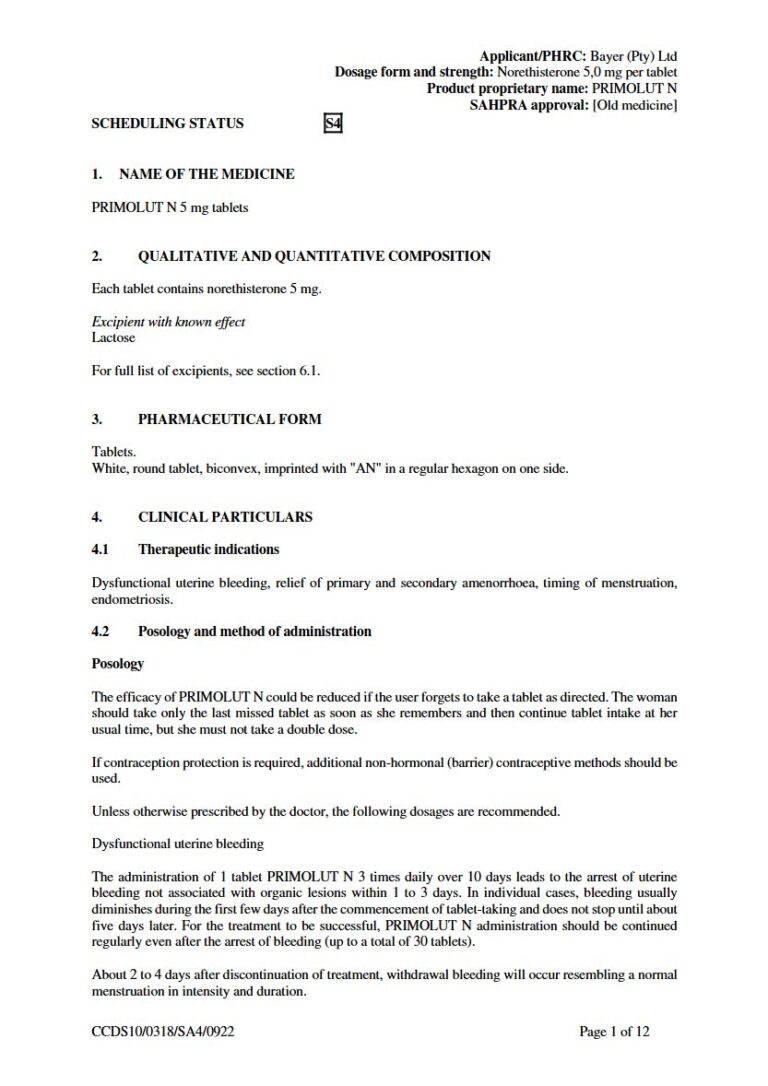
Dysfunctional uterine bleeding, relief of primary and secondary amenorrhoea, timing of menstruation, endometriosis.
4.2 Posology and method of administration
Posology
The efficacy of PRIMOLUT N could be reduced if the user forgets to take a tablet as directed. The woman should take only the last missed tablet as soon as she remembers and then continue tablet intake at her usual time, but she must not take a double dose.
If contraception protection is required, additional non-hormonal (barrier) contraceptive methods should be used.
Unless otherwise prescribed by the doctor, the following dosages are recommended.
Dysfunctional uterine bleeding
The administration of 1 tablet PRIMOLUT N 3 times daily over 10 days leads to the arrest of uterine bleeding not associated with organic lesions within 1 to 3 days. In individual cases, bleeding usually diminishes during the first few days after the commencement of tablet-taking and does not stop until about five days later. For the treatment to be successful, PRIMOLUT N administration should be continued regularly even after the arrest of bleeding (up to a total of 30 tablets). About 2 to 4 days after discontinuation of treatment, withdrawal bleeding will occur resembling a normal menstruation in intensity and duration.
Slight bleeding during tablet-taking
Occasionally, slight bleeding may occur after initial arrest of bleeding. In these cases, tablet-taking must not be interrupted.
Lack of arrest of haemorrhage, continuous or reoccurrence of bleeding
The use of PRIMOLUT N may assist in the differential diagnosis of uterine bleeding. If the bleeding does not stop in spite of regular tablet-taking, an organic cause or an extragenital factor (e.g. polyps, carcinoma of the cervix uteri or endometrium, myoma, residua of abortion, extra-uterine pregnancy, or coagulation disorders) must be considered. The attending physician must be informed immediately, because further measures are then mostly required. This also applies in cases where after initial arrest of haemorrhage, heavier bleedings still occur during tablet-taking.
Prevention of recurrence
To prevent dysfunctional bleeding recurrence in patients with anovulatory cycles PRIMOLUT N can be administered prophylactically (1 tablet 1 to 2 times daily from the 16th to the 25th day of the cycle (1st day of the cycle = 1st day of the last bleeding). The withdrawal bleeding occurs a few days after administration of the last tablet. Only the physician can decide whether this measure is necessary. The physicianu2019s decision is then based on the course of the basal body temperature, which must be measured daily.
Relief of primary and secondary amenorrhoea
Hormone treatment of secondary amenorrhoea can be carried out only after the exclusion of pregnancy. Before treatment of primary or secondary amenorrhoea is commenced, the presence of a prolactin-producing pituitary tumour should be excluded. The possibility cannot be ruled out that macroadenomas increase in size when exposed to higher doses of estrogen for prolonged periods of time. Endometrial priming with an estrogen must be carried out (e.g. for 14 days) before beginning treatment with PRIMOLUT N. Thereafter 1 tablet of PRIMOLUT N is given 1 to 2 times daily for 10 days. Withdrawal bleeding occurs within a few days after intake of the last tablet. In patients in whom sufficient endogenous estrogen production has been achieved, an attempt can be made to stop the estrogen treatment and to induce a cyclical bleeding by the administration of 1 tablet PRIMOLUT N twice daily from the 16th to the 25th day of the cycle. Exception: Patients of whom it can be safely assumed that endogenous estrogen production is insufficient (primary amenorrhoea in gonadal dysgenesia).
Please note
During treatment pregnancy must not occur. Contraception should be practised with non-hormonal methods (with the exception of the rhythm and temperature methods). If withdrawal bleeding at regular intervals of about 28 days fails to occur under the therapeutic scheme (see above), pregnancy must be considered despite the protective measures. The treatment must then be interrupted until the situation has been clarified by differential diagnosis.
Premenstrual syndrome, cyclical mastopathy
1 tablet PRIMOLUT N taken 1 to 3 times daily during the luteal phase of the cycle may relieve or improve premenstrual symptoms such as headaches, depressive moods, water retention, and a feeling of tension in the breasts.
Timing of menstruation
Monthly menstrual bleeding can be postponed with administration of Primolut N. However, this method should be restricted to users who are not at risk of pregnancy during the treatment cycle. Dosage: 1 tablet PRIMOLUT N 2 to 3 times daily for not longer than 10 to 14 days, beginning about 3 days before the expected menstruation. Bleeding will occur 2 to 3 days after having stopped medication. If it does not, the doctor must be consulted.
Endometriosis
Treatment is commenced on the 5th day of the cycle with 1 tablet PRIMOLUT N twice daily, increasing to 2 tablets twice daily in the event of spotting. When the bleeding ceases, the initial dose can be resumed. Duration of treatment: at least 4 to 6 months. During treatment, ovulation and menstruation do not occur. After discontinuation of hormone treatment, a withdrawal bleeding will occur.
Method of administration
The tablets are to be swallowed whole with some liquid.
4.3 Contraindications
PRIMOLUT N should not be used in the presence of any of the conditions listed below, which are also derived from information on other progestogen-only products and combined oral contraceptives (COCs). Should any of the conditions appear during the use of PRIMOLUT N, the use of the preparation must be discontinued immediately.
u2022 Hypersensitivity to the active substance or to any of the excipients listed in section 6.1.
u2022 Known or suspected pregnancy.
u2022 Lactation.
u2022 Presence or a history of venous or arterial thrombotic/thromboembolic events (e.g. deep venous thrombosis, pulmonary embolism, myocardial infarction) or of a cerebrovascular accident.
u2022 Presence of a history of prodromi of a thrombosis (e.g. transient ischaemic attack, angina pectoris).
u2022 A high risk of venous or arterial thrombosis (see section 4.4).
u2022 History of migraine with focal neurological symptoms.
u2022 Diabetes mellitus with vascular involvement.
u2022 Presence or history of severe hepatic disease, as long as liver function values have not returned to normal.
u2022 Use of direct-acting antiviral (DAA) medicines containing ombitasvir, paritaprevir, or dasabuvir, and combinations of these (see section 4.5).
u2022 Presence or history of liver tumours (benign or malignant).
u2022 Known or suspected sex hormone-dependent malignancies.
4.4 Special warnings and precautions for use
If any of the conditions/risk factors mentioned below is present or deteriorates, an individual risk-benefit analysis should be done before PRIMOLUT N is started or continued.
Circulatory disorders
It has been concluded from epidemiological surveys that the use of oral estrogen/progestogen containing ovulation inhibitors is attended by an increased incidence of arterial and venous thromboembolic diseases. Therefore, one should keep the possibility of an increased thromboembolic risk in mind, particularly where there is a history of thromboembolic diseases.
Generally recognised risk factors for venous thromboembolism (VTE) include a positive personal or family history (VTE in a sibling or a parent at a relatively early age), age, obesity, prolonged immobilisation, major surgery, or major trauma. The increased risk of thromboembolism in the puerperium must be considered (see section 4.6). Treatment should be stopped at once if there are symptoms of an arterial or venous thrombotic event or suspicion thereof.
Tumours
Benign liver tumours and malignant liver tumours have been reported in users of hormonal substances such as the one contained in PRIMOLUT N. In isolated cases, these tumours have led to life-threatening intra-abdominal haemorrhages. A hepatic tumour should be considered in the differential diagnosis when severe upper abdominal pain, liver enlargement or signs of intra-abdominal haemorrhage occur in women taking PRIMOLUT N.
Other
Strict medical supervision is necessary if the patient suffers from diabetes. Diabetes mellitus must be actively excluded as this disease requires careful supervision. The requirements for oral antidiabetics or insulin may change. Chloasma may occasionally occur, especially in women with a history of chloasma gravidarum. Women with a tendency to chloasma should avoid exposure to the sun or ultraviolet radiation when taking PRIMOLUT N. Patients who have a history of psychic depression should be carefully observed and the medicine discontinued if the depression recurs to a serious degree.
Depressed mood, depression and risk of suicidality
Depressed mood and depression are well-known undesirable effects of hormonal containing products. Depression can be serious and is a well-known risk factor for suicidal behaviour and suicide. Women should be advised to contact their medical practitioner in case of mood changes and depressive symptoms, including shortly after initiating the treatment.
Medical examination
A complete medical history should be taken, and a physical and gynaecological examination should be performed prior to the initiation or reinstitution of the use of PRIMOLUT N, guided by the contraindications (see section 4.3) and warnings (see section 4.4), and these should be repeated during the use of PRIMOLUT N. The frequency and nature of these assessments should be adapted to the individual woman but should generally include special reference to blood pressure, breasts, abdomen, and pelvic organs, and should also include cervical cytology.
Patients with rare hereditary problems of galactose intolerance, total lactase deficiency or glucose-galactose malabsorption should not take this medicine.
Reasons for immediate discontinuation of the tablets
Occurrence for the first time of migrainous headaches or more frequent occurrence of unusually severe headaches, sudden perceptual disorders (e.g. disturbances of vision or hearing), first signs of thrombophlebitis or thromboembolic symptoms (for example, unusual pains in or swelling of the legs, stabbing pains on breathing or coughing for no apparent reason), a feeling of pain and tightness in the chest, pending operations (six weeks beforehand), immobilisation (for instance, following accidents), onset of jaundice, onset of anicteric hepatitis, generalised pruritus, significant rise in blood pressure, pregnancy.
4.5 Interactions with other medicines
Note: The prescribing information of concomitant medications should be consulted to identify potential interactions.
Effects of other medicines on PRIMOLUT N
Interactions can occur with medicines that induce microsomal enzymes, which can result in increased clearance of sex hormones and which may lead to changes in the uterine bleeding profile and/or reduction of the therapeutic effect. Enzyme induction can be observed after a few days of treatment. Maximal enzyme induction is generally seen within a few weeks. After the cessation of medicine therapy enzyme induction may be sustained for about 4 weeks.
Substances increasing the clearance of sex hormones (diminished efficacy by enzyme induction), e.g.: Phenytoin, barbiturates, primidone, carbamazepine, rifampicin, and possibly also oxcarbazepine, topiramate, felbamate, griseofulvin, rifabutin and products containing St. Johnu2019s wort.
Substances with variable effects on the clearance of sex hormones, e.g.: When co-administered with sex hormones, many HIV/HCV protease inhibitors and nonnucleoside reverse transcriptase inhibitors can increase or decrease plasma concentrations of estrogen or progestin. These changes may be clinically relevant in some cases.
Substances decreasing the clearance of sex hormones (enzyme inhibitors): Strong and moderate CYP3A4 inhibitors such as azole antifungals (e.g. itraconazole, voriconazole, fluconazole), verapamil, macrolides (e.g. clarithromycin, erythromycin), diltiazem and grapefruit juice can increase plasma concentrations of the estrogen, or the progestin, or both.
Etoricoxib doses of 60 to 120 mg/day have been shown to increase plasma concentrations of ethinylestradiol 1,4 to 1,6-fold, respectively when taken concomitantly with a combined hormonal medicine containing 0,035 mg ethinylestradiol.
Effects of PRIMOLUT N on other medicines
Progestogens may interfere with the metabolism of other medicines. Accordingly, plasma and tissue concentrations may either increase (e.g. ciclosporin) or decrease (e.g. lamotrigine). In vitro, ethinylestradiol is a reversible inhibitor of CYP2C19, CYP1A1 and CYP1A2 as well as a mechanism-based inhibitor of CYP3A4/5, CYP2C8, and CYP2J2. In clinical studies, administration of a hormonal contraceptive containing ethinylestradiol did not lead to any increase or only to a minor increase in plasma concentrations of CYP3A4 substrates (e.g. midazolam) while plasma concentrations of CYP1A2 substrates can increase slightly (e.g. theophylline) or moderately (e.g. melatonin and tizanidine).
Pharmacodynamic interactions
Co-administration of ethinylestradiol-containing medicines with direct-acting antiviral (DAA) medicines containing ombitasvir, paritaprevir, or dasabuvir, and combinations of these has been shown to be associated with increases in ALT levels to greater than 20 times the upper limit of normal in healthy female subjects and HCV infected women (see section 4.3).
4.6 Fertility, pregnancy and lactation
Pregnancy
The use of PRIMOLUT N during pregnancy is contraindicated.
Lactation
PRIMOLUT N should not be used during lactation. Norethisterone is secreted into breast milk (see section 5.2).
4.7 Effects on ability to drive and use machines
None known.
4.8 Undesirable effects
Undesirable effects are more common during the first months after start of intake of PRIMOLUT N and subside with duration of treatment. In addition to the undesirable effects listed in section 4.4, the following undesirable effects have been reported in users of PRIMOLUT N, although a causal relationship could not always be confirmed.
System Organ Class (MedDRA)
Very common (u2265 1/10)
Common (u2265 1/100 to < 1/10)
Uncommon (u2265 1/1 000 to < 1/100)
Rare (u2265 1/10 000 to < 1/1 000)
Very rare (< 1/10 000)
Immune system disorders
Hypersensitivity reactions
Nervous system disorders
Headache
Migraine
Eye disorders
Visual disturbances
Respiratory, thoracic, and mediastinal disorders
Dyspnoea
Gastrointestinal disorders
Nausea
Skin and subcutaneous tissue disorders
Urticaria
Rash
Reproductive system and breast disorders
Uterine/vaginal bleeding including
Spotting*
Hypomenorrhoea*
Amenorrhoea*
General disorders and administration site conditions
Oedema
*in the indication Endometriosis
Post-marketing side effects
Depression can be severe and is a well-known risk factor for suicidal behaviour and suicide. Women should be advised to contact that medical practitioner in case of mood changes and depressive symptoms, including shortly after initiating the treatment.
Reporting of suspected adverse reactions
Reporting suspected adverse reactions after authorisation of the medicine is important. It allows continued monitoring of the benefit/risk balance of the medicine. Healthcare professionals are asked to report any suspected adverse reactions to SAHPRA via the u201c6.04 Adverse Drug Reaction Reporting Formu201d, found online under SA HPRAu2019s publications: https://www.sahpra.org.za/Publications/Index/8
4.9 Overdose
There have been no reports of ill-effects from overdosage and treatment is generally unnecessary. There are no special antidotes, and treatment should be symptomatic.
