
Propecia 1 mg Tablets
PDF Leaflet Revision Date: 25 July 2025
Clinical Summary
Quick overview from the medicine insert
Indication
Delays hair loss and increases hair density in men with androgenetic alopecia.
Dosage (summary)
1 mg tablet daily, with or without food.
Onset of Action / Duration
Onset: 3 months, Duration: Reversibility within 12 months after withdrawal.
Special Populations
- Not indicated for women
- Not indicated for children
Pregnancy & Breastfeeding
Contraindicated in women; risk of male fetal genital abnormalities.
Key Drug Interactions
- No clinically significant interactions identified
Contraindications
- Women
- Hypersensitivity to components
- Children
Common side effects
- Decreased libido
- Erectile dysfunction
- Decreased volume of ejaculate
Counselling Points
- Report breast changes
- Avoid handling crushed tablets if pregnant
Serious warnings
- Risk of breast cancer in men
- Male infertility and poor seminal quality
Important Disclaimer
The Propecia 1 mg Tablets professional information leaflet below is the property of Organon South Africa and is provided on Medinsert exactly as issued, with no.. alterations or editorial changes. We make every effort to keep content current by updating documents as soon as new versions become available. Medinsert serves as a trusted access point for healthcare professionals, but does not replace official sources or clinical judgement. For more details, please read our full disclaimer. read more>>
 Healthcare Professionals Only
This content is for registered healthcare professionals
Sign in or create a free account to read the full package insert.
Free for HPCSA-registered professionals. Powered by Medinsert.
Clinical Particulars
Section 4 of the official insert — extracted exactly as issued, no alterations
4.1 Therapeutic indications
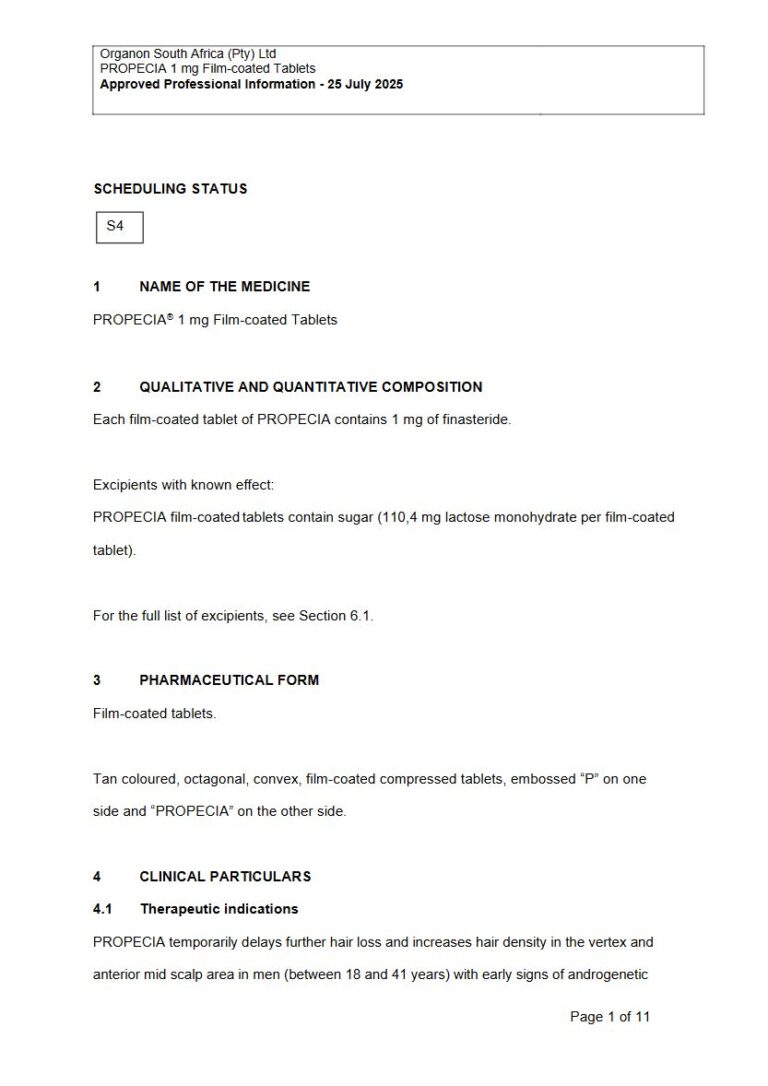
PROPECIA temporarily delays further hair loss and increases hair density in the vertex and anterior mid scalp area in men (between 18 and 41 years) with early signs of androgenetic alopecia. PROPECIA is not effective in postmenopausal women with androgenetic alopecia.
4.2 Posology and method of administration
The recommended dosage is one 1 mg tablet daily. PROPECIA may be taken with or without food. In general, daily use for 3 months or more is necessary before increased hair growth and/or prevention of further hair loss is observed. Continued use is recommended to obtain maximum benefit. Withdrawal of treatment leads to reversibility of effect within 12 months. PROPECIA is not indicated for use in women or children.
4.3 Contraindications
PROPECIA is contraindicated in the following:
- Contraindicated in women (see 4.6 Fertility, pregnancy and lactation).
- Hypersensitivity to any component of PROPECIA.
- PROPECIA is not indicated for use in children.
4.4 Special warnings and precautions for use
Breast cancer has been reported in men taking PROPECIA during the post-marketing period. Medical practitioners should instruct their patients to promptly report any changes in their breast tissue such as lumps, pain, gynaecomastia or nipple discharge. Men with family history of male breast carcinoma should be monitored. Male infertility and/or poor seminal quality have occurred. In clinical studies with PROPECIA in men 18 to 41 years of age, the mean value of serum prostate-specific antigen (PSA) decreased from 0,7 ng/ml at baseline to 0,5 ng/ml at Month 12. When PROPECIA is used for treatment of male pattern hair loss in older men who also have benign prostatic hyperplasia (BPH), consideration should be given to the fact that, in older men with BPH, PSA levels are decreased by approximately 50 %. Paediatric use: PROPECIA is not indicated for use in children. Use in the elderly: Clinical studies with PROPECIA have not been conducted in elderly men with male pattern hair loss. Information regarding lactose intolerance: Patients with rare hereditary problems of galactose intolerance, the Lapp lactase deficiency, glucose-galactose malabsorption or galactosaemia, should not take this medicine.
4.5 Interaction with other medicines and other forms of interaction
No interactions of clinical importance have been identified. Finasteride does not appear to affect the cytochrome P450-linked metabolising enzyme system. Compounds that have been tested in man have included antipyrine, digoxin, glyburide, propranolol, theophylline, and warfarin and no interactions were found. Although specific interaction studies were not performed, in clinical studies finasteride doses of 1 mg or more were used concomitantly with ACE inhibitors, paracetamol, alpha-blockers, benzodiazepines, beta-blockers, calcium channel blockers, cardiac nitrates, diuretics, H2 antagonists, HMG-CoA reductase inhibitors, prostaglandin synthetase inhibitors (NSAIDs) and quinolones, without evidence of clinically significant adverse interactions.
4.6 Fertility, pregnancy and lactation
Pregnancy: PROPECIA is contraindicated for use in women due to the risk in pregnancy. PROPECIA may cause abnormalities of the external genitalia of a male foetus when administered to a pregnant woman. Women should not handle crushed or broken tablets of PROPECIA when they are or may potentially be pregnant because of the possibility of absorption of finasteride and the subsequent potential risk to a male foetus. PROPECIA Tablets are coated and will prevent contact with the active ingredient during normal handling, provided the tablets have not been broken or crushed. Breastfeeding: PROPECIA is not indicated for use in women. It is not known whether finasteride is excreted in human milk. Fertility: Male infertility and/or poor seminal quality have occurred. See 4.4 Special warnings and precautions for use.
4.7 Effects on ability to drive and use machines
There are no data to suggest that PROPECIA affects the ability to drive or use machines.
4.8 Undesirable effects
Clinical trial data: Discontinuation of therapy due to any clinical adverse experience occurred in 1,7 % of 945 men treated with PROPECIA. Frequency of side effects: Very common (u2265 1/10); common (u2265 1/100 to u02c2 1/10); uncommon (u2265 1/1 000 to u02c2 1/100); rare (u2265 1/10 000 to u02c2 1/1 000); very rare (< 1/10 000), including isolated reports. Psychiatric disorders: Uncommon: Decreased libido. Reproductive systems and breast disorders: Uncommon: Erectile dysfunction, decreased volume of ejaculate. In placebo controlled clinical trials, resolution of these side effects occurred in men who discontinued therapy with PROPECIA and in some men who continued with treatment. Post-marketing experience: The following additional adverse experiences were reported in post-marketing use. Because these reactions are reported voluntarily from a population of uncertain size, it is not possible to reliably estimate the frequency. Immune system disorders: Hypersensitivity reactions such as rash, pruritus, urticaria and angioedema (including swelling of the lips, tongue, throat and face). Psychiatric disorders: Depression; decreased libido that continued after discontinuation of treatment. Reproductive systems and breast disorders: Sexual dysfunction (erectile dysfunction and ejaculation disorders) that continued after discontinuation of treatment, breast tenderness and enlargement, testicular pain, haematospermia, male infertility and/or poor seminal quality*. * Normalisation or improvement of seminal quality has been reported after discontinuation of finasteride. Reporting of suspected adverse reactions: Reporting suspected adverse reactions after authorisation of the medicine is important. It allows continued monitoring of the benefit/risk balance of the medicine. Health care providers are requested to report any suspected adverse drug reactions to the South African Health Products Regulatory Authority (SAHPRA) via the Med Safety APP (Medsafety X SAHPRA) and eReporting platform (who-umc.org) found on the SAHPRA website.
4.9 Overdose
In clinical studies, single doses of finasteride up to 400 mg and multiple doses of finasteride up to 80 mg/day for three months did not result in side effects. No specific treatment for overdosage with PROPECIA is recommended. Treatment is symptomatic and supportive.
