
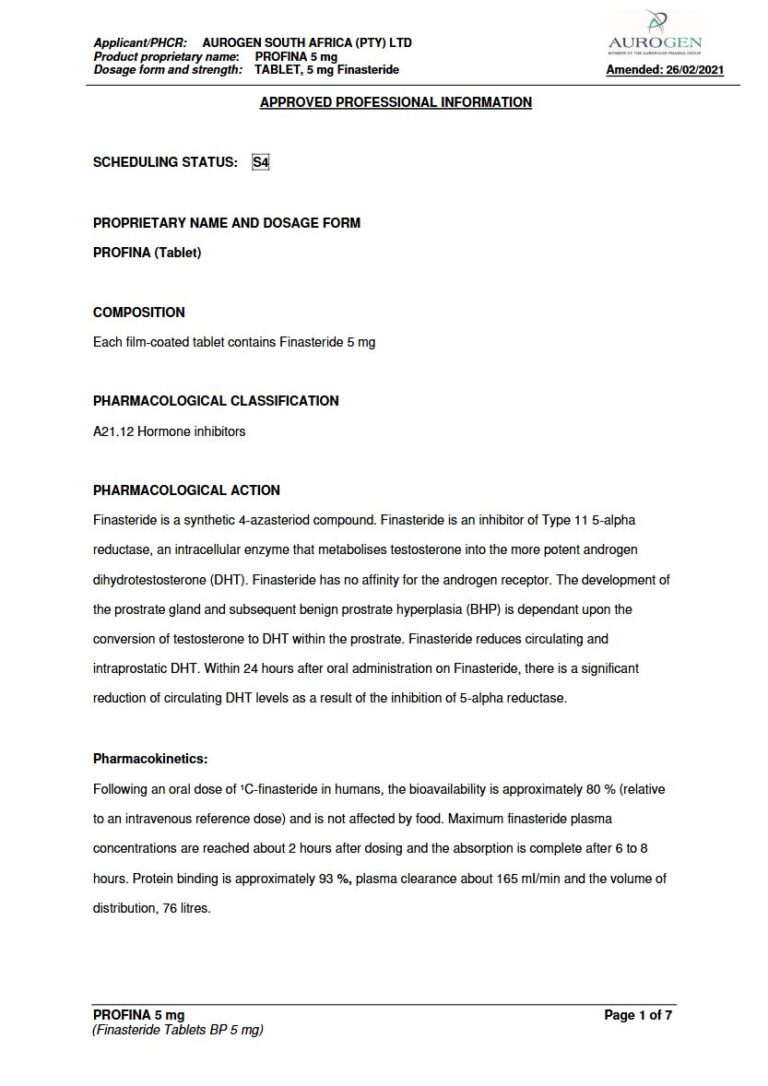
Profina 5 Mg Tablets
PDF Leaflet Revision Date: 02 March 2023
Clinical Summary
Quick overview from the medicine insert
Indication
Treatment of symptomatic benign prostatic hyperplasia (BPH) in men.
Dosage (summary)
One 5 mg tablet daily, with or without food.
Onset of Action / Duration
Onset: 24 hours, Duration: 6-12 months for therapeutic response.
Special Populations
- Elderly
- Renal impairment
Pregnancy & Breastfeeding
Contraindicated in pregnancy; unknown if excreted in breast milk.
Key Drug Interactions
- Digoxin
- Propranolol
- Warfarin
- Glibenclamide
- Theophylline
Contraindications
- Hypersensitivity
- Pregnancy
- Women
- Pediatric use
Common side effects
- Impotence
- Decreased libido
- Breast tenderness
- Rash
Counselling Points
- Avoid handling crushed tablets if pregnant
- Use condoms to prevent exposure to female partners
Serious warnings
- Risk of male foetus abnormalities if used in pregnancy
Important Disclaimer
The Profina 5 Mg Tablets professional information leaflet below is the property of Aurogen South Africa and is provided on Medinsert exactly as issued, with no.. alterations or editorial changes. We make every effort to keep content current by updating documents as soon as new versions become available. Medinsert serves as a trusted access point for healthcare professionals, but does not replace official sources or clinical judgement. For more details, please read our full disclaimer. read more>>
 Healthcare Professionals Only
This content is for registered healthcare professionals
Sign in or create a free account to read the full package insert.
Free for HPCSA-registered professionals. Powered by Medinsert.
Clinical Particulars
Section 4 of the official insert — extracted exactly as issued, no alterations
4.1 Therapeutic indications
PROFINA is indicated for the treatment of symptomatic benign prostatic hyperplasia (BPH) in men with an enlarged prostrate to:
- Improve urinary flow and improve the symptoms associated with BPH by causing regression of the enlarged prostrate.
- Decrease the incidence of acute urinary retention.
- Improve the symptoms associated with BPH.
- Decrease the incidence of the surgery including transurethral resection of the prostrate (TURP) prostatectomy.
4.2 Posology and method of administration
The recommended dosage is one 5 mg tablet with or without food. Although early improvement in symptoms may be seen, a therapeutic trial of 6 u2014 12 months may be necessary to assess whether a beneficial response has been achieved.
Dosage in Renal Insufficiency: Adjustments in dosage are not required in patients with varying degrees of renal insufficiency (creatinine clearances as low as 9 mI/min) as there are no changes in the disposition of PROFINA as compared to healthy subjects.
Dosage in the Elderly: No adjustments in dosage are required even though the elimination of PROFINA S 5 mg is decreased in patients more than 70 years of age.
4.3 Contraindications
Hypersensitivity to any of the components of PROFINA:
- Pregnancy u2014 (See u201cPrecautions, Use in pregnancy and Lactation and Exposure to PROFINA - Risk to Male Foetus (see below)
- PROFINA - is not indicated for use in women.
- PROFINA - is not indicated for paediatric use.
4.4 Special warnings and precautions for use
PROFINA is contra-indicated for use in women when they are or may potentially be pregnant as it may cause abnormalities of the external genitalia of a male foetus when administered to a pregnant women. (see Pregnancy and Exposure to PROFINA 5mg - Risk to Male Foetusu201d below). It is not known whether PROFINA is excreted in breast milk.
Serum Prostate Specific Antigens (S-PSA) levels decrease in patients treated with PROFINA.
4.5 Interactions with other medicines
No interactions of clinical importance have been identified. PROFINA does not appear to significantly affect the cytochrome P450-linked drug metabolising enzyme system. Compounds tested in men included digoxin, propranolol, warfarin, glibenclamide and theophylline and no clinically meaningful interactions were found.
Other Concomitant Therapy: PROFINA has been used concomitantly with ACE-inhibitors, paracetamol, acetylsalicylic acid, alpha-blockers, beta-blockers, calcium channel blockers, cardiac nitrates, diuretics, H2 antagonists, HMG-CoA reductase inhibitors, nonsteroidal anti-inflammatory drugs (NSAIDs), quinolones and benzodiazepines with evidence of clinically significant adverse interactions.
4.6 Fertility, pregnancy and lactation
Use in Pregnant and lactating Mothers: PROFINA is contra-indicated in pregnancy (see u201cContra-indicationsu201d). Because of the ability of Type II 5-alpha reductase inhibitors to inhibit conversion of testosterone to dihydrotesterone, these drugs, including PROFINA, may cause abnormalities of the external genitalia of a male foetus when administered to a pregnant women.
Lactation: It is not known if PROFINA is excreted in human milk.
Exposure to PROFINA - (by pregnant women) - Risk to Male Foetus: PROFINA are coated and will prevent contamination with the active ingredient during normal handling, provided that the tablets have not been broken or crushed. Pregnant women should not handle crushed or broken PROFINA because of the possibility of absorption of PROFINA and the subsequent potential risk to male foetus (see u2018Use in Pregnancyu2019).
In addition since PROFINA is present in semen, male patients should wear a condom or otherwise avoid exposure of female sexual partners at risk of becoming pregnant.
4.8 Undesirable effects
Side Effects: Reproductive system and breast disorders
- Less frequent: Impotence, decrease in libido, decrease in volume of ejaculate and ejaculation disorder, breast tenderness
- The following side effects have been reported and frequencies are unknown: Testicular pain
- Skin and subcutaneous tissue disorder: Less frequent: Rash, hypersensitivity reactions, including pruritus, urticaria, and swelling of the lips and face.
4.9 Overdose
No specific treatment of over-dosage with PROFINA is recommended. Treatment is symptomatic and supportive.
