
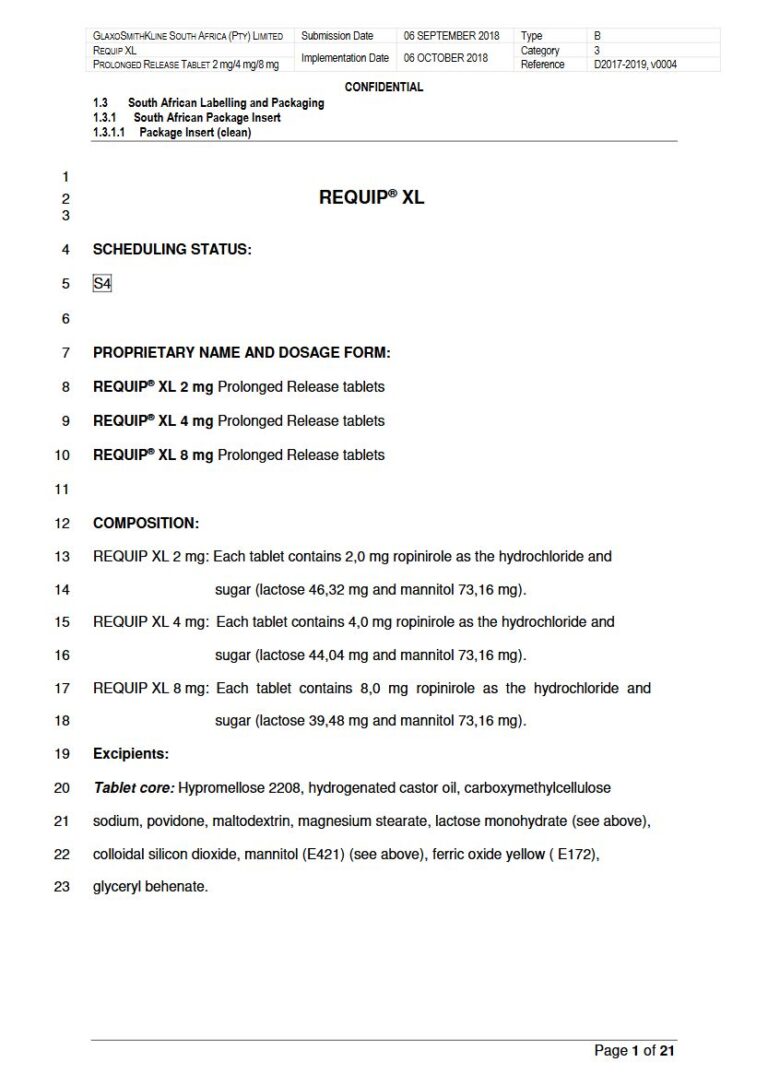
Requip 2mg. 4mg. 8mg Tablets
PDF Leaflet Revision Date: 06 September 2018
Clinical Summary
Quick overview from the medicine insert
Indication
Treatment of Parkinsonu2019s Disease.
Dosage (summary)
Initial: 2 mg once daily, titrate as needed up to 24 mg.
Onset of Action / Duration
Onset: 6 hours, Duration: 24 hours
Special Populations
- Elderly
- Renal impairment
- Hepatic impairment
Pregnancy & Breastfeeding
Contraindicated in pregnancy and lactation.
Key Drug Interactions
- CYP1A2 inhibitors
- Neuroleptics
- CNS depressants
Contraindications
- Hypersensitivity to ropinirole
- Severe renal impairment
- Pregnancy
- Lactation
Common side effects
- Somnolence
- Dizziness
- Nausea
- Hypotension
Counselling Points
- Avoid driving until effects are known
- Monitor for drowsiness
- Gradual dose adjustment recommended
Serious warnings
- Risk of sudden sleep episodes
- Impulse control disorders
- Postural hypotension
Important Disclaimer
The Requip 2mg. 4mg. 8mg Tablets professional information leaflet below is the property of Glaxosmithkline South Africa and is provided on Medinsert exactly as issued, with no.. alterations or editorial changes. We make every effort to keep content current by updating documents as soon as new versions become available. Medinsert serves as a trusted access point for healthcare professionals, but does not replace official sources or clinical judgement. For more details, please read our full disclaimer. read more>>
 Healthcare Professionals Only
This content is for registered healthcare professionals
Sign in or create a free account to read the full package insert.
Free for HPCSA-registered professionals. Powered by Medinsert.
Clinical Particulars
Section 4 of the official insert — extracted exactly as issued, no alterations
4.1 Therapeutic indications
Treatment of Parkinsonu2019s Disease:
- REQUIP XL is indicated as early therapy in patients requiring dopaminergic therapy.
- As adjunctive treatment to L-dopa, REQUIP XL enhances the efficacy of L-dopa, including control of u2018on-offu2019 fluctuations and u2018end-of-doseu2019 effects associated with chronic L-dopa therapy and permits reduction in daily L-dopa dose.
4.2 Posology and method of administration
Individual dose titration against efficacy and tolerability is recommended. REQUIP XL tablets should be taken as a single daily dose and should be taken at a similar time each day. The tablet(s) must be swallowed whole and must not be chewed, crushed or divided. REQUIP XL tablets may be taken with or without food.
Treatment initiation:
The dose should be titrated according to the individual clinical response. The recommended initial dose is 2 mg once daily for one week. A guide for the titration regimen for the first four weeks of treatment is given in the table below:
| Week | 1 | 2 | 3 | 4 |
|---|---|---|---|---|
| Total daily dosage (mg) | 2 | 4 | 6 | 8 |
Therapeutic regimen:
If sufficient symptomatic control is not achieved or maintained after the initial titration period, as described above, the daily dose may then be increased by increments of up to 4 mg once every one to two weeks, as necessary. The dose may be adjusted depending on the therapeutic response. The dose may be increased up to a maximum of 24 mg once daily. Doses above 24 mg/day have not been investigated in clinical trials. When REQUIP XL tablets are given as adjunct therapy to L-dopa, it may be possible to reduce gradually the L-dopa dose, depending on the clinical response. In clinical trials, the L-dopa dose was reduced gradually by approximately 30 % in patients receiving REQUIP XL tablets concurrently. In patients with advanced Parkinsonu2019s disease receiving REQUIP XL in combination with L-dopa, dyskinesias can occur. In clinical trials it was shown that a reduction of the L-dopa dose may ameliorate dyskinesia (see WARNINGS AND SPECIAL PRECAUTIONS). REQUIP XL should be discontinued gradually by reducing the daily dose over the period of one week. If treatment is interrupted for one day or more, re-initiation by dose titration should be considered (see above).
4.3 Contraindications
Hypersensitivity to ropinirole or to any of the excipients.
Pregnancy and lactation.
Severe renal impairment, except when on haemodialysis.
4.4 Special warnings and precautions for use
Falling Asleep During Activities of Daily Living: Patients treated with REQUIP XL have reported falling asleep while engaged in activities of daily living, including the operation of motor vehicles which sometimes resulted in accidents. Although many of these patients reported somnolence while on REQUIP XL, some perceived that they had no warning signs such as excessive drowsiness, and believed that they were alert immediately prior to the event. Some of these events have been reported as late as one year after initiation of treatment. Somnolence is a common occurrence in patients receiving REQUIP XL. Many clinical experts believe that falling asleep while engaged in activities of daily living always occurs in a setting of pre-existing somnolence although patients may not give such a history. For this reason, prescribers should continually reassess patients for drowsiness or sleepiness especially since some of the events occur well after the start of treatment. Prescribers should also be aware that patients may not acknowledge drowsiness or sleepiness until directly questioned about drowsiness or sleepiness during specific activities. Before initiating treatment with REQUIP XL, patients should be advised of the potential to develop drowsiness and specifically asked about factors that may increase the risk with REQUIP XL such as concomitant sedating medications, the presence of sleep disorders and concomitant medications that increase ropinirole plasma levels (e.g. ciprofloxacin u2013 see INTERACTIONS). If a patient develops significant daytime sleepiness or episodes of falling asleep during activities that require active participation (e.g. conversations, eating, etc.), REQUIP XL should ordinarily be discontinued (see DOSAGE AND DIRECTIONS FOR USE for guidance in discontinuing REQUIP XL). If a decision is made to continue REQUIP XL, patients should be advised to not drive and to avoid other potentially dangerous activities. There is insufficient information to establish that dose reduction will eliminate episodes of falling asleep while engaged in activities of daily living.
Because of the additive sedative effects, caution should also be used when patients are taking alcohol or other CNS depressants (e.g. benzodiazepines, antipsychotics, and antidepressants) in combination with REQUIP XL.
Pathological Gambling and Hypersexuality: Impulse control symptoms including compulsive behaviours such as pathological gambling and hypersexuality have been reported in patients treated with REQUIP XL. Such behaviours have been reported principally in Parkinsonu2019s disease patients treated with dopaminergic agents, especially at higher doses and were generally reversible upon dose reduction or treatment discontinuation.
Syncope: Syncope, sometimes associated with bradycardia, was observed in association with REQUIP XL in both early Parkinsonu2019s disease (without L-dopa) patients and advanced Parkinsonu2019s disease (with L-dopa) patients. Most of these cases of syncope occurred more than four weeks after initiation of therapy with REQUIP XL and were usually associated with a recent increase in dose.
Symptomatic hypotension: Dopamine agonists such as REQUIP XL appear to impair the systemic regulation of blood pressure, with resulting postural hypotension, especially during dose escalation. Parkinsonu2019s disease patients, in addition, appear to have an impaired capacity to respond to a postural challenge. Parkinsonu2019s patients being treated with REQUIP XL therefore require careful monitoring for signs and symptoms of postural hypotension, especially during dose escalation and should be informed of this risk (see WARNINGS AND SPECIAL PRECAUTIONS).
Postural hypotension: Patients should be advised that they may develop postural (orthostatic) hypotension with or without symptoms such as dizziness, nausea, syncope and sometimes sweating. Hypotension and/or orthostatic symptoms may occur more frequently during initial therapy or with an increase in dose or at any time. Accordingly, patients should be cautioned against rising rapidly after sitting or lying down, especially if they have been doing so for prolonged periods and especially at the initiation of treatment with REQUIP XL.
Hallucinations: Patients should be warned that hallucinations can occur and that the elderly are at a higher risk than younger patients with Parkinsonu2019s disease.
Dyskinesia: REQUIP XL may potentiate the dopaminergic side effects of L-dopa and may cause and/or exacerbate pre-existing dyskinesia. Decreasing the dose of L-dopa may ameliorate this side effect.
Cardiac conditions: Due to the pharmacological action of ropinirole, patients with severe cardiovascular disease should be treated with caution.
Psychotic disorders: Patients with major psychotic disorders should only be treated with dopamine agonists if the potential benefits outweigh the risks (see also INTERACTIONS).
4.5 Interactions with other medicines
Neuroleptics and other centrally active dopamine antagonists, such as sulpiride or metoclopramide, may diminish the effectiveness of REQUIP XL and, therefore, concomitant use of these medicines with REQUIP XL should be avoided. No pharmacokinetic interaction has been seen between REQUIP XL and L-dopa or domperidone, which would necessitate dosage adjustment of either medicine. No interaction has been seen between ropinirole and other medicines commonly used to treat Parkinsonu2019s disease. In a study in Parkinsonian patients receiving concurrent digoxin, no interaction was seen which would require dosage adjustment. It has been established from in vitro experiments that ropinirole is metabolized by the cytochrome P450 enzyme CYP1A2. There is, therefore, the potential for an interaction between ropinirole and substrates (such as theophylline) or inhibitors (such as ciprofloxacin) of this enzyme. In patients already receiving REQUIP XL, the dose of REQUIP XL may need to be adjusted when these medicines are introduced or withdrawn. Increased plasma concentrations of ropinirole have been observed in patients treated with high doses of oestrogens. In patients already receiving hormone replacement therapy (HRT), REQUIP XL treatment may be initiated in the normal manner. However, if HRT is stopped or introduced during treatment with REQUIP XL, dosage adjustment may be required.
4.6 Fertility, pregnancy and lactation
REQUIP XL should not be used during pregnancy and lactation.
4.7 Effects on ability to drive and use machines
REQUIP XL may cause somnolence. Patients should be advised neither to drive a car nor operate other complex machinery, until they have gained sufficient experience on REQUIP XL to gauge whether or not, it affects their mental and/or motor performance adversely.
4.8 Undesirable effects
During the pre-marketing development of REQUIP, patients received REQUIP either without L-dopa (early Parkinsonu2019s disease studies) or as concomitant therapy with L-dopa (advanced Parkinsonu2019s disease studies). Because these two populations may have differential risks for various adverse events, the adverse events for the two populations have been separated. Adverse events are listed below by system organ class and frequency. Frequencies are defined as: very common (u22651/10), common (u22651/100, <1/10), uncommon (u22651/1 000, <1/100), rare (u22651/10 000, <1/1 000) very rare (<1/10 000), including isolated reports. Unless otherwise indicated, the data in the following table was observed with both REQUIP and REQUIP XL formulations.
Clinical trial data:
Use in Monotherapy Studies
Use in Adjunct Therapy Studies
Psychiatric disorders
- common hallucinations
- confusion, hallucinations
Nervous system disorders
- very common somnolence, syncope
- dyskinesia
- common dizziness, including vertigo
- somnolence
- dizziness (including vertigo)
Vascular disorders
- common postural hypotension
- hypotension
- uncommon postural hypotension
- hypotension
Gastrointestinal disorders
- very common nausea
- common abdominal pain, vomiting, dyspepsia, constipation
- nausea, constipation
4.9 Overdose
It is anticipated that the symptoms of ropinirole overdose will be related to its dopaminergic activity. These symptoms may be alleviated by appropriate treatment with dopamine antagonists such as neuroleptics or metoclopramide.
