
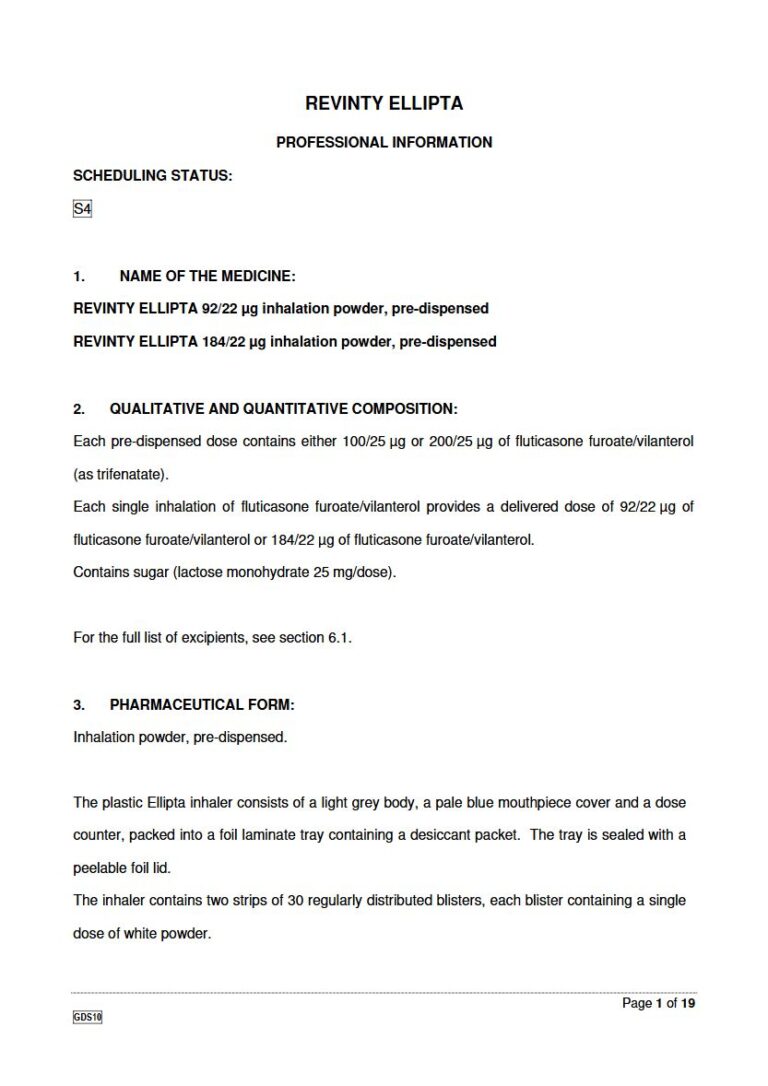
Revinty Ellipta Powder
PDF Leaflet Revision Date: 22 May 2024
Clinical Summary
Quick overview from the medicine insert
Indication
Maintenance treatment of asthma and COPD.
Dosage (summary)
One inhalation of 100/25 u03bcg or 200/25 u03bcg once daily for adults and adolescents 12 years and older.
Special Populations
- Elderly
- Renal impairment
- Hepatic impairment
Pregnancy & Breastfeeding
Safety during pregnancy and lactation not established.
Key Drug Interactions
- Beta-blockers may cause bronchospasms.
- CYP3A4 inhibitors may increase systemic exposure.
Contraindications
- Severe milk-protein allergy
- Hypersensitivity to fluticasone furoate or vilanterol
Common side effects
- Pneumonia
- Headache
- Upper respiratory tract infection
- Bronchitis
- Candidiasis
Counselling Points
- Rinse mouth after use.
- Use regularly even when asymptomatic.
- Seek medical advice if symptoms worsen.
Serious warnings
- Not for acute asthma or COPD exacerbations.
- Paradoxical bronchospasm may occur.
- Increased risk of pneumonia in COPD patients.
Important Disclaimer
The Revinty Ellipta Powder professional information leaflet below is the property of Glaxosmithkline South Africa and is provided on Medinsert exactly as issued, with no.. alterations or editorial changes. We make every effort to keep content current by updating documents as soon as new versions become available. Medinsert serves as a trusted access point for healthcare professionals, but does not replace official sources or clinical judgement. For more details, please read our full disclaimer. read more>>
 Healthcare Professionals Only
This content is for registered healthcare professionals
Sign in or create a free account to read the full package insert.
Free for HPCSA-registered professionals. Powered by Medinsert.
Clinical Particulars
Section 4 of the official insert — extracted exactly as issued, no alterations
4.1 Therapeutic indications
Asthma: REVINTY is indicated for the maintenance, preventive treatment of asthma.
COPD: REVINTY is indicated for the maintenance treatment of airflow obstruction in patients with chronic obstructive pulmonary disease (COPD) including chronic bronchitis and/or emphysema and to reduce exacerbations of COPD in patients with an exacerbation history.
4.2 Posology and method of administration
Posology: REVINTY is for inhalation only. REVINTY should be administered once daily either morning or evening but at the same time every day. After inhalation, patients should rinse their mouth with water without swallowing.
Method of administration: Asthma: Patients should be made aware that REVINTY must be used regularly, even when asymptomatic. If symptoms arise in the period between doses, an inhaled, short-acting beta 2 -agonist should be taken for immediate relief. Patients should be regularly re-assessed by a healthcare professional so that the strength of REVINTY they are receiving remains optimal and is only changed on medical advice.
Adults and adolescents aged 12 years and over: The recommended dose of REVINTY is: One inhalation of REVINTY 100/25 u03bcg once daily Or One inhalation of REVINTY 200/25 u03bcg once daily.
A starting dose of REVINTY 100/25 u03bcg should be considered for patients who require a low to mild dose of inhaled corticosteroid in combination with a long acting beta 2 -agonist. REVINTY 200/25 u03bcg should be considered for patients who require a higher dose of inhaled corticosteroid in combination with a long acting beta 2 -agonist. If patients are inadequately controlled on REVINTY 100/25 u03bcg, consider increasing the dose to 200/25 u03bcg, which may provide additional improvement in asthma control.
Children: The safety and efficacy of REVINTY has not been established in children less than 12 years of age.
COPD: Adults: The recommended dose of REVINTY is: One inhalation of REVINTY 100/25 u03bcg once daily. REVINTY 200/25 u03bcg is not indicated for patients with COPD.
Use and handling: Refer to Patient Information Leaflet for the step-by-step instructions.
Special populations (asthma and COPD): Elderly: No dosage adjustment is required in patients over 65 years (see section 5.2). Renal impairment: No dose adjustment is required for patients with renal impairment (see section 5.2).
Hepatic impairment: A clinical pharmacology study in subjects with mild, moderate and severe hepatic impairment showed up to 3-fold increase in systemic exposure to fluticasone furoate (AUC) (see section 5.2). Caution should be exercised when dosing patients with hepatic impairment who may be more at risk of systemic adverse reactions associated with corticosteroids. For patients with moderate (Child Pugh class B) or severe (Child Pugh class C) hepatic impairment the maximum dose is 100/25 u03bcg (see section 4.4).
Children and adolescents: Do not give RELVAR to children under the age of 12 years for the treatment of asthma, or children and adolescents of any age for the treatment of COPD.
4.3 Contraindications
REVINTY is contraindicated in patients with severe milk-protein allergy or who have demonstrated hypersensitivity to either fluticasone furoate, vilanterol or any of the excipients listed in section 6.1.
4.4 Special warnings and precautions for use
Exacerbations: REVINTY should not be used to treat acute asthma symptoms or an acute exacerbation in COPD, for which a short-acting bronchodilator is required. Increasing use of short-acting bronchodilators to relieve symptoms indicates deterioration of control and patients should be reviewed by a medical practitioner. Patients should not stop therapy with REVINTY, in asthma or COPD, without medical practitioner supervision since symptoms may recur after discontinuation. Asthma-related adverse events and exacerbations may occur during treatment with REVINTY. Patients should be asked to continue treatment but to seek medical advice if asthma symptoms remain uncontrolled or worsen after initiation of REVINTY.
Paradoxical bronchospasm: Paradoxical bronchospasm may occur with an immediate increase in wheezing after dosing. This should be treated immediately with a short-acting inhaled bronchodilator. REVINTY should be discontinued immediately, the patient assessed and alternative therapy instituted if necessary.
Cardiovascular effects: Cardiovascular effects, such as cardiac dysrhythmias e.g. supraventricular tachycardia and extrasystoles may be seen with sympathomimetic medicines, including REVINTY. In a placebo-controlled study in subjects with a history of, or an increased risk of cardiovascular disease, there was no increase in the risk of, cardiovascular events, serious cardiovascular events, or adjudicated cardiovascular deaths in patients receiving REVINTY compared with placebo (see section 4.8). However, REVINTY should be used with caution in patients with cardiovascular disease, or heart rhythm abnormalities, hyperthyroidism or uncorrected hypokalaemia. Hypokalaemia may occur. Overdosages may cause cardiac effects. High dosages may increase the risk of serious side effects, including cardiac dysrhythmias. This risk is further aggravated if REVINTY is administered concomitantly with other medicines that cause hypokalaemia and cardiac dysrhythmias, or in the presence of hypoxia and acidosis. The maximum dosage should not be exceeded.
Patients with hepatic impairment: For patients with moderate (Child Pugh class B) and severe (Child Pugh class C) hepatic impairment, the 100/25 u03bcg dose should be used and patients should be monitored for systemic corticosteroid-related adverse reactions (see section 4.2 and section 5.2).
Patients with diabetes mellitus: There have been reports of increases in blood glucose levels in diabetic patients and this should be considered when prescribing to patients with a history of diabetes mellitus (see section 4.8).
Systemic corticosteroid effects: Systemic corticosteroid effects may occur, particularly at high doses prescribed for long periods. Systemic effects include, HPA axis suppression, decrease in bone mineral density, growth retardation in children and adolescents, cataract, glaucoma and central serous chorioretinopathy (CSCR). REVINTY should be administered with caution in patients with pulmonary tuberculosis or in patients with chronic or untreated infections.
Pneumonia: An increase in pneumonia has been observed in patients with COPD receiving REVINTY. There was also an increased incidence of pneumonias resulting in hospitalisation. In some incidences these pneumonia events were fatal (see section 4.8). Medical practitioners should remain vigilant for the possible development of pneumonia in patients with COPD as the clinical features of such infections overlap with the symptoms of COPD exacerbations. Risk factors for pneumonia in patients with COPD receiving REVINTY include current smokers, patients with a history of prior pneumonia, patients with a body mass index < 25 kg/m2 and patients with a (forced expiratory volume) FEV1 < 50 % predicted. These factors should be considered when REVINTY is prescribed and treatment should be re-evaluated if pneumonia occurs. Patients with asthma taking REVINTY 200/25 u03bcg may be at an increased risk of pneumonia compared with those receiving REVINTY 100/25 u03bcg or placebo (see section 4.8). No risk factors were identified.
Contains lactose: REVINTY contains lactose monohydrate. Patients with rare hereditary problems of galactose intolerance e.g. galactosaemia, Lapp lactase deficiency or glucose-galactose malabsorption or fructose intolerance should not use REVINTY (see section 2).
4.5 Interaction with other medicines and other forms of interaction
Clinically significant medicine interactions mediated by fluticasone furoate or vilanterol at clinical doses are considered unlikely due to the low plasma concentrations achieved after inhaled dosing.
Interaction with beta-blockers: Beta-adrenergic blockers may cause bronchospasms and may weaken or antagonise the effect of beta 2 -adrenergic agonists. Therefore, concurrent use of both non-selective and selective beta-blockers should be avoided unless there are compelling reasons for their use (see section 4.4).
Interaction with CYP3A4 inhibitors: Fluticasone furoate and vilanterol are both rapidly cleared by extensive first-pass metabolism mediated by the liver enzyme CYP3A4. Care is advised when co-administering with strong CYP3A4 inhibitors (e.g. ketoconazole, ritonavir) as there is potential for an increased systemic exposure to both fluticasone furoate and vilanterol, which could lead to an increase in the potential for adverse reactions (see section 5.2). A repeat dose CYP3A4 interaction study was performed in healthy subjects with the fluticasone furoate/vilanterol combination (200/25) and the strong CYP3A4 inhibitor ketoconazole (400 mg). Co-administration increased mean fluticasone furoate AUC(0-24) and Cmax by 36 % and 33 %, respectively. The increase in fluticasone furoate exposure was associated with a 27 % reduction in 0-24 h weighted mean serum cortisol.
Interaction with P-glycoprotein inhibitors: Fluticasone furoate and vilanterol are both substrates of P-glycoprotein (P-gp). A clinical pharmacology study in healthy subjects with co-administered vilanterol and the potent P-gp and moderate CYP3A4 inhibitor verapamil did not show any significant effect on the pharmacokinetics of vilanterol. Clinical pharmacology studies with a specific P-gp inhibitor and fluticasone furoate have not been conducted.
4.6 Fertility, pregnancy and lactation
Safety during pregnancy and lactation has not been established.
4.7 Effects on ability to drive and use machines
There have been no studies to investigate the effect of REVINTY on driving performance or the ability to operate machinery.
4.8 Undesirable effects
Clinical trial data: Data from clinical trials were used to determine the frequency of adverse reactions associated with REVINTY. In the asthma clinical development program a total of 7 034 patients were included in an integrated assessment of adverse reactions. In the COPD clinical development program a total of 6 237 subjects were included in an integrated assessment of adverse reactions. With the exception of pneumonia and fractures, the safety profile was similar in patients with asthma and COPD. During clinical studies, pneumonia and fractures were more frequently observed in patients with COPD. These adverse reactions are listed by system organ class and frequency. The following convention has been used for the classification of adverse reactions: Very common: u2265 1/10 Common: u2265 1/100 to < 1/10 Uncommon: u2265 1/1 000 to < 1/100 Rare: u2265 1/10 000 to < 1/1 000 Very rare < 1/10 000.
System organ class Adverse reaction(s) Frequency Infections and infestations Pneumonia*, Upper respiratory tract infection, Bronchitis, Influenza, Candidiasis of mouth and throat Common Nervous system disorders Headache Very Common Cardiac disorders Extrasystoles** Uncommon Respiratory, thoracic & mediastinal disorders Nasopharyngitis Oropharyngeal Pain, Sinusitis, Pharyngitis Very Common Common Gastrointestinal disorders Abdominal Pain Common Musculoskeletal and connective tissue disorders Arthralgia, Back Pain, Fractures*** Common General disorders and administration site conditions: Pyrexia. Common
Description of selected adverse reactions: * Pneumonia (see section 4.4): In two replicate 12 month studies in a total of 3 255 patients with COPD (mean post-bronchodilator screening FEV1 45 % of predicted, standard deviation (SD) 13 %) who had experienced a COPD exacerbation in the previous year, there was a higher incidence of pneumonia (6 % - 7 %) reported in patients receiving the fluticasone furoate (at strengths of 50, 100, and 200 u03bcg)/vilanterol 25 u03bcg combination than in those receiving vilanterol 25 u03bcg alone (3 %). Pneumonia which required hospitalisation occurred in 3 % of patients receiving REVINTY (all strengths) and in < 1 % of patients receiving vilanterol. In these studies, nine fatal cases of pneumonia were reported. Of these, seven were reported during treatment with REVINTY 200/25 u03bcg, one during treatment with REVINTY 100/25 u03bcg and one post-treatment with vilanterol monotherapy.
In SUMMIT, a multi-centre, randomised study (HZC113782), 16 568 subjects received REVINTY 100/25 u03bcg, fluticasone furoate 100 u03bcg, vilanterol 25 u03bcg, or placebo for a mean of 1,7 years. Subjects had moderate COPD (mean post-bronchodilator screening FEV1 60 % of predicted, SD 6 %) and a history of, or an increased risk of, cardiovascular disease. The adverse events of pneumonia are noted in the table below.
On-treatment events Number (%) of subjects [event rate per 1 000 treatment years] FF/VI 100/25 N = 4 140 FF 100 N = 4 157 VI 25 N = 4 140 Placebo N = 4 131 Pneumonia 237 (6) [39,5] 228 (5) [42,4] 163 (4) [27,7] 214 (5) [38,4] Serious pneumonia 140 (3) [22,4] 146 (4) [25,1] 104 (3) [16,4] 127 (3) [22,2] Adjudicated pneumonia deaths 13 (<1) [1,8] 10 (<1) [1,5] 6 (<1) [0,9] 9 (<1) [1,4]
In an integrated analysis of 11 studies in asthma (7 034 patients), the incidence of pneumonia (adjusted for exposure, due to low numbers and limited number of patients on placebo) seen with REVINTY 100/25 u03bcg strength (9,6/1000 patient years) was similar to placebo (8,0/1000 patient years). There was a higher incidence of pneumonia in the 200/25 u03bcg strength (18,4/1000 patient years) compared to the 100/25 u03bcg strength.
** Cardiovascular events (see section 4.4): For the SUMMIT study (see description above), cardiovascular adverse events are noted in the table below.
On-treatment events Number (%) of subjects [event rate per 1 000 treatment years] FF/VI 100/25 N = 4 140 FF 100 N = 4 157 VI 25 N = 4 140 Placebo N = 4 131 Cardiovascular 735 (18) [163] 699 (17) [157] 707 (17) [157] 695 (17) [164] Serious cardiovascular 350 (8) [64,5] 320 (8) [58,1] 337 (8) [59,2] 318 (8) [63,2] Adjudicated cardiovascular deaths 82 (2) [11,7] 80 (2) [11,6] 90 (2) [12,9] 86 (2) [13,0]
*** Fractures: In two replicate 12 month studies in a total of 3 255 patients with COPD the incidence of bone fractures overall was low in all treatment groups, with a higher incidence in all REVINTY groups (2 %) compared with the vilanterol 25 u03bcg group (< 1 %). Although there were more fractures in the REVINTY groups compared with the vilanterol 25 u03bcg group, fractures typically associated with corticosteroid use (e.g., spinal compression/thoracolumbar vertebral fractures, hip and acetabular fractures) occurred in < 1 % of the REVINTY and vilanterol treatment arms. For the SUMMIT study (see description above), fractures are noted in the table below.
On-treatment events Number (%) of subjects [event rate per 1 000 treatment years] FF/VI 100/25 N = 4 140 FF 100 N = 4 157 VI 25 N = 4 140 Placebo N = 4 131 All fractures 82 (2) [13,6] 66 (2) [12,8] 74 (2) [13,2] 69 (2) [11,5] Fractures commonly associated with ICS use 23 (<1) [3,4] 24 (<1) [3,9] 17 (<1) [2,4] 13 (<1) [2,1]
In an integrated analysis of 11 studies in asthma (7 034 patients), the incidence of fractures was < 1 %, and usually associated with trauma.
Post-marketing data: System organ class Adverse reaction(s) Frequency Immune system disorders: Hypersensitivity reactions including anaphylaxis, angioedema, rash and urticaria Less Frequent Metabolism and nutrition disorders: Hyperglycaemia Uncommon Psychiatric disorders: Anxiety Less Frequent Nervous system disorders: Tremor Less Frequent Cardiac disorders palpitations, tachycardia Less Frequent Respiratory, thoracic & mediastinal disorders Paradoxical bronchospasm Less Frequent Musculoskeletal and connective tissue disorders: Muscle Spasms. Common
Reporting of suspected adverse reactions: Reporting suspected adverse reactions after authorisation of REVINTY ELLIPTA is important. It allows continued monitoring of the benefit/risk balance of REVINTY ELLIPTA. Health care providers are asked to report any suspected adverse reactions to: SAHPRA via the u201c6.04 Adverse Drug Reaction Reporting Formu201d, found online under SAHPRAu2019s publications: https://www.sahpra.org.za/Publications/Index/8.
4.9 Overdose
Symptoms and signs: An overdose of REVINTY may produce signs and symptoms due to the individual componentsu2019 actions, including those seen with overdose of other beta 2 -agonists and consistent with the known inhaled corticosteroid class effects (see section 4.4).
Treatment: There is no specific treatment for an overdose with REVINTY. If overdose occurs, the patient should be treated supportively with appropriate monitoring as necessary. Cardioselective beta-blockade should only be considered for profound vilanterol overdose effects that are clinically concerning and unresponsive to supportive measures. Cardioselective beta-blocking medicines should be used with caution in patients with a history of bronchospasm. Further management should be as clinically indicated or as recommended by the national poison centre, where available.
