
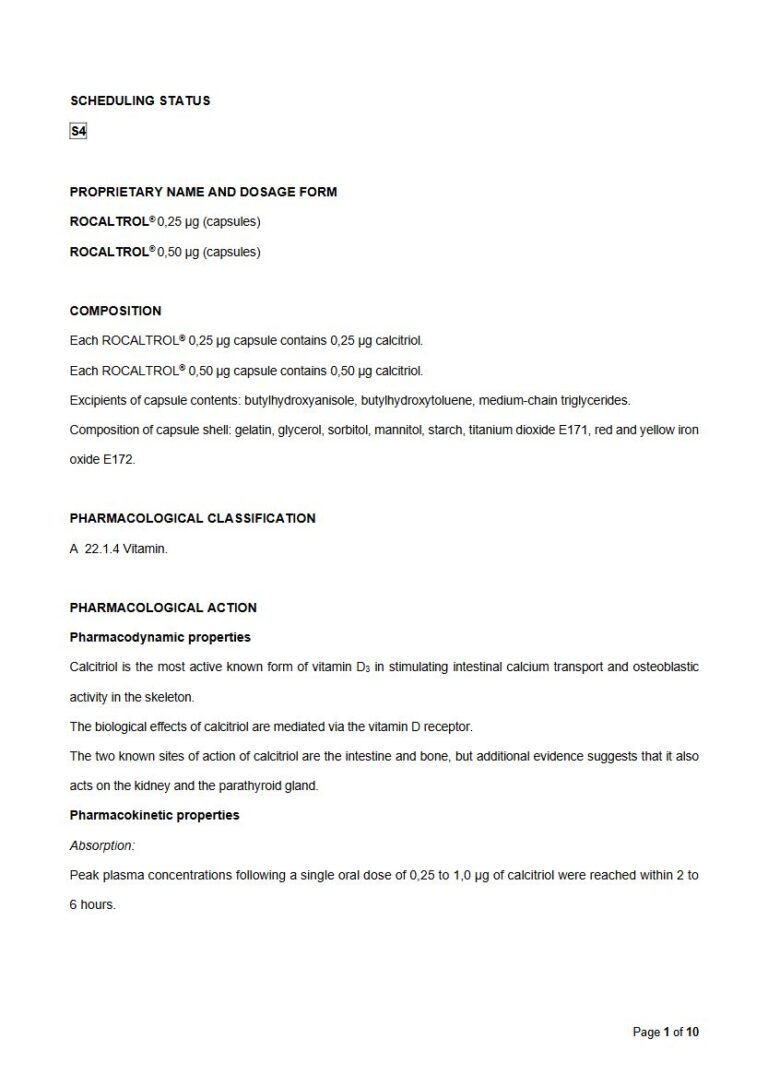
Rocaltrol 0,25 µg/ 0,50 µg Capsules
PDF Leaflet Revision Date: 29 April 2005
Clinical Summary
Quick overview from the medicine insert
Indication
Adjunct treatment for post-menopausal osteoporosis and renal bone disease.
Dosage (summary)
0.25 u03bcg twice daily for osteoporosis; adjust based on serum calcium.
Onset of Action / Duration
Onset: 2-6 hours, Duration: 5-8 hours
Special Populations
- Renal impairment
- Elderly patients
Pregnancy & Breastfeeding
Use in pregnancy only if benefits outweigh risks; avoid breastfeeding.
Key Drug Interactions
- Thiazides increase hypercalcaemia risk
- Digitalis may cause dysrhythmias
- Avoid magnesium-containing antacids
Contraindications
- Hypercalcaemia
- Hypersensitivity to calcitriol
Common side effects
- Hypercalcaemia
- Decreased appetite
- Nausea
- Headache
Counselling Points
- Adhere to prescribed diet
- Recognize hypercalcaemia symptoms
- Monitor fluid intake
Serious warnings
- Monitor serum calcium and phosphate levels
- Risk of hypercalcaemia with dietary changes
Important Disclaimer
The Rocaltrol 0,25 µg/ 0,50 µg Capsules professional information leaflet below is the property of Pharmaco Distribution and is provided on Medinsert exactly as issued, with no.. alterations or editorial changes. We make every effort to keep content current by updating documents as soon as new versions become available. Medinsert serves as a trusted access point for healthcare professionals, but does not replace official sources or clinical judgement. For more details, please read our full disclaimer. read more>>
 Healthcare Professionals Only
This content is for registered healthcare professionals
Sign in or create a free account to read the full package insert.
Free for HPCSA-registered professionals. Powered by Medinsert.
Clinical Particulars
Section 4 of the official insert — extracted exactly as issued, no alterations
4.1 Therapeutic indications
- As an adjunct treatment of established post-menopausal osteoporosis where hormones or bisphosphonates cannot be used.
- Renal bone disease (renal osteodystrophy) such as in chronic renal failure, especially on intermittent haemodialysis.
- Hypophosphataemic vitamin D resistant and pseudo vitamin D deficiency rickets and osteomalacia.
- Nutritional and malabsorptive rickets and osteomalacia.
- Hypoparathyroidism (idiopathic and post-surgical); pseudo-hypoparathyroidism.
4.2 Posology and method of administration
The optimal daily dosage of ROCALTROL must be carefully determined for each patient (adults as well as children) on the basis of serum calcium level. ROCALTROL therapy should always be started at the lowest possible dose and should not be increased without careful monitoring of serum calcium.
A prerequisite for optimal efficacy of ROCALTROL is adequate but not excessive calcium intake at the beginning of therapy. Calcium supplements may be necessary and should be administered according to local guidelines.
Because of improved calcium absorption from the gastrointestinal tract, some patients on ROCALTROL may be maintained on a lower calcium intake. Patients who tend to develop hypercalcaemia may require only low doses of calcium or no supplementation at all.
During the stabilisation phase of treatment with ROCALTROL, serum calcium levels should be checked at least twice weekly. When the optimal daily dosage of ROCALTROL has been determined, serum calcium levels should be checked every month (or as indicated below for individual indications). Samples for serum calcium should be taken without a tourniquet.
Treatment with ROCALTROL should be stopped immediately as soon as the serum calcium level exceeds the accepted normal upper limit or the serum creatinine exceeds the accepted normal upper limit for age. Treatment should be stopped until normocalcaemia ensues. During the periods of hypercalcaemia, serum calcium and phosphate levels must be determined daily. When normal levels have been attained, the treatment with ROCALTROL can be continued, at a daily dose of 0,25 u03bcg lower than that previously used. An estimate of daily dietary calcium intake should be made and the intake adjusted when indicated. 24 hour urine calcium should be monitored (initially every month, then 6 monthly) since it will increase long before the serum calcium or renal function deteriorates.
4.3 Contraindications
Patients with hypercalcaemia or evidence of vitamin D intoxication.
Patients with known hypersensitivity to calcitriol (or medicines of the same class) or any of the excipients of ROCALTROL.
4.4 Special warnings and precautions for use
- The serum calcium times phosphate (Ca x P) product should not be allowed to exceed 5,6 mmol2/u21132.
- Since ROCALTROL is the most potent metabolite of vitamin D available, vitamin D and its derivatives should be withheld during treatment, thereby ensuring that the development of hypervitaminosis D is avoided.
- If the patient is switched from ergocalciferol (vitamin D2) to calcitriol, it may take several months for the ergocalciferol level in the blood to return to the baseline value.
- Patients with normal renal function who are taking ROCALTROL should avoid dehydration. Adequate fluid intake should be maintained.
- Immobilised patients, e.g. those who have undergone surgery, are particularly exposed to the risk of hypercalcaemia.
- There is a close correlation between treatment with calcitriol and the development of hypercalcaemia. An abrupt increase in calcium intake as a result of changes in diet (e.g. increased consumption of dairy products) or uncontrolled intake of calcium preparations may trigger hypercalcaemia. Patients should be advised that strict adherence to the prescribed diet is mandatory and they should be instructed on how to recognise the symptoms of hypercalcaemia (see SIDE EFFECTS). ROCALTROL should be stopped immediately when the serum calcium level exceeds the accepted normal upper limit or the serum creatinine exceeds the accepted normal upper limit for age. Treatment with ROCALTROL can be resumed as soon as normocalcaemia ensues.
- Calcitriol increases inorganic phosphate levels in serum. While this is desirable in patients with hypophosphataemia, caution is called for in patients with renal failure because of the danger of ectopic soft tissue calcification. In such cases, the plasma phosphate level should be maintained at the normal level (2 - 5 mg/100 mu2113 or 0,65 - 1,62 mmol/litre) by the oral administration of appropriate phosphate-binding agents and a diet low in phosphate.
- Patients with vitamin D resistant rickets (familial hypophosphataemia) should continue their oral phosphate therapy. However, possible stimulation of intestinal phosphate absorption by calcitriol should be taken into account since this effect may modify the requirement for phosphate supplementation. The regular laboratory investigations that are required include serum determinations of calcium, phosphorus, magnesium and alkaline phosphatase and of the calcium and phosphate content in 24-hour urine.
- During the stabilisation phase of treatment with ROCALTROL, serum calcium levels should be checked at least twice weekly, see DOSAGE AND DIRECTIONS FOR USE.
4.5 Interactions with other medicines
- Diet: Dietary instructions, especially those concerning calcium supplements, should be strictly observed and uncontrolled intake of additional calcium containing preparations avoided.
- Thiazides: Concomitant treatment with a thiazide diuretic increases the risk of hypercalcaemia.
- Digitalis: Calcitriol dosage must be determined with care in patients undergoing treatment with digoxin, as hypercalcaemia in such patients may precipitate cardiac dysrhythmias.
- Other Vitamin D supplements: A relationship of functional antagonism exists between vitamin D analogues, which promote calcium absorption, and corticosteroids, which inhibit it.
- Antacids: Magnesium-containing medicines (e.g. antacids) may cause hypermagnesaemia and should therefore not be taken during therapy with ROCALTROL by patients on chronic renal dialysis.
- Since ROCALTROL also has an effect on phosphate transport in the intestine, kidneys and bones, the dosage of phosphate-binding agents must be adjusted in accordance with the serum phosphate concentration (normal values: 2 - 5 mg/100 ml, or 0,6 - 1,6 mmol/litre).
- Patients with vitamin D resistant rickets (familial hypophosphataemia) should continue their oral phosphate therapy. However, possible stimulation of intestinal phosphate absorption by calcitriol should be taken into account since this effect may modify the requirement for phosphate supplements.
- Bile acid sequestrants such as cholestyramine and sevelamer can reduce intestinal absorption of fat-soluble vitamins and may impair intestinal absorption of calcitriol.
4.6 Fertility, pregnancy and lactation
Pregnancy: Vitamin D is teratogenic in animals. In a very limited number of pregnancies exposed to this formulation, there was no evidence of foetal abnormalities in humans. See DOSAGE AND DIRECTIONS FOR USE.
ROCALTROL should only be used in pregnant women with hypoparathyroidism when the expected therapeutic benefit clearly outweighs the possible adverse events and serum calcium levels can be carefully monitored. See DOSAGE AND DIRECTIONS FOR USE.
Lactation: ROCALTROL may be excreted in human milk. A mother should not breastfeed whilst taking ROCALTROL.
4.7 Effects on ability to drive and use machines
On the basis of the pharmacodynamics profile of reported adverse events, this product is presumed to be safe or unlikely to adversely affect such activities. Patients to determine effects before driving or using machines. Contains sorbitol and may have a laxative effect. Patients with a rare hereditary condition of sorbitol intolerance should not take ROCALTROL.
4.8 Undesirable effects
The adverse reactions (ADR) listed below reflect the experience from investigational studies of ROCALTROL. The most commonly reported adverse reaction was hypercalcaemia. The ADRs listed in Table 1 are presented by system organ class and frequency categories, defined using the following convention: Very common (u22651/10); common (u22651/100 to <1/10); uncommon (u22651/1 000 to<1/100); rare (u22651/10 000 to <1/1 000); very rare (<1/10 000); not known (cannot be estimated from the available data). Within each frequency grouping, undesirable effects are presented in order of decreasing seriousness.
Table 1 Summary of ADRs Occurring in Patients Receiving ROCALTROLu00ae
System Organ Class
- Very common: Hypercalcaemia
- Common: Decreased appetite
- Uncommon: Polydipsia, Dehydration
- Not known: Apathy
Adverse effects may occur which are similar to those due to excessive dose of vitamin D, i.e. hypercalcaemia syndrome or calcium intoxication (depending on the severity and duration of hypercalcaemia). See DOSAGE AND DIRECTIONS FOR USE and WARNINGS AND SPECIAL PRECAUTIONS.
Occasional acute symptoms include decreased appetite, headache, nausea, vomiting, abdominal pain or abdominal pain upper and constipation. Because of the short biological half-life of calcitriol, pharmacokinetic investigations have shown normalisation of elevated serum calcium within a few days of treatment withdrawal, i.e. much faster than in treatment with vitamin D3 preparations. Chronic effects may include muscular weakness, weight decreased, sensory disturbances, pyrexia, thirst, polydipsia, polyuria, dehydration, apathy, growth retardation and urinary tract infection. In concurrent hypercalcaemia and hyperphosphatemia of > 6 mg/100 mu2113 or > 1,9 mmol/u2113, soft tissue calcification may occur; this can be seen radiographically. Hypersensitivity reactions including rash, erythema, pruritus, and urticarial may occur in susceptible individuals. Laboratory Abnormalities: In patients with normal renal function, chronic hypercalcaemia may be associated with an increased blood creatinine.
4.9 Overdose
The initial signs and symptoms of vitamin D intoxication associated with hypercalcaemia include weakness, fatigue, somnolence, headache, anorexia, nausea, vomiting, diarrhoea and pruritus. Appropriate symptomatic and supportive treatment includes fluids to prevent renal stone damage.
