
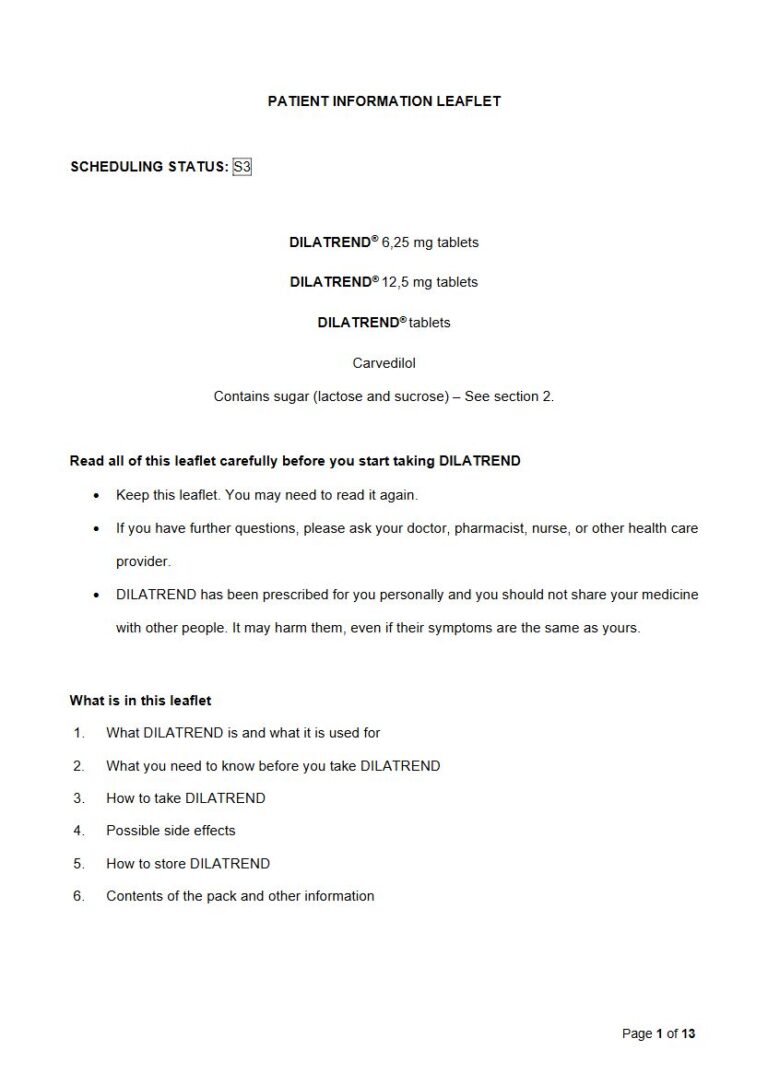
Dilatrend 6.25mg. 12.5mg Tablet
PDF Leaflet Revision Date: 08 Aug 2025
Clinical Summary
Quick overview from the medicine insert
Indication
Used to treat hypertension, congestive heart failure, and heart failure post-heart attack.
Dosage (summary)
Starting dose for hypertension: 12.5 mg once daily; for heart failure: 3.125 mg twice daily.
Special Populations
- Elderly
- Patients with liver problems
- Diabetics
Pregnancy & Breastfeeding
Not recommended in pregnancy; excreted in breast milk.
Key Drug Interactions
- Diuretics
- Calcium channel blockers
- Insulin
- MAOIs
- NSAIDs
Contraindications
- Hypersensitivity to carvedilol
- Asthma
- Severe fluid retention
- Liver problems
- Heart block
- Low blood pressure
Common side effects
- Dizziness
- Headache
- Fatigue
- Low blood pressure
- Fluid retention
Counselling Points
- Take with food
- Avoid alcohol
- Do not stop abruptly
- Monitor for dizziness
Serious warnings
- Severe allergic reactions
- Sinus arrest
- Kidney problems
- Severe skin reactions
Important Disclaimer
The Dilatrend 6.25mg. 12.5mg Tablet professional information leaflet below is the property of Pharmaco Distribution and is provided on Medinsert exactly as issued, with no.. alterations or editorial changes. We make every effort to keep content current by updating documents as soon as new versions become available. Medinsert serves as a trusted access point for healthcare professionals, but does not replace official sources or clinical judgement. For more details, please read our full disclaimer. read more>>
 Healthcare Professionals Only
This content is for registered healthcare professionals
Sign in or create a free account to read the full package insert.
Free for HPCSA-registered professionals. Powered by Medinsert.
Clinical Particulars
Section 4 of the official insert — extracted exactly as issued, no alterations
4.1 Therapeutic indications
DILATREND is used to treat the following:
- High blood pressure (hypertension).
- Congestive heart failure.
- Heart failure following a recent heart attack.
4.2 Posology and method of administration
Do not share medicines prescribed for you with any other person. Always take DILATREND exactly as your doctor has told you. You should check with your doctor if you are not sure. Treatment with DILATREND is long-term therapy and should not be stopped abruptly, but reduced gradually at weekly intervals.
High blood pressure: The usual starting dose is 12,5 mg once a day for two days. After two days the dose is usually 25 mg once a day. If necessary, your doctor may gradually increase the dose further at intervals of two weeks or more to a maximum of 50 mg a day in two doses. If you are elderly, you may not need any more than 12,5 mg a day.
Congestive heart failure: Adults and elderly: The usual starting dose is 3,125 mg (half a 6,25 mg tablet), twice a day for two weeks. Your doctor will then increase the dose slowly, over several weeks, up to 25 mg twice a day. If you weigh more than 85 kg the dose may be increased to 50 mg twice a day. When used for heart failure, treatment with DILATREND should be started by a specialist doctor. If you have stopped taking DILATREND for more than two weeks you should talk to your doctor. He will need you to go back to the starting dose again.
Congestive heart failure following a recent heart attack: When used for heart failure following a recent heart attack, treatment with DILATREND should be started by a specialist doctor. The usual starting dose is 6,25 mg. If you tolerated the first dose, your doctor will then increase the dose to 6,25 mg twice a day and maintain for it 3 to 10 days. Your doctor may then increase your dose to 12,5 mg twice a day and then to a maximum of 25 mg twice a day. Your doctor will decide which dose is best for you and monitor you carefully each time the dose is increased or changed.
4.3 Contraindications
Do not take DILATREND:
- If you are hypersensitive (allergic) to carvedilol or any of the other ingredients of DILATREND (listed in section 6).
- If you have ever had wheezing due to asthma or other lung diseases.
- If you have severe fluid retention (swelling of your ankles and feet).
- If you have problems with your liver.
- If you have problems with your heart (for example u201cheart blocku201d, slow or uneven heartbeat).
- If you have low blood pressure.
- If you have a problem with acid levels in your blood (metabolic acidosis).
- If you have a growth on one of your adrenal glands (phaeochromocytoma).
4.4 Special warnings and precautions for use
Talk to your doctor or pharmacist before taking DILATREND:
- If you have problems with your lungs.
- If you have problems with your kidneys.
- If you have diabetes (high blood sugar).
- If you wear contact lenses.
- If you have problems with your blood vessels (peripheral vascular disease) or with the blood circulation in your fingers and toes (Raynaudu2019s phenomenon).
- If you have ever had problems with your thyroid.
- If you have ever had a serious allergic reaction (for example, sudden swelling causing difficulty breathing or swallowing, swelling of the hands, feet and ankles or a severe rash).
- If you have had an allergy and are having treatment to desensitise you.
- If you have a skin disorder called psoriasis, after taking beta-blocker medicines.
- If you have a heart condition called u201cPrinzmetalu2019s vasospastic or variant anginau201d.
- If you have a tumour that develops in one of your adrenal glands (phaeochromocytoma).
4.5 Interactions with other medicines
Always tell your healthcare professional if you are taking any other medicine. (This includes complementary or traditional medicines). Tell your doctor or pharmacist if you are taking or have recently taken other medicines. This is because DILATREND can affect the way some medicines work. Also some medicines can affect the way DILATREND works.
Tell your doctor or pharmacist if you are taking any of the following:
- Other medicines for your heart or your blood pressure, including water tablets (diuretics), calcium channel blockers (e.g. diltiazem or verapamil), digoxin, and amiodarone.
- Catecholamine-depleting agents (e.g. reserpine and monoamine oxidase inhibitors (MAOIs).
- Fluoxetine and paroxetine (used to treat depression).
- Medicines for diabetes, such as insulin or metformin.
- Rifampicin (used to treat infections).
- Guanethidine or bethanidine.
- Phenothiazines (e.g. chlorpromazine).
- Ciclosporin and tacrolimus (used after an organ transplant).
- Medicines used when your heart does not beat smoothly (e.g. disopyramide, quinidine, procainamide, lignocaine, phenytoin).
- Clonidine (used to treat high blood pressure, migraine and flushing in the menopause).
- Isoprenaline (used to treat asthma).
- Cimetidine (used to treat indigestion, heartburn and stomach ulcers).
- Non-steroidal anti-inflammatory drugs (NSAIDs, including aspirin).
- Beta-agonist bronchodilators (used to treat chest tightness and wheezing due to asthma or other chest conditions (e.g. salbutamol and terbutaline sulphate).
4.6 Fertility, pregnancy and lactation
If you are pregnant or breastfeeding your baby, think you may be pregnant or are planning to have a baby, please consult your doctor, pharmacist or other healthcare professional for advice before taking DILATREND. There is no adequate clinical experience with DILATREND in pregnant women. DILATREND should not be used in pregnant women, as foetal harm may occur. DILATREND and/or its metabolites are excreted in breast milk. Breastfeeding is therefore not recommended while taking DILATREND.
4.7 Effects on ability to drive and use machines
You may feel dizzy while taking DILATREND. This is more likely when you start treatment, or if your treatment has changed, and when you drink alcohol. If this happens to you, do not drive or use any tools or machines. Talk to your doctor if you notice any other problems that might affect driving, using tools or machines while you are taking DILATREND. It is not always possible to predict to what extent DILATREND may interfere with the daily activities of a patient. Patients should ensure that they do not engage in the above activities until they are aware of the measure to which DILATREND affects them.
4.8 Undesirable effects
DILATREND can have side effects. The possible side effects and how likely you are to get them will depend on the reason you are being treated with DILATREND. Not all side effects reported for DILATREND are included in this leaflet. Should your general health worsen, or if you experience any untoward effects while taking DILATREND, consult your doctor, pharmacist or other healthcare professional for advice.
If you get any of the following serious side effects contact your doctor immediately or seek urgent medical advice / go to the hospital emergency department:
- Severe allergic reactions: signs may include sudden swelling of the throat, face, lips and mouth. This may make it difficult to breathe or swallow.
- Chest pains accompanied by shortness of breath, sweating and feeling sick.
- Sinus arrest - signs include your heartbeat becoming very slow or stopping. You may also feel dizzy, unusually tired and short of breath. This may occur especially in people over 65 years old or with other heartbeat problems.
- Passing water (urinating) less often with swelling of legs, indicating problems with your kidneys.
- Very low blood sugar (hypoglycaemia) which might cause seizures or unconsciousness.
- Skin reactions - Infrequently, severe skin conditions (erythema multiforme, Stevens-Johnson syndrome and toxic epidermal necrolysis) can occur. Redness, often associated with blisters may appear on the skin or mucous membranes, such as the inside of the mouth, the genital areas or the eyelids. These can appear initially as circular patches often with central blisters, which may progress to widespread peeling of the skin and can be life threatening. These serious skin reactions are often preceded by headache, fever and body aches (flu-like symptoms).
These are all very serious side effects. If you have them, you may have had a serious reaction to DILATREND. You may need urgent medical attention or hospitalisation.
4.9 Overdose
If you take more DILATREND than you should, talk to a doctor or go to a hospital straight away. Take the medicine pack with you. The following effects may happen if you have taken more tablets than you should: a slow or pauses in your heartbeat, feeling dizzy or light-headed, becoming breathless, wheezy or extremely tired. In the event of overdosage, consult your doctor or pharmacist. If neither is available, contact the nearest hospital or poison control centre.
If you forget to take DILATREND, if you forget to take a dose, take it as soon as you remember. However, if it is nearly time for the next dose, skip the missed dose. Do not take a double dose to make up for a forgotten dose.
If you stop taking DILATREND, do not stop taking DILATREND without talking to your doctor. Your doctor may want you to stop taking DILATREND slowly over one to two weeks.
