
Ronia 1 ml Solution for injection or infusion.
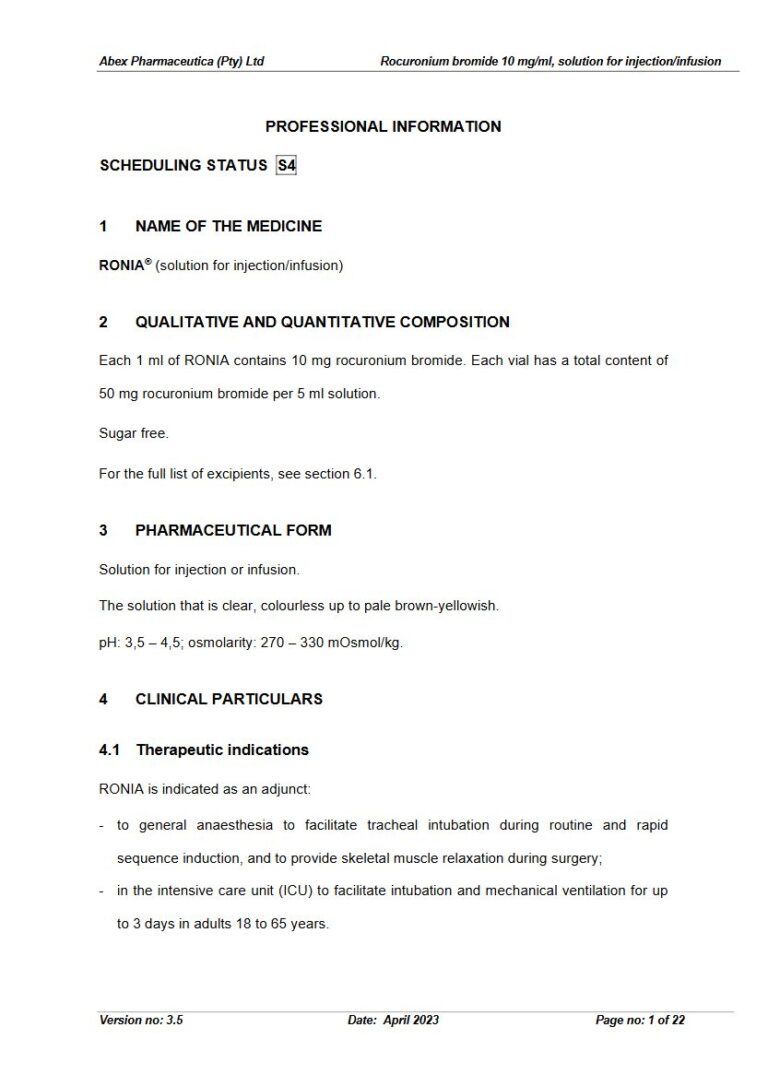
PDF Leaflet Revision Date: April 2023
Clinical Summary
Quick overview from the medicine insert
Indication
Adjunct to general anaesthesia for tracheal intubation and muscle relaxation.
Dosage (summary)
0.6 mg/kg for intubation; maintenance 0.15 mg/kg.
Onset of Action / Duration
Onset: 60-90 secs, Duration: 30-50 mins.
Special Populations
- Elderly patients
- Hepatic impairment
- Renal impairment
- Obese patients
Pregnancy & Breastfeeding
Safety in pregnancy and lactation not established; use with caution.
Key Drug Interactions
- Halogenated volatile anaesthetics
- Aminoglycosides
- Corticosteroids
- Suxamethonium
Contraindications
- Hypersensitivity to rocuronium
- Neonates
- Paediatric and elderly patients in ICU
Common side effects
- Injection site pain
- Prolonged neuromuscular block
- Tachycardia
- Hypersensitivity reactions
Counselling Points
- Ensure ventilatory support until recovery
- Monitor neuromuscular function
- Avoid driving or operating machinery for 24 hours post-recovery
Serious warnings
- Respiratory muscle paralysis
- Risk of anaphylaxis
- Prolonged neuromuscular blockade
- Medication errors may lead to death
Important Disclaimer
The Ronia 1 ml Solution for injection or infusion. professional information leaflet below is the property of Abex Pharmaceutica and is provided on Medinsert exactly as issued, with no.. alterations or editorial changes. We make every effort to keep content current by updating documents as soon as new versions become available. Medinsert serves as a trusted access point for healthcare professionals, but does not replace official sources or clinical judgement. For more details, please read our full disclaimer. read more>>
 Healthcare Professionals Only
This content is for registered healthcare professionals
Sign in or create a free account to read the full package insert.
Free for HPCSA-registered professionals. Powered by Medinsert.
Clinical Particulars
Section 4 of the official insert — extracted exactly as issued, no alterations
4.1 Therapeutic indications
RONIA is indicated as an adjunct:
- to general anaesthesia to facilitate tracheal intubation during routine and rapid sequence induction, and to provide skeletal muscle relaxation during surgery;
- in the intensive care unit (ICU) to facilitate intubation and mechanical ventilation for up to 3 days in adults 18 to 65 years.
4.2 Posology and method of administration
Posology
RONIA should be administered only by experienced doctors familiar with the use of neuromuscular blocking medicines. The dosage of RONIA should be individualised in each patient. The method of anaesthesia and the expected duration of surgery, the method of sedation and the expected duration of mechanical ventilation, the possible interaction with other medicines that are administered concomitantly, and the condition of the patient should be considered when determining the dose. The use of an appropriate neuromuscular monitoring technique is recommended for the evaluation of the neuromuscular block and recovery. Inhalation anaesthetics potentiate the neuromuscular blocking effects of RONIA (see section 4.5). This potentiation becomes clinically relevant during the course of anaesthesia when a certain tissue concentration of the volatile medicines is reached. Consequently, adjustments should be made by administering smaller maintenance doses at less frequent intervals or by using lower infusion rates of RONIA during long lasting procedures (longer than 1 hour) under inhalational anaesthesia (see section 4.5).
Risk of medication errors
Accidental administration of neuromuscular blocking medicines may result in serious adverse events, including fatal outcomes. Store RONIA with the cap and ferrule intact and in a manner that minimises the possibility of selecting the wrong product (see section 4.4).
In adult patients the following dosage recommendations may serve as a general guidance for tracheal intubation and muscle relaxation for short to long lasting surgical procedures and for use in the ICU.
Surgical procedures
Tracheal intubation
The standard intubating dose during routine anaesthesia is 0,6 mg rocuronium bromide per kg body mass, which results in adequate intubation conditions within 90 seconds in nearly all patients. A dose of 1,0 mg RONIA per kg body mass is recommended for facilitating tracheal intubation conditions during rapid sequence induction of anaesthesia, after which adequate intubation conditions are also established within 60 seconds in nearly all patients.
Higher doses
Should there be a reason for selection of larger doses in individual patients, initial doses up to 2 mg/kg RONIA have been administered during surgery. The use of these high doses of RONIA decreases the onset time and increases the duration of action (see section 5.2).
Maintenance dosing
The recommended maintenance dose is 0,15 mg RONIA per kg body mass. In the case of long-term inhalational anaesthesia, this should be reduced to 0,075 to 0,1 mg/kg RONIA. The maintenance doses should be given as a bolus when twitch height has recovered to 25 % of control twitch height, or when 2 to 3 responses to train-of-four stimulation (TOF) are present (see section 5.2). No cumulative effect (progressive increase in duration of action) with repetitive maintenance dosing at the recommended level has been observed.
Continuous infusion
If RONIA is administered by continuous infusion, it is recommended to give a loading dose of 0,6 mg RONIA per kg body mass and, when the neuromuscular block starts to recover, to start administration by infusion. The infusion rate should be adjusted to maintain twitch response at 10 % of control twitch height or to maintain 1 to 2 responses to train-of-four stimulation. In adults under intravenous anaesthesia, the infusion rate required to maintain the neuromuscular block at this level ranges from 0,3 to 0,6 mg/kg per hour. Under inhalational anaesthesia the infusion rate ranges from 0,3 to 0,4 mg/kg per hour. Continuous monitoring of the neuromuscular block is essential since infusion rate requirements vary from patient to patient and with the anaesthetic method used.
Dosage in paediatric patients
For infants (28 days to 23 months), children (2 to 14 years) and adolescents (12 to 18 years) the recommended intubation dose during routine anaesthesia and maintenance dose are similar to those in adults. For continuous infusion in paediatrics the infusion rates, with exception of children, are the same as for adults. For children higher infusion rates might be necessary. For children the same initial infusion rates as for adults are recommended, and this should be adjusted to maintain twitch response at 10 % of control twitch height, or to maintain 1 or 2 responses to train-of-four stimulation during the procedure. The experience with RONIA in rapid sequence induction in paediatric patients is limited. RONIA is therefore not recommended for facilitating tracheal intubation conditions during rapid sequence induction in paediatric patients.
Elderly patients and patients with hepatic and/or biliary tract disease and/or renal failure
The standard intubation dose for elderly patients and patients with hepatic and/or biliary tract disease and/or renal failure during routine anaesthesia is 0,6 mg/kg RONIA. Regardless of the anaesthetic technique used, the recommended maintenance dose for these patients is 0,075 to 0,1 mg/kg RONIA and the recommended infusion rate is 0,3 to 0,4 mg/kg per hour (see u201cContinuous infusion u201d).
Dosage in overweight and obese patients
When used in overweight or obese patients (defined as patients with a body weight of 30 % or more above ideal body mass) doses should be reduced considering a lean body mass.
Intensive care procedures
Tracheal intubation
For tracheal intubation, the same doses should be used as described above under surgical procedures.
Maintenance dosing
The use of an initial loading dose of 0,6 mg RONIA per kg body mass is recommended, followed by a continuous infusion as soon as twitch height recovers to 10 % or upon reappearance of 1 to 2 twitches to train-of-four (TOF) stimulation. Dosage should always be titrated to effect in the individual patient. The recommended initial infusion rate for the maintenance of a neuromuscular block of 80 to 90 % (1 to 2 twitches to TOF stimulation) in adult patients is 0,3 to 0,6 mg/kg per hour during the first hour of administration, which will need to be decreased during the following 6 to 12 hours, according to individual response. Thereafter, individual dose requirements remain relatively constant. A large interpatient variability in hourly infusion rates has been found, with mean hourly infusion rates ranging from 0,2 to 0,5 mg/kg per hour depending on nature and extent of organ failure(s), concomitant medicine and individual patient characteristics. To provide optimal individual patient control, monitoring of neuromuscular transmission is strongly recommended. Safety and efficacy beyond 3 days has not been established.
Following continuous infusion in the ICU, the time to recovery of the TOF ratio to 0,7 depends on the level of block at the end of the infusion. After a continuous infusion for 20 hours or more the median (range) time between return of T2 to TOF stimulation and recovery of the TOF ratio to 0,7 approximates 1,5 (1 to 5) hours in patients without multiple organ failure and 4 (1 to 25) hours in patients with multiple organ failure.
Method of administration
RONIA is for single use only. RONIA is administered intravenously either as a bolus injection or as a continuous infusion (see section 6.6 for compatible infusion fluids). Administration should begin immediately after mixing and should be completed within 24 hours. Unused solutions should be discarded.
4.3 Contraindications
- RONIA is contraindicated in patients with hypersensitivity to rocuronium bromide, or to the bromide ion, or to any of the excipient of RONIA;
- There is inadequate data to support the use of RONIA in neonates (0 to 1 month);
- RONIA is not recommended for the facilitation of mechanical ventilation in the intensive care in paediatric and elderly patients due to a lack of data on safety and efficacy.
4.4 Special warnings and precautions for use
RONIA causes paralysis of the respiratory muscles. Ventilatory support is therefore mandatory for patients treated with RONIA until adequate spontaneous respiration is restored. It is important to anticipate intubation difficulties, particularly when used as part of a rapid sequence induction technique.
Residual neuromuscular blockade
Residual neuromuscular blockade has been reported for rocuronium bromide, as in RONIA u2013 see section 4.8. To prevent complications, it is recommended to extubate only after the patient has recovered sufficiently from neuromuscular block. Other factors which could cause residual neuromuscular blockade after extubation in the post-operative phase (such as medicine interactions or the condition of the patient) should also be considered. If not used as part of standard clinical practice, the use of a reversal medicine should be considered, especially in those cases where residual neuromuscular blockade is more likely to occur. It is essential to ensure that the patient is breathing spontaneously, deeply and regularly before leaving the theatre after anaesthesia.
Hypersensitivity/anaphylaxis
Severe anaphylactic and anaphylactoid reactions, which may be fatal, can occur after the administration of RONIA (see section 4.8 (c)). High rates of cross-reactivity between neuromuscular blocking medicines have been reported. Therefore, where possible, before administering RONIA, hypersensitivity to other neuromuscular blocking medicines should be excluded. RONIA should only be used when absolutely essential in susceptible patients. Patients who experience a hypersensitivity reaction under general anaesthesia should be tested subsequently for hypersensitivity to other neuromuscular blockers.
Histamine release and histaminoid reactions
Since neuromuscular blocking substances are known to be capable of inducing histamine release both locally at the site of injection and systemically, the possible occurrence of itching and erythematous reactions at the site of injection and/or generalised histaminoid (anaphylactoid) reactions (see section 4.8), should always be taken into consideration when administering RONIA.
Cardiac effects
RONIA may increase the heart rate (see section 4.8).
Prolonged neuromuscular blockage
Prolonged paralysis and/or skeletal muscle weakness has been noted after long-term use of RONIA in the ICU (see section 4.8). In order to help preclude possible prolongation of neuromuscular blockage and/or overdose, it is strongly recommended that neuromuscular transmission is monitored throughout the use of RONIA. Patients should also receive adequate analgesia and sedation. RONIA should furthermore be titrated to effect in the individual patients, or under the supervision of, experienced medical practitioners who are familiar with its actions and with appropriate neuromuscular monitoring techniques.
Myopathy
Myopathy has been reported regularly after long-term administration of RONIA in the ICU, in combination with corticosteroids. In patients receiving both RONIA and corticosteroids, treatment with RONIA should be limited as much as possible.
Suxamethonium
If suxamethonium is used for intubation, the administration of RONIA should be delayed until the patient has clinically recovered from the neuromuscular blockade induced by suxamethonium (see section 4.5).
Malignant hyperthermia
Because RONIA is always used with other medicines and because of the possibility of the occurrence of malignant hyperthermia during anaesthesia, even in the absence of known triggering medicines, medical practitioners should be familiar with the early signs, confirmatory diagnosis and treatment of malignant hyperthermia prior to the start of any anaesthesia. Cases of malignant hyperthermia with rocuronium (as in RONIA) have been reported during post-marketing surveillance; however, a causal association has not been proven.
Risk of death due to medication errors
Administration of RONIA results in paralysis, which may lead to respiratory arrest and death, a progression that may be more likely to occur in a patient for whom it is not intended. Confirm proper selection of intended product and avoid confusion with other injectable solutions that are present in critical care and other clinical settings. If another healthcare provider is administering the product, ensure that the intended dose is clearly labelled and communicated.
The following conditions may influence the pharmacokinetics and/or pharmacodynamics of RONIA:
Hepatic and/or biliary tract disease and renal failure
Rocuronium bromide, as contained in RONIA, is excreted in bile and urine (see section 5.2). Prolongation of action has been reported with doses of 0,6 mg/kg RONIA in patients with clinically significant hepatic and/or biliary disease, or with renal failure/impairment. Therefore, RONIA should be used with caution in these patients.
Prolonged circulation time
Conditions associated with prolonged circulation time such as cardiovascular diseases, old age and oedematous states resulting in an increased volume of distribution, may contribute to a slower onset of the effect. The duration of action may also be prolonged due to reduced plasma clearance.
4.5 Interactions with other medicines and other forms of interaction
The following medicines have been shown to influence the extent and/or duration of the effect of RONIA:
Increased effect
- Halogenated volatile anaesthetics potentiate the neuromuscular block of RONIA. The effect only becomes apparent with maintenance dosing (see section 4.2, u201cSurgical procedures, Maintenance dosingu201d). Reversal of the block with acetylcholinesterase inhibitors could also be inhibited.
- After intubation with suxamethonium (see section 4.2 and 4.8).
- Long-term concomitant use of corticosteroids and RONIA in the ICU may result in prolonged duration of neuromuscular block or myopathy. See section 4.4 and 4.8.
Other medicines:
- Antibiotics: aminoglycosides, lincosamides (e.g. lincomycin and clindamycin), polypeptide antibiotics, acylamino-penicillin antibiotics.
- Diuretics, quinidine, quinine, magnesium salts, calcium channel blocking medicines, lithium salts, local anaesthetics (lidocaine I.V., bupivacaine epidural) and acute administration of phenytoin of u00df-blocking medicines.
Recurarisation (increase in neuromuscular block after a variable period of recovery) has been reported after post-operative administration of aminoglycoside, lincosamide, polypeptide and acylamino-penicillin antibiotics, quinidine, quinine and magnesium salts (see section 4.4).
Decreased effect
- Prior chronic administration of phenytoin or carbamazepine
- Calcium chloride, potassium chloride
- Protease inhibitor homologues (such as gabexate and ulinastatin)
- Neostigmine, edrophonium, pyridostigmine, aminopyridine derivatives
Variable effect
Administration of other non-depolarising neuromuscular blocking medicines in combination with RONIA may produce attenuation of potentiation of the neuromuscular block, depending on the order of administration and the neuromuscular blocking medicines used. Suxamethonium given after the administration of RONIA may produce potentiation or attenuation of the neuromuscular blocking effect of RONIA.
Effect of RONIA on other medicines
Combined use of RONIA with lidocaine could result in a quicker onset of action of lidocaine.
Paediatric population
No formal interaction studies have been reported.
4.6 Fertility, pregnancy and lactation
Pregnancy
The safety of use of RONIA in pregnancy has not been established.
Caesarean section
In patients undergoing Caesarean section, RONIA can be used as part of a rapid sequence induction technique, provided no intubation difficulties are anticipated and a sufficient dose of anaesthetic medicine is administered or following suxamethonium facilitated intubation. However, RONIA, administered in doses of 0,6 mg/kg may not produce adequate conditions for intubation until 90 seconds after administration. This dose has been shown to be safe in patients undergoing Caesarean section. RONIA does not affect Apgar score, foetal muscle tone or cardiorespiratory adaptation.
From umbilical cord blood sampling it is apparent that only limited placental transfer of rocuronium bromide occurs which does not lead to the observation of clinical adverse effects in the new-born. Doses of 1,0 mg/kg have not been investigated in Caesarean section patients. Therefore, only a dose of 0,6 mg/kg is recommended in this patient group.
Reversal of neuromuscular block induced by neuromuscular blocking medicines may be inhibited or unsatisfactory in patients receiving magnesium salts for toxaemia of pregnancy because magnesium salts enhance neuromuscular blockade. Therefore, in these patients the dosage of RONIA should be reduced and be titrated to twitch response.
Breastfeeding
The safety of use of RONIA in lactation has not been established.
4.7 Effects on ability to drive and use machinery
Patients should be warned not to handle potentially dangerous machinery or drive a car within 24 hours after the full recovery from the neuromuscular blocking action of RONIA.
4.8 Undesirable effects
a) Summary of the safety profile
The most common undesirable effects are pain/reaction around injection site, changes in vital functions and prolonged neuromuscular block. The most frequently reported serious adverse medicine reactions during post-marketing surveillance is anaphylactic and anaphylactoid reactions and associated symptoms.
b) Tabulated list of adverse reactions
Immune system disorders
- Less frequent: Hypersensitivity, anaphylactic reaction (sometimes fatal), anaphylactic shock, anaphylactoid reaction (see section 4.4), angioedema
Nervous system disorders
- Less frequent: Flaccid paralysis
Cardiac disorders
- Less frequent: Tachycardia
Vascular disorders
- Less frequent: Hypotension, circulatory collapse and shock, flushing
Respiratory, thoracic and mediastinal disorders
- Less frequent: Bronchospasm
Frequency unknown: Apnoea, respiratory failure
Skin and subcutaneous tissue disorders
- Less frequent: Urticaria, rash, erythematous rash, itching
Musculoskeletal, connective tissue and bone disorders
- Less frequent: Muscular weakness, steroid myopathy (see section 4.4)
General disorders and administration site conditions
- Less frequent: Medicine ineffective, decreased medicine effect/therapeutic response, increased medicine effect/therapeutic response, injection site pain, injection site reaction, facial oedema
Frequency unknown: Malignant hyperthermia
Injury, poisoning and procedural complication
- Less frequent: Prolonged neuromuscular block (see section 4.4), delayed recovery from anaesthesia, airway complication of anaesthesia.
c) Discussion of selected adverse reactions
Anaphylaxis
Severe anaphylactic reactions to neuromuscular blocking medicines, including RONIA, have been reported (see section 4.8). Anaphylactic/ anaphylactoid reactions are bronchospasm, cardiovascular changes (e.g. hypotension, tachycardia, circulatory collapse u2013 shock), and cutaneous changes (e.g. angioedema, urticaria). These reactions have, in some cases, been fatal. Due to the possible severity of these reactions, one should always assume they may occur and take the necessary precautions.
Clinical study reports mention a slight increase in mean plasma histamine level following rapid bolus administration of 0,3 u2013 0,9 mg rocuronium bromide per kg body weight.
Prolonged neuromuscular block
The most frequent adverse reaction to non-depolarising blocking medicines as a class consists of an extension of the medicine's pharmacological action beyond the time period needed. This may vary from skeletal muscle weakness to profound and prolonged skeletal muscle paralysis resulting in respiratory insufficiency or apnoea (see section 4.4).
Myopathy
Myopathy has been reported after the use of various neuromuscular blocking medicines in the ICU in combination with corticosteroids (see section 4.4).
Local injection site reactions
During rapid sequence induction of anaesthesia, pain on injection has been reported, especially when the patient has not yet completely lost consciousness and particularly when propofol is used for induction. Clinical study reports mention pain on injection in 16 % of the patients who underwent rapid sequence induction of anaesthesia with propofol and in less than 0,5 % of the patients who underwent rapid sequence induction of anaesthesia with fentanyl and thiopental.
Paediatric patients
A meta-analysis of 11 clinical studies in paediatric patients (n = 704) with rocuronium bromide (up to 1 mg/kg) showed that tachycardia was identified as an adverse medicine reaction with a frequency of 1,4 %.
Reporting of suspected adverse reactions
Reporting suspected adverse reactions after authorisation of the medicine is important. It allows continued monitoring of the benefit/risk balance of the medicine. Healthcare providers are asked to report any suspected adverse reactions to SAHPRA via the u201c6.04 Adverse Drug Reactions Reporting Formu201d, found online under SAHPRAu2019s publications: https://www.sahpra.org.za/Publications/Index/8
4.9 Overdose
Symptoms of overdose
In overdose, side effects can be precipitated and/or be of increased severity. See section 4.8.
Treatment of overdose
In the event of overdose and prolonged neuromuscular block, the patient should continue to receive ventilatory support and sedation. Upon start of spontaneous recovery, suggamadex or an acetylcholinesterase inhibitor (e.g. neostigmine, edrophonium, pyridostigmine) should be administered in adequate doses. When administration of an acetylcholinesterase inhibiting medicine fails to reverse the neuromuscular effects of RONIA, artificial ventilation must be continued until spontaneous breathing is restored. Repeated dosages of an acetylcholinesterase inhibitor can be dangerous. Further treatment is symptomatic and supportive.
