
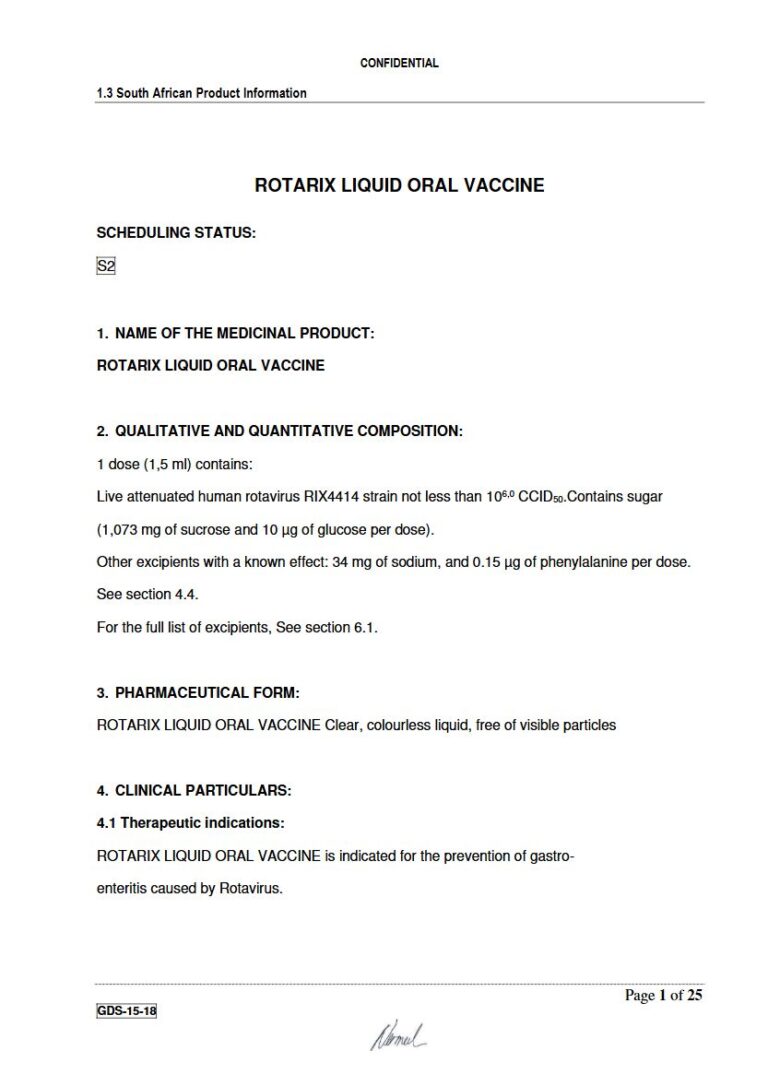
Rotarix Liquid Oral Vaccine 1,5 ml
PDF Leaflet Revision Date: 13 February 2025
Clinical Summary
Quick overview from the medicine insert
Indication
Prevention of gastro-enteritis caused by Rotavirus in infants.
Dosage (summary)
Two doses; first dose from 6 weeks, second dose at least 4 weeks later, to be completed by 24 weeks.
Special Populations
- Preterm infants
- HIV-infected infants
Pregnancy & Breastfeeding
Not intended for adults; no data on use during pregnancy or lactation.
Key Drug Interactions
- Concomitant administration with routine vaccines is safe
Contraindications
- Hypersensitivity to vaccine components
- Immunodeficiency
- History of intussusception
Common side effects
- Diarrhoea
- Irritability
- Abdominal pain
Counselling Points
- Complete the vaccination course
- Monitor for symptoms of intussusception
- Maintain hygiene after vaccination
Serious warnings
- Risk of intussusception
- Do not inject
Important Disclaimer
The Rotarix Liquid Oral Vaccine 1,5 ml professional information leaflet below is the property of Glaxosmithkline South Africa and is provided on Medinsert exactly as issued, with no.. alterations or editorial changes. We make every effort to keep content current by updating documents as soon as new versions become available. Medinsert serves as a trusted access point for healthcare professionals, but does not replace official sources or clinical judgement. For more details, please read our full disclaimer. read more>>
 Healthcare Professionals Only
This content is for registered healthcare professionals
Sign in or create a free account to read the full package insert.
Free for HPCSA-registered professionals. Powered by Medinsert.
Clinical Particulars
Section 4 of the official insert — extracted exactly as issued, no alterations
4.1 Therapeutic indications
ROTARIX LIQUID ORAL VACCINE is indicated for the prevention of gastro-enteritis caused by Rotavirus. ROTARIX LIQUID ORAL VACCINE is intended for use in infants in the first six months of life. ROTARIX LIQUID ORAL VACCINE should not be administered to children older than 24 weeks of age.
4.2 Posology and method of administration
Posology
The vaccination course consists of two doses. The first dose may be administered from the age of 6 weeks. There should be an interval of at least 4 weeks between doses. The vaccination course should be completed by the age of 24 weeks. ROTARIX may be given to preterm infants with the same posology (see 4.8 and 5.1). In clinical trials, spitting or regurgitation of the vaccine has rarely been observed, and, under such circumstances, a replacement dose was not given. However, in the unlikely event that an infant spits out or regurgitates most of the vaccine dose, a single replacement dose may be given at the same vaccination visit. It is strongly recommended that infants who receive a first dose of ROTARIX LIQUID ORAL VACCINE complete the 2-dose regimen with ROTARIX LIQUID ORAL VACCINE.
Method of administration
ROTARIX LIQUID ORAL VACCINE is for oral use only. ROTARIX LIQUID ORAL VACCINE SHOULD UNDER NO CIRCUMSTANCES BE INJECTED. There are no restrictions on the infantu2019s consumption of food or liquid, including breast milk, either before or after vaccination. There is no evidence available to suggest that breastfeeding would reduce the protection against rotavirus gastro-enteritis afforded by ROTARIX LIQUID ORAL VACCINE. Therefore, breastfeeding may be continued during the vaccination schedule.
Incompatibilities: In the absence of compatibility studies, this medicinal product must not be mixed with other medicinal products. ROTARIX LIQUID ORAL VACCINE SHOULD UNDER NO CIRCUMSTANCES BE INJECTED. For instructions for administration, see section 6.6.
4.3 Contraindications
ROTARIX LIQUID ORAL VACCINE should not be administered to subjects with known hypersensitivity after previous administration of ROTARIX LIQUID ORAL VACCINE or to any component of the vaccine listed in section 6.1. ROTARIX LIQUID ORAL VACCINE is contra-indicated in infants who have known or suspected immunodeficiency. However, caution is advised when ROTARIX LIQUID ORAL VACCINE is administered to asymptomatic human immunodeficiency virus (HIV) infected subjects. Subjects with history of intussusceptions. Subjects with uncorrected congenital malformation (such as Meckelu2019s diverticulum) of the gastrointestinal tract that would predispose for intussusception. Subjects with Severe Combined Immunodeficiency (SCID) disorder (see section 4.8).
4.4 Special warnings and precautions for use
ROTARIX LIQUID ORAL VACCINE SHOULD UNDER NO CIRCUMSTANCES BE INJECTED. ROTARIX LIQUID ORAL VACCINE is intended for use in infants in the first six months of life. ROTARIX LIQUID ORAL VACCINE should not be administered to children older than 24 weeks of age as safety has not been demonstrated, particularly in relation to risk of intussusception. Administration of ROTARIX LIQUID ORAL VACCINE should be postponed in subjects suffering from acute severe febrile illness. However, the presence of a minor infection, such as a cold, should not result in the deferral of vaccination. The administration of ROTARIX LIQUID ORAL VACCINE should be postponed in subjects suffering from diarrhoea or vomiting. There are no data on the safety and efficacy of ROTARIX ORAL VACCINE in infants with gastrointestinal illnesses. Administration of ROTARIX LIQUID ORAL VACCINE may be considered with caution in such infants when, in the opinion of the physician, withholding the vaccine entails greater risk. The risk of intussusception has been evaluated in a large safety trial (including 63 225 infants) conducted in Latin America and Finland. No increased risk of intussusception was observed in this clinical trial following administration of ROTARIX when compared with placebo. However, post-marketing safety studies indicate a transient increased incidence of intussusceptions after vaccination, mostly within 7 days of the first dose and to a lesser extent, the second dose. The overall incidence of intussusceptions remains rare. Whether ROTARIX affects the overall risk of intussusceptions has not been established. As a precaution, healthcare professionals should follow-up on any symptoms indicative of intussusception (severe abdominal pain, persistent vomiting, bloody stools, abdominal bloating and/or high fever). Parents/guardians should be advised to promptly report such symptoms. For subjects with a predisposition for intussusceptions, see section 4.3. ROTARIX LIQUID ORAL VACCINE is contra-indicated in infants who have known or suspected immunodeficiency. However, ROTARIX LIQUID ORAL VACCINE can be given to asymptomatic human immunodeficiency virus (HIV) infected subjects. Administration of ROTARIX in immunosuppressed infants, including infants on immunosuppressive therapy, should be based on careful consideration of potential benefits and risks (see section 4.8). Do not use ROTARIX vaccines interchangeably with any other rotavirus vaccine.
4.5 Interaction with other medicinal products and other forms of interaction
ROTARIX can be given concomitantly with any of the following monovalent or combination vaccines [including hexavalent vaccines (DTPa-HBV-IPV/Hib)]: diphtheria-tetanus-whole cell pertussis vaccine (DTPw), diphtheria-tetanus-acellular pertussis vaccine (DTPa), Haemophilus influenzae type b vaccine (Hib), inactivated polio vaccine (IPV), hepatitis B vaccine (HPV), pneumococcal vaccine and meningococcal serogroup C vaccine. Clinical studies demonstrated that the immune responses and the safety profiles of the administered vaccines were unaffected. Concomitant administration of ROTARIX and oral polio vaccine (OPV) does not affect the immune response to the polio antigens. Although concomitant administration of OPV may slightly reduce the immune response to rotavirus vaccine there is currently no evidence that clinical protection against severe rotavirus gastro-enteritis would be affected. The immune response to ROTARIX is unaffected when OPV is administered two weeks apart from ROTARIX.
4.6 Fertility, pregnancy and lactation
ROTARIX LIQUID ORAL VACCINE is not intended for use in adults. Thus, human data on use during pregnancy or lactation are not available and animal reproduction studies have not been performed.
4.7 Effects on ability to drive and use machines
Not applicable
4.8 Undesirable effects
Summary of the safety profile:
The safety profile presented below is based on data from clinical trials conducted with either the lyophilised or the liquid formulation of ROTARIX. In a total of four clinical trials, approximately 3 800 doses of ROTATRIX liquid formulation were administered to approximately 1 930 infants. Those trials have shown that the safety and reactogenicity profile of the liquid formulation is comparable to the lyophilised formulation. In a total of twenty-three clinical trials, approximately 106 000 doses of ROTARIX (lyophilised or liquid formulation) were administered to approximately 51 000 infants. In three placebo-controlled clinical trials (Finland, India and Bangladesh), in which ROTARIX was administered alone (administration of routine paediatric vaccines was staggered), the incidence and severity of the solicited events (collected 8 days post-vaccination), diarrhoea, vomiting, loss of appetite, fever, irritability and cough/runny nose, were not significantly different in the group receiving ROTARIX when compared to the group receiving placebo. No increase in the incidence or severity of these reactions was seen with the second dose.
In a pooled analysis from seventeen placebo-controlled clinical trials (Europe, North America, Latin America, Asia, Africa) including trials in which ROTARIX was co-administered with routine paediatric vaccines (see section 4.5), the following adverse events (collected 31 days post-vaccination) were considered as possibly related to vaccination. Tabulated list of adverse reactions:
Clinical Trial Data:
The following convention has been used for the classification of frequency:
Very common: uf0b3 1/10
Common: uf0b3 1/100 and < 1/10
Uncommon: uf0b3 1/1 000 and < 1/100
Rare: uf0b3 1/10 000 and < 1/1 000
Very rare: < 1/10 000
System Organ Class Frequency Adverse reactions
Gastrointestinal disorders Common Diarrhoea
Uncommon Abdominal pain, flatulence
Very rare Intussusception (see section 4.4)
Not known* Haematochezia
Not known* Gastroenteritis with vaccine viral shedding in infants with Severe Combined Immunodeficiency (SCID) disorder
Skin and subcutaneous tissue disorders Uncommon Dermatitis
Very rare Urticaria
General disorders and administration site conditions Common Irritability
Respiratory, thoracic and mediastinal disorders Not known* Apnoea in very premature infants (u2264 28 weeks of gestation) (see section 4.4)
* Because these events were reported spontaneously, it is not possible to reliably estimate their frequency.
Description of selected adverse reactions
Gastrointestinal disorders: Common: diarrhoea, Uncommon: flatulence, abdominal pain
Skin and subcutaneous tissue disorders: Uncommon: dermatitis
General disorders and administration site conditions: Common : irritability.
The risk of intussusception has been evaluated in a large safety trial conducted in Latin America and Finland where 63 225 infants were enrolled. This trial gave evidence of no increased risk of intussusception in the ROTARIX group when compared with the placebo group as shown in the table below.
4.9 Overdose
Some cases of overdose have been reported. In general, the adverse event profile reported in these cases was similar to that observed after administration of the recommended dose of ROTARIX.
