
Salazopyrin 500 Mg Tablets
PDF Leaflet Revision Date: 17 October 2025
Clinical Summary
Quick overview from the medicine insert
Indication
Treatment of acute ulcerative colitis and Crohn's disease.
Dosage (summary)
Adults: 2-4 tablets every 6 hours (max 24 tablets/day) for acute; 4 tablets/day for remission.
Special Populations
- Renal impairment
- Hepatic impairment
Pregnancy & Breastfeeding
Contraindicated in pregnancy and lactation due to potential teratogenicity.
Key Drug Interactions
- Increased risk of leukopenia with thiopurines
- Potentiation of anticoagulants
- Reduced absorption of folate
Contraindications
- Hypersensitivity to sulphasalazine
- Porphyria
- Severe renal or hepatic failure
- Gastric and duodenal ulcers
Common side effects
- Gastric distress
- Nausea
- Leukopenia
- Pruritus
Counselling Points
- Monitor for signs of infection
- Report any rash or hypersensitivity symptoms
- Maintain adequate hydration to prevent crystalluria
Serious warnings
- Risk of serious infections
- Myelosuppression
- Severe hypersensitivity reactions
Important Disclaimer
The Salazopyrin 500 Mg Tablets professional information leaflet below is the property of Pfizer Laboratories and is provided on Medinsert exactly as issued, with no.. alterations or editorial changes. We make every effort to keep content current by updating documents as soon as new versions become available. Medinsert serves as a trusted access point for healthcare professionals, but does not replace official sources or clinical judgement. For more details, please read our full disclaimer. read more>>
 Healthcare Professionals Only
This content is for registered healthcare professionals
Sign in or create a free account to read the full package insert.
Free for HPCSA-registered professionals. Powered by Medinsert.
Clinical Particulars
Section 4 of the official insert — extracted exactly as issued, no alterations
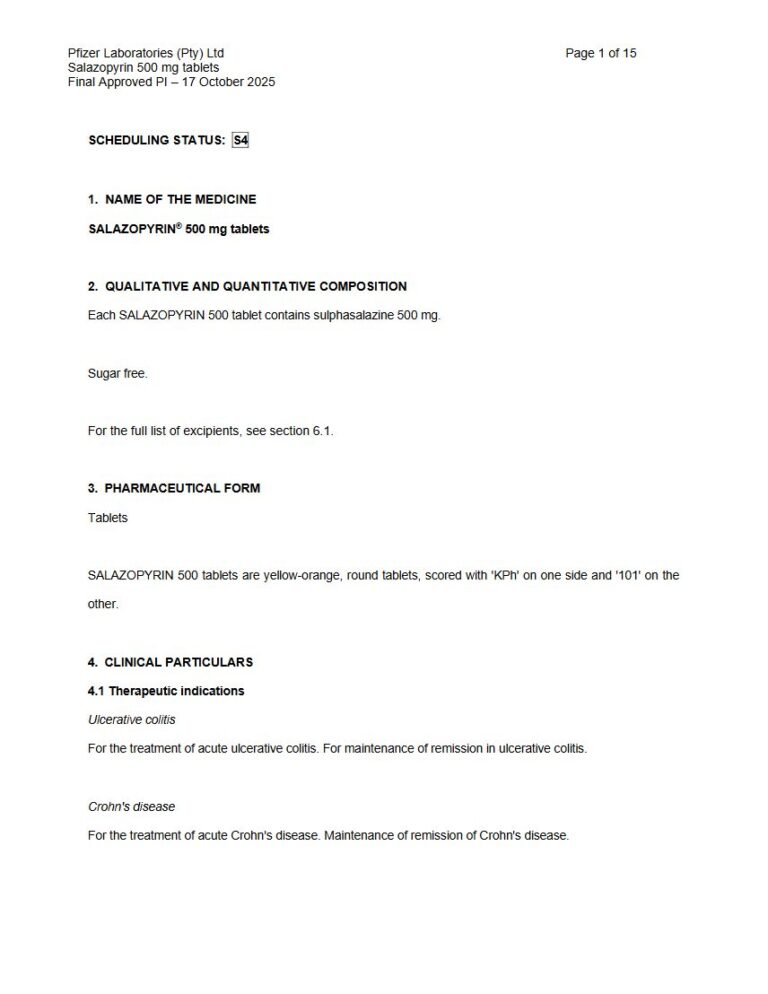
4.1 Therapeutic indications
Ulcerative colitis
For the treatment of acute ulcerative colitis. For maintenance of remission in ulcerative colitis.
Crohn's disease
For the treatment of acute Crohn's disease. Maintenance of remission of Crohn's disease.
4.2 Posology and method of administration
Posology
The dosage should be adjusted according to the response to the treatment and the patientu2019s tolerance to SALAZOPYRIN. The tablets should be taken at regular intervals during the day, preferably with meals. Night-time intervals between doses should not exceed eight hours.
Patients not previously treated with SALAZOPYRIN are advised to raise the dose gradually during the first few weeks. Patients experiencing gastrointestinal side effects to the uncoated SALAZOPYRIN are advised to use SALAZOPYRIN EN or a lower dose.
Ulcerative colitis/Crohn's disease
Adults
Acute attacks: Two to four tablets every six hours with a maximum of 24 tablets (12 g) per day.
Remission: The dose must be reduced to 4 tablets (2 g) per day.
Paediatric population
SALAZOPYRIN tablets are not suitable for patients under 18 years of age.
Method of administration
For oral use.
4.3 Contraindications
- Hypersensitivity to sulphasalazine, sulphonamides, salicylates or the excipients of SALAZOPYRIN (listed in section 6.1)
- Porphyria
- Haemorrhagic diathesis
- Severe renal or hepatic failure
- Gastric and duodenal ulcers
- Pregnancy and lactation (see section 4.6)
- Infants and children
4.4 Special warnings and precautions for use
Serious infections associated with myelosuppression, including sepsis and pneumonia, have been reported. Patients who develop a new infection while undergoing treatment with SALAZOPYRIN should be monitored closely. Administration of SALAZOPYRIN should be discontinued if a patient develops a serious infection. Caution should be exercised when considering the use of SALAZOPYRIN in patients with a history of recurring or chronic infections or with underlying conditions which may predispose patients to infections. There is no clinical experience or data on restarting SALAZOPYRIN after a serious infection and/or neutropenia have resolved.
SALAZOPYRIN should be administered under medical supervision before and during therapy: Complete blood counts, including differential white cell count and liver function tests should be performed in all patients before starting therapy with SALAZOPYRIN and every second week during the first three months of therapy. During the second three months, the same tests should be done once monthly and thereafter once every three months and as clinically indicated. Assessment of renal function (including urinalysis) should be performed in all patients initially and at least monthly for the first three months of treatment. Thereafter, monitoring should be performed as clinically indicated.
Discontinue SALAZOPYRIN treatment if the renal function continues to deteriorate. The presence of clinical signs such as sore throat, fever, pallor, purpura, or jaundice during SALAZOPYRIN treatment may indicate myelosuppression, haemolysis, or hepatotoxicity. The patient should be advised to report any untoward symptoms immediately. Discontinue treatment with SALAZOPYRIN while awaiting the results of blood tests.
SALAZOPYRIN or its metabolites may interfere with ultraviolet absorbance, particularly at 340 nm, and may cause interference with some laboratory assays that use nicotinamide adenine dinucleotide [NAD(H)] or nicotinamide adenine dinucleotide phosphate [NADP(H)]. Caution should be exercised in the interpretation of these laboratory results in patients who are receiving SALAZOPYRIN (see section 4.5).
SALAZOPYRIN should not be given to patients with impaired hepatic or renal function or with blood dyscrasias. Reduction of dosage may be required in patients with renal impairment. SALAZOPYRIN should be given with caution to patients with severe allergy or bronchial asthma.
Severe hypersensitivity reactions may include internal organ involvement, such as hepatitis, nephritis, myocarditis, mononucleosis-like syndrome (i.e., pseudomononucleosis), haematological abnormalities (including haematophagic histiocytosis), and/or pneumonitis including eosinophilic infiltration. Severe, life-threatening systemic hypersensitivity reactions such as Drug rash with eosinophilia and systemic symptoms (DRESS) have been reported in patients taking various medicines including SALAZOPYRIN. It is important to note that early manifestations of hypersensitivity, such as fever or lymphadenopathy, may be present even though rash is not evident. If such signs or symptoms are present, the patient should be evaluated immediately. SALAZOPYRIN should be discontinued if an alternative aetiology for the signs or symptoms cannot be established.
Serious skin reactions, some of them fatal, including exfoliative dermatitis, Stevens-Johnson syndrome, and toxic epidermal necrolysis, have been reported very rarely in association with the use of SALAZOPYRIN. Patients appear to be at highest risk for these events early in the course of therapy, the onset of the event occurring in the majority of cases within the first month of treatment. SALAZOPYRIN should be discontinued at the first appearance of skin rash, mucosal lesions, or any other sign of hypersensitivity.
Treatment should be discontinued immediately when a rash appears because of the danger of severe allergic reactions such as the Stevens-Johnson syndrome.
If serious toxic or hypersensitivity reactions occur, SALAZOPYRIN should be discontinued immediately. Some weeks after discontinuation, SALAZOPYRIN may be re-introduced beginning with a low dose followed by small increases in dosage regimen.
SALAZOPYRIN inhibits the absorption and metabolism of folic acid and may cause folic acid deficiency, potentially resulting in serious haematological toxicity. Patients, especially those with glucose-6-phosphate dehydrogenase deficiency, should be observed closely for signs of haemolytic anaemia.
Adequate fluid intake (1 200 mL to 1 500 mL daily) is necessary to reduce the risk of crystalluria. If this cannot be accomplished, sodium bicarbonate may be given.
Oligospermia and infertility in men treated with SALAZOPYRIN has been reported. SALAZOPYRIN may cause yellow staining of soft contact lenses. Patients with HIV may have an increased incidence of adverse effects, especially rash, fever and leukopenia. Patients with slow acetylator phenotype are more likely to show adverse effects due to sulphapyridine. SALAZOPYRIN may cause an orange colouring of the urine.
4.5 Interaction with other medicines and other forms of interaction
Reduced absorption of folate and digoxin have been reported when used concomitantly with SALAZOPYRIN. Due to inhibition of thiopurine methyltransferase (TPMT) by SALAZOPYRIN, bone marrow suppression and leukopenia have been reported when thiopurine 6-mercaptopurine or its prodrug, azathioprine, and oral SALAZOPYRIN were used concomitantly.
Sulphonamides as in SALAZOPYRIN may potentiate the effects of oral coagulants, methotrexate and phenytoin. Coadministration of SALAZOPYRIN and methotrexate to rheumatoid arthritis patients did not alter the pharmacokinetic disposition of the medicines. However, an increased incidence of gastrointestinal adverse events, especially nausea, was reported.
Several reports of possible interference with measurements, by liquid chromatography, of urinary normetanephrine causing a false-positive test result have been observed in patients exposed to SALAZOPYRIN or its metabolite, mesalamine/mesalazine.
SALAZOPYRIN or its metabolites may interfere with ultraviolet absorbance, particularly at 340 nm, and may cause interference with some laboratory assays that use NAD(H) or NADP(H) to measure ultraviolet absorbance around that wavelength. Examples of such assays may include alanine aminotransferase (ALT), aspartate aminotransferase (AST), creatine kinase-muscle/brain (CK-MB), glutamate dehydrogenase (GLDH), ammonia, thyroxine, or glucose. Consult with the testing laboratory regarding the methodology used. Caution should be exercised in the interpretation of these laboratory results in patients who are receiving SALAZOPYRIN. Results should be interpreted in conjunction with clinical findings (see section 4.4).
The hypoglycaemic effect of sulphonylureas may be enhanced. Interactions with warfarin, methotrexate, probenecid, sulfinpyrazone, spironolactone, furosemide and rifampicin may occur.
Potentiation of undesirable glucocorticoid effects on the stomach may occur. SALAZOPYRIN chelates iron and interferes with its absorption. The action of SALAZOPYRIN may be antagonised by para-aminobenzoic acid and medicines derived from it, particularly the procaine group of local anaesthetics. Paraldehyde has been reported to increase the acetylation of sulphonamides with subsequent increased risk of crystalluria with concomitant use with SALAZOPYRIN. Coadministration antibiotic therapy may possibly alter the patient's response to SALAZOPYRIN.
4.6 Fertility, pregnancy and lactation
SALAZOPYRIN is contraindicated in pregnancy and lactation (see section 4.3).
Pregnancy
SALAZOPYRIN inhibits the absorption and metabolism of folic acid which may lead to teratogenicity. SALAZOPYRIN should therefore not be used during pregnancy or lactation.
Breastfeeding
Sulphasalazine as in SALAZOPYRIN is found in breast milk. There have been reports of bloody stools or diarrhoea in infants who were breastfeeding from mothers on SALAZOPYRIN.
4.7 Effects on ability to drive and use machines
SALAZOPYRIN may affect your ability to drive and use machinery (see section 4.8).
4.8 Undesirable effects
Tabulated summary of adverse reactions
The following adverse events have been reported in association with SALAZOPYRIN therapy. In the table below all adverse reactions, which occurred at an incidence greater than placebo are listed by system organ class and frequency: Very common (u2265 1/10); common (u2265 1/100 to < 1/10); uncommon (u2265 1/1 000 to < 1/100); rare (u2265 1/10 000 to < 1/1 000); very rare (< 1/10 000), not known (cannot be estimated from the available data). The adverse reactions may also be associated with the underlying disease and/or concomitant medicines.
System organ class Frequency Adverse reaction Infections and infestations Uncommon Pseudomembranous colitis (as a result of alteration of the intestinal bacterial flora), parotitis Not known Aseptic meningitis Blood and lymphatic system disorders Common Leukopenia (following bone marrow depression), red cell abnormalities Uncommon Thrombocytopenia, eosinophilia, methaemoglobinaemia, hypoprothrombinaemia Not known Pancytopenia, agranulocytosis, aplastic anaemia, macrocytosis, megaloblastic anaemia, haemolytic anaemia Immune system disorders Not known Serum sickness Endocrine disorders Uncommon Hypothyroidism Metabolism and nutrition disorders Common Loss of appetite Uncommon Hypoglycaemic effect (with high doses) Psychiatric disorders Uncommon Depression, insomnia, hallucinations Nervous system disorders Common Dizziness, headache, taste disorders Uncommon Peripheral neuropathy, ataxia, peripheral neuritis, convulsions, multiple sclerosis, chorea Not known Encephalopathy, smell disorders Eye disorders Uncommon Yellow staining of soft contact lenses, optic neuropathy, transient myopia, periorbital oedema Ear and labyrinth disorders Common Tinnitus Uncommon Vertigo Cardiac disorders Uncommon Cyanosis Not known Pericarditis Vascular disorders Uncommon Vasculitis including polyarteritis nodosa Respiratory, thoracic and mediastinal disorders Common Cough Uncommon Fibrosing alveolitis, dyspnoea Not known Eosinophilic infiltration Gastrointestinal disorders Very common Gastric distress, nausea Common Abdominal pain Uncommon Stomatitis Not known Pancreatitis Hepato-biliary disorders Uncommon Hepatitis Not known Hepatotoxic reactions Skin and subcutaneous tissue disorders Common Pruritus, exanthema, erythema, urticaria Uncommon Alopecia, skin rashes, photosensitivity, contact dermatitis, exfoliative dermatitis, toxic epidermal necrolysis (Lyellu2019s syndrome), Stevens - Johnson syndrome, erythema nodosum Not known toxic pustuloderma, Lichen planus Musculoskeletal and connective tissue disorders Common Arthralgia Not known Systemic lupus erythematosus, Sjogrenu2019s syndrome Renal and urinary disorders Common Proteinuria, urine may be coloured orange Uncommon Nephrotoxic syndrome, haematuria Not known Interstitial nephritis, crystalluria Reproductive system and breast disorder Common Oligospermia General disorders and administration site conditions Common Fever Uncommon Fatigue, facial oedema, manifestations of a generalised hypersensitivity reaction to sulphonamides includes a syndrome resembling pulmonary eosinophilia Investigations Uncommon Elevation of liver enzymes
4.9 Overdose
Symptoms of overdosage include those of salicylism and overdosage with sulphonamides. Treatment is symptomatic and supportive.
