
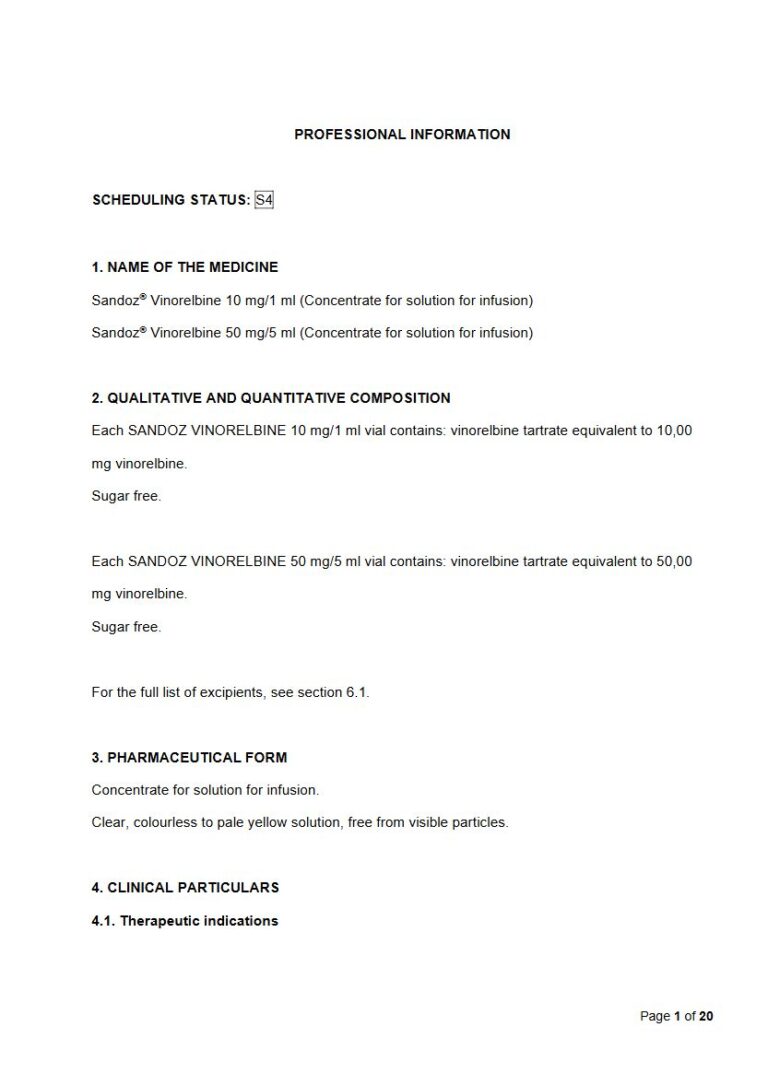
Sandoz Vinorelbine 10 mg/1 ml/50 mg/5 ml Solution
PDF Leaflet Revision Date: 22 July 2025
Clinical Summary
Quick overview from the medicine insert
Indication
Palliative treatment of advanced inoperable NSCLC and metastatic breast cancer.
Dosage (summary)
25-30 mg/mu00b2 weekly for single-agent; 30 mg/mu00b2 weekly for metastatic disease.
Special Populations
- Hepatic impairment
- Elderly patients
Pregnancy & Breastfeeding
Contraindicated in pregnancy and breastfeeding; effective contraception required during treatment.
Key Drug Interactions
- Phenytoin
- Itraconazole
- Cisplatin
- Mitomycin C
Contraindications
- Hypersensitivity to vinorelbine
- Severe hepatic insufficiency
- Severe granulocytopenia
- Pregnancy and lactation
Common side effects
- Neutropenia
- Nausea
- Vomiting
- Fatigue
- Constipation
Counselling Points
- Avoid contact with eyes
- Report signs of infection
- Use gloves when handling
- Monitor for signs of neuropathy
Serious warnings
- Cytotoxic drug; requires monitoring of blood counts
- Risk of extravasation injury
- Potential for severe allergic reactions
Important Disclaimer
The Sandoz Vinorelbine 10 mg/1 ml/50 mg/5 ml Solution professional information leaflet below is the property of Sandoz Sa and is provided on Medinsert exactly as issued, with no.. alterations or editorial changes. We make every effort to keep content current by updating documents as soon as new versions become available. Medinsert serves as a trusted access point for healthcare professionals, but does not replace official sources or clinical judgement. For more details, please read our full disclaimer. read more>>
 Healthcare Professionals Only
This content is for registered healthcare professionals
Sign in or create a free account to read the full package insert.
Free for HPCSA-registered professionals. Powered by Medinsert.
Clinical Particulars
Section 4 of the official insert — extracted exactly as issued, no alterations
4.1. Therapeutic indications
SANDOZ VINORELBINE is indicated in the palliative treatment of advanced inoperable Non-Small Cell Lung Cancer (NSCLC) as a single agent or in combination. Combination therapy proves to be more effective than monotherapy.
SANDOZ VINORELBINE is also indicated for the treatment of patients with metastatic breast cancer who have failed anthracycline first-line monotherapy for metastatic disease or who have relapsed within 6 months of anthracycline-based adjuvant therapy.
4.2. Posology and method of administration
In single-agent therapy, the usual dose is 25 to 30 mg/m2 administered weekly. For metastatic disease, the dosage schedule is 30 mg/m2 per week. In polychemotherapy, the dose and the frequency depend on the protocol.
Administration precautions: SANDOZ VINORELBINE must be administered intravenously. It is of the utmost importance that the intravenous needle or catheter be properly positioned before any SANDOZ VINORELBINE is injected. Leakage into surrounding tissue during intravenous administration of SANDOZ VINORELBINE may cause considerable irritation; local tissue necrosis and/or thrombophlebitis (see section 4.4). If extravasation does take place, the injection should be discontinued immediately, and any remaining portion of the dose should then be introduced into another vein. Local hyaluronidase injection and applying moderate heat to the area of leakage have helped disperse drug and minimise discomfort associated with the extravasation of other vinca alkaloids. Caution should be exercised in handling and preparing the solution of SANDOZ VINORELBINE. Skin reactions may occur with accidental exposure. The use of gloves is recommended. If the solution of SANDOZ VINORELBINE contacts the skin or mucosa, immediately wash the skin or mucosa thoroughly with soap and water. Severe irritation of the eye has been reported with accidental contamination of the eye with another vinca alkaloid. If this happens with SANDOZ VINORELBINE, the eye should be washed with water immediately and thoroughly.
4.3. Contraindications
SANDOZ VINORELBINE is contraindicated in:
- Patients who are hypersensitive (allergic) to vinorelbine or other vinca alkaloids, or to any of the excipients
- Pregnancy and lactation (see section 6.6)
- Patients with severe hepatic insufficiency
- Patients who have drug-induced severe granulocytopenia or severe thrombocytopenia
- In combination with yellow fever vaccine (see section 4.5).
4.4 Special warnings and precautions for use
SANDOZ VINORELBINE is a cytotoxic drug and should be used only by physicians experienced with cancer chemotherapeutic drugs. Blood counts should be taken prior to the next dose. Discontinue or reduce the dosage upon evidence of abnormal depression of the bone marrow (see table).
SANDOZ VINORELBINE IS FOR INTRAVENOUS USE ONLY. SANDOZ VINORELBINE is a moderate vesicant and can produce phlebitis or extravasation injury. Adequate flushing of the vein after peripheral administration is necessary to decrease the risk of phlebitis. It is extremely important that the needle be properly positioned in the vein before this product is injected. Leakage into the surrounding tissue may cause severe irritation. If leakage does take place, the injection should be discontinued immediately, and any remaining portion of the dose should then be introduced into another vein.
A low incidence of death (1 %) caused by neutropenic sepsis has been reported (see section 4.8). Bone marrow toxicity, especially granulocytopenia, is dose-limiting. Complete blood counts with differentials should be done and results assessed prior to each dose of SANDOZ VINORELBINE. SANDOZ VINORELBINE should not be administered to patients with granulocyte counts < 1000 cells/ml3. Patients who develop severe granulocytopenia should be monitored for infection and/or fever (see section 4.2).
Granulocytes (cells/ml3) on days of treatment Dose of SANDOZ VINORELBINE (mg/m2) + 1 500 000 30 1 000 000 to 1 499 000 15 < 1 000 000 Do not administer. Repeat granulocyte count in 1 week. If granulocyte count is < 1 000 000 cells/ml3 for 3 weeks discontinue SANDOZ VINORELBINE.
SANDOZ VINORELBINE should be administered with caution to patients with hepatic insufficiency. In patients who develop hyperbilirubinaemia during treatment with SANDOZ VINORELBINE, the dose should be adjusted. Special care should be taken when prescribing for patients with history of ischaemic heart disease (see section 4.8). As there is a low level of renal excretion there is no pharmacokinetic rationale for reducing the dose of SANDOZ VINORELBINE in patients with impaired kidney function (see sections 4.2, 5.2). SANDOZ VINORELBINE should not be given concomitantly with radiotherapy if the treatment field includes the liver.
SANDOZ VINORELBINE is specifically contraindicated with yellow fever vaccine and its concomitant use with other live attenuated vaccines is not recommended. Caution must be exercised when combining SANDOZ VINORELBINE and strong inhibitors or inducers of CYP3A4 (see section 4.5), and its combination with phenytoin (like all cytotoxic medicines) and with itraconazole (like all vinca alkaloids) is not recommended. All contact with the eyes should be strictly avoided. There is a risk of severe irritation and even corneal ulceration if the drug is sprayed under pressure. Immediate washing of the eye with normal saline solution should be undertaken if any contact occurs.
4.5 Interaction with other medicines and other forms of interaction
Phenytoin: as with all cytotoxic medicines, risk of exacerbation of convulsions resulting from the decrease of phenytoin digestive absorption by cytotoxic drug or risk of toxicity enhancement or loss of efficacy of the cytotoxic drug due to increased hepatic metabolism by phenytoin.
Itraconazole: as with all vinca-alkaloids, increased neurotoxicity of vinca-alkaloids due to the decrease of their hepatic metabolism.
Cisplatin: There is no mutual pharmacokinetic interaction when combining SANDOZ VINORELBINE with cisplatin over several cycles of treatment. However, the incidence of granulocytopenia associated with SANDOZ VINORELBINE use in combination with cisplatin is higher than associated with SANDOZ VINORELBINE single medicine.
Mitomycin C: risk of bronchospasm and dyspnoea are increased, in rare cases an interstitial pneumonitis was observed. Acute pulmonary reaction has been reported with SANDOZ VINORELBINE use in conjunction with mitomycin. Cautious administration of SANDOZ VINORELBINE is advised.
Ciclosporin, tacrolimus: excessive immunodepression with risk of lymphoproliferation. As vinca alkaloids are known substrates for P-glycoprotein, and in the absence of a specific study, caution should be exercised when combining SANDOZ VINORELBINE with strong modulators of this membrane transporter. Concurrent use of SANDOZ VINORELBINE with other bone marrow depressants may increase the bone marrow depressant effect of SANDOZ VINORELBINE and radio therapy. Concomitant or sequential use of paclitaxel and SANDOZ VINORELBINE may result in neuropathy and routine monitoring for neuropathy symptoms is recommended.
Yellow fever vaccine: as with all cytotoxic medicines, risk of fatal generalised vaccine disease (see section 4.3). Live attenuated vaccines: (for yellow fever vaccine, see concomitant use contraindicated) as with all cytotoxics, risk of generalised vaccine disease, possibly fatal. This risk is increased in patients already immunodepressed by their underlying disease. It is recommended to use an inactivated vaccine when one exists (e.g. poliomyelitis) (see section 4.4). Due to the suppression of normal defence mechanisms by SANDOZ VINORELBINE, concurrent use of SANDOZ VINORELBINE with live virus vaccine may potentiate the replication of the vaccine virus, may increase the side effects of the vaccine virus, and/or may decrease the patientu2019s antibody response to the vaccine. Immunisation of these patients should be undertaken only with extreme caution after careful review of the patientu2019s haematological status and only with the knowledge and consent of the physician managing the SANDOZ VINORELBINE therapy.
As CYP3A4 is mainly involved in the metabolism of vinorelbine, combination with strong inhibitors of this isoenzyme (e.g. azole antifungals such as ketoconazole and itraconazole) could increase blood concentrations of vinorelbine and combination with strong inducers of this isoenzyme (e.g. rifampicin, phenytoin) could decrease blood concentrations of vinorelbine.
Anticoagulant treatment: as with all cytotoxic medicines, the frequency of INR (International Normalised Ratio) monitoring should be increased due to the potential interaction with oral anticoagulants and increased variability of coagulation in patients with cancer.
4.6 Fertility, pregnancy and lactation
SANDOZ VINORELBINE is contraindicated in pregnancy and breastfeeding women (see section 4.3). Women of child-bearing potential: Women of child-bearing potential have to use effective contraception during treatment and up to 7 months after treatment (see section 4.3).
Pregnancy: SANDOZ VINORELBINE is suspected to cause serious birth effects when administered during pregnancy (see section 5.3). In case of a vital indication for treatment with SANDOZ VINORELBINE during pregnancy a medical consultation concerning the risk of harmful effects for the child should be conducted. If pregnancy occurs during treatment genetic counselling should be offered.
Breastfeeding: It is unknown whether SANDOZ VINORELBINE is excreted in human breast milk. The excretion of SANDOZ VINORELBINE in milk has not been studied in animal studies. A risk to the suckling child cannot be excluded therefore breastfeeding must be discontinued before starting treatment with SANDOZ VINORELBINE (see section 4.3).
Fertility: Men being treated with SANDOZ VINORELBINE are advised not to father a child during treatment and for 4 months after treatment (see section 4.3). Prior to treatment, advice should be sought for conserving sperm due to the chance of irreversible infertility as a consequence of treatment with vinorelbine.
4.7 Effects on ability to drive and use machines
Special care should be taken before performing tasks that require attention until it is known how SANDOZ VINORELBINE affects the patient.
4.8 Undesirable effects
System Organ Class Adverse reaction Frequency Frequent Less frequent Frequency unknown Infections and infestations Infection bacterial, viral or fungal at different localisations (respiratory, urinary, GI tract) mild to moderate and usually reversible with an appropriate treatment. Severe sepsis sometimes with other organ failure, septicaemia, complicated septicaemia and sometimes fatal. Neutropenic sepsis, neutropenic infection.
Blood and lymphatic system disorders Anaemia, granulocytopenia, bone marrow depression resulting mainly in neutropenia, reversible within 5 to 7 days and non-cumulative over time, thrombocytopenia. Febrile neutropenia, Pancytopenia, leucopenia.
Immune system disorders Systemic allergic reactions as anaphylaxis, anaphylactic shock or anaphylactoid type reaction.
Endocrine disorders Pancreatitis. Inappropriate antidiuretic hormone secretion (SIADH).
Metabolism and nutrition disorders Severe hyponatraemia. Anorexia.
Nervous system disorders Asthenia, neurologic disorders including loss of deep tendon reflexes. Paresis, weakness of the lower extremities has been reported after a prolonged chemotherapy. Peripheral neuropathy (including severe paraesthesia and hypaesthesia). These effects are generally reversible. Headache, dizziness, ataxia, posterior reversible encephalopathy syndrome.
Cardiac disorders Ischemic heart disease (angina pectoris, myocardial infarction sometimes fatal), tachycardia, palpitation and heart rhythm disorders. Heart failure.
Vascular disorders Arterial hypotension, arterial hypertension, flushing and peripheral coldness, severe hypotension, collapse.
Respiratory, thoracic and mediastinal disorders Pulmonary reactions, dyspnoea and bronchospasm may occur in association with SANDOZ VINORELBINE treatment as with other vinca alkaloids, interstitial pneumopathy sometimes fatal has been reported. Bronchopulmonary toxicity: SANDOZ VINORELBINE is likely to cause dyspnoeic states and bronchospasm. The reactions begin minutes following the injection, but they may appear some hours later, cough, pulmonary embolism.
Gastrointestinal disorders Constipation, nausea and vomiting, stomatitis, diarrhoea usually mild to moderate may occur. Treatment may be resumed after recovery of normal bowel mobility, pancreatitis have been reported.
Hepato-biliary disorders Transient elevations of liver function tests without clinical symptoms were reported. Hepatic disorder.
Skin and subcutaneous tissue disorders Alopecia usually mild in nature may occur. Skin rash, generalised cutaneous reactions have been reported with SANDOZ VINORELBINE. Palmar-plantar erythrodysesthesia syndrome, skin hyperpigmentation (serpentine supravenous hyperpigmentation).
Musculoskeletal and connective tissue disorders Arthralgia including jaw pain and myalgia. Joint or muscle pain.
General disorders and administration site conditions Injection site reactions may include erythema, burning pain, vein discoloration and local phlebitis and thrombophlebitis. Asthenia, fatigue, fever, pain at different locations including chest pain and pain at the tumour site & local necrosis. Chills.
Investigations Weight loss.
c. Description of selected adverse reactions Constipation (is the main symptom which rarely progresses to paralytic ileus with SANDOZ VINORELBINE as single medicine and with the combination of SANDOZ VINORELBINE and other chemotherapeutic medicines). Nausea and vomiting (anti-emetic therapy may reduce their occurrence). Asthenia, fatigue, fever, pain at different locations including chest pain and pain at the tumour site have been experienced by patients receiving SANDOZ VINORELBINE therapy, local necrosis has been observed. Proper positioning of the intravenous needle or catheter and bolus injection followed by liberal flushing of the vein can limit these effects. Reporting of suspected adverse reactions: Reporting suspected adverse reactions after authorisation of the medicine is important. It allows continued monitoring of the benefit/risk balance of the medicinal product. Healthcare providers are asked to report any suspected adverse reactions to SAHPRA via the Med Safety APP (Medsafety X SAHPRA) and eReporting platform (who-umc.org) found on SAHPRA website. Suspected adverse reactions can also be reported directly to the HCR via https://pvi1j.solutions.iqvia.com or the e-mail address, [email protected].
4.9 Overdose
In case of overdose, the patient must be closely monitored for the appearance of severe granulocytopenia with an increased risk of serious secondary infections. Overdosage with SANDOZ VINORELBINE could produce bone marrow hypoplasia sometimes associated with infection, fever and paralytic ileus. There is no known antidote for the treatment of SANDOZ VINORELBINE overdosage. Therefore, treatment of overdose is supportive and may include appropriate blood transfusions and antibiotics.
